
What you will learn
On this pageContentsCloseOpen
Open any listicle titled "best Shopify wholesale apps" and count the paragraphs before you hit "Shopify has no built-in wholesale signup form." Usually one. Sometimes it is the first line.
That sentence is false as of September 3, 2026.
Shopify ships a feature called company account requests, built on the free Shopify Forms app. A prospect fills in a form on your storefront and Shopify automatically creates a company, a company location and a customer in your admin. The new company appears under Customers → Companies in the Ordering not approved tab, where, in Shopify's own words, companies created through the form "can't place orders in your online store or access B2B pricing until you approve them." A Flow template will approve them automatically if you would rather not review each one.
So there is a native application form, and a native approval queue. The gap that justifies an app is real — it is just much narrower than this category's marketing implies, and it sits in three specific places.
What the free path actually gives you
Install Shopify Forms, build a popup or inline form, and add the "Company and customer" field group. Company name and email address are the two fields required for automatic company creation. Answers can be stored as local fields in a metaobject, as customer metafields, or as company metafields, and one of the field types is a file upload of up to 20 MB. So you can natively collect a US resale certificate. Shopify simply does not check it.
Approval is manual by default: open the company, use Manage permissions, choose locations, assign permissions, and optionally tick "Notify customer that they can start placing B2B orders." The Flow template for hands-off approval is named "Allow ordering for companies created by company account requests."
None of this requires Shopify Plus. Shopify B2B runs on Basic, Grow, Advanced and Plus, with a handful of features still Plus-only — covered in which plans Shopify B2B runs on and what stayed Plus-only.
The three places the native form actually breaks
It cannot add a buyer to an existing company. Shopify's own documentation: "This feature doesn't allow customers to be added to an existing company." Every submission spawns a brand-new company, so the second buyer from an account you already sell to creates a duplicate.
Rejection means deletion. "To reject an application, delete the company." No rejected state, no archived state, no "we need more information" state. The record you would want for an audit trail is the record you have to destroy.
It does not work on a gated store. "You can't use company account requests when you have a dedicated store that is gated and available only to B2B customers." Switch on Online Store → Preferences → Store access → "Restrict access to B2B customers only," and prospects cannot reach the form. The workaround — ungate and hide prices through B2B-context theme customization — is itself restricted to the Advanced and Plus plans.
Two softer limits round it out: nothing submitted is verified, and an approved buyer has no native way to invite a colleague or add a company location.
If none of that describes you — public storefront, brand-new companies only, manual review, no verification — go build the form. The paid options below start at $19/month.
The question that actually sorts this category
Every app below promises "wholesale registration and approval," and they mean two architecturally different things by it. Does the app create a real Shopify B2B Company, or does it tag a regular customer and simulate wholesale with discount rules?
A native Company gives the buyer B2B catalogs, price lists, payment terms and B2B checkout — Shopify's own machinery. A tagged customer gives you a parallel wholesale system bolted onto your D2C store, with pricing that exists only as long as the app does.
You can check which one you are looking at before installing anything. Every App Store listing publishes a Data access section, and an app that writes a real Company must request the Edit companies — Companies scope. Absence is dispositive. Presence is necessary but not sufficient, so read the copy too — one app here holds the scope and never claims to create a company.
One honest caveat: Shopify Forms' own Data access list shows no companies scope, yet its submissions demonstrably create companies. First-party apps are not bound by the same disclosure rules. The scope test is reliable for third-party apps only.
| App | Edit companies scope | Listing claims native Company creation | Verdict |
|---|---|---|---|
| Onboard B2B: Company Profiles | Yes | Yes | Native Company |
| B2B Onboard | Yes | Yes | Native Company |
| B2B Registration & Approval | Yes | Yes — create new or link existing | Native Company |
| B2B Portal: Account & Approval | Yes | Copy says "company account access" and stops there | Not stated |
| ZS B2B Gateway | Yes | "B2B Companies support" listed on the $129/mo plan | Native only at $129/mo |
| Helium Customer Fields | No | Approves customers, applies tags and metafields | Customer/tag level |
| Wholesale Gorilla | No | Price rules and customer tags | Tag/discount level |
| Shopify Forms (first-party) | Not shown | Help Center: submission creates company, location, customer | Native, free |
Four of the third-party apps land on the native side. This is a split in the category, not a single winner.
Price, free tiers, and a review base to be suspicious of
| App | From | Free plan | Trial | Application cap | Rating (reviews) |
|---|---|---|---|---|---|
| Onboard B2B: Company Profiles | $50/month | No | 14 days | Not stated | 5.0 (13) |
| B2B Onboard | $0 | Yes — 1 form, 10/month | 14 days | 10 / 50 / 250 / unlimited | 5.0 (1) |
| B2B Registration & Approval | $19/month | No | 7 days | Not stated | 5.0 (2) |
| B2B Portal: Account & Approval | $19/month | No | 14 days | Unlimited, all tiers | 0.0 (0) |
| ZS B2B Gateway | $0 | Yes — 5/month | Not stated | 5 / 50 / unlimited | 5.0 (1) |
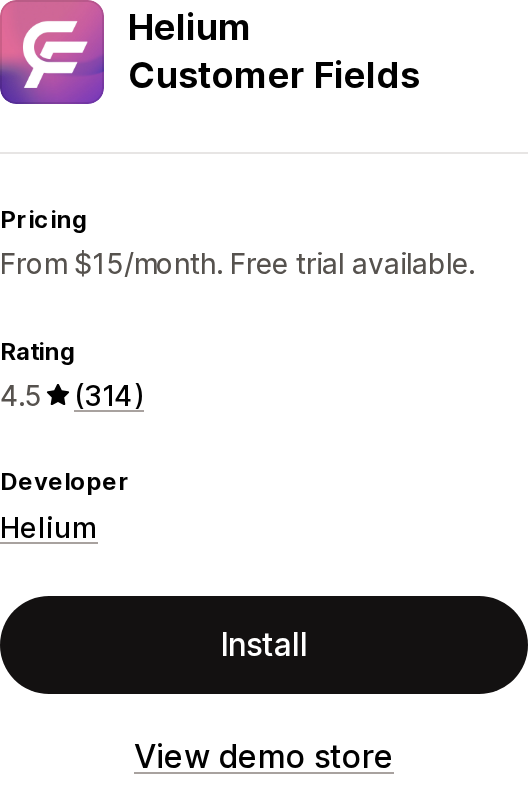
| Helium Customer Fields | $15/month | No | 14 days | Not stated | 4.5 (314) |
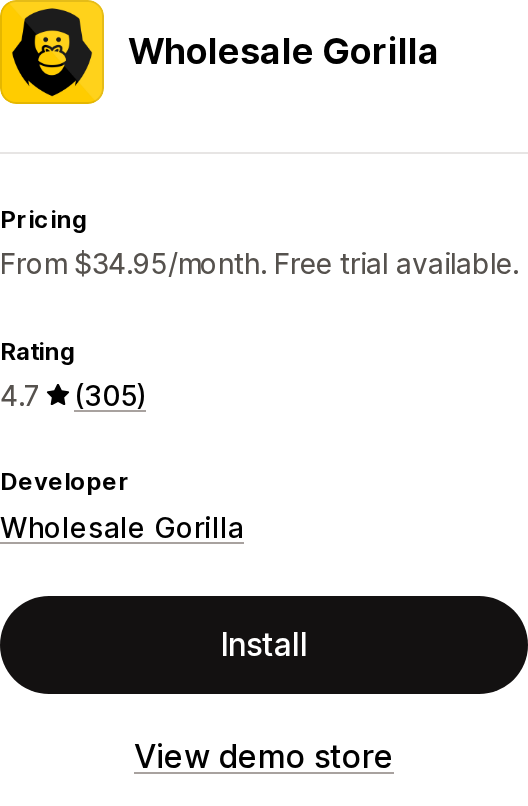
| Wholesale Gorilla | $34.95/month | No | 21 days | Not stated | 4.7 (305) |
All charges are billed in USD, verified on the English App Store listings on September 3, 2026.
Read the review column before the price column. Four of these seven apps have 13 reviews or fewer, and one has none at all. A "5.0" drawn from one review is not a rating; it is one person's first week. The two reviews behind B2B Registration & Approval come from merchants about one and two hours into the app. Among these seven, the review bases deep enough to read for patterns belong to Helium Customer Fields and Wholesale Gorilla — and neither creates a Company.
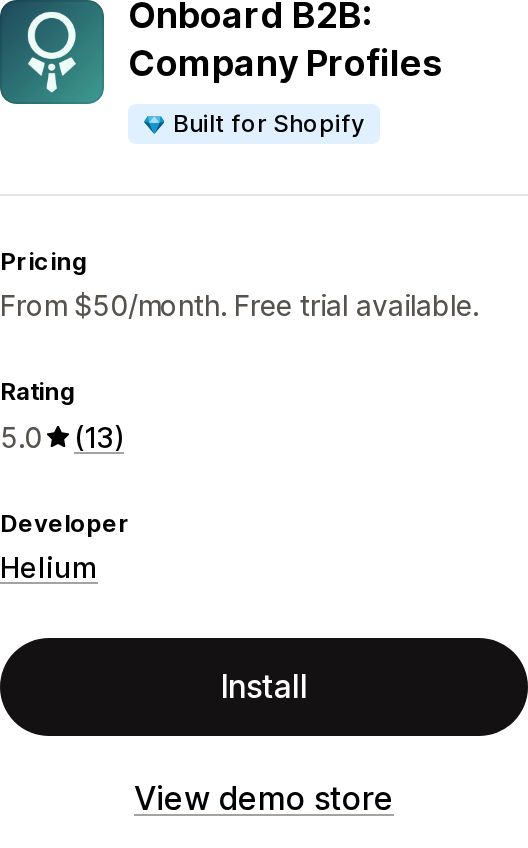
Onboard B2B: Company Profiles
Source: Shopify App Store listing — captured September 3, 2026
By Helium in Gig Harbor, Washington, and carrying the Built for Shopify badge; none of the other apps here do. A company application form with conditional rules, approval "including revisions" — the request-changes state the native flow lacks — and a self-manage portal where a location admin can add locations and invite team members. That last piece has no native equivalent. Pricing is $50/month (Basic), $150/month (Plus, adding company-specific catalog assignment and deposit requirements) and $300/month (Premium), 17% off annually, no free plan. Those two features sit at $150 because they are Plus-only in Shopify itself.
The constraint to check first: Helium's setup guide states that to use the company application form or the storefront B2B-only lock, you must uncheck Shopify's native B2B access control setting. Thirteen reviews is thin for a $50/month commitment.
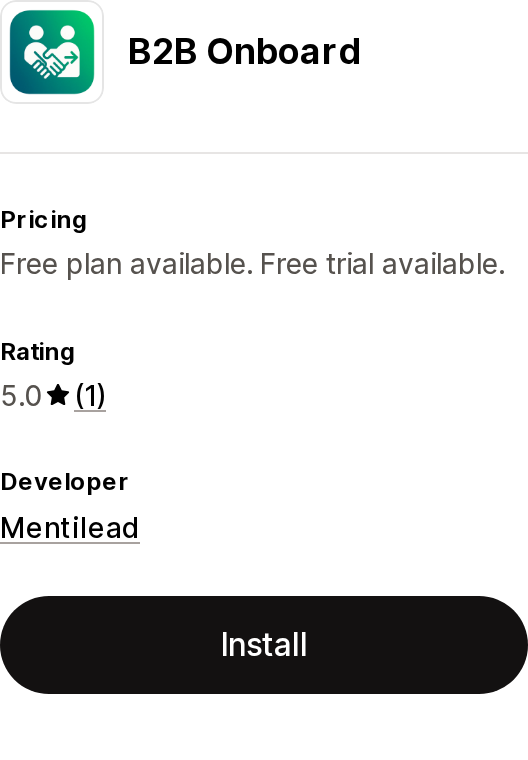
B2B Onboard
Source: Shopify App Store listing — captured September 3, 2026
Unusually direct about the plan question: buyers apply, you approve, a native B2B company is created, and it works without Plus. The vendor documents the mechanism too — pricing routes through "a B2B catalog on Shopify Plus, or adding the company's location to your Default B2B market on Basic, Grow, and Advanced."
Free covers 1 form and 10 applications a month with a "Powered by" badge. Starter is $14.99/month (3 forms, 50 applications), Growth $29.99 (10 forms, 250, plus auto-approval rules and AI resale certificate review), Pro $49.99 (unlimited). Applications past the cap are held and released oldest-first, and it runs on App Proxy, so no code touches your theme. Two things to weigh: data sits in AWS eu-central-1 in Frankfurt with audit logs kept seven years under Danish bookkeeping law; and there is one review, from a US merchant roughly two months in.
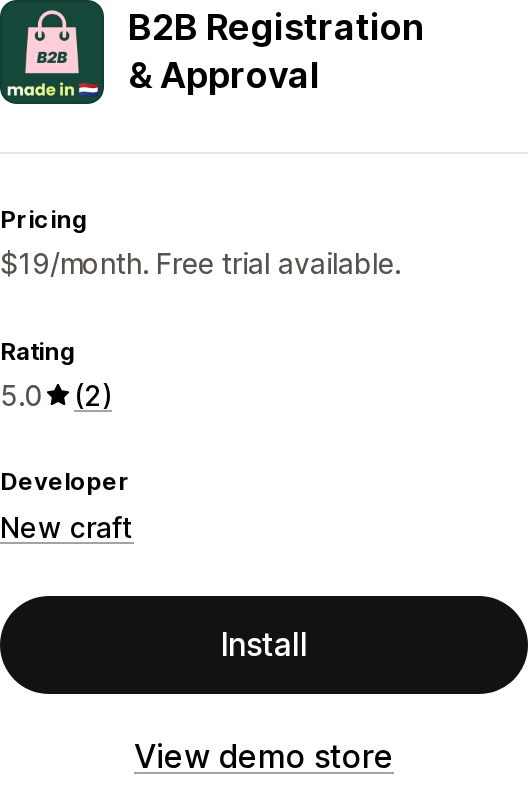
B2B Registration & Approval
Source: Shopify App Store listing — captured September 3, 2026
By New craft in Barneveld, Netherlands. Single tier at $19/month, or $150/year — a 34% annual saving, the largest here. Seven-day trial, no free plan. Its headline capability is the first native gap above: approval can create a new Shopify company or link the buyer to an existing one. Post-approval workflows then apply access, catalogs, payment terms, tax settings, tags and emails in one step.
The tradeoffs: two reviews; broad scopes including Edit discounts and Shopify Functions for payment and checkout validations; and "VAT checks" advertised without stating whether they hit a live registry or only check format.
B2B Portal: Account & Approval
By Pixelsafari in Düsseldorf. Pricing mirrors your Shopify plan: $19 (Basic), $49 (Grow), $59 (Advanced), $129 (Plus), free for development stores, with unlimited company registrations on every tier. Multi-step forms, reject and request-revision states, buyer self-service, and order approval routing — holding individual orders for review before checkout completes. A partial native alternative to that last one costs nothing: set a company location to allow only draft orders at checkout.
Two caveats, both large. It has zero reviews. And while it holds the Edit companies scope, its copy talks about "company account access" and never states that it creates a native Company — "not stated" on the decisive axis.
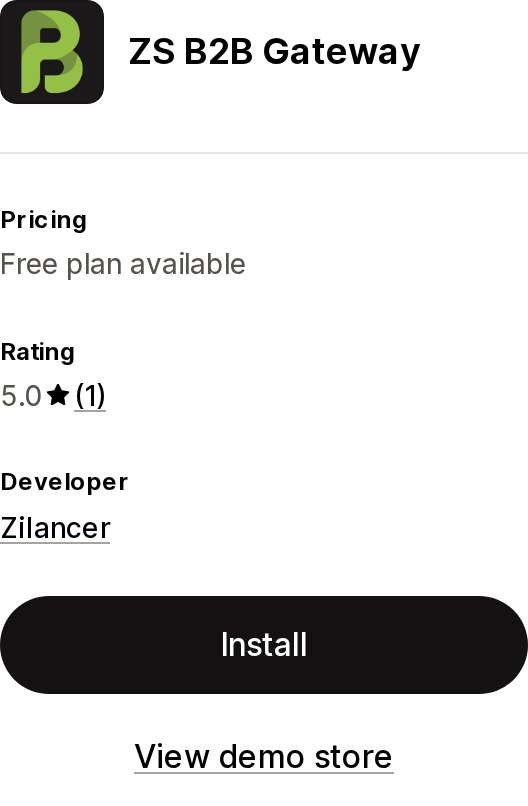
ZS B2B Gateway
Source: Shopify App Store listing — captured September 3, 2026
Useful as a teaching example, because it exposes the tag-versus-Company split inside its own pricing table. Free handles 5 applications a month. Starter at $19 adds auto-tagging, segment sync and tag-based discount rules synced to Shopify Discounts. Pro at $49 adds a bulk approve queue and price visibility rules. B2B Companies support and native catalog assignment appear on the Plus tier at $129/month — 6.8 times the Starter price. Below that you are buying the tag-and-discount model. One review, from a merchant three days in; launched June 2026.
Helium Customer Fields
Source: Shopify App Store listing — captured September 3, 2026
The incumbent for custom registration forms — 4.5 from 314 reviews, in market since 2015, US-based. Its Data access list has no companies scope. It approves customers, applying tags and metafields. Helium ships Onboard B2B separately precisely because these are different products.
There is a pricing trap worth naming. Basic is $15/month and Pro is $30, but Account Approval is on the $60/month Advanced plan — a merchant comparing "$15" against Onboard B2B's "$50" is comparing the wrong plans. VAT and tax ID are collected as fields, with no verification. Support responsiveness and clean metafield mapping recur as positives; onboarding effort at the $60 tier appears in individual recent reviews, one US merchant reporting "Way more coding than I anticipated."
Wholesale Gorilla
Source: Shopify App Store listing — captured September 3, 2026
A mature wholesale pricing suite from Asheville, North Carolina — 4.7 from 305 reviews, in market since 2018, with the longest trial here at 21 days. Price rules by store, collection, product or variant; net terms; shipping rules; order limits; quantity breaks; quick order form. Lite is $34.95/month, Advanced $69.95, Premium $149.95.
It does not hold the companies scope, so approved buyers get tags and price rules, not B2B catalogs, price lists or B2B checkout. The registration form is a secondary feature by the vendor's own tiering: "basic" at $34.95, "customizable" at $149.95. It also edits Online Store pages, the theme and the checkout page — a different uninstall risk profile than App Proxy-based apps. The rating distribution has a real tail: 86% five-star, but twelve one-star reviews, including an August 2026 complaint from a four-year merchant about AI-driven support and recurring checkout failures.
Nobody verifies a US EIN or resale certificate
Registry-backed verification exists, but not for the United States. B2B Onboard checks EU VAT against VIES, UK VAT against HMRC, Australian ABN against ABR, New Zealand NZBN, and Norwegian organisation numbers against Brønnøysundregistrene. Canadian GST/HST numbers are format-checked only.
For US resale certificates, the same app uses AI-assisted OCR that flags mismatches on company name, tax ID, issuing state and expiry, applies per-state exemptions, and automatically removes the exemption when a certificate lapses. The vendor's own framing: it is decision-support, and "A flag means 'take a closer look,' not 'deny.'"
Everything else here collects the certificate as a file upload, exactly as native Shopify Forms does, and checks nothing. If your compliance posture assumes an app validated a buyer's tax-exempt status, it did not. This article is not tax advice.
What survives uninstall
Companies, company locations and customers are Shopify's own objects, so deleting the app that created them leaves them in place. Mentilead states it plainly for B2B Onboard: Shopify customer accounts created through the approval process are not affected by uninstallation. The other native-Company apps do not document uninstall behaviour, so there the reasoning is sound but not vendor-confirmed. Uninstall Helium Customer Fields or Wholesale Gorilla and the tags and metafields stay, but the pricing logic keyed off them stops. The accounts survive; the wholesale prices do not.
Decide in this order
- Public storefront, brand-new companies only, manual review? Build the native form. $0. Add the Flow auto-approve template when volume justifies it.
- A buyer at an existing company needs to sign up? Native cannot. B2B Registration & Approval states create-or-link explicitly, at $19/month.
- Store gated to B2B customers only? Company account requests are unavailable, and ungating plus B2B-context theme editing needs Advanced or Plus. Onboard B2B's form and storefront lock also require Shopify's gating setting switched off.
- Need to reject without destroying the record? All four native-
Companyapps offer some form of this. Native does not. - Testing whether wholesale demand exists, or collecting US resale certificates? B2B Onboard's free tier gives 10 real applications a month with native companies, and its paid tiers add per-state exemptions with automatic revocation on lapse — as decision-support. ZS B2B Gateway's free tier gives 5, tag-based.
- Not on native Shopify B2B, and just want wholesale prices on a D2C store? Wholesale Gorilla, or Helium Customer Fields at $60. Accept no B2B catalogs, no B2B checkout, and pricing that stops at uninstall.
If your buyers negotiate before ordering, the adjacent decision is quoting rather than registration — see request a quote on Shopify with draft orders and RFQ apps.
Sources
- Shopify Help Center: B2B on Shopify, Company account requests, B2B features by plan, B2B features, B2B customer login and accounts
- Shopify.dev:
companyCreatemutation, Start building B2B - Vendor documentation: Onboard B2B setup guide, B2B Onboard FAQ
- Shopify App Store listings, pricing tabs, Data access sections and public reviews for all apps named, retrieved September 3, 2026
Shopify Flow adds and removes product tags for free on every paid plan, but its Get product data action returns at most 100 products per run, so backfilling an existing catalog becomes a scheduled loop. Flow also has no generic Product updated trigger, which means it structurally cannot re-tag a product after you edit its type, vendor, or price. Shopify Magic suggests a product category and fills category metafields, but product tag generation is not on its published feature list. The six apps compared here meter completely different units: Leap Auto Tags counts every tag added and every tag removed as one credit against 2,000 per month at $8, FilterTag meters 500 to 50,000 generated tags per month at $9 to $59, TAGit AI works out to 3 to 9 cents per generated tag, and Helium charges $9.99 one-time per 100 products. Mechanic and Matrixify charge flat fees of $16 to $199 and $20 to $200 with no per-tag metering at all. Check the denominator before you check the price. Researched September 3, 2026.