
What you will learn
On this pageContentsCloseOpen
Most "Shopify EDI" articles were written to answer one question: Shopify does not speak EDI, so which middleware do you bolt on? As of January 2026 that framing is out of date, and the replacement framing that vendors are now pushing — "Shopify has native EDI" — is wrong in a more expensive way.
Here is what actually shipped. In the Winter '26 Edition B2B roundup, published January 20, 2026, Shopify wrote: "you can sync EDI purchase orders from SPS Commerce and Crstl directly into Shopify as draft orders. Approve orders and print shipping labels directly in your admin, bringing EDI workflows into the platform for the first time."
Read that sentence for what it names rather than what it implies. Two vendors are named. Both are commercial EDI platforms that bill you outside your Shopify invoice. What Shopify built is a landing surface for their output — a way for a purchase order that already got translated somewhere else to arrive in your Drafts queue instead of a separate portal tab. That is a genuinely useful thing. It is not EDI capability.
The short version
- Shopify still has no EDI engine. Nothing in the admin generates an 850, 856, or 810, and nothing validates a retailer's compliance spec.
- The Winter '26 native sync is scoped to two named partners, SPS Commerce and Crstl. There is no generic EDI connector for anyone else.
- SPS Commerce's own Shopify landing page words the direct integration as "Integrate EDI orders directly into Shopify Plus for order management." Shopify's announcement does not name a plan requirement. Confirm your plan before you scope the project.
- The App Store's EDI shelf is startlingly thin as social proof goes: SPS Commerce has 7 reviews, Crstl has 3, Logicbroker has 0. Ten reviews across the three listings.
- Published prices are not comparable to each other. Crstl posts $149/month with no document fees. Logicbroker posts $3,000/year. Pipe17 posts $24,000/year. SPS Commerce posts nothing at all — "Contact SPS Commerce for full pricing details prior to install."
What EDI actually requires, and which part Shopify now covers
A retail EDI relationship is four separate obligations, and merchants routinely price only the first one.
A transport connection. An AS2 or SFTP/VAN link to the trading partner, with certificates, testing, and a certification pass before the retailer turns you on.
Document translation. Your data has to become X12 documents in the retailer's dialect: 850 purchase order inbound, 997 functional acknowledgement back, 856 advance ship notice with the SSCC-18 label hierarchy, 810 invoice, often 846 inventory advice.
Compliance rules per partner. Every retailer publishes its own spec — routing guide, label placement, ASN timing windows, allowed carriers. Miss one and you get a chargeback, which is why SPS Commerce's Shopify listing sells on "minimizing errors and chargebacks" rather than on features.
Operational landing. Somebody has to see the PO, pick it, ship it, and confirm it.
Shopify's Winter '26 launch addresses the fourth item, for two vendors. The first three remain entirely with SPS Commerce or Crstl, and that is where the money is. So the honest way to state the change is: EDI orders can now sit in the same Drafts queue as your phone and email B2B orders, instead of in a vendor portal.
That queue is the existing B2B draft order surface, and it comes with the constraints Shopify already documents there. Per the Help Center page on creating B2B orders using draft orders, draft orders carry a PO number field, support payment terms, and can lock line-item pricing — but deposit requirements on draft orders are available only on the Shopify Plus plan, and price locks are not supported for product bundles. If a big-box program pays on Net terms with a deposit, that detail decides your plan.
The three EDI-first listings, with what the App Store actually shows
All EDI Orders. One Platform. — SPS Commerce
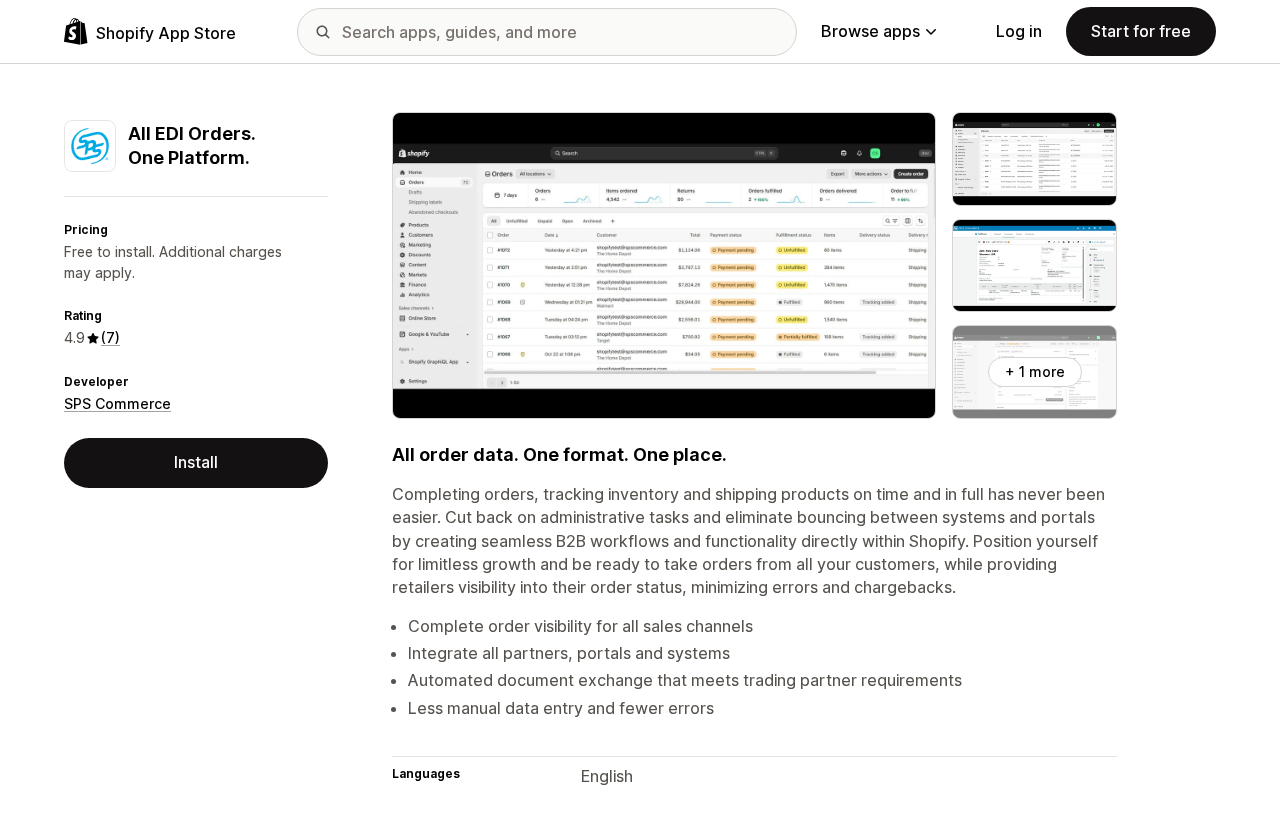
Source: Shopify App Store, retrieved September 2, 2026.
The listed name is All EDI Orders. One Platform. — not "SPS Commerce," which is the developer name. If you search the App Store for the company you will not find it by title. Launched September 30, 2022. Developer address: 333 S 7th St, Minneapolis, MN. Rating 4.9 across 7 reviews.
Pricing on the listing is "Free to install," with the note "External charges may be billed by SPS Commerce separately from your Shopify invoice" and the free tier described as "Contact SPS Commerce for full pricing details prior to install." There is no published price. SPS is a public company selling annual contracts with onboarding services; treat "free to install" as a lead form, not a price.
Two details worth pulling out of the listing body. First, the data access block is unusually wide for an order integration: alongside customers, products, and orders it requests "Edit other data: Locations, payment terms." An app that can edit payment terms is an app that can change what a company owes and when. Second, the recent reviews describe the workflow precisely — one US merchant, in April 2026, writes that SPS "pushes all info (product details, shipping address, etc.) from SPS over to Shopify as a draft so I can review it and then push it through as an order." That is the Winter '26 flow described from the merchant side.
The catch is on SPS's own site, not Shopify's. The SPS Commerce Shopify page lists three consolidation paths, and the third reads: "Integrate EDI orders directly into Shopify Plus for order management." Shopify's announcement names no plan. We could not find a Shopify document that resolves the discrepancy, so treat plan eligibility as a question for your SPS solutions advisor before you budget the project.
Crstl: No-code EDI for Brands
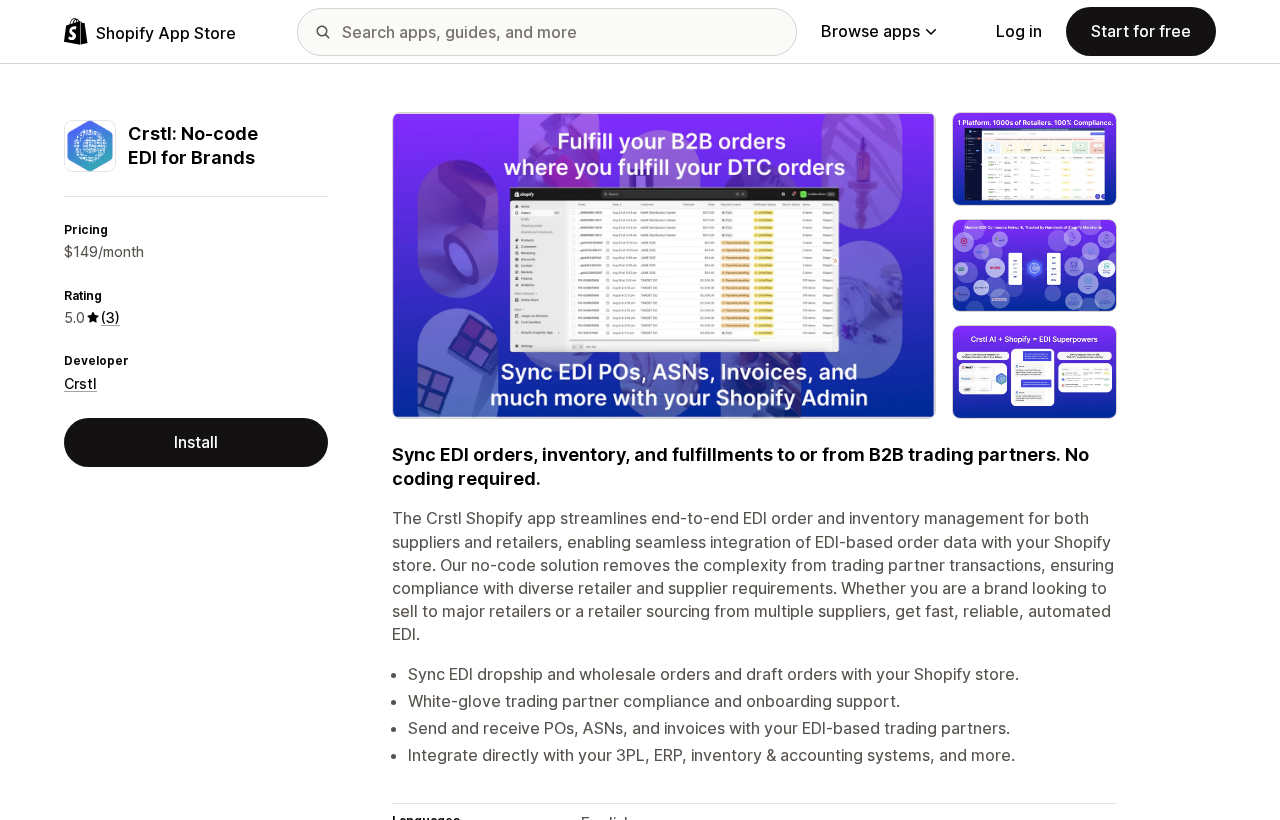
Source: Shopify App Store, retrieved September 2, 2026.
Crstl is the only vendor in this category that posts a number: $149/month, with "No Document Fees" listed as the first bullet of the plan. In an industry that has historically metered per kilocharacter or per document, publishing a flat rate with no document fee is the single most useful piece of pricing information on the entire shelf — because it means you can forecast the line item.
Launched May 1, 2024, based in San Francisco. Rating 5.0 across 3 reviews. The listing bullets promise "white-glove trading partner compliance and onboarding support" and sending and receiving "POs, ASNs, and invoices."
Two honest caveats. The $149 figure is a starting price — the listing says "Starts at" and links to a demo form for "all pricing options," so onboarding for a complex trading partner is unlikely to be inside it. And all three reviews are dated February 2025. Eighteen months with no new review on a listing that Shopify just promoted into a native integration is a data point, though it is a weak one: EDI implementations are sold by salespeople and reviewed by nobody.
Logicbroker
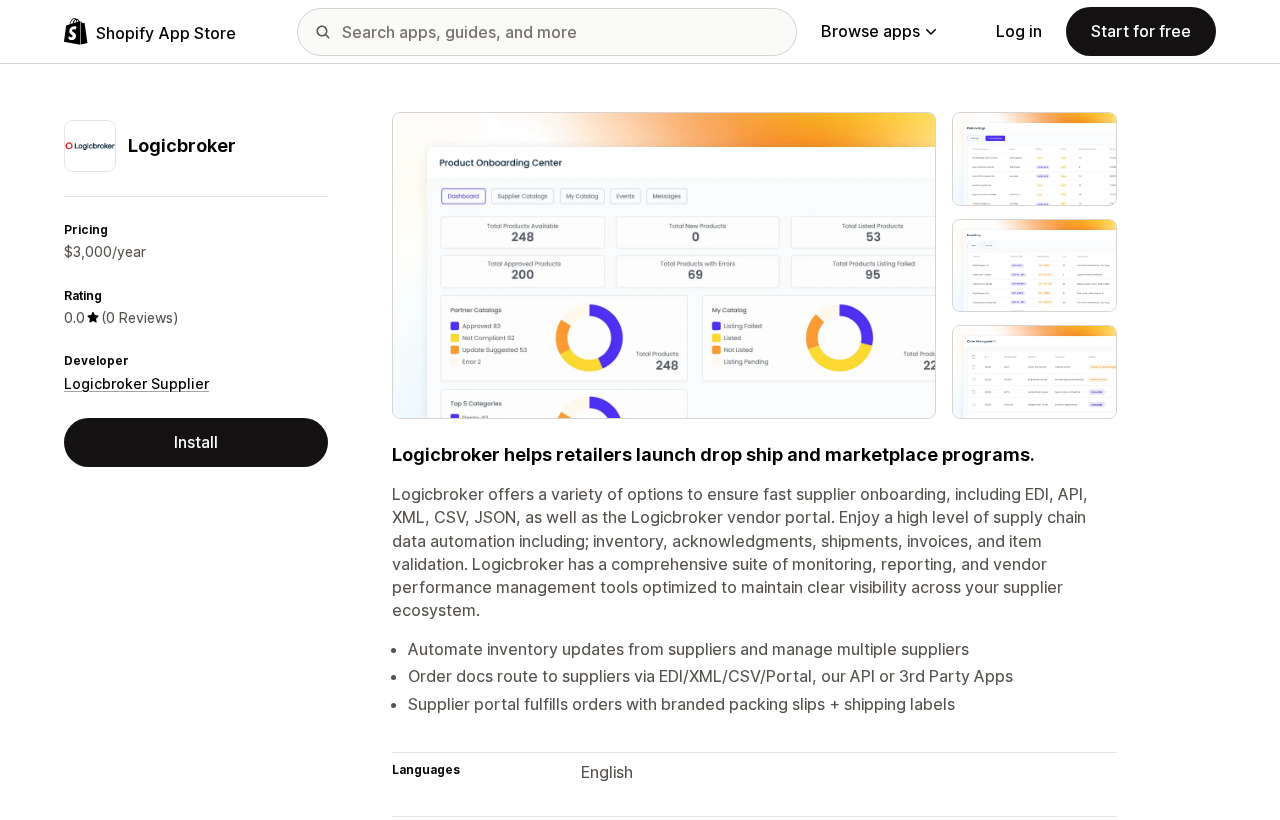
Source: Shopify App Store, retrieved September 2, 2026.
Logicbroker is on the shelf but it is pointed the other way, and this is the most common mis-selection in the category. Its own description opens: "Logicbroker helps retailers launch drop ship and marketplace programs." You install it if you are the retailer recruiting suppliers, not if you are the brand trying to get compliant with Target.
Listed at $3,000/year for a "Starter Package," with "Call for more details," external charges billed separately. Launched October 27, 2020, and it has zero reviews — the listing shows "No reviews yet" after nearly six years. It is not part of the Winter '26 native sync.
Two adjacent apps that get recommended for EDI and are not EDI
Search results for "Shopify EDI app" reliably surface two order-management platforms. Both are real and good at what they do; neither will make you EDI-capable on its own.
Pipe17 posts $24,000/year for the Standard plan, which includes 4,000 orders/month, 5 connectors, 1 ERP connection, and "Purchase Order / Transfer Order support." Rating 4.9 across 21 reviews, launched January 31, 2023, based in Seattle. It is order routing and ERP middleware for mid-market and enterprise sellers — it moves orders between Shopify, marketplaces, 3PLs, and NetSuite. If your retail program already terminates in an ERP that has EDI, Pipe17 connects those; it does not produce X12 documents for a new trading partner.
Order Desk starts at $20/month plus 25¢ per order (Starter, 3 integrations, one user), then $60/month + 10¢/order (Pro) and $125/month + 5¢/order (Plus), all after a 30-day free trial. Rating 4.9 across 22 reviews, launched July 2, 2015. Its strength is a rules engine across 300-plus fulfillment and print-on-demand services. The per-order fee is the thing to model: at 10,000 orders a month, Pro costs $60 + $1,000.
The comparison that matters: what does each one actually replace?
| App | Listed price (USD) | Reviews | Who it is for | Replaces the EDI engine? | Part of Winter '26 native sync |
|---|---|---|---|---|---|
| All EDI Orders. One Platform. (SPS Commerce) | Free to install, external charges, no published price | 7 (4.9) | Brands selling into big-box retail | Yes | Yes |
| Crstl: No-code EDI for Brands | From $149/month, no document fees | 3 (5.0) | Brands and retailers wanting a forecastable line item | Yes | Yes |
| Logicbroker | $3,000/year Starter, external charges | 0 | Retailers recruiting drop-ship suppliers | Yes, on the retailer side | No |
| Pipe17 | $24,000/year (4,000 orders/mo) | 21 (4.9) | Mid-market sellers with an ERP | No | No |
| Order Desk | From $20/month + 25¢/order | 22 (4.9) | Small to mid sellers automating fulfillment routing | No | No |
All prices as listed on the Shopify App Store on September 2, 2026. Ratings and review counts as displayed the same day.
Two things fall out of this table that a features grid would hide.
The prices are not on the same axis. Crstl's $149/month and Pipe17's $24,000/year are not competing offers — they are different products that both appear when you search for EDI. Comparing them by price produces a nonsense answer. Compare them by which of the four EDI obligations they discharge.
Nobody in this category is buying on reviews. Ten reviews across three EDI listings, against 1,949 on a single Etsy sync app in the same store, tells you the purchase is made by a salesperson and an ops lead in a scoping call, not in the App Store. Which means the App Store listing is not where your diligence happens — the trading partner list is.
How to choose
Start from the retailer, not the app. Your trading partner's routing guide names the documents, the label spec, and the ASN window. Take that document to both vendors and ask them to confirm the map exists today. SPS's pitch is precisely this — "leverage existing EDI maps from SPS" — and the value of a network is whether your specific partner is already on it.
If you need a forecastable monthly cost, start with Crstl. It is the only listing on the shelf with a published number and an explicit no-document-fee commitment. Confirm at the demo what onboarding costs, because "starts at" is doing work in that sentence.
If the program is Target, Costco, or a grocery chain with a deep spec, expect to price SPS. It is a network with pre-built maps and 24/7 support, and there is no published price because there isn't one. Ask, in writing, whether the direct-to-Shopify draft order path requires Shopify Plus on your account — their own page says Plus, and Shopify's does not.
If you are the retailer, not the supplier, you are looking at Logicbroker, and the zero-review listing means your diligence is entirely reference calls.
If you already have an ERP that speaks EDI, you may not need any of this. Pipe17 or a Patchworks/Fulfil-class ERP connector moves orders between Shopify and the system that already handles compliance. Shopify expanded exactly these prebuilt ERP integrations in the same Winter '26 release.
What we could not confirm
- Whether the Winter '26 EDI draft order sync requires the Shopify Plus plan. Shopify's announcement does not say; SPS Commerce's own Shopify page says Plus for the direct-integration path. These are not necessarily describing the same thing.
- SPS Commerce's actual pricing. There is no published figure on the listing or the landing page.
- What Crstl's onboarding costs beyond the $149/month base, and whether the flat rate holds across trading partner counts.
- Whether the sync is bidirectional in the admin — Shopify's wording covers purchase orders inbound and approving/labeling in the admin, but does not describe ASN or invoice generation happening in Shopify. Based on both vendors' descriptions, those still originate in the vendor platform.
References
- Shopify Winter '26 Edition: Ten Features That Unify Your B2B Operations — Shopify, January 20, 2026
- Creating B2B orders using draft orders — Shopify Help Center
- All EDI Orders. One Platform. — Shopify App Store
- Crstl: No-code EDI for Brands — Shopify App Store
- Logicbroker — Shopify App Store
- Pipe17 — Shopify App Store
- Order Desk — Shopify App Store
- Simplified Shopify EDI integration with SPS Commerce Fulfillment — SPS Commerce
All App Store figures retrieved September 2, 2026.
Shop Pay Installments is free to activate, needs no app, and Shopify never publishes what it costs you — the rate is visible only inside your own admin. It also refuses Capital One and Chase credit cards, restricts monthly plans to debit cards only, excludes gift cards and subscriptions, and can't be turned off for individual products. Affirm can suspend your account for being password-protected, for having a non-English storefront, or for being primarily B2B. And Shopify's Getting paid page says disputes appear in your admin while its FAQ says they don't. If you fail the eligibility gates, the alternative is on-site messaging apps from Klarna, Afterpay, Sezzle, Zip, and PayPal — a category rated between 1.0 and 3.2 stars. Researched September 2, 2026.