
What you will learn
On this pageContentsCloseOpen
There is a specific moment in a brand's life when Shopify stops being enough, and it is not the moment most people expect. It is not traffic, and it is not order volume. It is the email from a retail buyer that says: we will send purchase orders via EDI, you will return a functional acknowledgment, an advance ship notice before the truck moves, and an invoice after it lands. Here is our vendor compliance guide. You have thirty days.
Nothing in the Shopify admin speaks that language. There is no screen where an X12 850 becomes an order.
Why Shopify has nothing here, and why that is reasonable
Shopify's order object is built around a checkout. A customer picks items, pays, and an order exists. Every part of the model — payment status, fulfillment status, customer record — assumes the buyer initiated the transaction on your storefront.
A retail purchase order is the opposite shape. The buyer originates a document, on their schedule, in a format their compliance guide defines down to the segment level. There is no payment at the time of the order; there are terms. There is no shipping address the customer typed; there is a distribution centre and routing instructions. The retailer expects documents back at defined points, and failing to send them accurately is what generates chargebacks.
The Shopify Admin API is REST and GraphQL. EDI is X12 or EDIFACT. These are not near-misses that a mapping layer inside Shopify could close; they are different assumptions about who starts a transaction.
The closest native surface is B2B, which gives you company profiles, price lists and payment terms — and which is restricted to Shopify Plus. B2B is a self-serve wholesale portal. It is for a buyer who logs in and places an order themselves. It does not receive documents, and no amount of Plus solves an 850.
So the question is not whether you need something outside Shopify. It is what that something costs, and how much of your order flow it can put back inside the admin.
The entire App Store category is two listings
We searched the US Shopify App Store on September 2, 2026 for EDI, EDI 850, ASN 856, and trading partner terms. Two apps came back that actually do retailer EDI.
| App | Developer | Launched | Rating | Listed price |
|---|---|---|---|---|
| All EDI Orders. One Platform. | SPS Commerce | September 30, 2022 | 4.9 (7) | Free to install. Additional charges may apply. |
| Crstl: No‑code EDI for Brands | Crstl | May 1, 2024 | 5.0 (3) | Starts at $149/month |
From each app's Shopify App Store listing, US locale, retrieved September 2, 2026.
Ten reviews between them. That is not a mature app category with a review-count leaderboard; it is two vendors with a Shopify front door. Treat the ratings as almost meaningless and read the seven SPS reviews individually instead — they are the most useful thing on either listing, and we will come back to them.
SPS Commerce: the mechanics are in the reviews, the price is not on the page
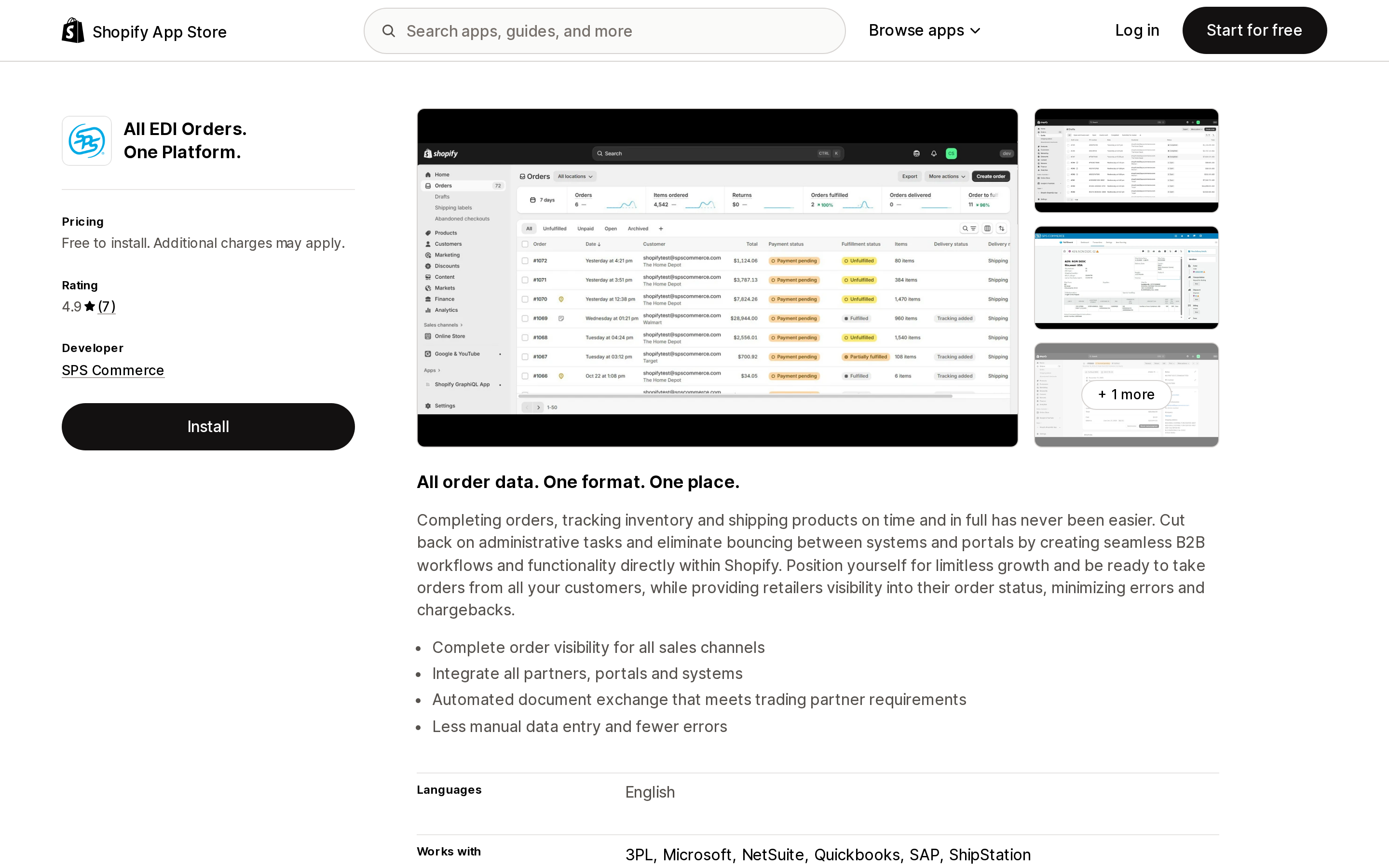
Source: Shopify App Store (SPS Commerce, "All EDI Orders. One Platform."), retrieved September 2, 2026
SPS Commerce is a public company headquartered in Minneapolis, and its App Store listing is titled "All EDI Orders. One Platform." rather than by brand name. The pitch is consolidation: order data from Shopify, marketplaces and retailers in one format in one place, with automated document exchange that meets trading partner requirements.
The pricing card is the most informative part of the listing, precisely because of what it declines to say.
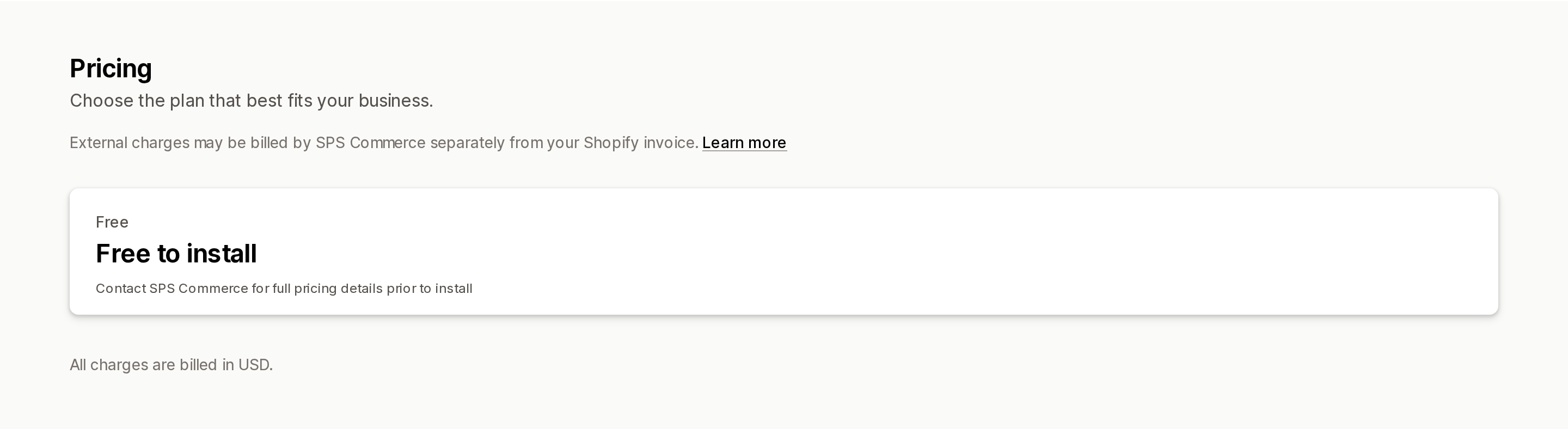
Source: Shopify App Store (SPS Commerce), pricing section, retrieved September 2, 2026
Two lines matter. "External charges may be billed by SPS Commerce separately from your Shopify invoice" means the cost does not appear on your Shopify bill and is not governed by Shopify's app billing rules — a materially different arrangement from the in-Shopify recurring and usage charges most apps use. And "Contact SPS Commerce for full pricing details prior to install" is an explicit instruction not to treat this as a self-serve install.
That is not evasion so much as an accurate description of the product. EDI onboarding involves per-retailer maps, testing and certification against a specific vendor compliance guide, and a support relationship. It cannot be a $29 checkbox. But it does mean that if you are comparing this against a $149 competitor on price, you have no number to compare.
What the app actually does day to day is described best by a merchant, not by the marketing copy. One US reviewer explains that SPS pushes product details and the shipping address from SPS into Shopify as a draft order, which they review and then push through as a real order. That single sentence tells you the integration pattern: the retailer's PO is translated outside Shopify and lands in the admin as a draft for a human to confirm. If you were imagining EDI orders appearing silently as paid orders, adjust the expectation — and adjust your staffing, because someone reviews each one.
Two of the seven reviews specifically describe integrating with Shopify Plus, and SPS's own Shopify page lists three deployment patterns, one of which is described as integrating EDI orders directly into Shopify Plus for order management. The listing does not state that Plus is required, and we could not confirm that it is. If you are on Basic, Grow or Advanced, that is a question for the sales call rather than an assumption to make either way.
SPS's own site also documents PDF Order Automation for partners who send purchase orders as PDFs instead of EDI, which is a real and under-discussed problem for brands selling into smaller independent retailers.
The listing requests sensitive customer data along with customers, products, orders and store analytics — consistent with an integration that creates orders on your behalf.
Crstl: a printed price, and the phrase "No Document Fees"
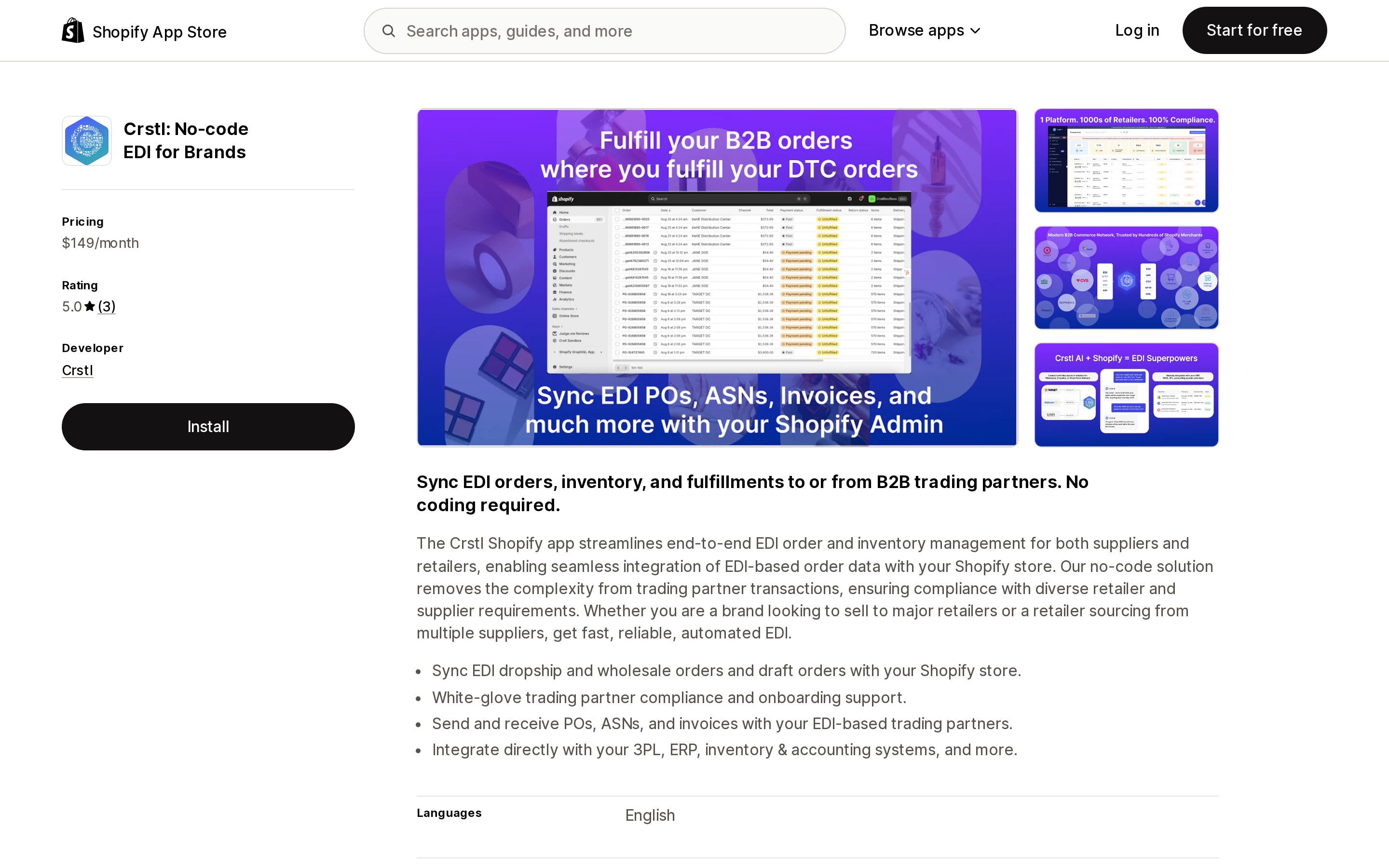
Source: Shopify App Store (Crstl: No‑code EDI for Brands), retrieved September 2, 2026
Crstl: No‑code EDI for Brands is developed by Crstl in San Francisco and launched on the App Store on May 1, 2024. It publishes a starting price of $149/month, and the plan lists white-glove trading partner onboarding and implementation, connections to hundreds of trading partners, integration with Shopify, ERP and WMS, and syncing of EDI dropship and wholesale orders and draft orders.
The line worth stopping on is No Document Fees.
A vendor does not put a negation on a pricing card unless the thing being negated is common in the category. Per-document or per-transaction billing — a charge each time an 850, 856 or 810 crosses the network — is a long-standing EDI pricing model, and it has an unpleasant property for a growing brand: your bill scales with retailer activity you do not control. A retailer that splits one PO into four, or sends change orders, sends you more documents. Flat monthly pricing moves that variance to the vendor.
Whether $149 is a good deal depends on something the listing does not tell you: how many trading partners that starting plan includes. "Starts at" and a link to more pricing options implies tiering, and in EDI the tier is almost always the connection count. Ask before you install, exactly as SPS tells you to.
Note also that Crstl describes itself as serving both directions — brands selling into retailers, and retailers sourcing from suppliers. If you are the one issuing POs to your own dropship vendors, that is a different use case from the one most of this article assumes, and it is worth naming on the call.
Three reviews. The 5.0 rating carries no information. Judge this on the pilot, not the stars.
Most of this market is not in the App Store
This is the part that changes how you should shop.
TrueCommerce publishes a Shopify integration and states it provides the EDI network services and support to run fully integrated EDI with Shopify. Logicbroker documents a Shopify connection that flows orders into Shopify automatically and sends POs, ASNs, PO acknowledgments and invoices by EDI, XML, CSV or API. Neither has a Shopify App Store listing.
That is normal for enterprise supply-chain software and abnormal for how Shopify merchants are trained to shop. If your instinct is "search the App Store, sort by reviews, install the top one," this category will hand you a two-item list and hide the rest of the market behind vendor websites and sales calls.
The practical consequence: the App Store is a poor discovery surface here, and the absence of a listing is not evidence that a vendor cannot serve you. Ask your retailer's vendor compliance team which providers their existing suppliers use — that list is more useful than any search result, because it tells you which maps already exist for that specific retailer.
What the bill is actually made of
Regardless of which vendor you choose, EDI pricing is built from a small number of drivers, and knowing them makes the sales call short:
- Trading partner connections. One retailer is one connection. Adding a second big-box account is usually a new line item, not free headroom.
- Document types per partner. 850 and 810 alone is cheaper than 850, 855, 856, 810, 846 and 852. Read the compliance guide before you quote.
- Onboarding and certification. Each retailer tests you against their own guide before going live. This is labour, and it is billed.
- Transaction volume. Only if the vendor meters documents — which is exactly why Crstl advertises that it does not.
- The Shopify seam. Whether orders land as draft orders for review or flow straight through changes your headcount, not your software bill. Ask which one you are buying.
And one thing that is not on any pricing page: chargebacks. Retailer deductions for late ASNs, wrong labels or short shipments are the actual financial risk of going into retail, and no Shopify app prevents them. The software only makes it possible to be compliant; the operation still has to be.
Decision rules
You have one retailer, standard documents, and want a number today. Crstl: No‑code EDI for Brands at $149/month. Confirm how many trading partner connections that includes before you install.
You have multiple retailers, marketplaces, or an ERP in the picture. SPS Commerce. Call them first — the listing tells you to — and get the quote in writing, remembering the charges arrive outside your Shopify invoice.
Your partners send PDFs, not EDI. Ask SPS about PDF Order Automation specifically; it is documented on their site and not on the App Store listing.
Your retailer named a provider. Use that one. Existing maps for that retailer are worth more than a feature comparison, and TrueCommerce and Logicbroker both serve Shopify without an App Store listing.
You are on Basic, Grow or Advanced. Ask directly whether the deployment you are being quoted assumes Shopify Plus. Two of the seven SPS reviews describe Plus deployments and SPS's own site names Plus in one of its three patterns; the listing states no plan requirement, and neither should you until you have asked.
The one thing not to do is treat this like an app purchase. Every other category on the App Store lets you install, try, and uninstall in an afternoon. This one starts with a compliance guide and ends with a signed contract, and the app is the smallest part of it.
Sources
Shopify's admin address validation is on by default, free, on every plan, and supports the US. Checkout-time validation is one toggle away. Shopify's own documentation then warns that running a third-party address validation app at the same time can create conflicting suggestions and reduce checkout conversion — you are meant to pick one. That reframes the whole category: apps are not there to duplicate deliverability checking, they are there to enforce policy Shopify's validator does not enforce, like blocking PO boxes or requiring an apartment number. We priced four real apps from the US App Store on September 2, 2026, spanning $4.99/month flat, $0.04 per order, and one that requires a separate subscription billed outside Shopify.