What you will learn
On this pageContentsCloseOpen
Every "best Shopify fraud app" list starts by explaining that Shopify flags high-risk orders and you decide what to do. That's true, and it's also the least interesting thing about Shopify's native fraud stack.
The interesting part is written in Shopify's own documentation, and almost nobody quotes it: there are entire order types that never receive a fraud recommendation at all. Point of Sale orders. B2B orders. Subscription renewals. Orders paid in full with a gift card. Free orders. On those, the risk column in your admin isn't "low" — it's empty.
Shopify Protect, the free chargeback coverage, has a second, non-overlapping set of exclusions. And Fraud Control, Shopify's own free blocking app, can't block anything unless you're on Shopify Payments.
Below: exactly what the three native tools cover, the gaps they leave in writing, and eight real apps compared on the one axis that separates a $4.95/month app from a $450/month one — whether anyone but you eats the chargeback. Research date: September 2, 2026. All prices are USD as listed on the Shopify App Store.
The short version
- Shopify's fraud stack is three separate products, not one: fraud analysis (built into orders), the Fraud Control app, and Shopify Protect.
- Fraud recommendations require the Grow plan or higher, or Shopify Payments on any plan. On Basic without Shopify Payments you get indicators only — the raw signals, no overall risk verdict.
- Six order types get no fraud recommendation: test orders, free orders, orders paid in full with a gift card, Point of Sale orders, B2B orders, and subscription renewal orders.
- Shopify Protect is US-only and requires a US Shopify Payments account. It covers Shop Pay orders that are entirely physical and shipped — no digital products, no buy-online-pickup-in-store items, no Shop Pay Installments, and only the first order of a subscription.
- Shopify's own documentation says Fraud Control "doesn't guarantee coverage against chargebacks" and that "You are solely responsible for any costs that result from chargebacks on your store." The app sits at 2.2 stars.
- Of the eight apps below, only three shift chargeback liability off you. The rest either block traffic or take a cut of what they recover after the fact.
Shopify's fraud stack is three products, not one
1. Fraud analysis — and the plan line that splits it in two
Fraud analysis is built into the order page. Shopify's documentation splits it into two things that merchants routinely conflate:
Fraud indicators are individual details — whether the card passed AVS, whether the CVV matched, details about the IP address, whether the customer tried more than one card. These are available on the Basic plan or higher, grouped under High risk signals, Low risk signals, and Other details.
Fraud recommendations are the overall low/medium/high verdict, powered by machine learning trained across all Shopify stores. These are available on the Grow plan or higher, or if you use Shopify Payments on any plan.
That second line matters. A Basic-plan merchant using PayPal or a third-party gateway sees the signals but never sees the verdict. Shopify states this plainly and most comparison articles skip it entirely.
The six order types with no fraud recommendation
This is the part worth writing down. Shopify lists the orders that don't receive a fraud recommendation:
- test orders
- free orders
- orders paid in full with a gift card
- Point of Sale orders
- B2B orders
- subscription renewal orders
Read the last three again. If you run a retail location, a wholesale channel, or a subscription program, a meaningful share of your order volume is arriving with no risk verdict attached. Shopify also notes that fraud analysis "works with online credit card orders that Shopify can verify," and that if you use a third-party payment processor you should check with them about limitations.
There's one more operational detail in the same page that catches merchants off guard: fraud analysis can temporarily blocklist an IP address when many orders or failed payment attempts come from it in a short window. The block clears automatically in 6 to 24 hours, there is no way to lift it sooner, and if the customer tries again before it clears, the timer resets. The documented workaround is to create a draft order or ring the sale up in POS.
2. Fraud Control — free, Shopify Payments only, 2.2 stars
Fraud Control is Shopify's own free app (developer: Shopify, Ottawa, ON; launched May 10, 2023). It does two things: a dashboard, and checkout rules that block matching checkouts before they become orders.
The dashboard reports acceptance rate, high-risk order share, fraudulent chargeback share, Shopify Protect coverage, and orders canceled due to fraud. If you're on Shopify Payments it also shows a chargeback health status against thresholds set by the card networks:
| Status | Chargebacks as % of orders |
|---|---|
| Good standing | under 0.4% |
| At risk | 0.4% to 0.6% |
| Elevated risk | over 0.6% |
Those are useful numbers to know, because Shopify warns elsewhere that fulfilling high-risk orders "can result in disabling payment processing and removal from Shopify Payments."
Two constraints the listing doesn't lead with. First: "Fraud Control checkout rules are only available for merchants using Shopify Payments." If you're on a third-party gateway, the app is a dashboard and nothing more. Second, Shopify's own caution box: the app "doesn't guarantee coverage against chargebacks. It provides insight into potential fraud, but doesn't actively protect against it. You are solely responsible for any costs that result from chargebacks on your store."
The app is rated 2.2 out of 5 from 21 reviews — the lowest rating of any app in this article by a wide margin.
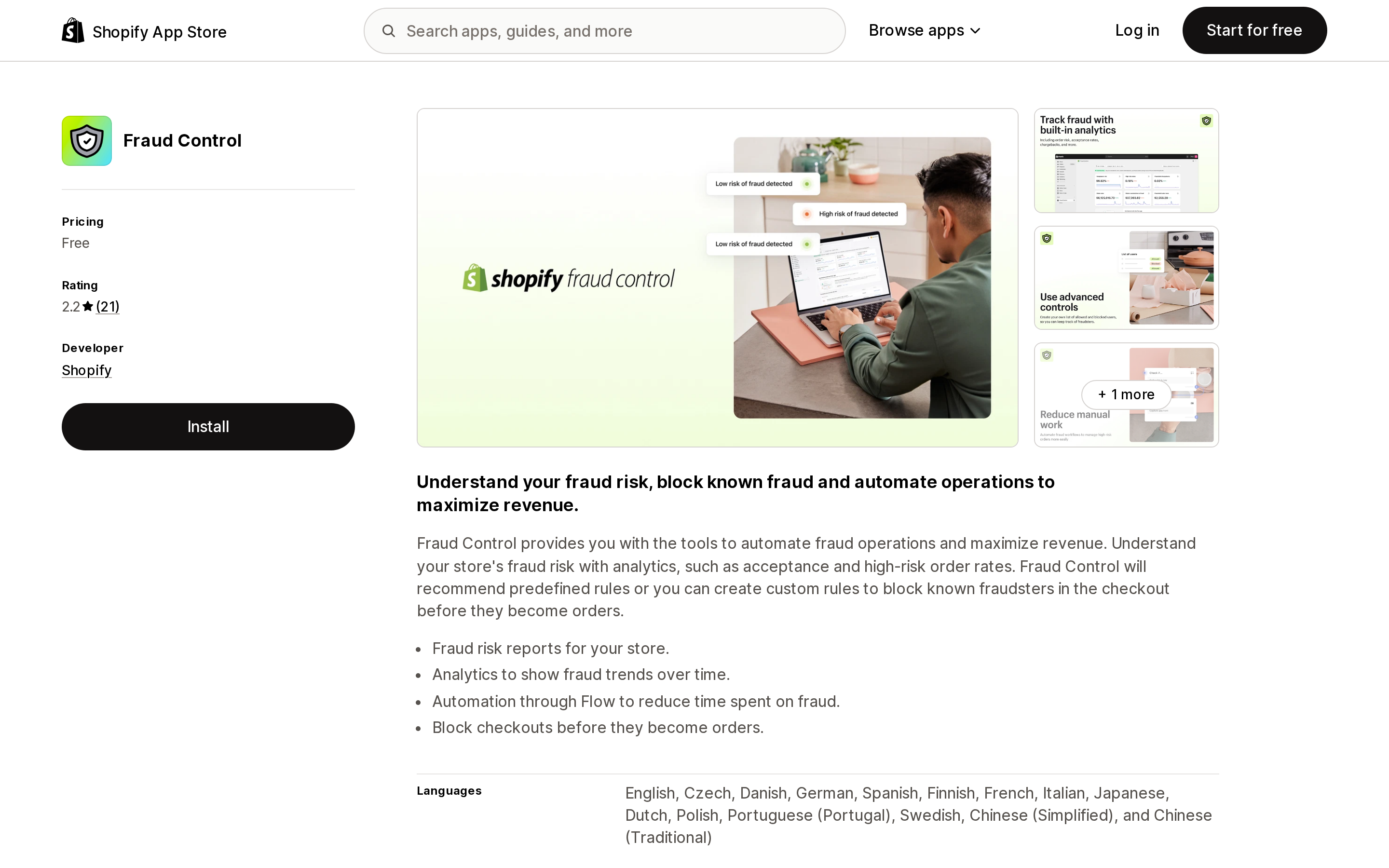
Source: Fraud Control on the Shopify App Store, captured September 2, 2026.
The Fraud Filter app is gone
Shopify used to ship a separate app called Fraud Filter that let you write allow/block rules without Shopify Payments. It no longer exists: the Help Center URL for it now redirects to the general checkout settings page, and Shopify's fraud analysis documentation now routes rule-based automation to Shopify Flow instead.
Merchants were told to migrate their rules into Flow. Shopify Community threads from the migration window document that the transfer was incomplete — one thread is titled "Flow lost all of my fraud filter data". Vendor blog posts date the sunset to January 31, 2025; we could not find a surviving Shopify-hosted page stating that date, so treat the date as reported rather than confirmed, and the removal itself as fact.
What replaced it in practice is the Flow template set that Fraud Control installs: manually capture payment on high-risk orders, cancel and restock high-risk orders, cancel orders from bad email addresses, restrict a customer to five orders a day, notify staff of chargebacks and high-risk orders, and flag return-abuse customers.
3. Shopify Protect — free, and narrower than it sounds
Shopify Protect reimburses the chargeback amount and the chargeback fee on eligible orders, and handles the dispute process for you. It costs nothing. It is also the most conditional product in Shopify's catalog.
From Shopify's own eligibility page:
- Location: you must be located in the United States and have a US Shopify Payments account.
- Payment method: Shop Pay only, including Shop Pay as an accelerated checkout on Facebook, Instagram, or Google. Shop Pay Installments orders aren't eligible.
- Contents: only orders that exclusively contain physical items requiring shipping. Any digital product, or any item bought online and picked up in store, disqualifies the whole order — "even if the order also contains shipped physical items."
- Subscriptions: only the first order is eligible. Recurring renewals get no coverage.
- Fulfillment: all non-refunded line items must be Fulfilled, with valid tracking, within 7 days of the order, and marked in transit by the carrier within 10 days.
- Carriers: tracking must come from one of 13 supported carriers — Shopify Fulfillment Network, USPS, UPS, Canada Post, DHL Express, FedEx, TForce Final Mile, Lone Star Overnight, United Delivery Service, CDL Last Mile, Lasership, GLS, Ontrac. All items must ship with supported carriers.
- Address changes: "Changing the shipping address on an order after checkout voids the Shopify Protect coverage for that order."
One expansion worth knowing: Managed Markets orders processed with Shopify Payments are automatically protected.
Notice how cleanly the two native gaps interlock. Subscription renewals get no fraud recommendation and no Protect coverage. B2B orders get no recommendation and are almost never Shop Pay. POS orders get neither. Those are exactly the order types a third-party app is being bought to cover.
The only axis that matters: who pays
Fraud apps look interchangeable on a feature list. They are not, because they answer one question in three completely different ways.
Group A — liability shift. The vendor guarantees approved orders and reimburses you when one turns into a fraudulent chargeback. You pay a percentage of revenue whether or not fraud happens.
Group B — recovery. No guarantee. The vendor fights chargebacks after they land and takes a cut of what it wins back. You pay only on success, but you carry the loss on everything it doesn't win.
Group C — blocking and automation. No guarantee, no recovery. The app blocks traffic, applies rules, and automates cancellation. Cheap, and it never reduces your liability by a dollar.
Most "best fraud app" rankings mix all three into one list sorted by star rating, which is how a $4.95/month blocker ends up ranked above a guarantee provider.
Eight apps, sorted by who eats the chargeback
| App | Rating (reviews) | Pricing | Charged on | Liability shift |
|---|---|---|---|---|
| Signifyd | 4.5 (71) | Free to install, external charges | Not published on listing | Yes — fraud and non-fraud chargebacks on approved orders |
| ClearSale Fraud Protection | 3.6 (46) | Free to install, external charges | Not published on listing | Yes — fraud chargebacks on approved orders |
| Wyllo (formerly NoFraud) | 4.8 (152) | Free / $250 / $350 / $450 per month | % of revenue, with a monthly floor | Optional, capped — $500 / $1,000 / $2,000 per plan tier |
| Chargeflow Prevent Chargebacks | 4.7 (368) | Free to install | 25% of recovered chargebacks; Prevent 1,000 free then $0.20/order | No |
| Disputifier: Smart Chargebacks | 4.6 (90) | Free to install | 20% of won-back revenue; alerts $17–$27.50 each | No |
| Beacon Fraud Prevention | 4.6 (13) | From $0.03/month | $0.03 per order, or $125/month for 5,000 orders | No |
| Blockify Fraud Filter, Blocker | 4.9 (1,581) | Free / $9.99 / $19.99 / $39.99 per month | Flat monthly, tier-gated features | No |
| FraudBlock Fraud Prevention | 4.3 (26) | Free / $4.95 / $19.95 / $29.95 per month | Orders per month (30 / 200 / 500 / 500+) | No |
Group A: the three that take the loss
Signifyd — 4.5 stars, 71 reviews. Developer in San Jose, CA; launched June 21, 2013. Its listing makes the broadest guarantee on the App Store: instant approve/decline at checkout "backed by a financial guarantee against fraud chargebacks on all approved orders. This shifts liability away from the merchant," and a bullet promising "Full protection against fraud and non-fraud chargebacks." Non-fraud is the unusual word there — it means friendly fraud and item-not-received disputes, not just stolen cards. Pricing is not published: the listing says only "Free to install" with a 14-day trial, and "External charges may be billed by Signifyd separately from your Shopify invoice."
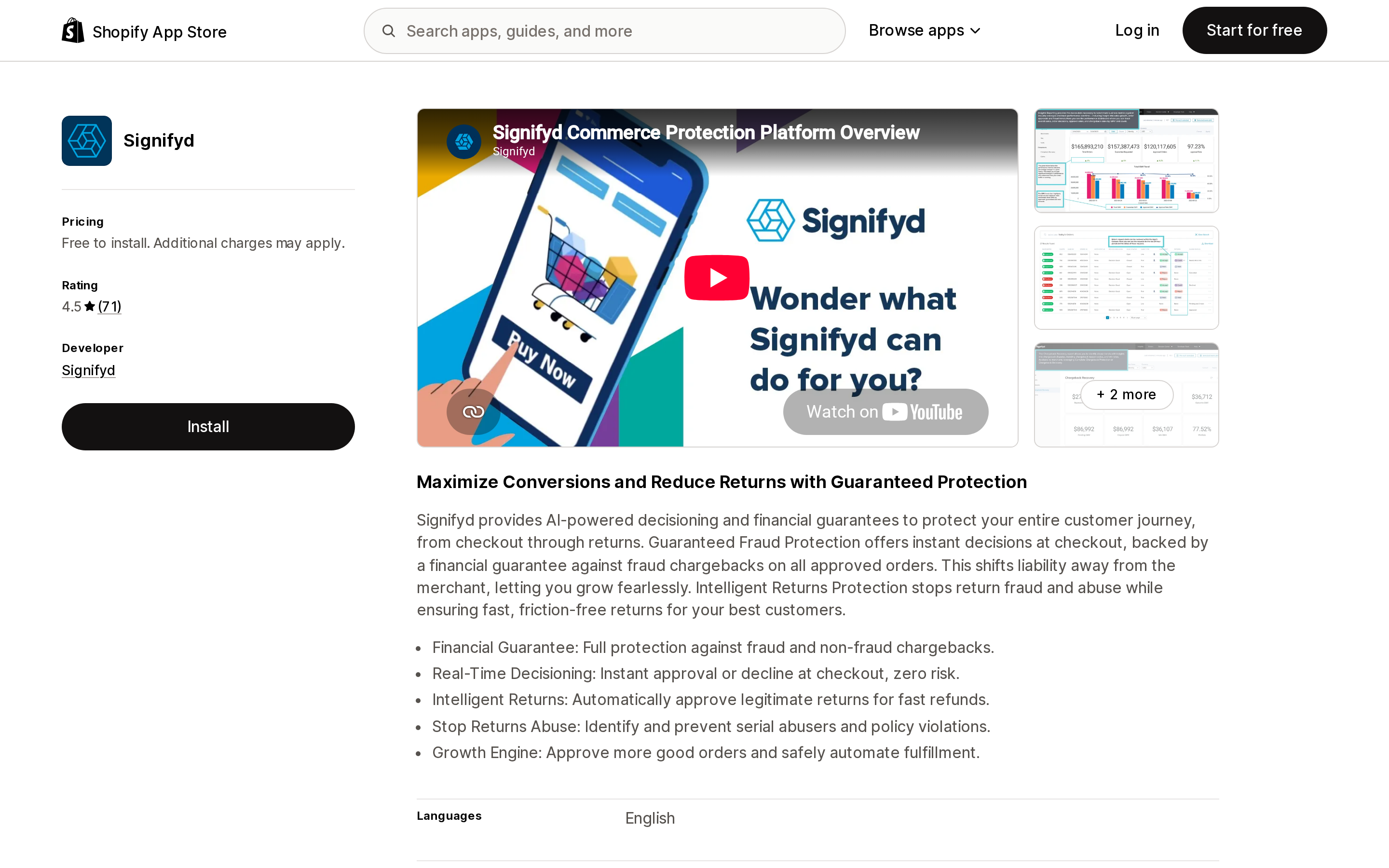
Source: Signifyd on the Shopify App Store, captured September 2, 2026.
ClearSale Fraud Protection — 3.6 stars, 46 reviews. Miami, FL; launched April 2, 2020. Combines AI with human analysts and states the guarantee plainly: "If we approve it and it's fraud, we'll cover it." Pricing is also unpublished, described as "flexibility to design a program that meets your specific business needs," and also billed externally. The 3.6 rating is the second-lowest here and worth reading the one-star reviews before signing.
Wyllo — 4.8 stars, 152 reviews. Note the name: this is the app formerly listed as NoFraud, now rebranded (the App Store slug still contains "nofraud"). New York, NY; launched November 23, 2016. It's the only app here that publishes the guarantee as a price list rather than a sales call:
| Plan | Price | Stated basis | Guarantee |
|---|---|---|---|
| Screening Only | Free to install | up to 100 orders/month free after trial | none |
| w/ $500 Guarantee | $250/month | 1% of revenue, min $250/mo, for merchants under $50K/mo | $500 |
| w/ $1000 Guarantee | $350/month | 1.25% of revenue, min $350/mo | $1,000 |
| w/ $2000 Guarantee | $450/month | 1.50% of revenue, min $450/mo | $2,000 |
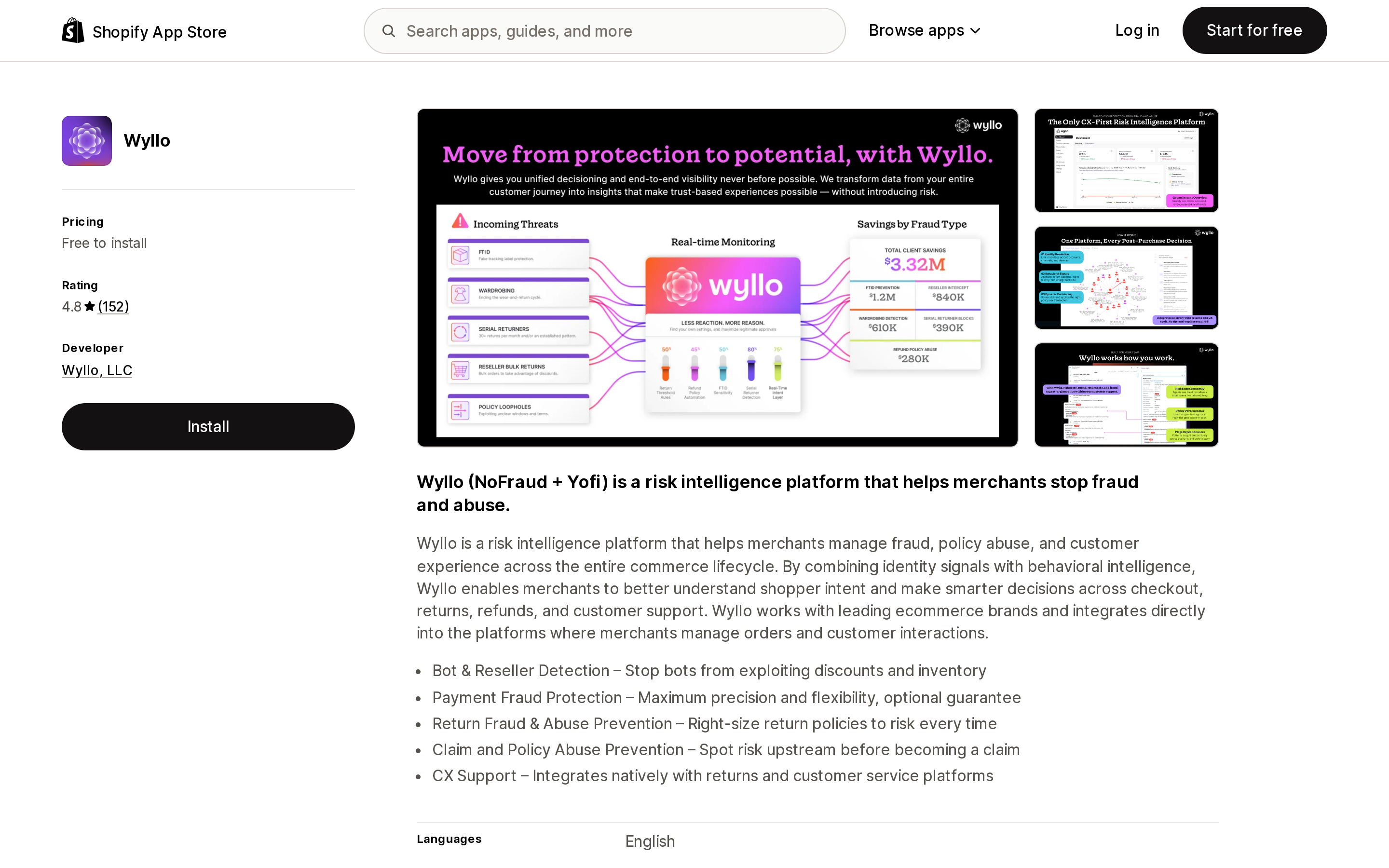
Source: Wyllo on the Shopify App Store, captured September 2, 2026. The listing name is now Wyllo; the URL still contains "nofraud".
The guarantee amount is a cap, not a promise of full coverage — that's the structural difference from Signifyd and ClearSale, and it's the number to check against your average order value before assuming you're protected.
Group B: paid out of what they recover
Chargeflow Prevent Chargebacks — 4.7 stars, 368 reviews. Wilmington, DE; launched June 14, 2021. One plan, three meters: 25% of recovered chargebacks, "Prevent" at 1,000 orders free then $0.20 per order, and alerts billed per prevented chargeback. Its pitch is "Only pay on successful recoveries."
Disputifier: Smart Chargebacks — 4.6 stars, 90 reviews. Clayton, NC; launched September 23, 2020. 20% of won-back revenue, plus chargeback alerts at $17 to $27.50 each. The alert pricing is the line to model: alerts are billed per alert whether or not the underlying dispute would have gone against you.
Neither shifts liability. Both are worth running alongside Shopify Protect rather than instead of it, because Protect handles the dispute process only for the narrow slice of orders it covers.
Group C: blocking and automation
Blockify Fraud Filter, Blocker — 4.9 stars, 1,581 reviews, and the highest review count in the category by a factor of four. Built for Shopify badge in the header. Developer based in Hanoi, Vietnam; launched March 13, 2018. Blocks IPs, countries, bots, VPN/Tor/proxy traffic. Free tier covers 4 block rules, 4 redirect rules and the first 200 visitors; $9.99 Premium, $19.99 Enterprise, $39.99 Shopify Plus. Auto-cancel of high-risk orders is listed only on the $39.99 Plus tier — check that before assuming the $9.99 plan does what the app description implies.
Beacon Fraud Prevention — 4.6 stars from only 13 reviews, so treat the rating as thin. Built for Shopify badge; developer Lizuna KK, Chiyoda-ku, Tokyo; launched April 27, 2018. Priced per order at $0.03, or $125/month including 5,000 orders and $0.025 per order above that. It cross-checks VoIP numbers, disposable emails, CVV and multi-account patterns, then automates cancellation, voids, holds and capture control. Despite "chargeback protection" appearing in its tagline, there is no guarantee anywhere in the listing.
FraudBlock Fraud Prevention — 4.3 stars, 26 reviews. Düsseldorf, Germany; launched July 31, 2019. It exists to do exactly one thing, and the listing states the premise better than any analysis could: "While Shopify automatically flags high-risk orders for you, it doesn't cancel them — you still have to go through your list of orders manually." $4.95 for 200 orders/month, $19.95 for 500, $29.95 above that.
That last quote is the honest summary of Group C: these apps automate a decision Shopify already made for you. They are cheap for the same reason they're cheap to build.
Two billing details that decide more than the star rating
External billing. Only Signifyd and ClearSale state that charges are billed separately from your Shopify invoice. Chargeflow and Disputifier show "Additional charges may apply" in the header but bill through Shopify in USD. That distinction matters for reconciliation, for your app-spend reporting, and for what happens when you uninstall.
Built for Shopify badges. Of the eight, only Blockify and Beacon carry the badge in their listing header. Signifyd, Wyllo, Disputifier, Chargeflow, ClearSale, FraudBlock and Fraud Control do not. The badge measures performance, design and integration quality — not whether the vendor will pay your chargeback. In this category, the two apps that carry it are both in Group C.
Choosing
If you're a US merchant on Shopify Payments with high Shop Pay adoption and an all-physical catalog: the native stack already covers a real share of your orders for free. Model your actual Protect-eligible percentage from the Fraud Control dashboard before paying for anything. Then buy for the gap — most often POS, B2B, subscription renewals, or digital goods.
If your average order value is above roughly $500: Wyllo's capped guarantees stop being meaningful protection. Compare Signifyd or ClearSale, and get the pricing in writing, since neither publishes it.
If your chargeback health is in "At risk" or "Elevated risk": the priority is a recovery tool plus manual capture, not a blocker. Being removed from Shopify Payments costs more than the chargebacks did.
If you're on Basic without Shopify Payments: you get no fraud recommendation and no Fraud Control checkout rules. This is the single configuration where a paid app is closest to mandatory, and the cheapest fix is a Group C blocker plus manual payment capture.
If most of your fraud pain is friendly fraud on delivered orders: none of the blockers help. That's Group A's "non-fraud chargebacks" language or Group B's recovery model, and nothing else.
Sources
- Reviewing orders with fraud analysis — Shopify Help Center
- Fraud Control app — Shopify Help Center
- Protecting an order with Shopify Protect — Shopify Help Center
- Shopify Protect for Shop Pay — Shopify Help Center
- App Store listings for Fraud Control, Signifyd, ClearSale, Wyllo, Chargeflow, Disputifier, Beacon, Blockify, FraudBlock
Ratings, review counts and prices were read from the listing pages on September 2, 2026, and change often. Re-check before you buy.
Shop Pay Installments is free to activate, needs no app, and Shopify never publishes what it costs you — the rate is visible only inside your own admin. It also refuses Capital One and Chase credit cards, restricts monthly plans to debit cards only, excludes gift cards and subscriptions, and can't be turned off for individual products. Affirm can suspend your account for being password-protected, for having a non-English storefront, or for being primarily B2B. And Shopify's Getting paid page says disputes appear in your admin while its FAQ says they don't. If you fail the eligibility gates, the alternative is on-site messaging apps from Klarna, Afterpay, Sezzle, Zip, and PayPal — a category rated between 1.0 and 3.2 stars. Researched September 2, 2026.