
What you will learn
On this pageContentsCloseOpen
Most write-ups of Shopify Managed Markets start with the fee. It is a reasonable place to start — 3.5% of the order total, or 3.25% on Shopify Plus, plus a 1.5% currency conversion fee, with no monthly commitment. Compared with hiring a customs broker and registering for VAT in a dozen countries, that reads as cheap.
The part that decides whether you can use it at all sits three pages deeper in the Help Center, in a table about product review statuses. Two of the four statuses carry the same sentence: Products that are in review status can't be published to your online store, and Products that are in unsupported status can't be published to your online store.
That is not a limit on your international markets. That is a limit on your storefront.
What Managed Markets actually changes
Shopify Markets — the international tooling that ships with every store — leaves you as the merchant of record. Tax registration, duties, and customs compliance stay yours. Managed Markets replaces you in that legal role. Shopify's overview page states it plainly: Managed Markets "adds Global-e as the merchant of record and takes those responsibilities on for a per-order fee."
Global-e registers for tax in your destination countries, remits duties and taxes to local authorities, assigns HS codes, produces commercial invoices, and guarantees the duty and tax amounts shown at checkout. If customs charges more than the quote, Shopify says Managed Markets covers the difference.
The flow of funds is worth understanding before you switch it on. Shopify Payments processes the transaction, then holds the money in a Global-e account. Global-e remits taxes and duties from that pool, and your payout arrives daily through Shopify Payments. Your customer sees your brand and your checkout throughout. Support questions — including questions about payouts and customs documents — go to Shopify Support, not to Global-e.
Who can turn it on
The eligibility rules are stricter than "US, Canada, or UK."
For a US business, Shopify requires you to be based in the continental United States, explicitly excluding territories such as Puerto Rico and Guam. You need at least one non-PO-box location in the US and at least one fulfillment location in the continental US.
Canadian stores need all their Canadian fulfillment locations in the same province, and must use Shopify Tax or Basic Tax — manual tax settings disqualify you. UK stores can have fulfillment in Great Britain or in Northern Ireland, but not both.
Across all three: Shopify Payments is mandatory, the Basic plan or higher is required, and your store currency must be the default currency of your home country. A US business running a store priced in EUR cannot activate Managed Markets.
The product review gate
Before activation, Shopify reviews your entire catalog against a restricted-items list. Review then continues for as long as you use Managed Markets, re-running on every product you add or edit.
The Help Center's prohibited-items page lists 35 restricted categories. A few are unsurprising — tobacco, CBD, weapons, drugs. Others cover an enormous share of ordinary DTC catalogs:
- Batteries and electronics: "All batteries, electronics, and electrical items that contain or have batteries attached, or plug directly into the electrical current." The examples run from computer monitors to extension cords.
- Beauty and cosmetics: perfume, nail polish, aerosols, hand sanitizer, lash adhesive, wipes. Soaps, shampoos, lotions, and moisturizers are separately restricted in regions including Mexico, Spain, Italy, and Greece.
- Ingestibles, wellness, and medical devices: vitamins, supplements, first aid kits, activity monitors, contraceptives. Shopify adds that "all items that make any health, medical, or wellness claims will be restricted internationally."
- Consumer safety: car seats, strollers, helmets, children's chairs.
- Home and garden: candles, essential oils, incense, plants, soil.
- Speciality apparel: mother of pearl buttons, feather trim, python belts, military uniforms.
To be reviewed at all, a product needs a title, a description, and a product category. Most results come back in seconds; some take up to 24 hours.
Then the four statuses:
| Status | What it means |
|---|---|
| In review in (X) regions | Under review. Can't be published to your online store. |
| Product unsupported | Can't be sold on Managed Markets at all. Can't be published to your online store. |
| Unsupported in (X) regions | Blocked for specific markets only. Not displayed to customers there. |
| Supported in (X) regions | Cleared for all your current markets. |
Read the first two rows again. A product waiting on Global-e's classifier, or misclassified by it, is blocked from your storefront — not just from Belgium. If you add products in batches, or edit descriptions often, that is a publishing dependency you did not have before.
Shopify's stated remedy is category metafields. If a product is wrongly marked unsupported, you fill in the category metafields more accurately and the product is re-reviewed. That is a real fix, but it means your international sales channel now depends on how completely your merchandising team fills in Shopify's taxonomy fields.
One more line from the same page deserves attention: "If your catalog primarily sells unsupported items, then you might be ineligible to use Managed Markets."
What Managed Markets quietly removes
The requirements page lists feature limitations that are easy to skim past and expensive to discover later.
Subscriptions are stripped, not blocked. Shopify's wording: if you have products set up for subscriptions, "the subscription selling plan is removed for all international markets managed by Managed Markets." Customers can still buy them as one-time purchases. Products available only by subscription are hidden from international customers entirely.
B2B orders aren't supported. You have to act as your own merchant of record for them. The transaction fee isn't charged on international B2B orders either — which is the same statement from the other direction.
Free orders aren't supported. Any order with a value of zero falls back to you as merchant of record.
Digital-only orders aren't supported. An order qualifies only if it contains both a digital and a physical product. Digital products also can't go in draft orders.
PayPal isn't supported. Shop Pay, Apple Pay, and Google Pay are.
Shopify Collabs isn't compatible. Neither are checkout redirects, nor multiple business entities in one store.
Manual bundles break customs. Shopify Bundles works; a bundle built as a single product with items added as one line item does not, because accurate customs forms can't be generated for it.
Orders become hard to edit. Once a shipping label is printed, or the order is partly fulfilled, Managed Markets orders can't be edited.
A phone number is collected at checkout. Not optional.
EU right of withdrawal is all-or-nothing. Managed Markets applies compliant EU cancellation and return policies automatically, with no product-level exemptions. You still respond to requests, buy return labels, and absorb the cost of returns.
The arithmetic, using Shopify's own example
Shopify publishes a worked payout for a €150 order into the EU from a US store, with international pricing turned off:
| Line | Amount |
|---|---|
| Order total (€150 EUR) | $158.97 USD |
| Tax/VAT remitted | −$10.60 |
| Duties remitted | −$5.30 |
| Shopify Payments fee (3.9% + $0.30) | −$6.50 |
| Managed Markets fee (3.5%) | −$5.56 |
| FX fee (1.5%) | −$2.38 |
| You receive | $128.63 |
The tax and duty portions were never yours, so the fair way to read this is: on a €150 order, the platform layer takes $14.44 on top of remittance. Turning on Include duties and taxes in prices dynamically by region pushes those costs into your displayed prices instead, so the customer covers them — which is why Shopify's second worked example, with international pricing on, shows a much healthier payout.
Note also that Shopify stabilizes the FX rate rather than tracking mid-market. Rates typically update every 7 days, are guaranteed for 30 days per order, and Shopify states outright that the stabilized rate "will differ from the current mid-market rate."
Three things in Shopify's own tables that don't line up
Reading the Managed Markets documentation end to end turns up discrepancies worth checking against your own catalog rather than taking on trust.
The destination table lists 188 countries and regions — and the United States is not one of them. Canada and the United Kingdom both appear. For a Canadian or British store, that means US-bound orders are not Managed Markets orders.
Four countries named in the restriction rules aren't in the destination table at all. The knives section restricts shipments to Belarus, Türkiye, Ukraine, and Venezuela, and the jewelry section names Russia. None of the five appears in the compatible-destinations table.
The currency table lists 152 codes; the comparison page says 136. Counting the currency table on the requirements page gives 152 entries. The Managed Markets comparison page says you can "offer local currency from 136 available currencies." More striking is what is in the list: at least eight of the codes have been retired under ISO 4217 — LVL and LTL (Latvia and Lithuania moved to the euro in 2014 and 2015), HRK (Croatia, 2023), BYR (redenominated to BYN in 2016), MRO and STD (redenominated in 2018), CUC (withdrawn in Cuba in 2021), and VEF (replaced in Venezuela in 2018). Codes for Russia, Iran, and North Korea also appear, none of which are compatible destinations.
None of this stops Managed Markets working. It does mean that "supported currencies" and "countries you can actually sell to" are separate lists that shouldn't be read as one.
The Global-e app you're told not to install
Three separate Help Center pages warn that "Managed Markets and the Global-e app can't be used at the same time," and explain that the standalone Global-e app is a different product with direct Global-e support.
As of September 2, 2026, the Shopify App Store partner page for Global-e Online Ltd. lists 0 apps. If you want the standalone Global-e route, it isn't something you install from the public App Store today — which makes the choice, for most merchants, between Managed Markets and a third-party cross-border app.
Cross-border apps, compared on who carries the risk
The apps below all calculate and collect duties at checkout. They differ on who becomes the merchant of record, who eats a wrong customs bill, and what they meter on.
| App | Rating (reviews) | Pricing model | Remits tax for you | Notable requirement |
|---|---|---|---|---|
| Zonos Duty and Tax | 4.5 (151) | $2,500/yr Standard, $4,000/yr Premium, + $2/order + 10% of duties, taxes and fees | Yes — VAT, IOSS, UK VAT ID | Carrier Calculated Shipping (CCS) required |
| Swap Global | 3.8 (19) | Free to install; charges for orders shipped may apply | Yes — global duty and tax remittance | Pricing not published on the listing |
| FlavorCloud – AI Cross‑Border | 4.9 (68) | Free to install; "SaaS pricing based on usage" | Guaranteed DDP incl. duties, taxes, fees | Pricing not published on the listing |
| DHL Duty and Tax Calculator | 4.0 (17) | $50/mo (200 calls), $200/mo (800), $600/mo (2,500), then $0.25–$0.35 per extra call | No — display or collect only | Shopify CarrierService resource required |
| Easyship ‑ All in One Shipping | 4.1 (368) | Free (50 shipments/mo), $29, $69, $99+/mo | Not stated on the listing | Checkout duties are on paid tiers |
Zonos Duty and Tax
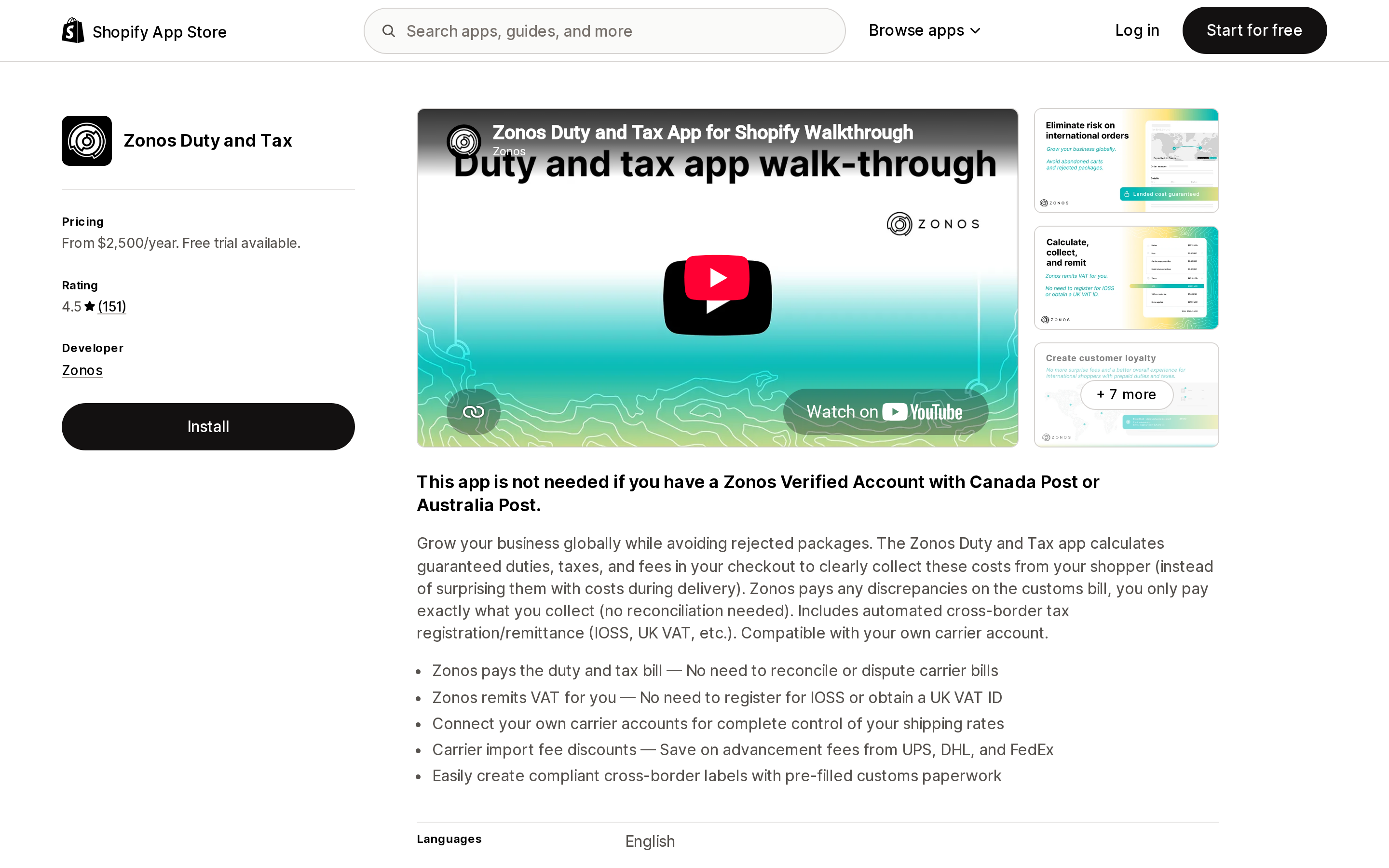
Source: Shopify App Store (Zonos Duty and Tax), retrieved September 2, 2026
Zonos is the closest thing here to a Managed Markets substitute that leaves you in control of carriers. Its listing states that Zonos pays the duty and tax bill so there's nothing to reconcile or dispute, remits VAT so you don't register for IOSS or a UK VAT ID, and lets you connect your own carrier accounts.
The cost structure is the opposite shape to Managed Markets: a large annual floor ($2,500 or $4,000) plus $2 per order plus 10% of the duties, taxes, and fees — which the listing notes can be passed to the customer. Both plans say "CCS required," meaning Shopify's Carrier Calculated Shipping API, which is not available on every plan and billing cycle. Check that before you budget.
The reviews are not uniform. A German merchant of over five years wrote in July 2026 about non-European customers being unable to check out with a discount code and receiving a "standard AI answer" from support. A US merchant wrote in June 2026 about migrating a Shopify Plus store off Global-e onto Zonos and rating the onboarding highly.
Swap Global
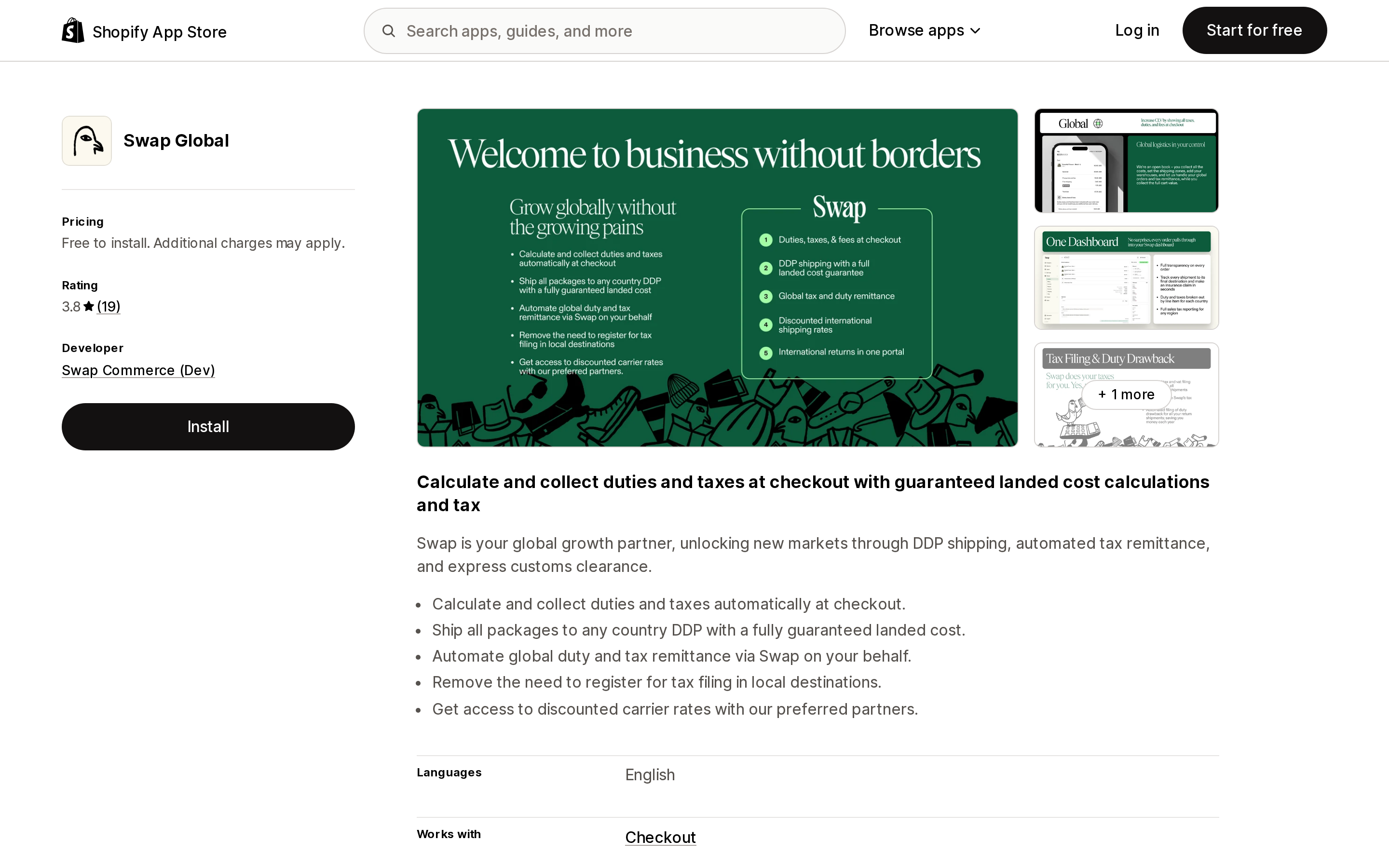
Source: Shopify App Store (Swap Global), retrieved September 2, 2026
Swap Global, from Swap Commerce, advertises fully guaranteed landed cost on DDP shipments to any country and automated global duty and tax remittance. It is free to install, with "charges for orders shipped may apply" and no published rate card.
At 3.8 across 19 reviews, it has the lowest rating of the five. The most recent review at the time of research (February 2026, from a Canadian merchant) alleges that quoted percentages changed after contract signature. That is one merchant's account, not a pattern — but with pricing that isn't published anywhere on the listing, it is a reason to get the commercial terms in writing before installing.
FlavorCloud – AI Cross‑Border
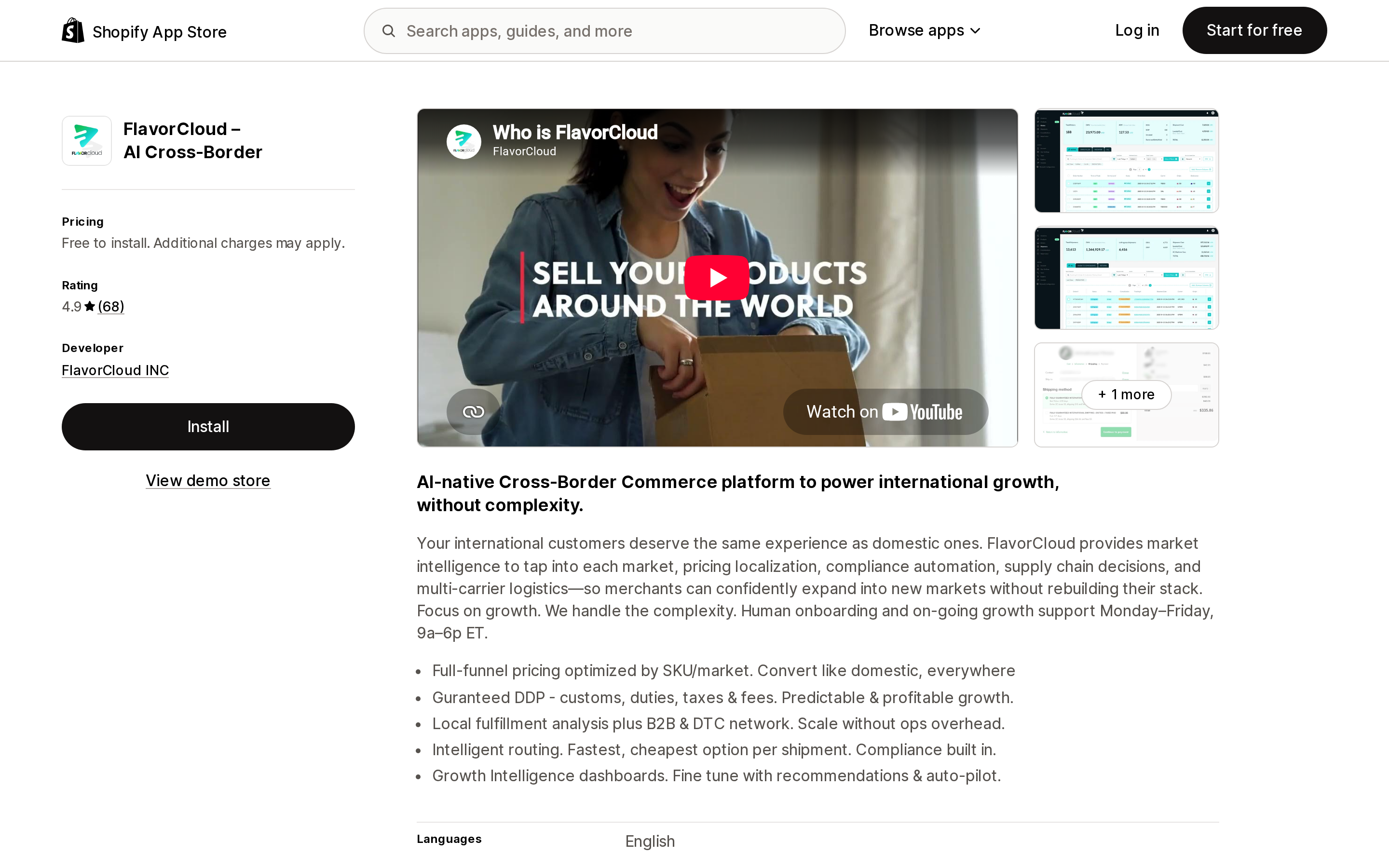
Source: Shopify App Store (FlavorCloud – AI Cross‑Border), retrieved September 2, 2026
FlavorCloud has the highest rating of the group at 4.9 across 68 reviews. Its listing leads on guaranteed DDP covering customs, duties, taxes and fees, per-SKU and per-market pricing, and intelligent carrier routing. It integrates with 3PLs including ShipBob, ShipHero, ShipMonk, GXO, Ryder, and DCL — the useful signal being that FlavorCloud assumes you already outsource fulfillment.
Like Swap, pricing is "free to install" with usage-based SaaS charges that aren't published on the listing.
DHL Duty and Tax Calculator
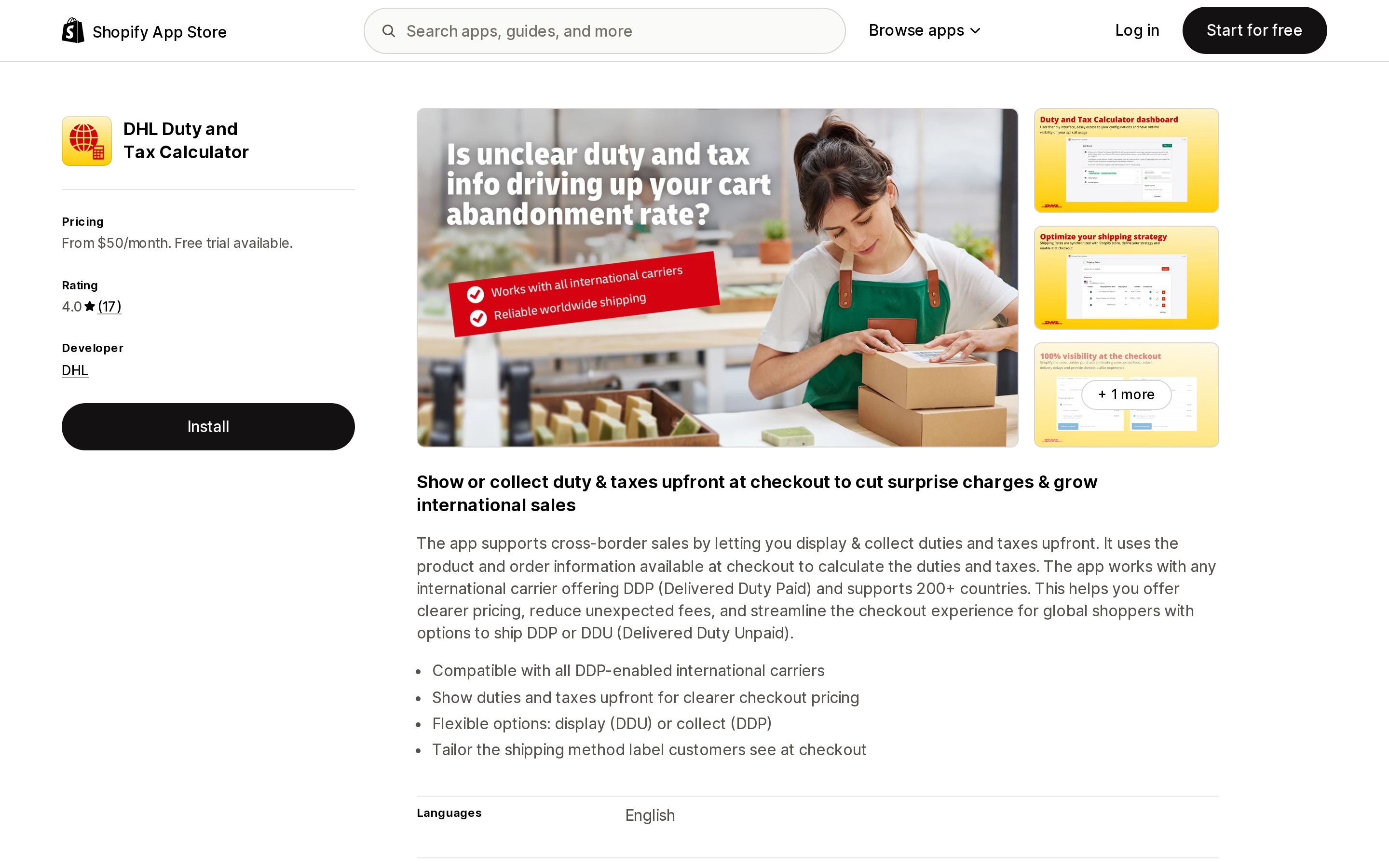
Source: Shopify App Store (DHL Duty and Tax Calculator), retrieved September 2, 2026
This is the narrowest tool in the list, and the only one with fully published pricing. DHL's app displays or collects duties and taxes at checkout, works with any DDP-enabled international carrier, and meters on API calls: $50/month for 200, $200 for 800, $600 for 2,500, with per-call overage between $0.25 and $0.35.
It does not become your merchant of record and does not remit tax. It is a calculator. A May 2026 review from a UK merchant makes the trade-off concrete: the DDU wording at checkout is ambiguous and can't be edited, and shipping costs can only be specified in the store's base currency. DHL replied publicly to that review.
Easyship ‑ All in One Shipping
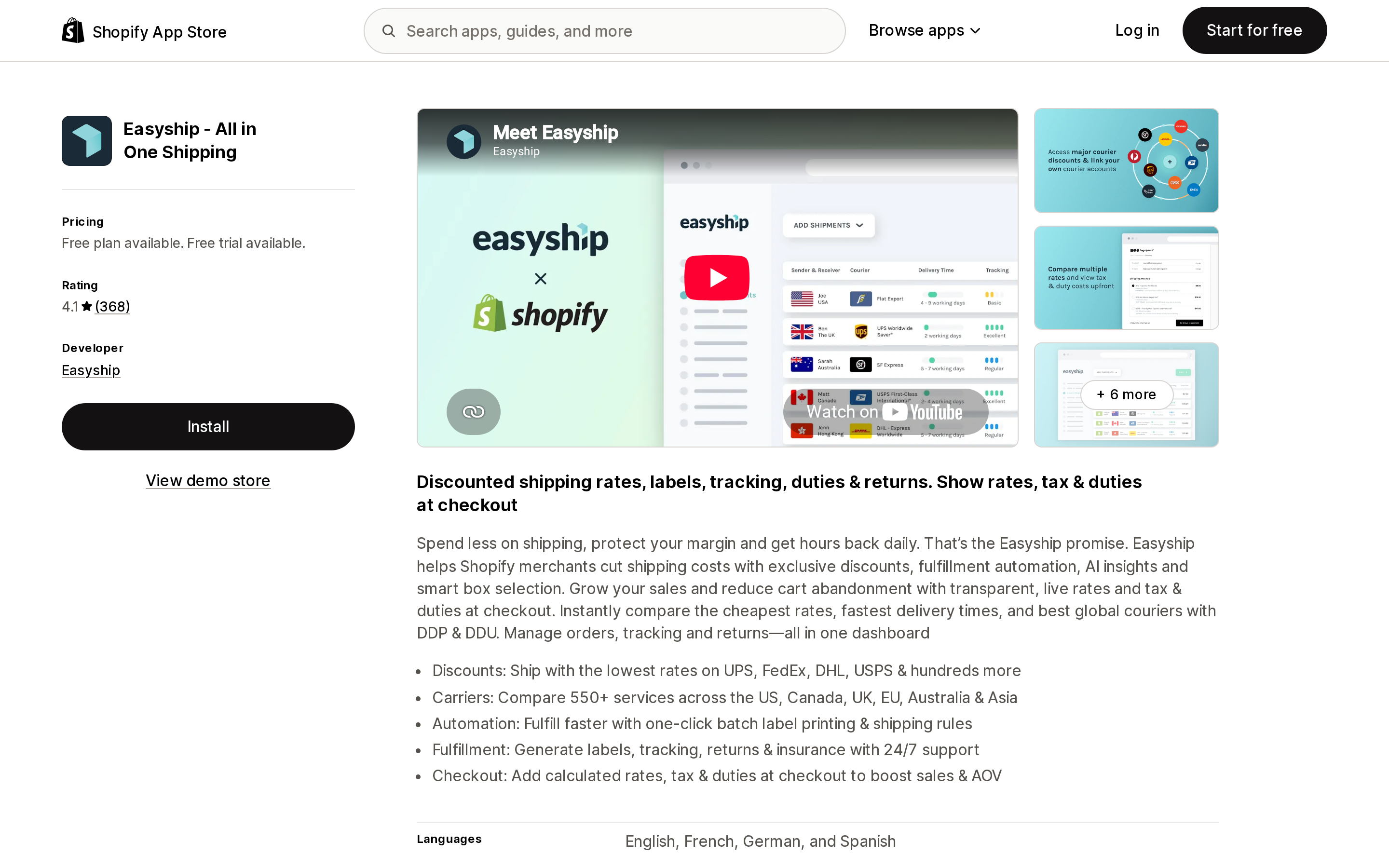
Source: Shopify App Store (Easyship ‑ All in One Shipping), retrieved September 2, 2026
Easyship is a shipping platform first and a duties tool second. The free tier covers 50 shipments a month and includes import tax and duty calculation, but live rates at checkout start on the $29/month Plus plan and DDP/DDU duties at checkout are listed under the $69/month Premier plan. Above that, Scale runs $99–$199/month for 5,000–10,000 shipments.
At 4.1 across 368 reviews it has by far the most review volume here, which reflects its broader remit — 550+ carrier services, batch labels, returns — rather than depth on cross-border tax. Merchant-of-record duties stay with you.
How to decide
Stay on Shopify Markets alone if international is a small share of orders and you are willing to ship DDU. You keep merchant-of-record duties, and customers may be billed on delivery.
Managed Markets fits a continental-US, Canadian, or UK store on Shopify Payments, selling physical, non-subscription, non-B2B products that survive the review gate, that wants tax registration to be someone else's problem and has no monthly volume to justify a floor fee. There is no monthly minimum and no commitment period.
Managed Markets does not fit if subscriptions are core to your international plan, if you sell B2B abroad, if PayPal is a meaningful share of your international payment mix, if your catalog is concentrated in electronics, supplements, cosmetics, or safety equipment, or if you cannot accept products being blocked from your online store while under review.
A third-party app fits when you want to keep carrier relationships and merchant-of-record status, or when Managed Markets' eligibility rules exclude you. Zonos is the option with published pricing and stated VAT remittance, if you can clear the CCS requirement and the annual floor. DHL's calculator is the cheapest honest way to show duties at checkout without changing who is legally selling. Swap and FlavorCloud both require a sales conversation before you know the price.
Whichever you pick, run your own catalog through the prohibited-items list before you run a spreadsheet on the fees. The fee is a percentage. The product review is a gate.
Sources
- Overview of Managed Markets — Shopify Help Center, retrieved September 2, 2026
- Requirements and considerations for using Managed Markets — Shopify Help Center, retrieved September 2, 2026
- Prohibited and restricted items on Managed Markets — Shopify Help Center, retrieved September 2, 2026
- Managed Markets with Shopify Payments — Shopify Help Center, retrieved September 2, 2026
- Comparing International and Managed Markets features — Shopify Help Center, retrieved September 2, 2026
- Shopify App Store listings for Zonos Duty and Tax, Swap Global, FlavorCloud – AI Cross‑Border, DHL Duty and Tax Calculator, and Easyship ‑ All in One Shipping, retrieved September 2, 2026
Shop Pay Installments is free to activate, needs no app, and Shopify never publishes what it costs you — the rate is visible only inside your own admin. It also refuses Capital One and Chase credit cards, restricts monthly plans to debit cards only, excludes gift cards and subscriptions, and can't be turned off for individual products. Affirm can suspend your account for being password-protected, for having a non-English storefront, or for being primarily B2B. And Shopify's Getting paid page says disputes appear in your admin while its FAQ says they don't. If you fail the eligibility gates, the alternative is on-site messaging apps from Klarna, Afterpay, Sezzle, Zip, and PayPal — a category rated between 1.0 and 3.2 stars. Researched September 2, 2026.