
What you will learn
On this pageContentsCloseOpen
Almost every "connect Shopify to marketplaces" post written in the last two years says the same thing: install Shopify Marketplace Connect, it's free, it does Amazon, eBay, Walmart, Etsy, and Target Plus. Two of those five are no longer true for a US merchant starting today.
Shopify's own help documentation lists four marketplaces you can connect: Amazon, Target Plus (United States only), Walmart (United States only), and eBay. Etsy appears on the page only inside a repeated warning box: new connections can't be made, and only merchants already syncing Etsy through the app can keep using it. TikTok Shop is not on the list at all, and never was — it lives in a completely separate app built by TikTok.
That leaves a real question for a US store: is the free first-party app enough, and if not, which specific hole are you trying to plug? Below are the documented limits, the fee structure that most write-ups get subtly wrong, and five real apps mapped to the gaps they actually close. Research date: September 2, 2026. All prices are USD as published on the Shopify App Store.
The short version
- Marketplace Connect connects Amazon, Target Plus, Walmart, and eBay. Target Plus and Walmart are United States only.
- New Etsy connections cannot be made. Shopify repeats this note on four separate help pages. Existing Etsy connections keep running.
- TikTok Shop is not a Marketplace Connect channel. The official TikTok app by TikTok Inc. is the one that syncs TikTok Shop products, orders, and inventory into your Shopify admin.
- Pricing is free to install, with the first 50 marketplace-synced orders per month free and a 1% fee on each additional synced order, capped at $99 per month. That cap is why the free app is hard to beat on price at volume.
- The limits that bite are structural, not commercial: inventory location can't be set per variant, and eleven Shopify metafield types are silently ignored.
What Marketplace Connect actually supports today
Shopify Marketplace Connect is published by Shopify itself and was previously named Codisto. On September 2, 2026 the listing shows a 4.2 rating from 1,968 reviews and "Free to install."
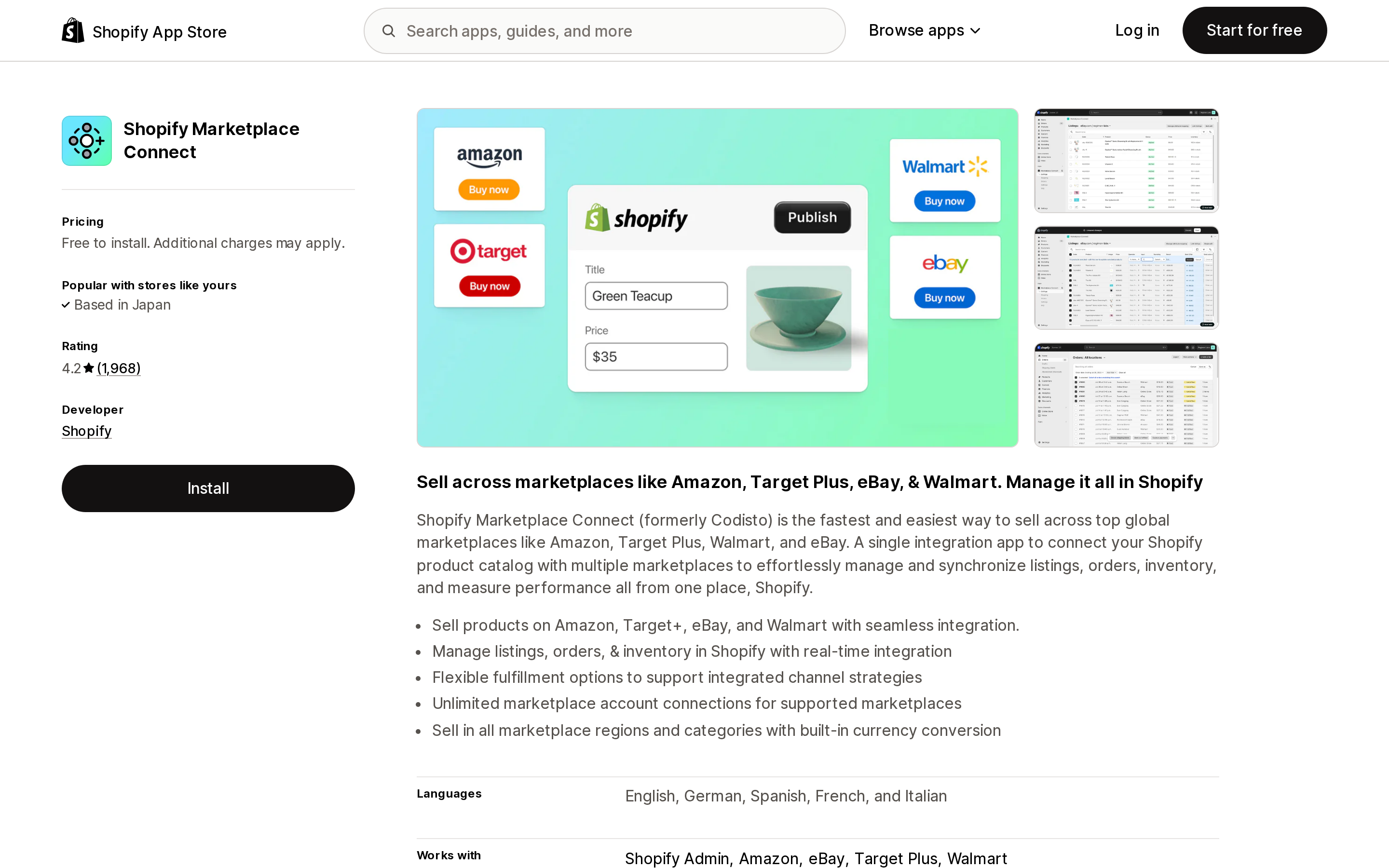
Source: Shopify App Store (Shopify Marketplace Connect), retrieved September 2, 2026
The supported channel list, taken from the Shopify Help Center:
| Marketplace | Region availability per Shopify Help Center |
|---|---|
| Amazon | Any region you hold a seller account in |
| eBay | Any region you hold a seller account in |
| Walmart | United States only |
| Target Plus | United States only |
| Etsy | Existing connections only — no new connections |
| TikTok Shop | Not supported |
Each marketplace also has its own gate before Marketplace Connect matters at all. Amazon requires a Seller Central account in the country you sell in. Target Plus is the strictest: you complete the Target Plus Seller Application form and must be approved before you can connect anything. All four require a unique product identifier per item — GTIN, UPC, MPN, or EAN — and private-label sellers without one need an exemption from each marketplace.
The Etsy situation, stated precisely
Shopify's wording is identical across the Marketplace Connect overview, requirements, product-listing, and fulfillment help pages: new connections to Etsy can't be made at this time, and merchants already selling on Etsy through Marketplace Connect can continue to use the app.
This is not a deprecation with a published end date. Shopify says "at this time," and does not state whether or when new connections will reopen — existing sellers should treat their connection as working but frozen rather than guaranteed. And if you are launching Etsy now, Marketplace Connect is not an option at all. That is the single most common reason a US merchant ends up running two integrations side by side.
The fee structure people describe wrong
The App Store pricing card reads: first 50 marketplace-synced orders per month free, 1% fee per additional synced order, capped at $99 per month.
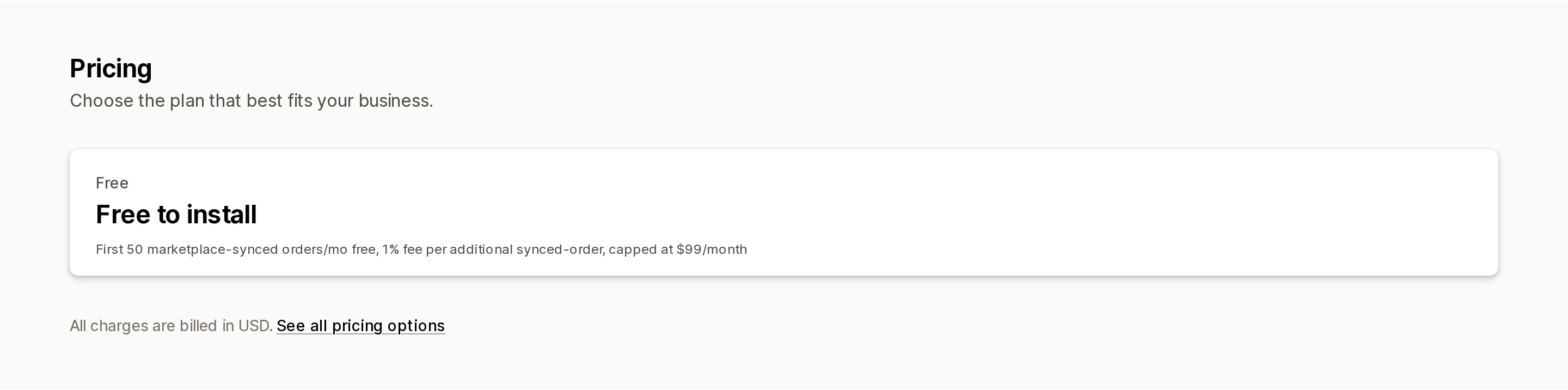
Source: Shopify App Store (Shopify Marketplace Connect), retrieved September 2, 2026
The Marketplace Connect help center adds a distinction the App Store card leaves out: order import is unlimited and free for unmanaged listings, and the 50-order monthly allowance applies to managed marketplace listings. A merchant who only wants marketplace orders flowing into Shopify, without the app controlling the listings, sits in a different bucket than one who lists and prices through it.
The $99 monthly cap is the number to hold onto. Run the math at 800 marketplace orders a month with a $60 average order value:
| App | Published model | Monthly cost at 800 orders / $48,000 GMV |
|---|---|---|
| Shopify Marketplace Connect | 1% per synced order over 50, capped | $99 (cap reached) |
| CedCommerce Amazon Channel | Order-count tiers | $99 (Growth, up to 1,000 orders — Amazon only) |
| M2E Multichannel Connect | GMV tiers plus overage | $79 + $168 overage = $247 |
| LitCommerce eBay Etsy Amazon + | Listing-count and channel-count tiers | From $29, unlimited order sync |
| Etsy Integration ‑ CedCommerce | Product- and order-count tiers | Above the published $59 Growth tier (500 orders) |
The Marketplace Connect row assumes the published 1% applies to order value, which at $60 per order clears the $99 cap well before order 800. Three different billing units — per synced order, per dollar of GMV, per listing — produce wildly different bills at the same volume. A high-order, low-AOV store is punished by GMV pricing. A large-catalog, low-order store is punished by listing pricing. Marketplace Connect's cap makes it the flattest of the three.
The limits that are not about price
These are the documented constraints most likely to force a merchant off the free app.
Inventory location cannot be set per variant. Shopify states plainly that you can configure inventory location individually, in bulk, or for all products in a regional marketplace, but "you can't configure inventory location for specific product variants." Multi-warehouse stores that split variants across locations hit this immediately.
Eleven metafield types are ignored. Marketplace Connect recognizes Date and Time, Date, Decimal, Dimension, Integer, Multi Line, Single Line, Collection, URL, True or False, and Color. It does not recognize JSON, Rich Text, Weight, Volume, Mixed Reference, Money, Rating, Page, Metaobject, Files, or Product Variant. If your Amazon bullets, eBay item specifics, or Walmart attributes live in a Metaobject or a Files metafield — a common pattern in modern Shopify catalogs — attribute mapping won't reach them. Duplicate metafield names are also a trap: only the first metafield created with that name syncs.
Attribute mapping is catalog-wide. The Marketplace Connect help center describes mapped fields as applying to all products. That is efficient for a uniform catalog and awkward for a merchant selling across several very different Amazon categories.
Target Plus orders can't use Amazon or Walmart fulfillment. Shopify states this restriction directly. Amazon connections, by contrast, support Fulfillment by Merchant, Fulfillment by Amazon, and Multi-Channel Fulfillment, and Marketplace Connect will automatically fall back from FBA to FBM inventory once FBA stock is depleted.
Returns don't restock. After a marketplace cancellation or return syncs back, inventory is deliberately not restocked in Shopify, to avoid overselling. Restocking is a manual adjustment.
None of this makes the app bad. It makes it a catalog-sync tool with a specific shape, and the apps below are worth paying for only when your shape doesn't match. Each entry below is filed under the gap it closes.
Five apps, mapped to the gap they close
TikTok — the channel Marketplace Connect never had
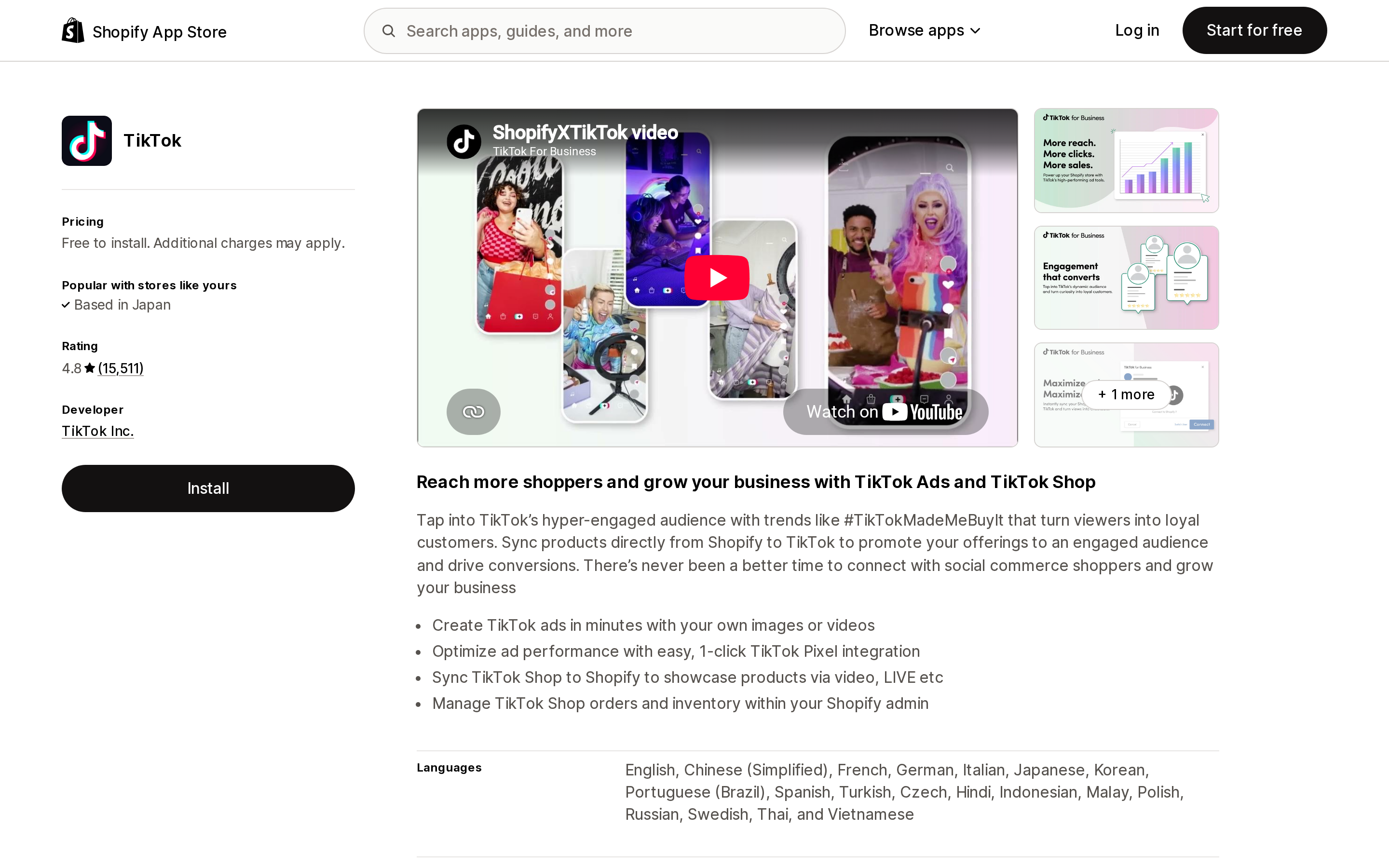
Source: Shopify App Store (TikTok), retrieved September 2, 2026
The TikTok app is published by TikTok Inc., is free to install, and shows a 4.8 rating from 15,511 reviews. Its listing covers both TikTok Ads and TikTok Shop: syncing TikTok Shop to Shopify to showcase products through video and LIVE, and managing TikTok Shop orders and inventory inside the Shopify admin. Ad spend is billed to your TikTok ad account, not through Shopify.
This is the cheapest gap to close, because it isn't a substitution — a merchant running Amazon and Walmart through Marketplace Connect can add TikTok Shop without touching the existing setup. The friction in recent reviews is on TikTok's side, in category approval and restricted-product documentation, rather than in the sync itself.
LitCommerce eBay Etsy Amazon + — the widest channel list
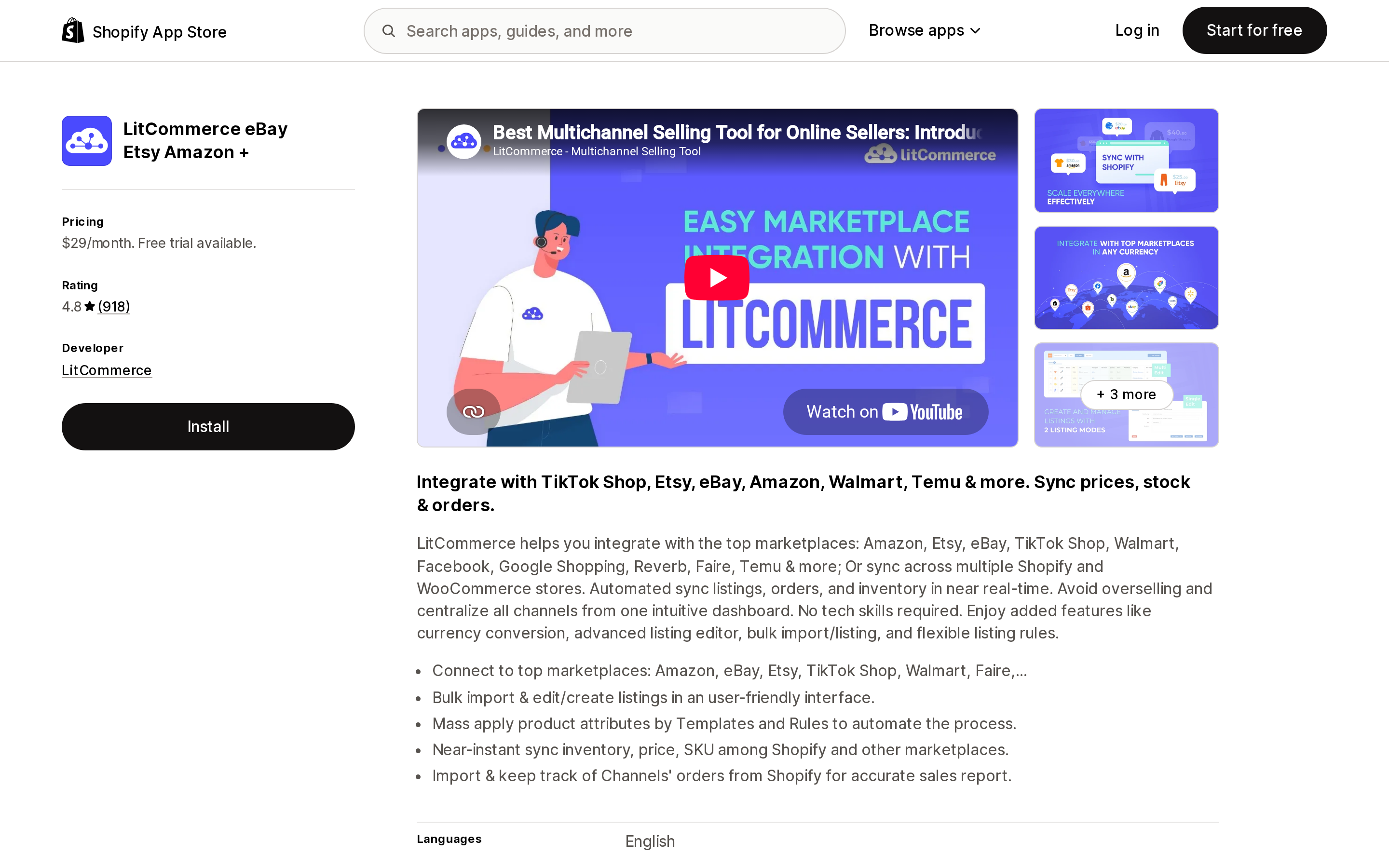
Source: Shopify App Store (LitCommerce eBay Etsy Amazon +), retrieved September 2, 2026
LitCommerce eBay Etsy Amazon + shows a 4.8 rating from 918 reviews. Its listing names Amazon, eBay, Etsy, TikTok Shop, Walmart, Faire, Temu, Reverb, Facebook, Google Shopping, Square, and Shopee, plus WooCommerce, BigCommerce, and Wix stores. The published plan is Pay as you go at $29/month, or $278/year, covering 1,000 listings across 3 channels with unlimited order sync and a 7-day free trial. Additional tiers exist behind "See all pricing options" on the listing.
The reason to look at it is that it closes Etsy, TikTok Shop, and the Marketplace Connect four in one tool, with billing driven by listing count rather than order count — which inverts the cost curve in favor of a modest catalog with heavy order volume. The trade-off surfaces in reviews: one August 2026 review describes products that Shopify treats as simple and Etsy treats as variant failing to link even with matching SKUs. Variant-model mismatches between platforms are a real onboarding risk here, not a hypothetical one.
M2E Multichannel Connect — for marketplaces nobody else lists
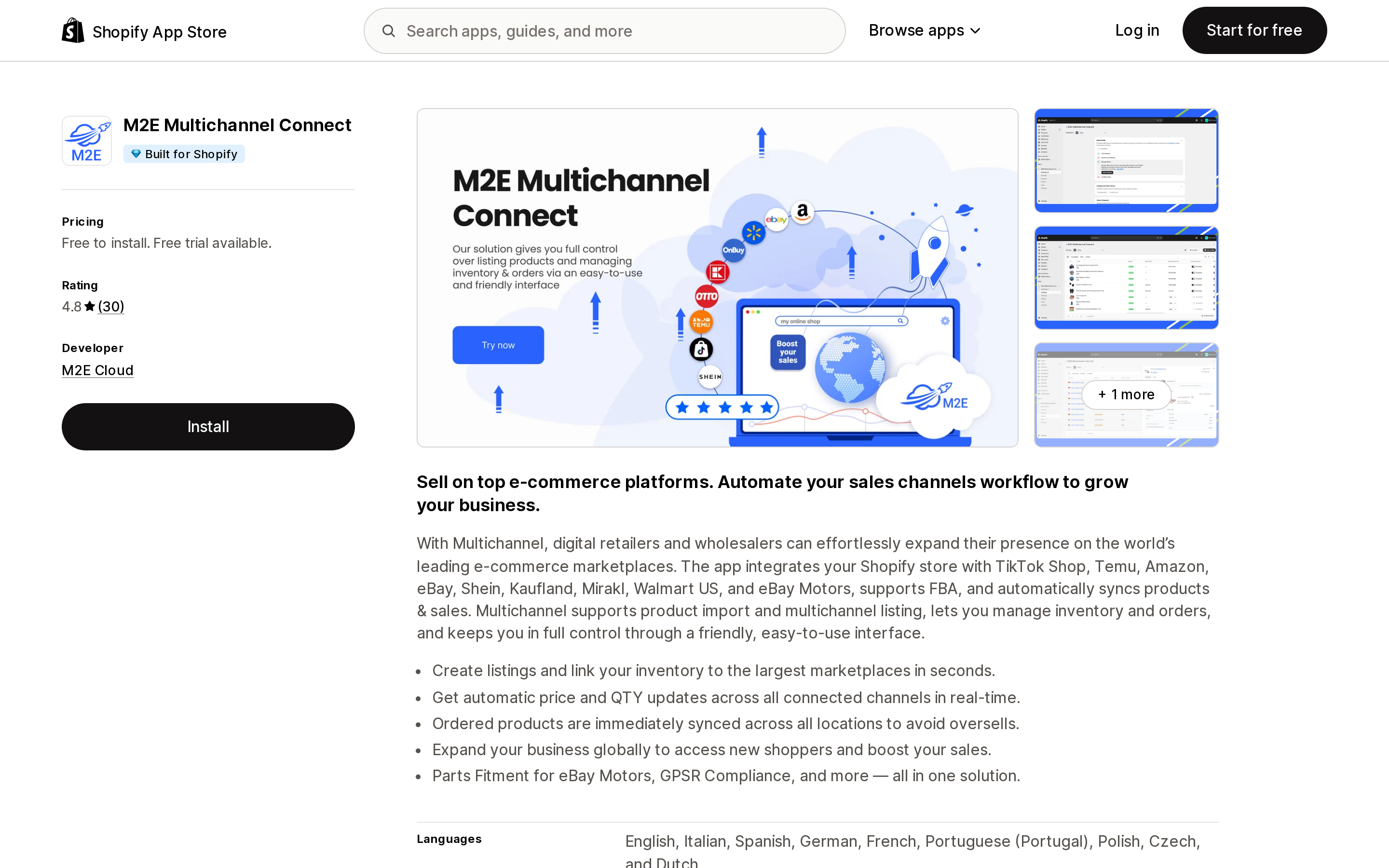
Source: Shopify App Store (M2E Multichannel Connect), retrieved September 2, 2026
M2E Multichannel Connect is published by M2E Cloud, carries the Built for Shopify badge, and shows a 4.8 rating from 30 reviews — a small enough sample that it should not be read as a general verdict on reliability. Its listing covers eBay, Amazon, Walmart, TikTok Shop, Temu, Shein, Kaufland, OTTO, Mirakl, and eBay Motors, and calls out Parts Fitment for eBay Motors and GPSR compliance.
Pricing is GMV-based, which is unusual in this category. Starter is free to install with order sales up to $1,000/month, after which a $39 payment is required. Starter 5K is $39/month for 5,000 listings, 2 seller accounts, and up to $5,000/month in order sales. Starter 20K is $79/month, or $816/year, for 20,000 listings, 3 seller accounts, up to $20,000/month in sales, and Mirakl plus 450+ Mirakl-based marketplaces. Overage is $6.00 per additional $1,000 outside the monthly allowance, and paid tiers include a 30-day free trial.
Pick this one for channel breadth — Mirakl-operated marketplaces and eBay Motors fitment are genuinely hard to get elsewhere — and price it carefully first. As the table above shows, GMV billing overtakes Marketplace Connect's $99 cap well before a store reaches serious volume.
CedCommerce Amazon Channel — Amazon depth instead of breadth
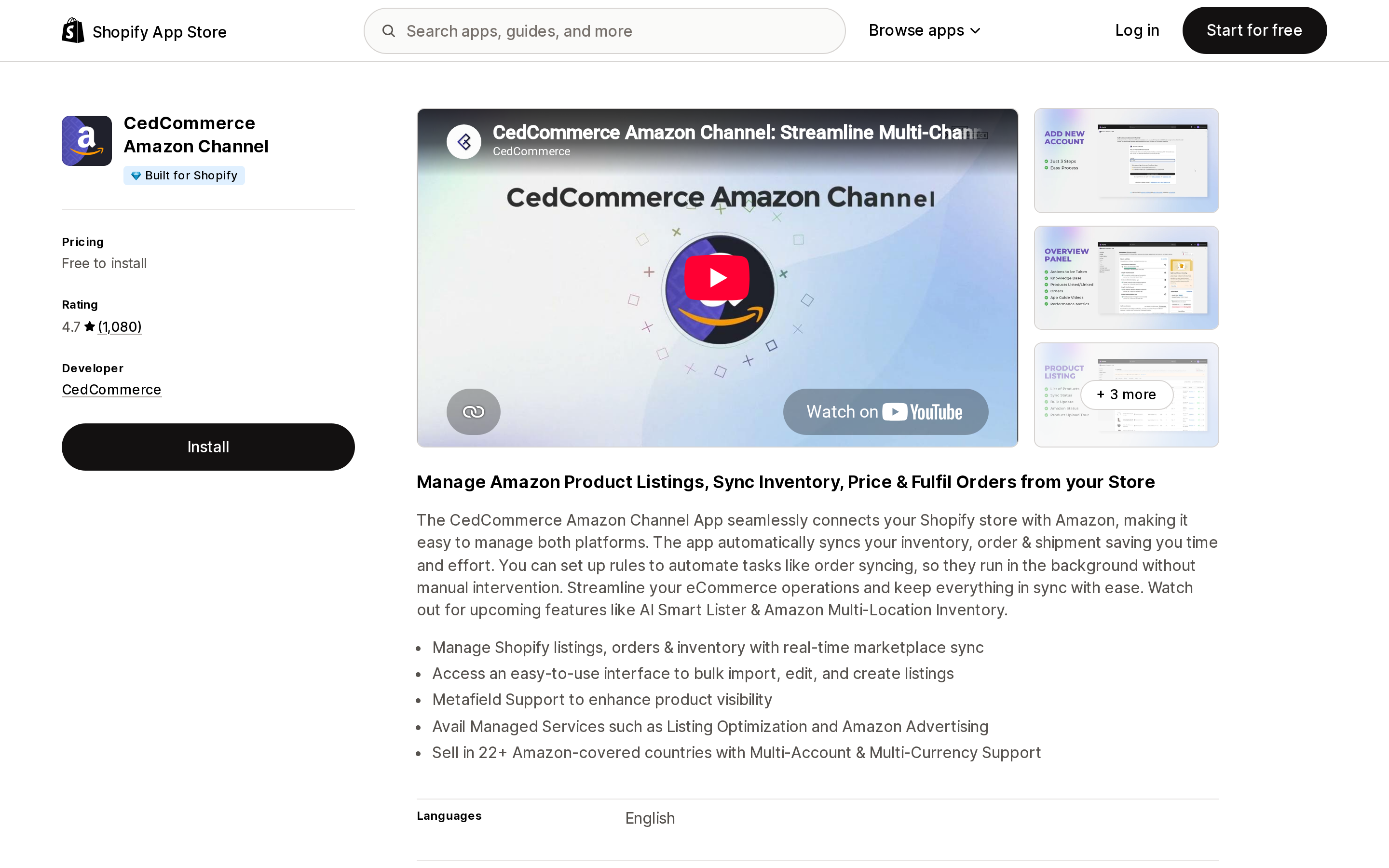
Source: Shopify App Store (CedCommerce Amazon Channel), retrieved September 2, 2026
CedCommerce Amazon Channel carries the Built for Shopify badge and shows a 4.7 rating from 1,080 reviews. It is Amazon-only, and covers 22+ Amazon countries with multi-account and multi-currency support. The listing names Shopify metafield support, a Product Optimizer Tool, and managed services including listing optimization and Amazon advertising.
Pricing runs on order count. The Free tier's card reads "50 orders/month; $0.2/order" — the listing does not spell out whether that per-order rate applies from the first order or only beyond 50, so confirm it in the app before relying on it. Paid tiers are $19/month for up to 100 orders, $49/month for up to 500 orders, and $99/month for the Growth tier at up to 1,000 orders, 10,000 products, and metafield support.
The case for it over Marketplace Connect is narrow but sharp: if Amazon is most of your marketplace revenue and listing quality is the constraint, optimization tooling matters more than channel count. Recent reviews are mixed on exactly that surface — an August 2026 review from a US store describes the app freezing in the attributes section during template creation, while others in the same period describe multi-year stable order sync. Treat the attribute-mapping workflow as the thing to stress during trial.
Etsy Integration ‑ CedCommerce — the closed door, reopened
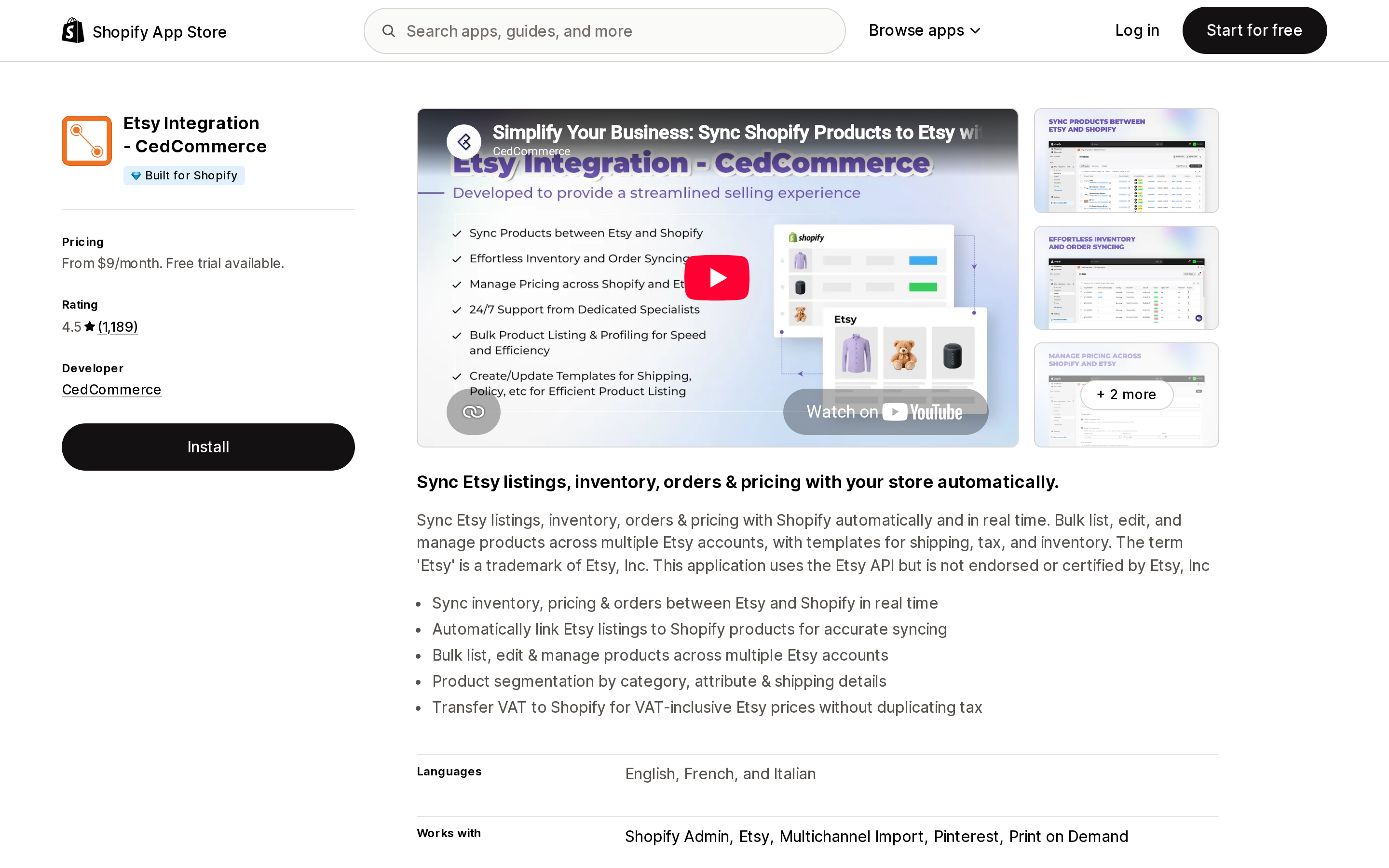
Source: Shopify App Store (Etsy Integration ‑ CedCommerce), retrieved September 2, 2026
Etsy Integration ‑ CedCommerce carries the Built for Shopify badge and shows a 4.5 rating from 1,189 reviews. It syncs Etsy listings, inventory, orders, and pricing in both directions, links existing Etsy listings to Shopify products automatically, and handles multiple Etsy accounts.
Plans are $9/month for 10 listed products and 1 account, $29/month for 200 products and 100 orders per month, and $59/month for the Growth tier at 1,000 products, 500 orders per month, 2 accounts, Etsy-to-Shopify inventory and fulfillment sync, and exporting Etsy reviews into Shopify. Each includes a 7-day free trial.
If Etsy is the only thing Marketplace Connect can't do for you, this is the smallest possible patch — a $9 to $59 line item next to a free app, rather than migrating four working channels. The 4.5 rating is the lowest of the five apps here, and the one-star reviews cluster on sync reliability and enterprise-tier expectations rather than on setup. Test sync behavior thoroughly during the trial if your Etsy catalog runs to tens of thousands of listings.
Which one you actually need
| Your situation | What to do |
|---|---|
| Amazon and eBay only, under 50 marketplace orders a month | Marketplace Connect, free. Nothing here beats it. |
| Amazon, eBay, Walmart, Target Plus, any volume | Marketplace Connect. The $99 cap is the cheapest ceiling in the category. |
| Adding TikTok Shop | Install the TikTok app alongside Marketplace Connect. Do not replace anything. |
| Starting Etsy from scratch | Etsy Integration ‑ CedCommerce next to Marketplace Connect, or LitCommerce to consolidate. |
| Etsy plus TikTok Shop plus the big four, one dashboard | LitCommerce. Budget setup time for variant-model mismatches. |
| Temu, Shein, Kaufland, OTTO, Mirakl, or eBay Motors fitment | M2E Multichannel Connect, after modeling the GMV overage. |
| Amazon is 80%+ of marketplace revenue and listings need work | CedCommerce Amazon Channel. |
| Variants split across warehouses, or attributes stored in Metaobject or Files metafields | Marketplace Connect will not map them. Evaluate a third-party app on that specific field. |
When the free app is the right answer
For a US merchant selling on Amazon, eBay, Walmart, and Target Plus, with marketplace attributes that fit inside the metafield types Marketplace Connect recognizes and no variant-level warehouse splits, there is no cost argument for replacing it. It is first-party, free below 50 synced orders a month, and never bills more than $99.
The reasons to add or switch are all coverage reasons: a channel Shopify doesn't connect, a channel Shopify has closed to new sellers, a data field Shopify doesn't map, or a fulfillment path Shopify blocks. Identify which one you're hitting before you shop, because two of the five apps above cost more than Marketplace Connect ever will.
One caveat: several recent reviews on the Marketplace Connect listing report sync interruptions on eBay and Walmart during August and September 2026. These are individual merchant reports, not a documented outage, and they cut across marketplaces and regions. If reliability rather than coverage is your reason for looking, verify current behavior on your own store before committing to a migration.
Sources
- Shopify Marketplace Connect app — Shopify Help Center
- Shopify Marketplace Connect app requirements — Shopify Help Center
- Marketplace Connect product listing requirements — Shopify Help Center
- Customize your product listings — Shopify Help Center
- Configuring inventory location for your products on Marketplace Connect — Shopify Help Center
- Fulfill your Marketplace Connect orders — Shopify Help Center
- What is Shopify Marketplace Connect? — Shopify Marketplace Connect Help Center
- Shopify Marketplace Connect — Shopify App Store
- TikTok — Shopify App Store
- LitCommerce eBay Etsy Amazon + — Shopify App Store
- M2E Multichannel Connect — Shopify App Store
- CedCommerce Amazon Channel — Shopify App Store
- Etsy Integration ‑ CedCommerce — Shopify App Store
Shop Pay Installments is free to activate, needs no app, and Shopify never publishes what it costs you — the rate is visible only inside your own admin. It also refuses Capital One and Chase credit cards, restricts monthly plans to debit cards only, excludes gift cards and subscriptions, and can't be turned off for individual products. Affirm can suspend your account for being password-protected, for having a non-English storefront, or for being primarily B2B. And Shopify's Getting paid page says disputes appear in your admin while its FAQ says they don't. If you fail the eligibility gates, the alternative is on-site messaging apps from Klarna, Afterpay, Sezzle, Zip, and PayPal — a category rated between 1.0 and 3.2 stars. Researched September 2, 2026.