
What you will learn
On this pageContentsCloseOpen
Open the Google & YouTube listing on the Shopify App Store and read the developer line. It says Google LLC. Shopify's own Help Center is equally blunt: "The Google & YouTube sales channel is managed by Google." Shopify supports installation and product setup; Merchant Center and Google Ads problems go to Google.
The same holds one platform over. Microsoft Channel is published by Microsoft, live since September 30, 2019; Pinterest by PINTEREST inc; Snapchat Ads by Snap Ads. Facebook & Instagram and TikTok round out the set. Every one is free to install, with ad spend billed by the platform. Shopify documents Facebook and Instagram by Meta as "free to use with all Shopify plans, subject to store eligibility"; the Google & YouTube channel carries its own country and currency eligibility rules.
So "I need a paid feed app because Shopify has no Bing integration" is false. Reach is not the wall. The wall is what happens the moment you want to change something: Shopify's product CSV carries Google Shopping columns for Custom Label 0 through 4, MPN, Gender, Age Group, Condition and Custom Product, and Shopify's own documentation says "the Google and YouTube channel doesn't use these metafields."
This article compares eight feed apps on three axes: monthly cost in USD and the unit it is metered in, field-level control, and named destinations beyond Google. All of it was verified on the Shopify App Store, US English listings, on September 3, 2026.
Shopify distributes these channels. The ad platforms build them.
All four below are free to install. None carries the Built for Shopify badge.
| Free channel | Publisher | Rating (reviews) | On the App Store since |
|---|---|---|---|
| Google & YouTube | Google LLC | 4.5 (5,168) | Nov 28, 2017 |
| Microsoft Channel | Microsoft | 3.1 (324) | Sep 30, 2019 |
| PINTEREST inc | 4.2 (1,628) | Feb 18, 2020 | |
| Snapchat Ads | Snap Ads | 4.6 (671) | Nov 20, 2018 |
Google & YouTube
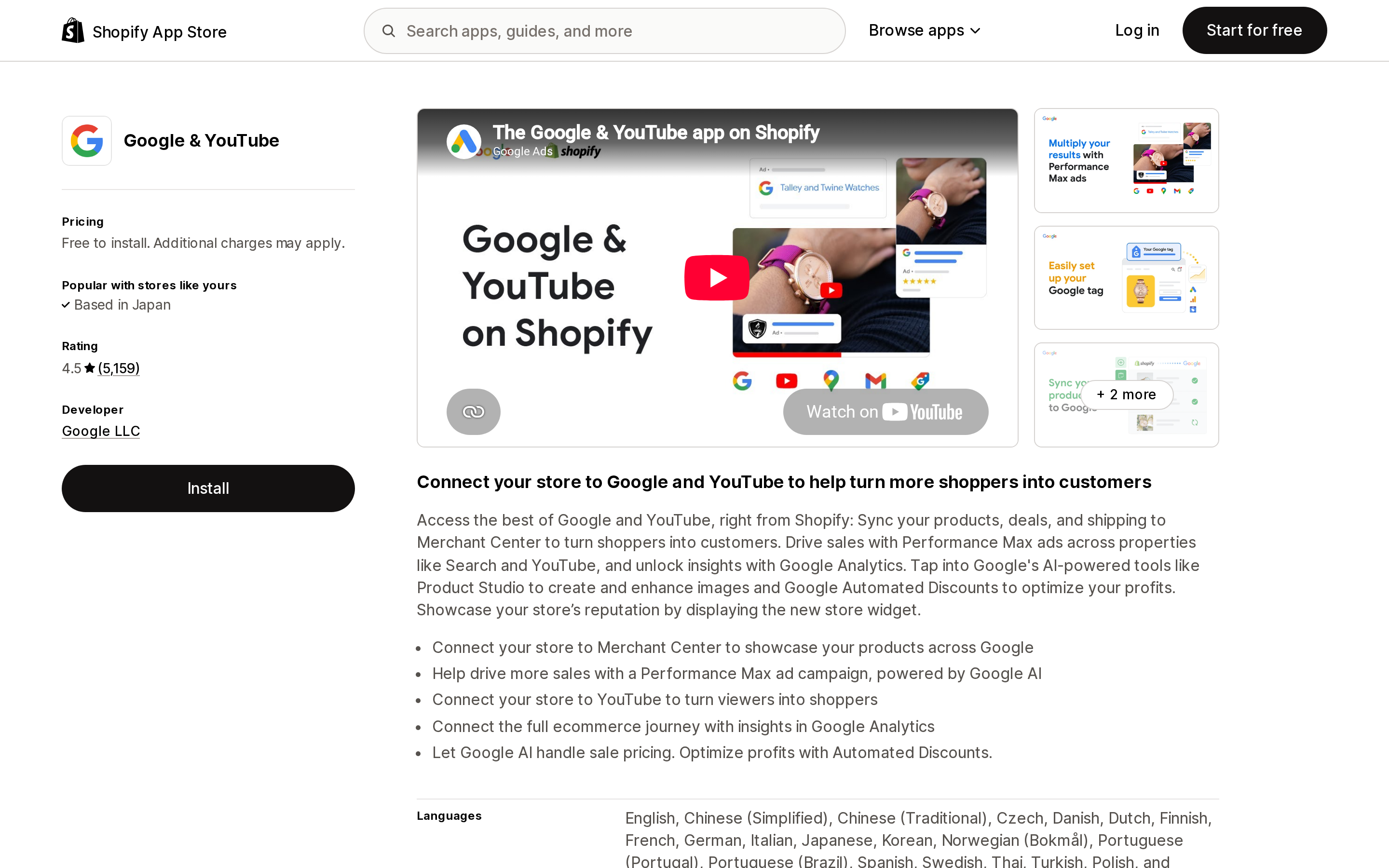
Source: Shopify App Store (Google & YouTube), retrieved September 3, 2026
It auto-syncs every product available to your Online Store into Google Merchant Center and refreshes inside Google's 30-day expiry window so listings do not lapse. Google Product Category and GTIN come from your product data, GTIN read from the variant Barcode field, and brand plus MPN can be added inside the channel for products with no barcode. Shopify also documents optimizing product titles and descriptions for Google Shopping listings from inside the channel. Discounts publish as Google promotions. For a single-country store with a clean catalog, that is enough.
Microsoft Channel
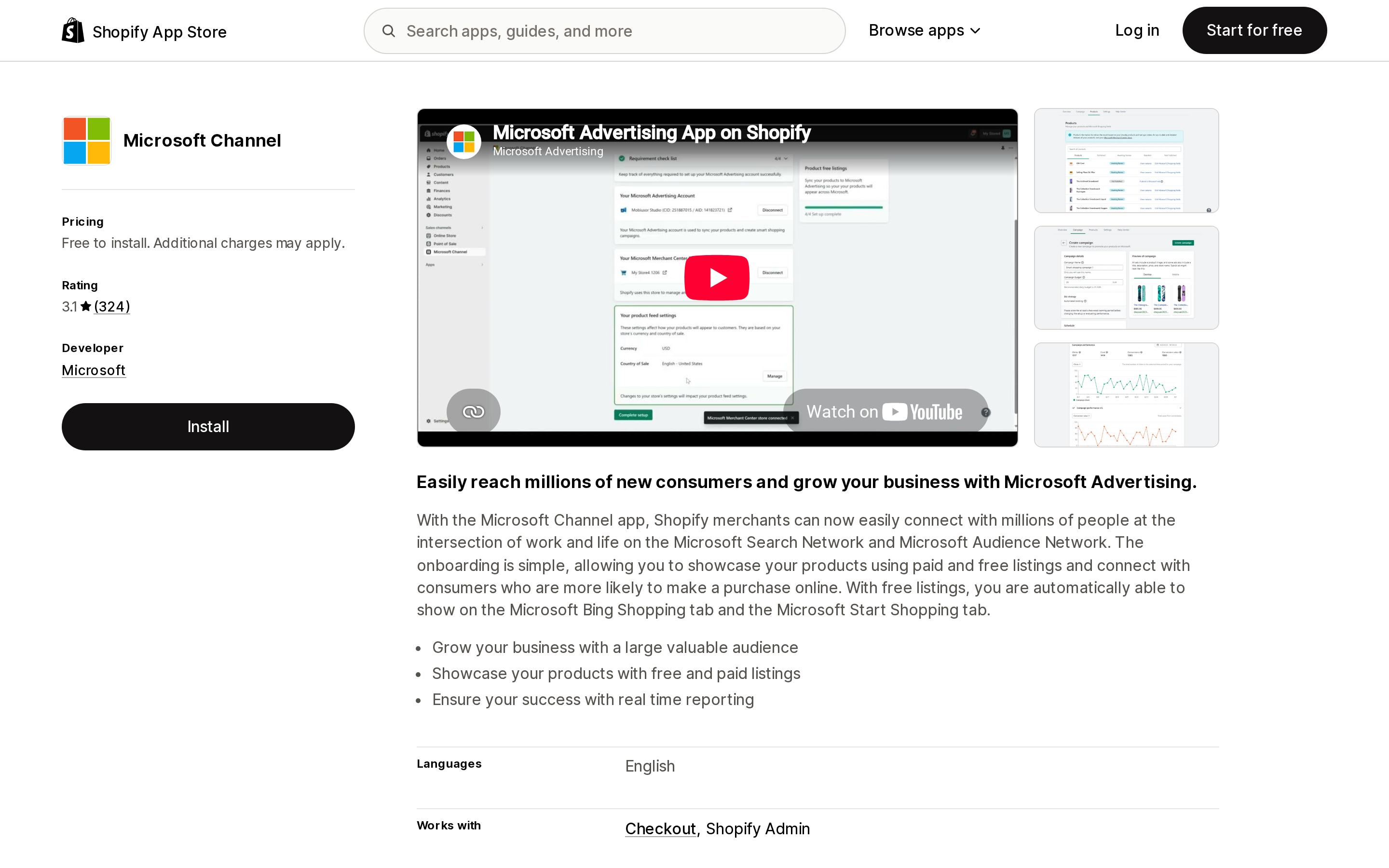
Source: Shopify App Store (Microsoft Channel), retrieved September 3, 2026
Its rating distribution is bimodal: 57 percent five-star and 26 percent one-star across 324 reviews, with recent negatives clustering on account suspension shortly after creation and identity-verification failures. Its App Store category is Ads, not Product feeds, and the listing states no SKU limits, refresh frequency, custom labels or exclusion rules.
What the native channels will not do
Editing inside the Google & YouTube channel is possible, but narrow. Shopify documents adding brand and MPN for products without a GTIN, setting a Google Product Category, adding unit pricing, and optimizing titles and descriptions for Google Shopping listings. Beyond that, the documentation is silent — and silence is what costs you.
The Google Shopping CSV columns are inert. Filling in Custom Label 0 through 4, MPN, Gender, Age Group, Condition or Custom Product does nothing unless an app reads them. If you have ever typed bestseller into Custom Label 0 and waited to bid on it in Google Ads, this is why nothing happened.
There is no native XML or TXT feed. Shopify's only product export is CSV, framed as a tool for backing up products, moving them to a new store and bulk-editing them, downloaded or emailed — no hosted, auto-refreshing feed URL to hand to a third party. The ProductFeed object in the Admin GraphQL API is not a substitute: it is publication-scoped plumbing whose only fields are an ID, a channel ID, country, language and status, and it exposes no file or feed URL.
No documented rule-based exclusion. Product selection is per-product availability toggling; "exclude everything out of stock, under $15, or from this vendor" is not expressible in the documented workflow. Shopify's Google & YouTube documentation describes no custom labels and no supplemental feeds, and each channel takes one catalog — no second, differently shaped feed for a different campaign structure.
Then the operational traps, quoted from Shopify's Help Center. "You can't use the Google & YouTube channel to sync your products when you have a multi-client account on Google Merchant Center." Connecting an existing Merchant Center account replaces any product feed already set up there — "it's overwritten to avoid conflicts." Only General shipping profile rates sync; custom profiles "will sync incorrectly." And product options, including variants, "need to be in English to sync with Google."
One thing Shopify did fix, in June 2026
Do not repeat the older advice that multi-market feeds are impossible natively. On June 17, 2026, Shopify shipped Channel Markets: channels became a market type in Shopify Markets, so you can assign a catalog per channel with channel-specific price, availability and currency, and the changelog states they "are now available to all merchants using Markets." That closes the multi-currency half at the catalog level. It does not add custom labels, rule-based exclusions or a second feed per channel.
The line where a feed app starts earning its price
If you sell in one country, run Google, Meta, Pinterest, Microsoft, Snapchat and TikTok, and your catalog syncs without errors, install the free channels and stop reading. You do not need an app.
You cross into app territory the moment any one of these is true: you need custom_label_0 through custom_label_4 for bid segmentation, rule-driven title or description rewrites at scale, rule-based exclusions, MPN mapped in bulk rather than product by product, more than one feed per platform, Criteo or an affiliate network, an existing multi-client Merchant Center structure, or custom shipping profiles.
Eight feed apps, three axes
| App | Starting price (USD) | Pricing unit | Free plan | Custom labels | Named destinations beyond Google | Built for Shopify |
|---|---|---|---|---|---|---|
| Simprosys Google Shopping Feed | $4.99/month | Products | No | Yes | Microsoft Advertising, Meta, Pinterest | No |
| Nabu for Google Shopping Feed | $39.99/month | Products + orders | Yes (100 products, 10 orders) | Not tagged | Generic XML marketplaces | Yes |
| Data Feed Watch Shopping Feeds | $64/month | SKUs + channels | No | Yes | Bing, Pinterest, Meta, TikTok, Criteo, Snapchat, Awin, Rakuten | No |
| Multifeed Google Shopping Feed | $5.95/month | Products | Yes (10 products) | Yes | Meta, TikTok; raw XML/TSV/CSV/JSON for custom platforms | Yes |
| FeedHub: Google Shopping Feed | $9.90/month | Variants | Yes (50 variants) | Yes | Meta, TikTok Shop | Yes |
| SCA ‑ Product Feed Manager | $6.99/month | Products | No | Not tagged | Microsoft and Bing Ads, Meta, Pinterest, TikTok, Amazon | No |
| Ced Google Shopping Feed & Ads | $13/month | SKUs | Yes (50 SKUs) | Not tagged | None | No |
| Omega Facebook Pixel, Meta Ads | $20.99/month | Shopify plan tier | Yes (1 feed) | Yes | Meta only | Yes |
One note on permissions: the App Store renders a Data access section on some of these listings and not others. On September 3, 2026 it appeared on three of the eight — Nabu, FeedHub and Omega. Where it did not appear, data access is simply not published on that listing; that is not evidence the app requests nothing.
Simprosys Google Shopping Feed
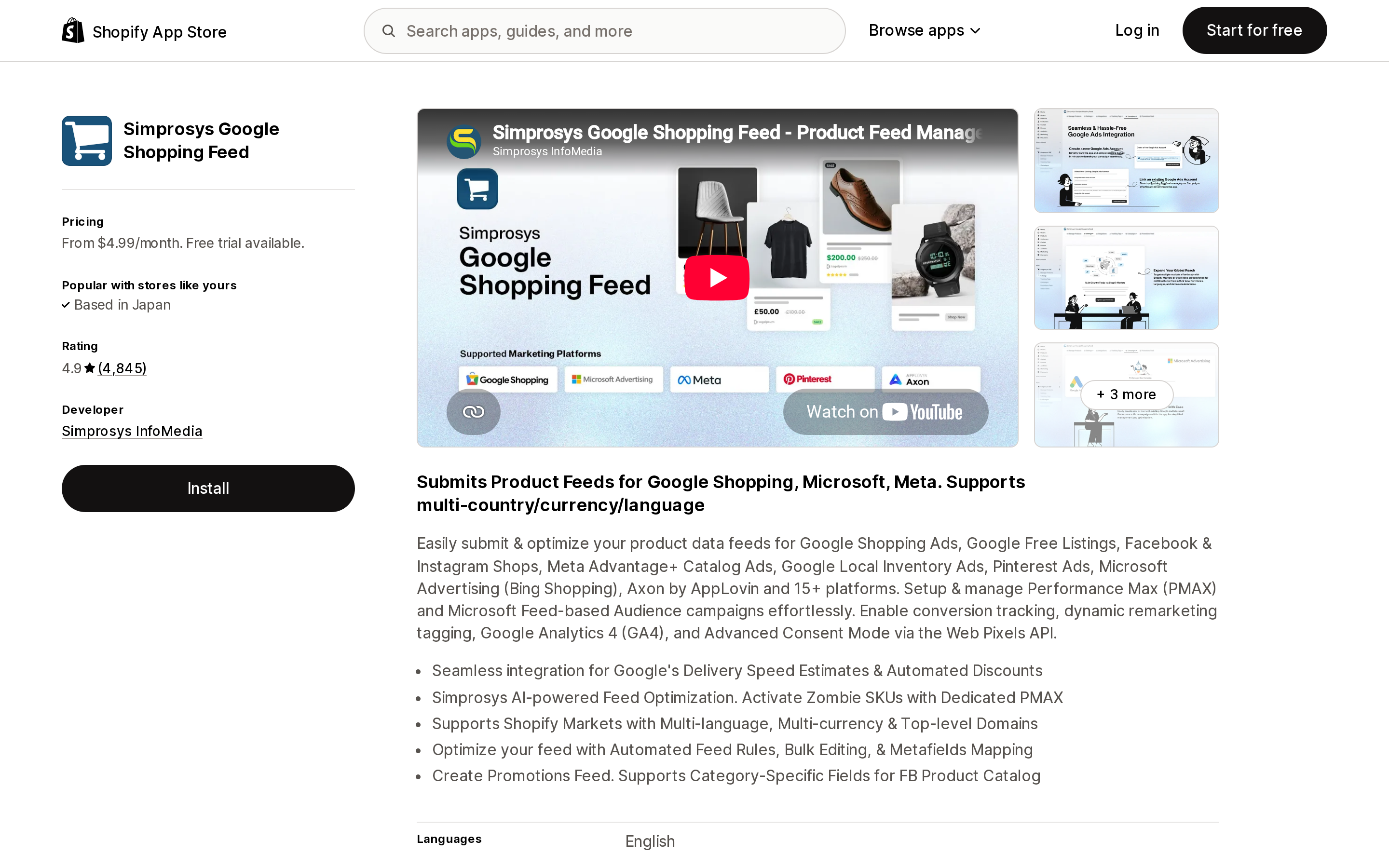
Source: Shopify App Store (Simprosys Google Shopping Feed), retrieved September 3, 2026
Rated 4.9 across 4,845 reviews, the largest review base of the eight by roughly five times the next biggest. Pricing runs $4.99/month up to 500 products, $8.99 to 1,000, $13.99 to 5,000 and $17.99 to 10,000, with a 21-day trial and no free plan. Above 10,000 products no price is published — you must contact support to budget. Every tier includes three multi-currency, multi-language or multi-country Markets feeds; further Markets feeds and XML output are metered add-ons. Custom labels are tagged; MPN mapping and a named title-rewrite rule are not stated on the listing. One reviewer notes that because submission runs through the Content API, Microsoft Merchant Center shows no feed URL at all.
Nabu for Google Shopping Feed
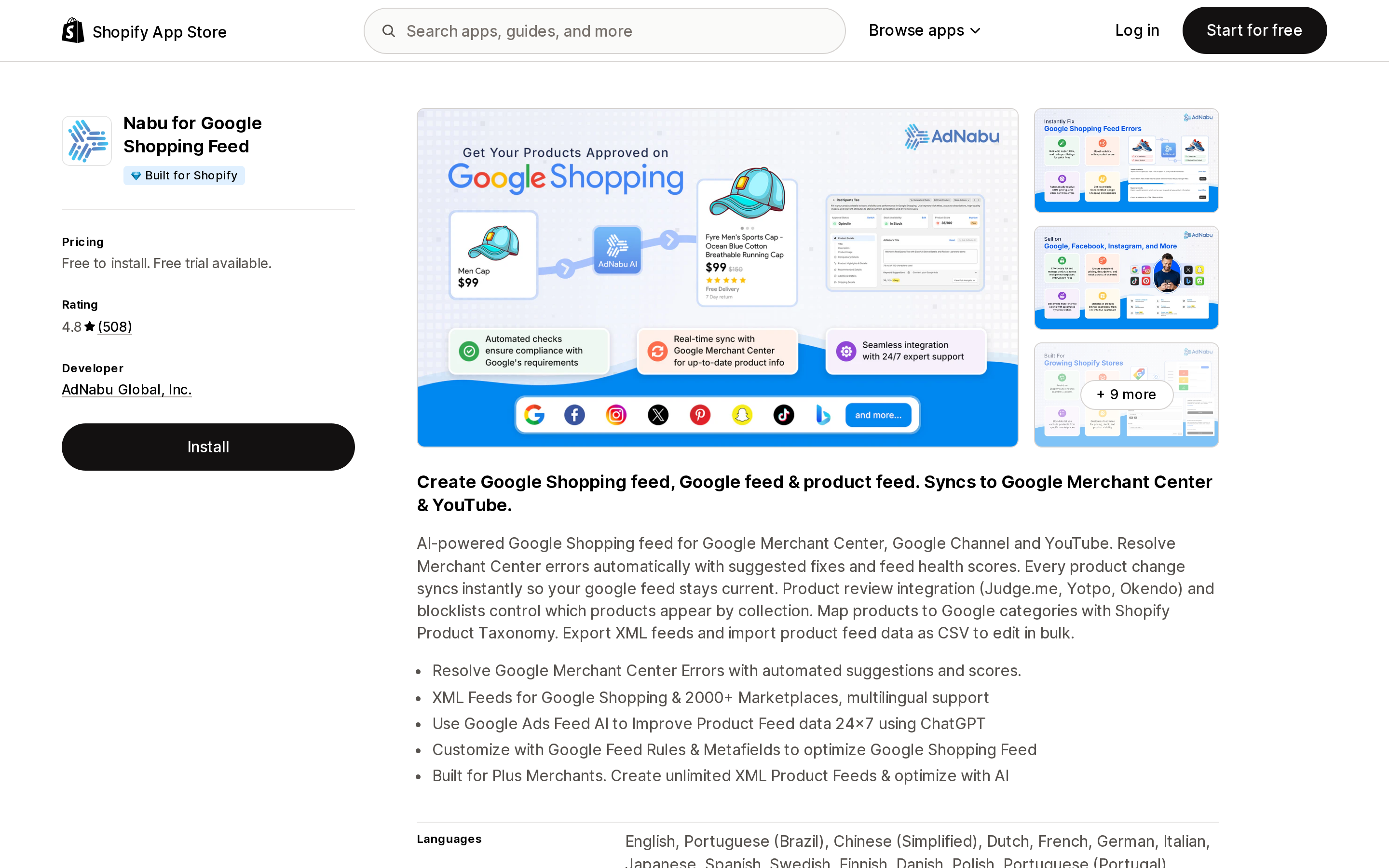
Source: Shopify App Store (Nabu for Google Shopping Feed), retrieved September 3, 2026
Built for Shopify, 4.8 across 508 reviews, developer incorporated in Newark, Delaware. Explorer is free for up to 100 products and 10 orders per month, then $19.99/month above 10 orders; Grow is $39.99/month for unlimited products, Advanced $99.99, Plus $249.99. Refresh frequency is plan-gated: hourly sync starts at Advanced, instant sync only at Plus. Exclusion works through blocklists by collection, capped at 10 below the top tier alongside 5 feed rules. It pulls review stars from Judge.me, Loox.io, Okendo and Yotpo into the feed, and names Shopify Flow in its Works with list. Custom labels are not among its feature tags — if bid segmentation is your reason for buying, confirm with the vendor first.
Data Feed Watch Shopping Feeds
Source: Shopify App Store (Data Feed Watch Shopping Feeds), retrieved September 3, 2026
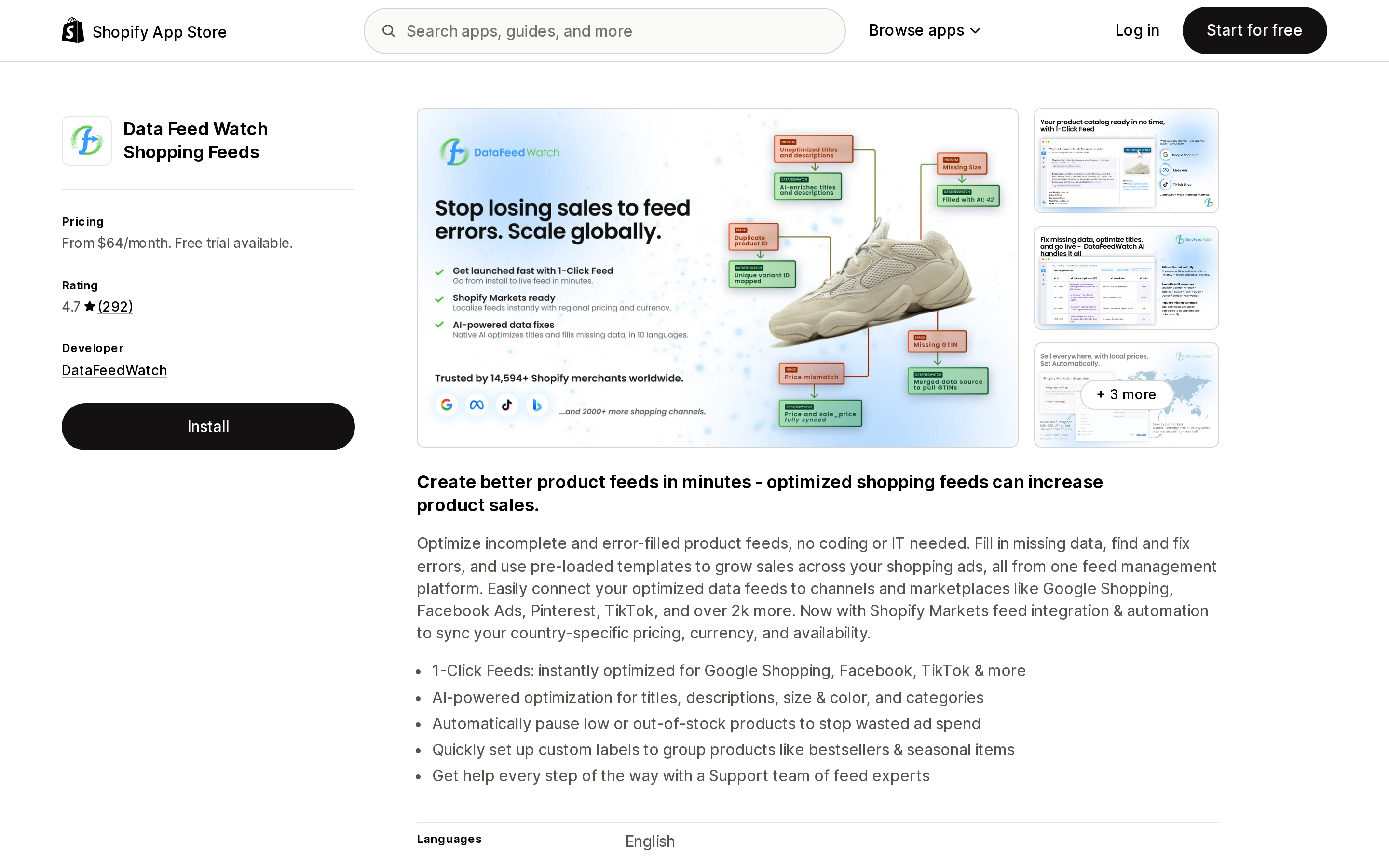
The oldest app here, live since April 12, 2013, rated 4.7 across 294 reviews. Of the eight apps checked in this article, it is the only one whose Works with list names Criteo, Snapchat, Awin or Rakuten. It lists Custom CSV, XML, TXT and JSON output for destinations with no named integration — Multifeed offers a comparable raw-file escape hatch, so treat this as one of two rather than a unique feature. It also makes the clearest field-control claims of the eight: AI-powered optimization for titles, descriptions, size, color and categories, automatic pausing of low or out-of-stock products, and custom labels. It is also the highest entry point of the eight at $64/month for 1,000 SKUs and three channels, rising through $84, $239 and $599 (100,000 SKUs, unlimited channels) — watch the channel counter, not just the SKU counter. Its refresh unit is one, two or five automatic daily shop updates by tier: full store re-reads per day, not an interval.
Multifeed Google Shopping Feed
Source: Shopify App Store (Multifeed Google Shopping Feed), retrieved September 3, 2026
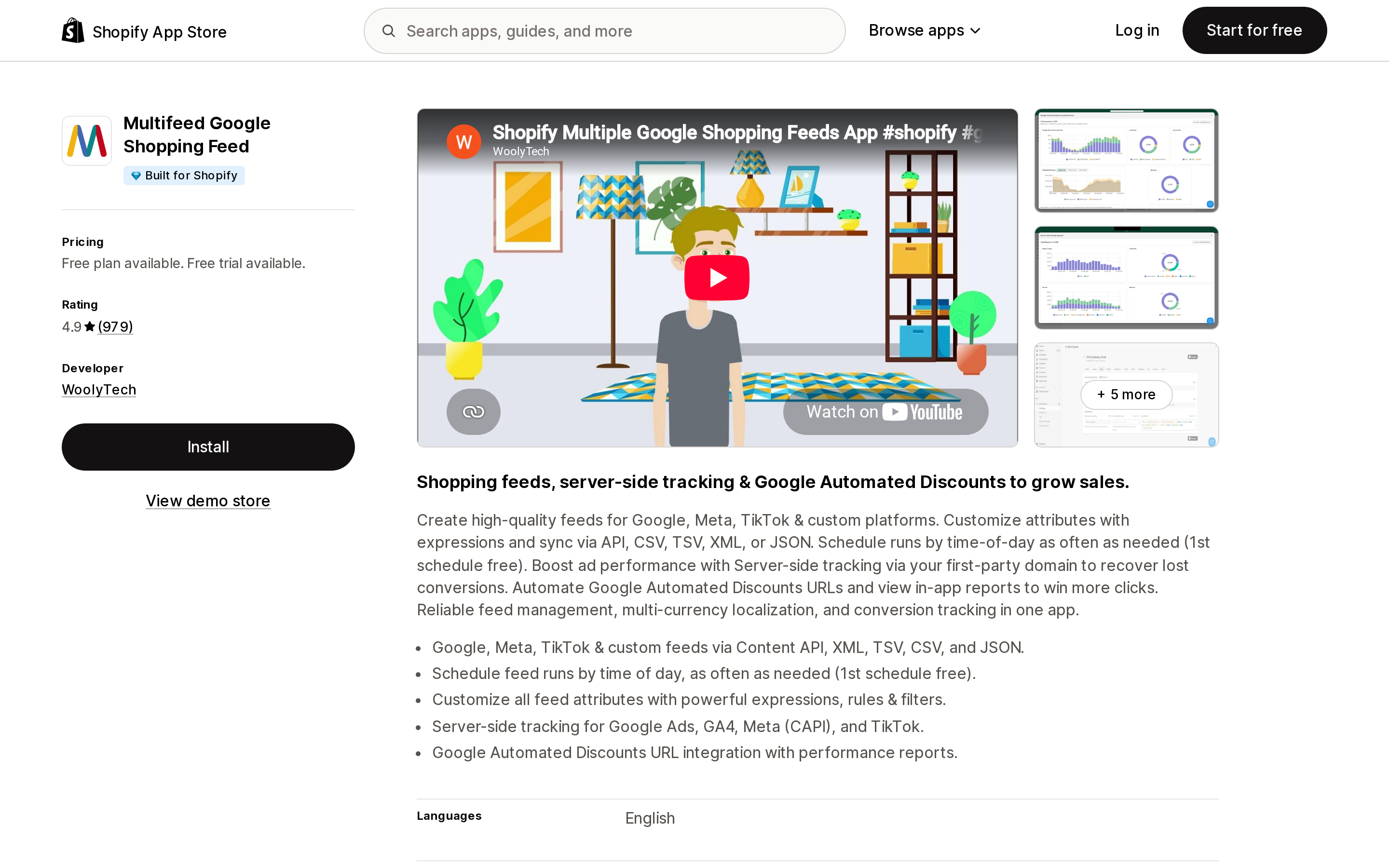
Built for Shopify, 4.9 across 979 reviews, developer based in Sheridan, Wyoming. The transformation specialist: several recent reviews praise its feed customization, one describing reshaping almost any field without touching Shopify products, with one-click undo. Multiple feeds are a first-class concept, metered at 2, 4 and 6 across the $5.95, $15.95 and $25.95 tiers, which directly answers the native one-catalog-per-channel limit. The free tier includes the expression engine, Content API, XML, TSV and CSV output and foreign-currency feeds, but caps at 10 products — a demo, not a running plan. Named destinations are Google, Meta, TikTok and "custom platforms" via raw file output. Microsoft, Bing, Snapchat, Criteo and affiliate networks are not mentioned, Pinterest appears only as a tracking tag, and MPN is not stated.
FeedHub: Google Shopping Feed
Source: Shopify App Store (FeedHub: Google Shopping Feed), retrieved September 3, 2026
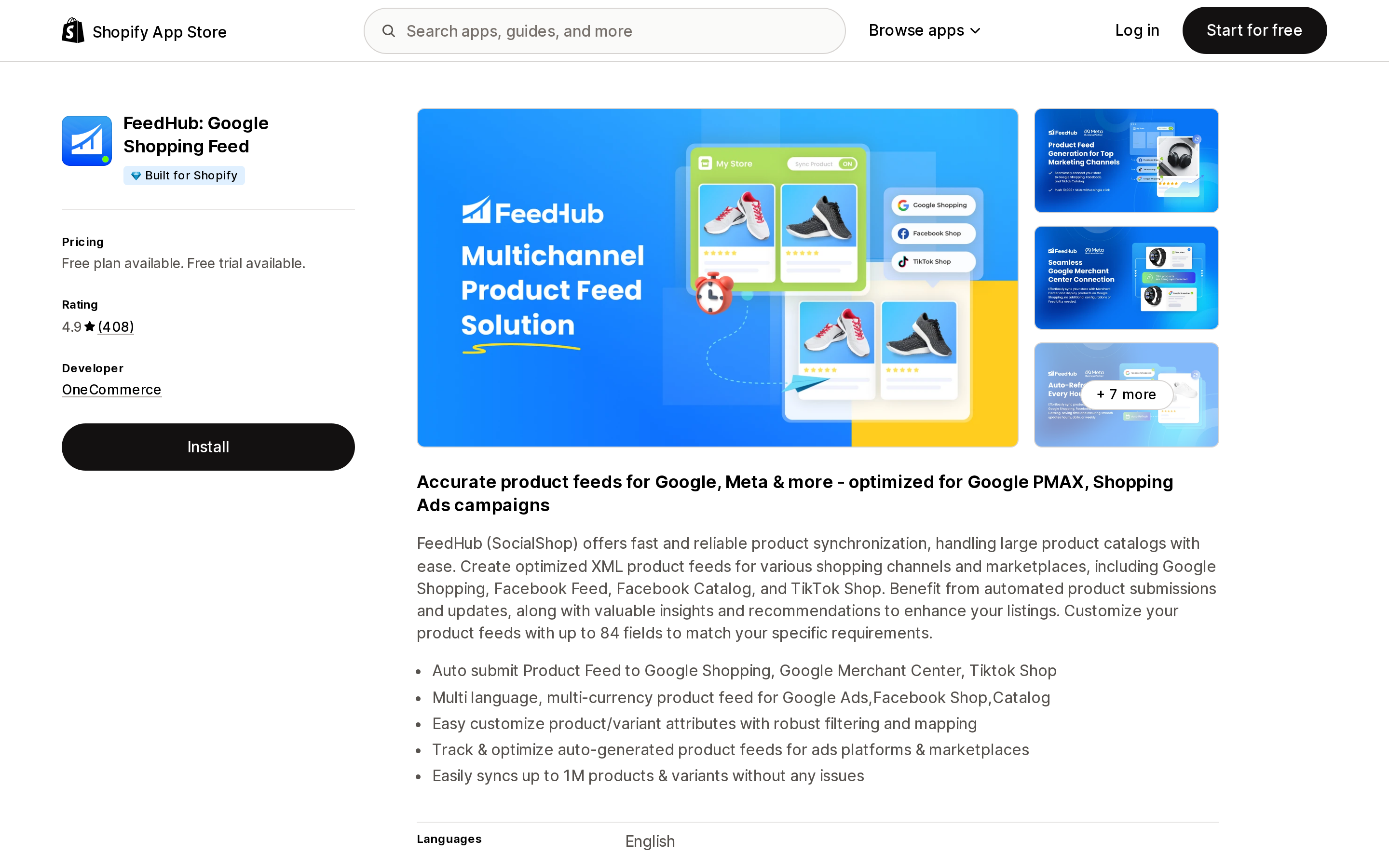
Built for Shopify, 4.9 across 408 reviews, with the most specific field-mapping claim of the eight at up to 84 fields. The critical caveat: its plan limits are counted in variants, not products. Starter is free at 50 variants and one feed with daily or weekly sync only; Standard is $9.90/month at 500 variants and adds hourly sync; Professional is $29.90 at 5,000 variants, Advanced $49.90 at 10,000. An apparel store with 500 products in a size-by-color matrix is not a $9.90 customer. Destinations are Google, Meta and TikTok Shop only. Its negative tail is small and old: all three one-star reviews predate 2025, and the most recent of them, from December 2024, is a one-line complaint that products would not sync.
SCA ‑ Product Feed Manager
Source: Shopify App Store (SCA ‑ Product Feed Manager), retrieved September 3, 2026
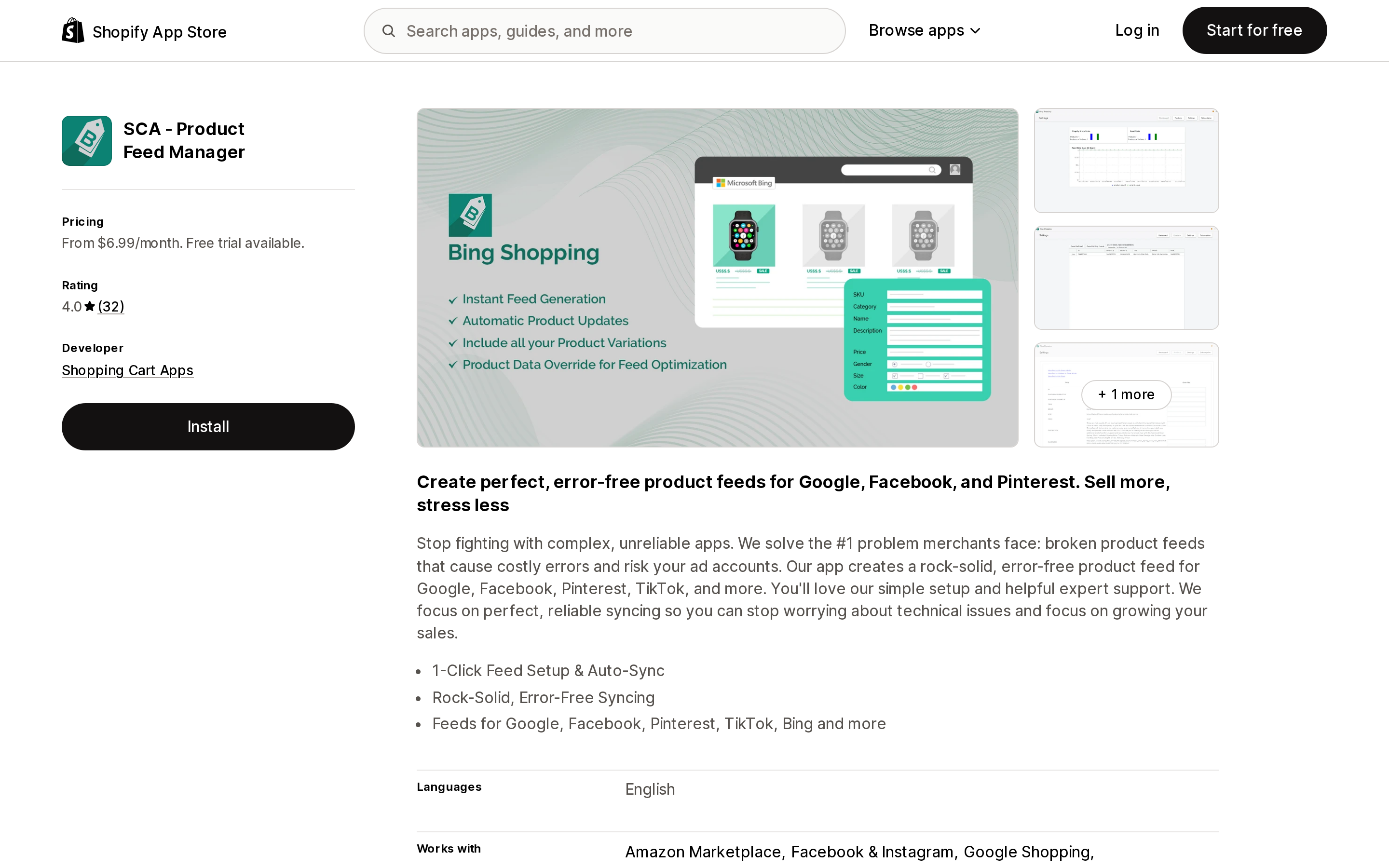
Interesting on price, thin on evidence. It names Microsoft and Bing Ads alongside Google, Meta, Pinterest, TikTok and Amazon from $6.99/month for 1,000 products, and $24.99/month buys 100,000 — against $599 at Data Feed Watch for the same SKU count, though Ced undercuts both at $13. But it has collected only 33 reviews in ten years, rated 4.0, with 21 percent one-star, a single two-star and no three- or four-star ratings at all. The visible reviews span an eight-year gap; the recent ones concern a billing complaint and a UI returning an internal error. There is no free plan, and custom labels, rule-based exclusion, title rewriting and GTIN or MPN mapping are not stated on the listing; neither is data access.
Ced Google Shopping Feed & Ads
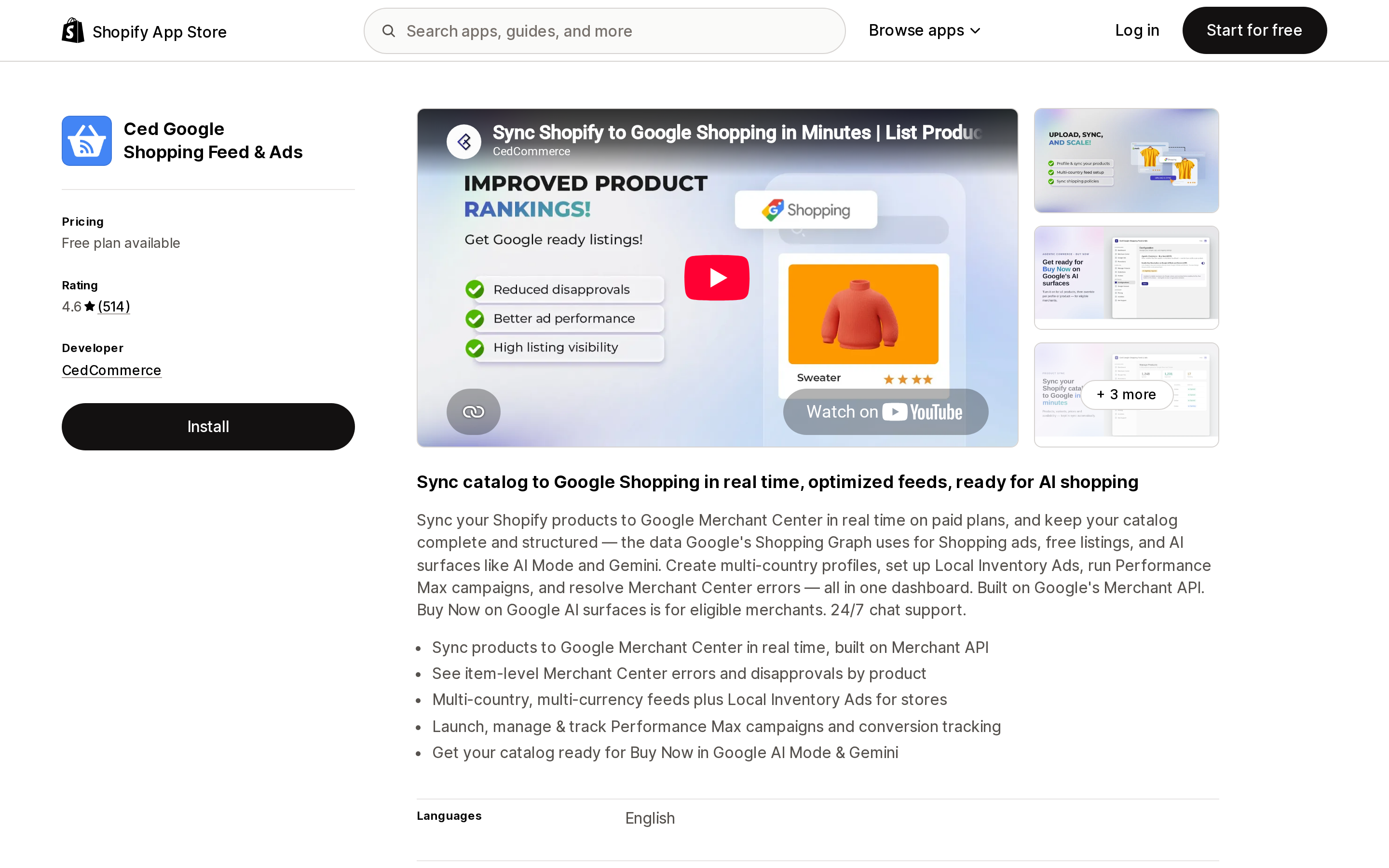
Source: Shopify App Store (Ced Google Shopping Feed & Ads), retrieved September 3, 2026
Google-only; the listing names no other destination. Rated 4.6 across 516 reviews. The free tier manages up to 50 SKUs with hourly sync, one custom profile and one target country. Growth at $13/month jumps to 100,000 SKUs with real-time syncing, multi-country profiles and unlimited Performance Max campaigns; Accelerate at $49 removes the SKU cap. That $13 step is the steepest capacity-per-dollar move here. No free trial is stated on the paid plans, and custom labels and GTIN management are not among its feature tags. Its most recent visible review is a serious complaint about feeds never being approved and support going quiet after payment.
Omega Facebook Pixel, Meta Ads
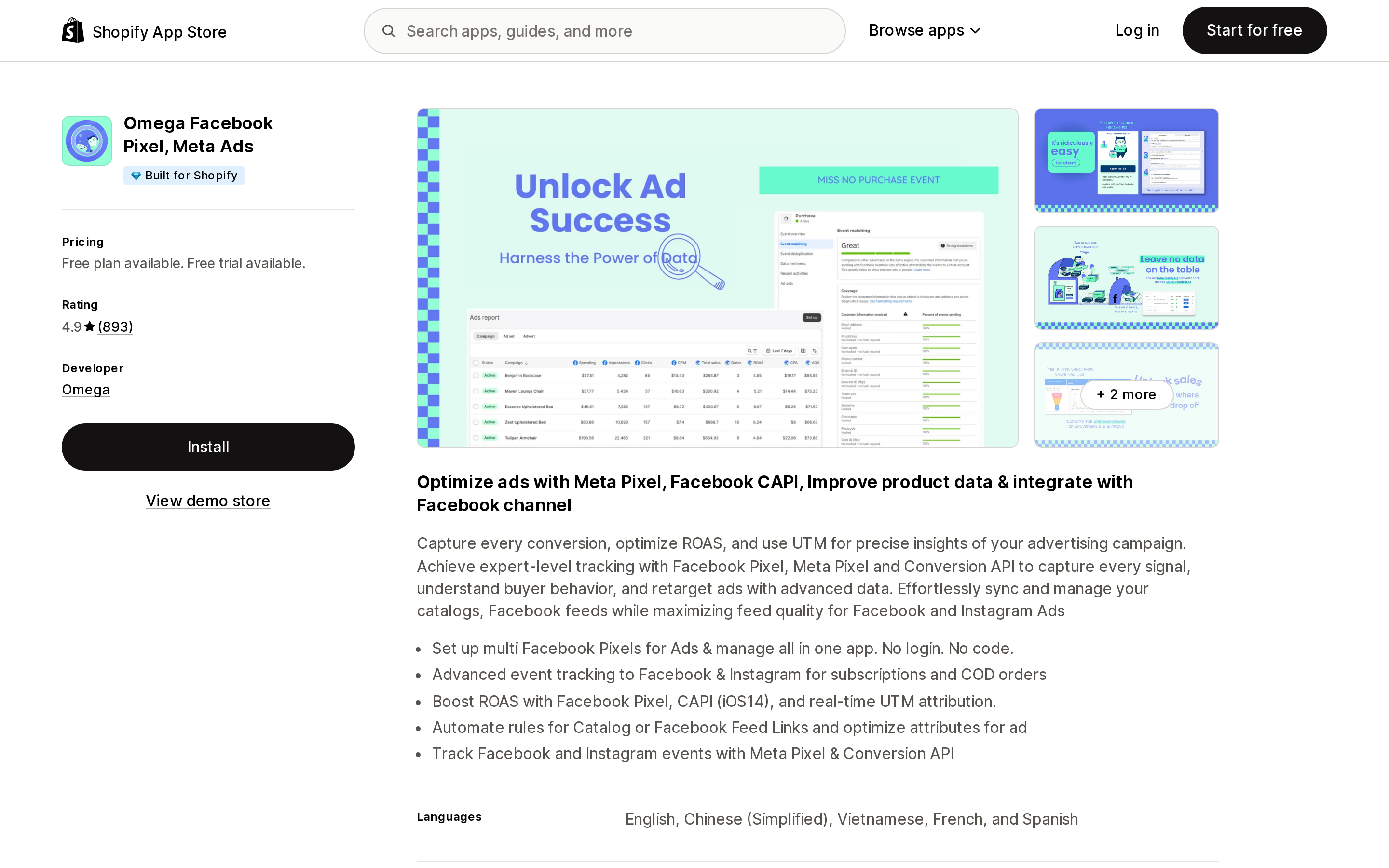
Source: Shopify App Store (Omega Facebook Pixel, Meta Ads), retrieved September 3, 2026
The Meta specialist rather than a general feed tool. Built for Shopify, 4.9 across 893 reviews. It combines Meta catalog feeds with Pixel and Conversions API in one install, and tags custom labels and custom rules, which the free Facebook & Instagram channel does not offer. The free tier gives one pixel, one Conversions API and one catalog feed at five orders per month. Paid tiers are $20.99, $35.99 and $45.99, named after Shopify plan tiers with identical listed features — you pay more because your Shopify plan is larger, not because the app does more. Extra Conversions APIs are $5.99/month each, and catalog charges scale with product count at an unpublished rate. Of the three apps here that publish a Data access section, its scope is the broadest: sensitive customer data, browsing behavior, script tags and theme edits, and edit access to 60 days of order history.
Feedonomics is a quote, not an install
Shopify acquired Feedonomics in 2022, and merchants reasonably ask whether it is simply available to them. It is not distributed through the Shopify App Store — no listing resolves at its expected slugs. Its own Shopify page has no install path, only a demo request, and is headlined "Your full-service product feed management solution for Shopify." Pricing is quote-only: "Pricing varies by SKU count, channel type, number of channels, and service level, and we never take a percentage of revenue."
The gate is commercial, not plan-based. Nothing on the Feedonomics side ties access to a Shopify plan tier, and Shopify's own Enterprise page does not mention Feedonomics at all — so do not assume you are excluded because of your plan, or included because of it.
Picking one
Google plus Microsoft Advertising plus Meta plus Pinterest under 10,000 products: Simprosys, $4.99 to $17.99/month. Criteo, Snapchat, Awin or Rakuten: Data Feed Watch, from $64/month. Transformation rather than reach: Multifeed, from $5.95/month. Meta only: Omega. Google-only with a large catalog and a tight budget: Ced, $13/month for 100,000 SKUs, without custom labels. Built for Shopify with Shopify Flow: Nabu, free to start under 10 orders a month, but verify custom-label support first. Low-variant catalog: FeedHub, $9.90/month.
Ratings, review counts and pricing on the App Store move constantly. Every figure here was read on September 3, 2026; re-check before you commit.
Sources
- https://help.shopify.com/en/manual/online-sales-channels/marketplaces/google
- https://help.shopify.com/en/manual/online-sales-channels/marketplaces/google/requirements
- https://help.shopify.com/en/manual/online-sales-channels/marketplaces/google/getting-setup/syncing-products
- https://help.shopify.com/en/manual/online-sales-channels/social-commerce/facebook-instagram-by-meta
- https://help.shopify.com/en/manual/products/import-export
- https://help.shopify.com/en/manual/products/import-export/using-csv
- https://help.shopify.com/en/manual/products/import-export/export-products
- https://shopify.dev/docs/api/admin-graphql/latest/objects/ProductFeed
- https://changelog.shopify.com/posts/set-channel-specific-prices-availability-and-currency-with-markets
- https://www.shopify.com/enterprise
- https://apps.shopify.com/google
- https://apps.shopify.com/microsoft-advertising
- https://apps.shopify.com/pinterest
- https://apps.shopify.com/snapchat-ads
- https://apps.shopify.com/google-shopping-feed
- https://apps.shopify.com/google-shopping-feed-2
- https://apps.shopify.com/datafeedwatch
- https://apps.shopify.com/multiple-google-shopping-feeds
- https://apps.shopify.com/feedhub-for-google-shopping
- https://apps.shopify.com/bing-shopping
- https://apps.shopify.com/google-express-integration
- https://apps.shopify.com/facebook-multi-pixels
- https://feedonomics.com/pricing/
- https://feedonomics.com/integrations/platforms/shopify/
The Customer object has no date-of-birth field, but Shopify ships a standard metafield definition named Birth date with the reserved key facts.birth_date, a customer segment function anniversary('metafields.facts.birth_date') that ignores the year, and a Celebrate customer birthday automation in Shopify Messaging. The native chain works end to end — storage, segment, send. What it does not solve is collection: Shopify Forms writes to a metafield you configure, the Plus-only Checkout Blocks Birthday template writes to an order metafield and, per Shopify's own note, does not apply it to the customer profile, and letting customers edit their own birth date in new customer accounts needs an extension or an app. Five real apps compared with USD pricing. Researched September 3, 2026.