
What you will learn
On this pageContentsCloseOpen
You decide to launch a refer-a-friend program. You open the Shopify admin, and you go looking for it.
It isn't there. Shopify's own documentation lists exactly four native tools for reaching new customers: Shopify Collabs, Shopify Audiences (Plus only), Shop Campaigns, and SEO tools. A program where your existing customers refer their friends is not among them.
That sends most merchants to the App Store, where the category is called "Affiliate programs," the top listings all say "referral" in their titles, and the pricing pages use three different meters that produce wildly different bills for the same program. This article establishes where the native boundary sits, explains why the referral-versus-affiliate blur costs merchants money, and works out the exact arithmetic on when each plan stops being the cheap one.
Research date: September 2, 2026. All prices are USD from the English App Store listings.
The short version
- Shopify has no native customer referral program. Shopify Collabs is affiliate and creator marketing, it charges a 2.9% processing fee on automatic commission payments, and it is not accepting new creator signups.
- You cannot hand-roll a real referral program with discount codes and Shopify Flow. You can build the reward. You cannot build the attribution — a shareable discount link carries a code, not an identity.
- Referral apps meter on three incompatible things: a percentage of referral revenue, your total monthly order count, or a flat feature tier.
- On Referral Candy & Affiliate, the $39 Basic plan stops being the cheapest plan at $571.43 of monthly referral revenue. At a $60 average order value, that is about ten referral orders a month.
- On Smile: Loyalty Program Rewards, the order limit counts every order your store takes, not the referred ones. Above 2,500 orders the marginal rate is $0.20 per order — higher than the average cost per order on any tier below it.
- Fraud control is not standard. It is named on the free plan of one app in this comparison and gated behind a paid tier on three others.
What Shopify actually gives you
Four native pieces are close enough to a referral program to be worth ruling out precisely.
Discount codes. You get percentage, fixed amount, free shipping, and Buy X Get Y, with per-code usage caps and a "limit to one per customer" setting tracked by email or phone. But codes are created one at a time in the admin, there is no native bulk unique-code generator, and Shopify caps you at five discount codes per order.
Shareable discount links and QR codes. The /discount/CODE link auto-applies to the cart and persists in the browser. This is Shopify's only native share primitive, and it carries a code, not a referrer. Two customers sharing the same link are indistinguishable to your reporting.
Store credit. Native since 2024, and the obvious referral reward — but it comes with constraints. Only the full balance can be applied at checkout, there is a $15,000 per-customer ceiling, it does not work on legacy customer accounts, and for stores created on or after May 12, 2025, third-party transaction fees apply to the store-credit portion of an order unless you are on Plus with Shopify Payments.
Shopify Flow. Free on Basic and above. Flow can react to an order and issue a reward. It cannot work out who referred that order.
Where the DIY version breaks
You can build a crude program: mint a discount code per referrer, share it, and use Flow to issue store credit when an order using that code lands. It fails in four places, and all four arrive at once.
- Attribution. To attribute, you need one unique code per referrer, created by hand, one at a time. At 200 referrers that is 200 manually created discounts.
- Double-sided rewards. Native tooling rewards the friend, because the code discounts their order. Rewarding the referrer requires knowing who they are, which brings you back to problem one.
- Fraud. "Limit to one per customer" tracks email and phone. It does not catch the same person on a second email address, a self-referral from the same device or shipping address, or a code posted to a coupon aggregator.
- The referrer's view. There is no native place for a customer to see their link, their pending rewards, or how many friends have converted.
The uncomfortable part is that none of these matter during a 20-referrer pilot and all of them matter the moment the program works.
Referral is not affiliate, and the category hides it
The App Store files both under "Affiliate programs." Six of the seven apps we examined carry the identical Referrals and Affiliate programs feature tags. The tags are the same. The merchant problem is not.
| Referral (refer-a-friend) | Affiliate / creator | |
|---|---|---|
| Who promotes | Existing customers | Recruited publishers and influencers |
| Volume per person | One to three in a lifetime | Ongoing, unbounded |
| Reward form | Small, double-sided: store credit, points, $10 off | Percentage commission, in cash |
| Infrastructure needed | Share widget, fraud checks, email automation | Partner portal, tiered commissions, payouts, tax forms |
| Main failure mode | Self-referral, sock-puppet emails, code leakage | Coupon leaking, brand bidding, disputed commissions |
The cost of the blur runs both ways. A merchant who wants a $10-off-for-both widget searches "affiliate program," lands on an app metered as a percentage of referral revenue, and buys payout and tax machinery they will never use — at a price that grows with success. A merchant who genuinely wants creators installs a loyalty app whose referral module has no payouts at all.
The paperwork difference is real. Shopify's own Collabs documentation notes that US merchants can collect W9s, that creators who do not submit one are capped at $599.99 per year in payouts, and that merchants "might be required to issue them a Form 1099." Cash commission payouts create a payer-side paperwork surface. Store credit and points rewards largely avoid it, because no cash leaves the business. Anything more specific than that is a question for your accountant, not a blog post.
Meter one: a percentage of referral revenue
Referral Candy & Affiliate
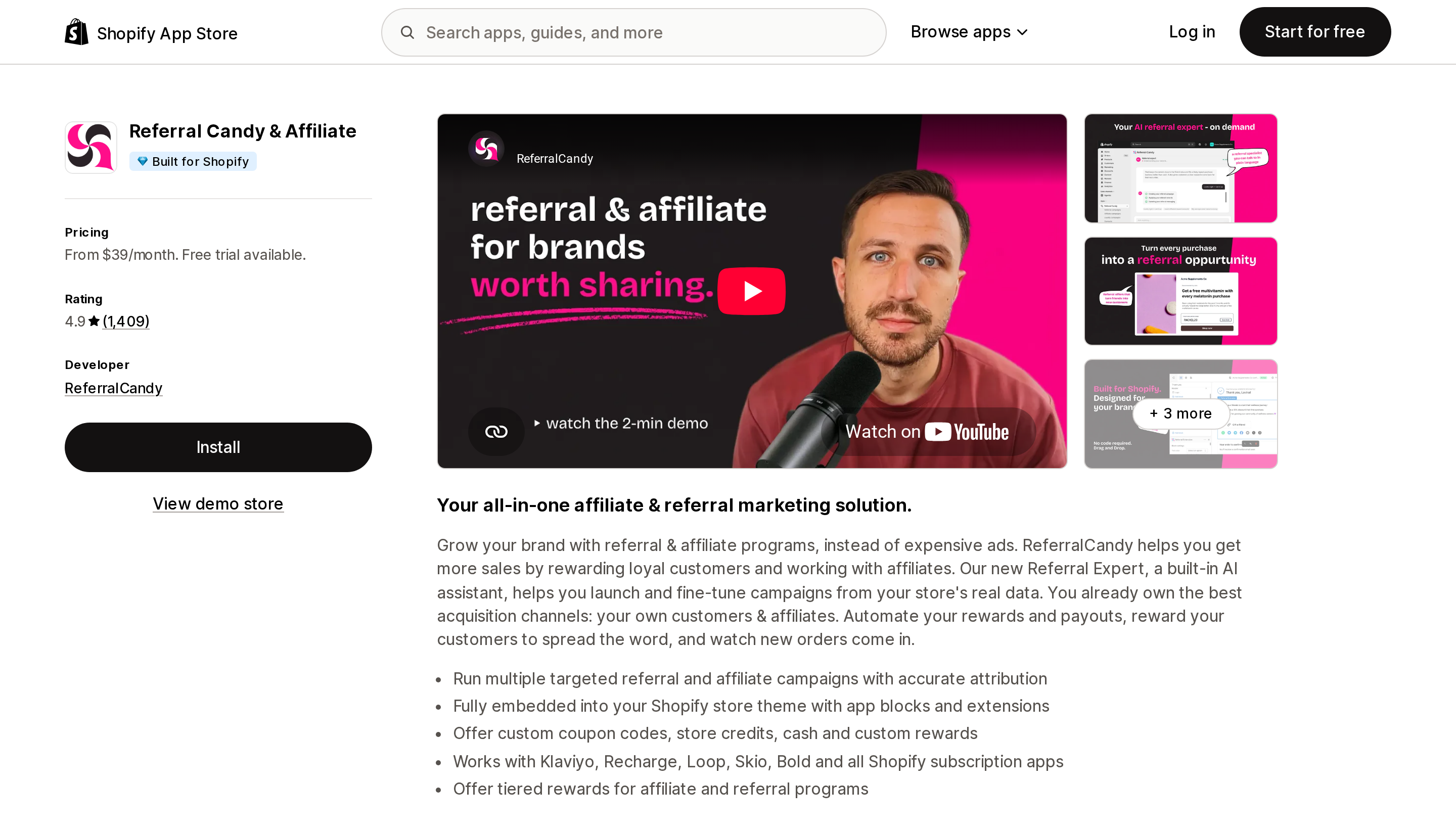
Source: Shopify App Store (Referral Candy & Affiliate), retrieved September 2, 2026
Built for Shopify, 4.9 across 1,409 reviews, live since September 28, 2010 — the longest-running listing in this comparison. It integrates with Checkout, Customer accounts, Shopify POS, Klaviyo, and the subscription stack (ReCharge, Loop, Skio, Appstle, Awtomic). Only two storefront languages, English and Spanish.
There is no free plan. Every tier is a monthly fee plus a success fee on referral sales:
| Plan | Monthly | Success fee on referral sales |
|---|---|---|
| Basic | $39 | 10.5% |
| Grow | $79 | 3.5% |
| Scale | $249 | 1.5% |
| Enterprise | $799 | 0.25% |
Set the two plans equal and solve. Basic costs 39 + 0.105R; Grow costs 79 + 0.035R. They meet when 0.07R = 40, so R = $571.43 — at which point both bills are exactly $99.00. Grow meets Scale when 0.02R = 170, so R = $8,500 (both $376.50). Scale meets Enterprise when 0.0125R = 550, so R = $44,000 (both $909.00).
| Monthly referral revenue | Basic | Grow | Scale | Enterprise | Cheapest |
|---|---|---|---|---|---|
| $500 | $91.50 | $96.50 | $256.50 | $800.25 | Basic |
| $571 | $99.00 | $99.00 | $257.57 | $800.43 | tie |
| $2,500 | $301.50 | $166.50 | $286.50 | $805.25 | Grow |
| $5,000 | $564.00 | $254.00 | $324.00 | $811.50 | Grow |
| $8,500 | $931.50 | $376.50 | $376.50 | $820.25 | tie |
| $25,000 | $2,664.00 | $954.00 | $624.00 | $861.50 | Scale |
| $75,000 | $7,914.00 | $2,704.00 | $1,374.00 | $986.50 | Enterprise |
At a $60 average order value, $571 in referral revenue is roughly ten referral orders a month. Basic is the cheapest plan only for stores whose program is barely running. Any store where referrals are actually working should be on Grow or above, and nothing on the listing page tells you that.
UpPromote Affiliate Marketing
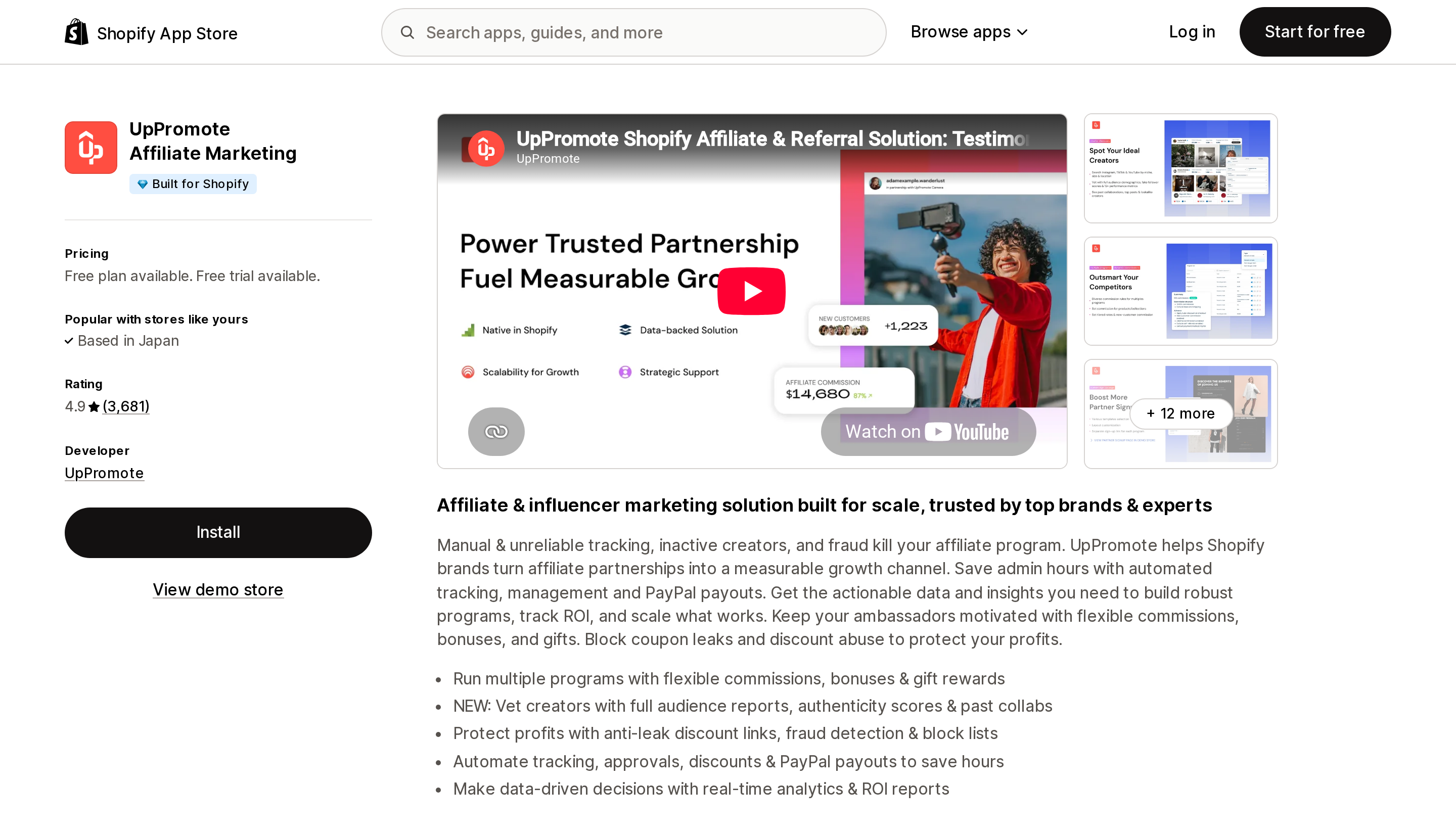
Source: Shopify App Store (UpPromote Affiliate Marketing), retrieved September 2, 2026
Built for Shopify, 4.9 across 3,681 reviews, 17 languages. It meters on three things at once: a monthly fee, a percentage of successful referral sales, and a cap on how many referrals you can review per month.
Free reviews up to $3,000/month in referral sales. Growth is $29.99 + 2% (300 referrals/month) and is where the customer referral program starts — it is not on the free plan. Professional is $89.99 + 1.5% (600 referrals/month) and adds anti-leak discounts, PayPal auto-payment, and 1099 tax form generation. Enterprise is $199.99 + 1%.
Growth meets Professional at 0.005R = 60, so R = $12,000. Professional meets Enterprise at R = $22,000. Watch the second meter, though: at a $50 average referral order, $12,000 of revenue is 240 referrals, comfortably inside Growth's 300 cap. At a $20 average order it is 600 referrals, which breaches it. The percentage meter and the count meter bind at different moments.
Meter two: your total monthly order count
Smile: Loyalty Program Rewards
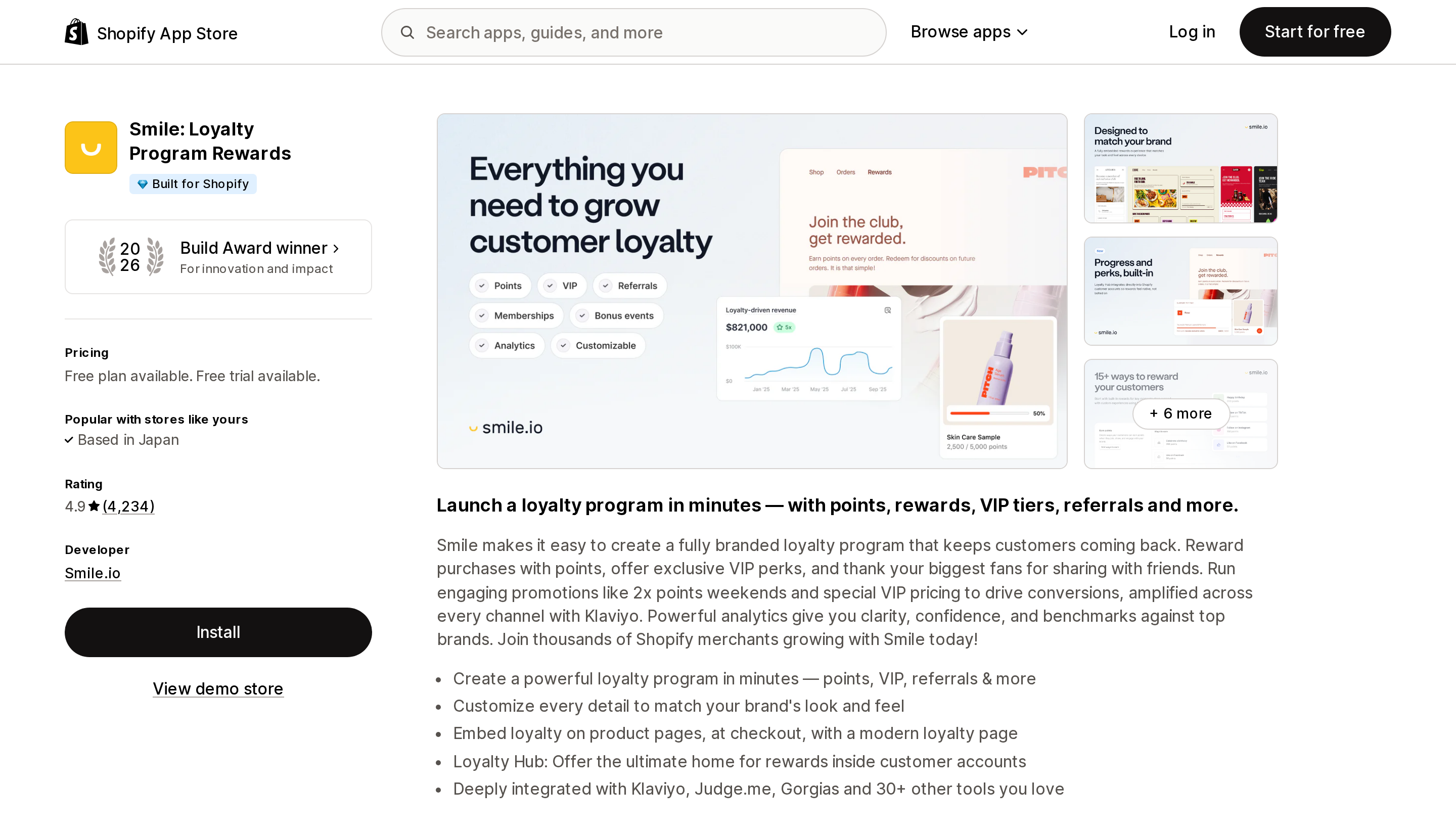
Source: Shopify App Store (Smile: Loyalty Program Rewards), retrieved September 2, 2026
Built for Shopify, 4.9 across 4,234 reviews, a 2026 Build Award winner, and the deepest integration list here — Checkout, Customer accounts, POS, Shopify Flow, Klaviyo, Gorgias, Judge.me, Loox, Mailchimp, Recharge, and 20+ storefront languages.
The free plan is unusually generous and includes referrals: points, rewards, referrals, 15+ earn and redeem options, full branding, and POS, up to 200 monthly orders. Essential is $15/month up to 500 orders, Standard is $79/month up to 1,000, and Growth is $199/month including 2,500 orders, then $20 per additional 100 orders.
Two things about that meter deserve saying out loud.
First, it counts every order your store takes, not the orders your referral program generated. A store doing 5,000 orders a month with 30 referrals pays $699 — $23 per referral. A store doing 400 orders with the same 30 referrals pays $15.
Second, the ladder inverts. The marginal rate above 2,500 orders is $0.20 per order, while the step from Essential to Standard works out at ($79 − $15) ÷ 500 = $0.128 per order. You get charged more per order the further past the top tier you go.
| Monthly orders | Arithmetic | Cost | Cost per order |
|---|---|---|---|
| 500 | Essential flat | $15 | $0.030 |
| 1,000 | Standard flat | $79 | $0.079 |
| 2,500 | Growth flat | $199 | $0.080 |
| 5,000 | 199 + 25 × 20 | $699 | $0.140 |
| 10,000 | 199 + 75 × 20 | $1,699 | $0.170 |
One more gap worth noting: Smile's listing plan bullets and feature tags do not name a referral fraud, anti-cheat, or self-referral control. Three of the other apps here do name one.
Growave: Loyalty & Wishlist
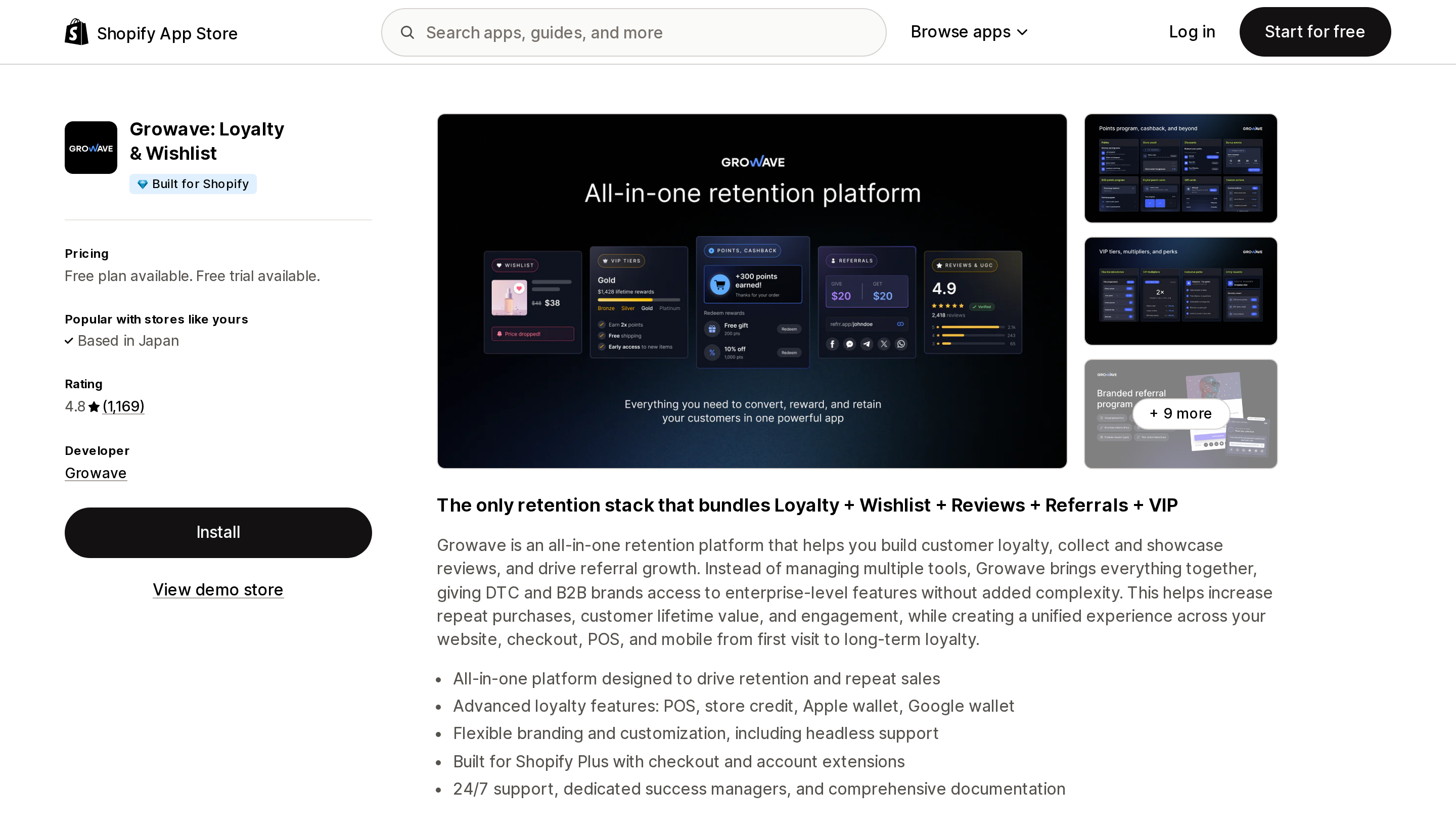
Source: Shopify App Store (Growave: Loyalty & Wishlist), retrieved September 2, 2026
Built for Shopify, 4.8 across 1,169 reviews, and the only app here bundling loyalty, wishlist, reviews, and referrals into one bill. Its ladder is the most sophisticated in the set because the overage rate falls as you climb: Entry is $15/month including 500 orders with $20 per additional 100; Growth is $199/month including 1,500 with $15 per 100; Plus is $499/month including 3,000 with $10 per 100.
Entry meets Growth at 1,420 orders. Growth meets Plus at 4,500 orders — so below 4,500, staying on Growth and paying overage beats upgrading, on price alone.
The catch is at the bottom. The referral program and fraud protection are a single bundled bullet on Entry, which means neither exists on Growave's free plan.
Meter three: flat tiers
BixGrow Affiliate Marketing
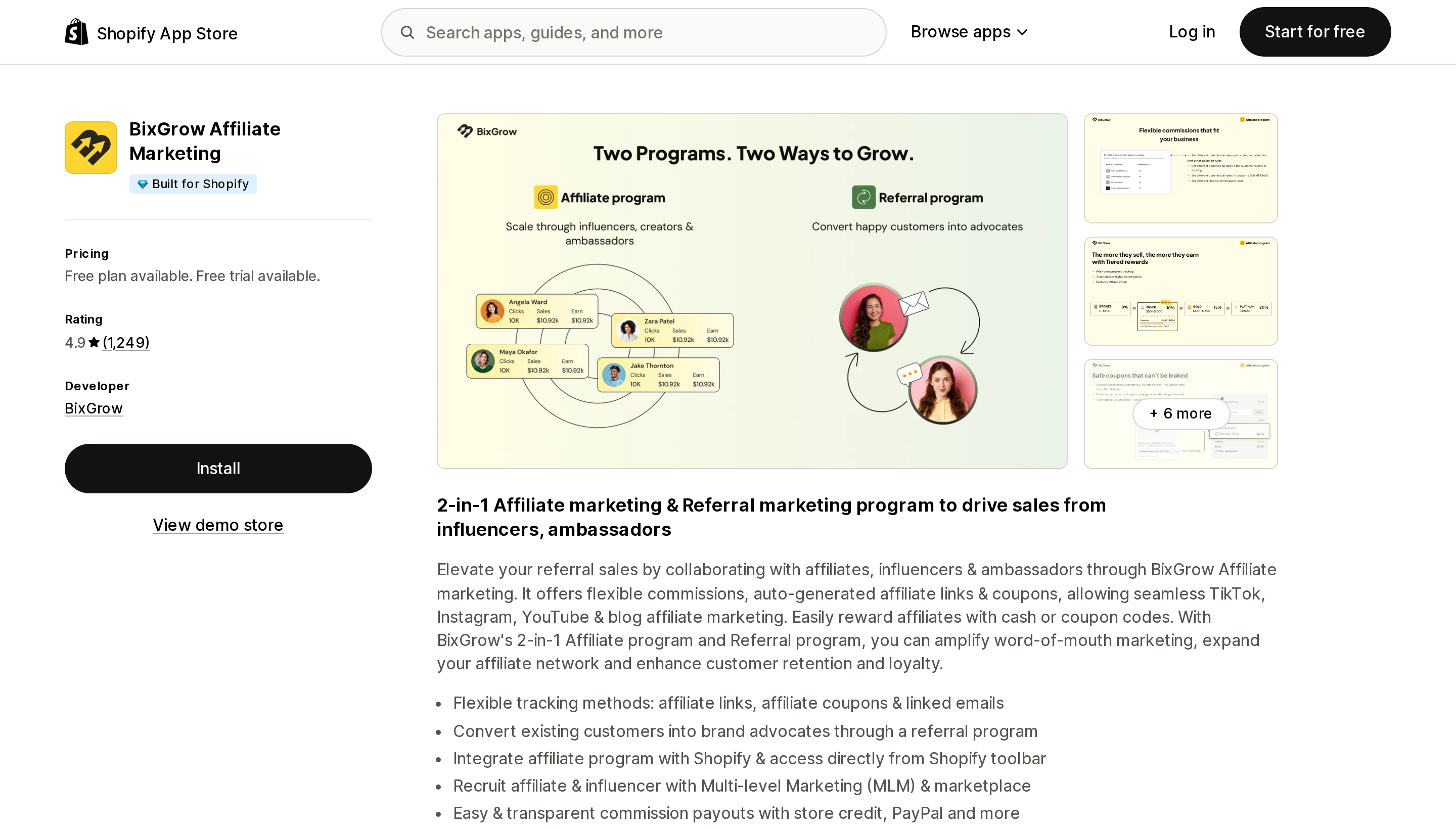
Source: Shopify App Store (BixGrow Affiliate Marketing), retrieved September 2, 2026
Built for Shopify, 4.9 across 1,249 reviews, 15 languages. Starter is free with one program, 50 referral orders a month, and up to 30 affiliates. Scale is $19.99 for unlimited affiliates, programs, and orders, and is where the referral program starts. Pro is $29.99 and adds commission tiers, PayPal and store credit payouts, and anti-leak coupons — the same protection UpPromote gates at $89.99. Advanced is $49.99 with automated PayPal payout and API access.
No percentage. No order metering above the free tier. Against Referral Candy's Grow plan (79 + 0.035R), BixGrow Pro at $29.99 flat is cheaper before a single dollar of commission enters the calculation. If what you need is referral and affiliate tracking without a loyalty points layer, the flat-tier apps are cheaper than the percentage apps at essentially every volume — the percentage models are selling you brand, integrations, and support, not price.
BON Loyalty Program & Rewards
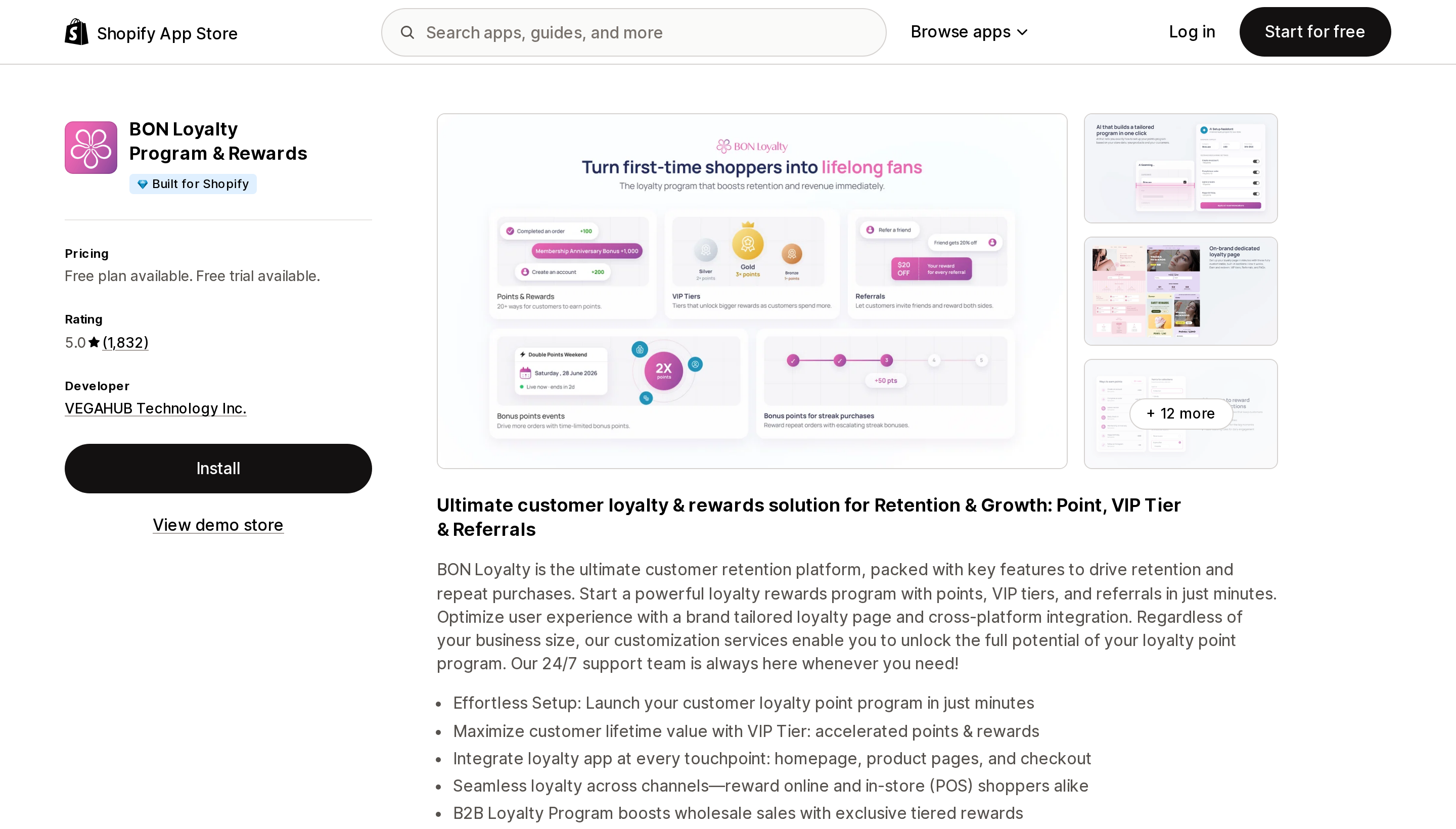
Source: Shopify App Store (BON Loyalty Program & Rewards), retrieved September 2, 2026
Built for Shopify, 5.0 across 1,832 reviews. It starts as an order-metered app and ends as a flat one: Free Forever up to 150 monthly orders, Starter $15 up to 300, Basic $29 up to 500, then Growth at $129 for unlimited monthly orders. No overage at any tier.
Two things stand out. Its free plan is the only one here that names an anti-cheat referral control at $0. And its flat $129 beats every order-metered competitor from roughly 1,500 monthly orders upward — at 5,000 orders it is 5.4× cheaper than Smile, and at 10,000 orders it is 13× cheaper.
| Monthly orders | Smile | Growave (best tier) | BON | Cheapest |
|---|---|---|---|---|
| 500 | $15 | $15 | $29 | Smile / Growave |
| 1,000 | $79 | $115 | $129 | Smile |
| 2,500 | $199 | $349 | $129 | BON |
| 5,000 | $699 | $699 | $129 | BON |
| 10,000 | $1,699 | $1,199 | $129 | BON |
The trade-offs are real: BON supports five storefront languages against Smile's twenty-plus, and it jumps straight from 500 orders at $29 to unlimited at $129 with nothing in between.
Comparison
| Referral Candy | Smile | UpPromote | BixGrow | BON | Growave | |
|---|---|---|---|---|---|---|
| Meter | % referral sales | Total monthly orders | % + referral cap | Flat features | Orders, then flat | Total monthly orders |
| Entry price for a working referral program | $39 + 10.5% | $0 (≤200 orders) | $29.99 + 2% | $19.99 | $0 (≤150 orders) | $15 |
| Referrals on the free plan | No free plan | Yes | No | No | Yes | No |
| Predictable at scale | No | No | No | Yes | Yes above $129 | No |
| Named fraud control | Not on listing | Not on listing | Yes, anti-leak at $89.99 | Yes, anti-leak at $29.99 | Yes, on free | Yes, at $15 |
| Cash affiliate payouts | Yes | No | Yes | Yes | No | No |
| Loyalty points included | No | Yes | No | No | Yes | Yes |
| Storefront languages | 2 | 20+ | 17 | 15 | 5 | 16 |
| Rating (reviews) | 4.9 (1,409) | 4.9 (4,234) | 4.9 (3,681) | 4.9 (1,249) | 5.0 (1,832) | 4.8 (1,169) |
How to choose
Under 200 monthly orders, and you want loyalty and referrals together. Smile's free plan or BON's free plan. BON caps lower at 150 orders but includes a named anti-cheat control at zero cost.
Above roughly 1,500 monthly orders on an order-metered app. Move to BON Growth at $129 flat. Order-count ladders become the most expensive option precisely as your store grows, and the growth has nothing to do with your referral program.
Already on Referral Candy Basic with referrals above $572 a month. Upgrade to Grow today. This is not a feature threshold, it is arithmetic. Above $8,500, go to Scale.
You want a bill you can forecast. BixGrow at $19.99 to $49.99 flat, or BON Growth at $129 flat. No percentage, no overage.
You need cash payouts with W9 and 1099 handling. UpPromote Professional at $89.99 + 1.5% is the only app here that names 1099 generation on a plan. Native Shopify Collabs is the alternative, with the 2.9% processing fee and the paused creator signups factored in.
Fraud is your main worry. BON on the free tier, BixGrow Pro at $29.99, or UpPromote Professional at $89.99. Do not assume the control is present where the listing does not name it.
Still under 20 referrers and just testing the idea. Discount codes and Flow are fine. Stop before it works.
What to check before you install
Prices on the Shopify App Store change without notice, so re-verify the tier you are about to buy. Beyond price, three questions decide whether the app survives contact with your store.
Ask what the meter actually counts. "Up to 500 monthly orders" and "up to 500 referral orders" are different products at the same price. Ask what the fraud control is by name, and which plan it is on — several listings imply protection through a feature tag without describing it. And check whether your reward form matches the app: if you want to pay cash commissions, you need payout rails and tax handling; if you want store credit, remember Shopify only applies the full balance at checkout, which makes a $10 referral credit less flexible than it sounds.
The bigger point is the one the listing pages obscure. Every app here is priced on the assumption that something grows — your referral revenue, your order count, or nothing at all. Pick the meter least correlated with the growth you actually expect.
Sources
- Shopify Help Center — Reaching new customers
- Shopify Help Center — Shopify Collabs payments and W9 collection
- Shopify Help Center — Store credit
- Shopify Help Center — Managing discounts
- Shopify Help Center — Shopify Flow
- Shopify App Store listings, retrieved September 2, 2026: Referral Candy & Affiliate, Smile: Loyalty Program Rewards, UpPromote Affiliate Marketing, BixGrow Affiliate Marketing, BON Loyalty Program & Rewards, Growave: Loyalty & Wishlist
Shop Pay Installments is free to activate, needs no app, and Shopify never publishes what it costs you — the rate is visible only inside your own admin. It also refuses Capital One and Chase credit cards, restricts monthly plans to debit cards only, excludes gift cards and subscriptions, and can't be turned off for individual products. Affirm can suspend your account for being password-protected, for having a non-English storefront, or for being primarily B2B. And Shopify's Getting paid page says disputes appear in your admin while its FAQ says they don't. If you fail the eligibility gates, the alternative is on-site messaging apps from Klarna, Afterpay, Sezzle, Zip, and PayPal — a category rated between 1.0 and 3.2 stars. Researched September 2, 2026.