
What you will learn
On this pageContentsCloseOpen
Open the Shopify App Store, search "shipping protection," and open the three highest-rated results that carry the Built for Shopify badge. Read the first paragraph of each listing.
Captain Shipping Protection: "We are not an insurance firm and do NOT underwrite plans."
Shipping Protection —Shipcheck: "We're not an insurance provider."
Insureful Shipping Protection: "Note: Not an insurance company."
All three sit in a Shopify App Store category literally named Warranties and insurance. None of them is hiding anything — the disclaimer is in the listing, above the fold, before you install. But almost no roundup of this category leads with it, and it is the one sentence that determines what you are actually buying.
Shopify already sells you insurance. It just isn't this.
Before you evaluate a single app, it is worth knowing that Shopify sells real, administered shipping insurance today — and most merchants comparing protection apps have never opened the page.
If you ship from the United States and buy labels in Shopify, you can insure a shipment for up to $5,000 USD. Shopify's published premium rates are $0.89 USD per $100 of coverage on domestic shipments and $1.29 USD per $100 on international shipments. Shipsurance is the insurance administrator for coverage purchased through Shopify, and claims are filed from the order in your Shopify admin.
If you are on the Grow, Advanced, or Plus plan with Shopify Payments activated, Shopify automatically includes up to $200 USD of coverage on each eligible label at no extra cost. Managed Markets labels get the same $200 on those plans; on Basic, Managed Markets orders get nothing included and you buy coverage yourself.
The exclusions matter and are specific:
- USPS First Class Mail is not eligible for insurance at all.
- UPS shipments to Puerto Rico are not eligible.
- Included coverage does not stack with carrier-provided coverage. Each eligible shipment tops out at $200 of included insurance.
- If a label has both Shipsurance coverage and carrier coverage, claims go to Shipsurance, not the carrier.
- For most shipments, claims can be filed 24 hours after the order has shipped and up to 120 days from the shipping date.
- Shopify does not support these claims. Shipsurance does, directly.
Here is the structural point. Shopify's native insurance is merchant-side: you buy it per label, you are the insured party, and your customer never sees it or pays for it. Every app in this article is customer-side: a fee added to the cart or checkout, paid by the shopper, in exchange for a promise about lost, stolen, or damaged packages.
Those are different products solving different problems. Native insurance protects your margin. Protection apps convert shipping risk into a line item — and, depending on the model, into revenue.
The only comparison axis that matters: who keeps the fee, and who pays the claim
Every app in this category answers two questions. Get these right and the rest of the feature list is detail.
Model A — self-funded. The app gives you a widget, a price rule, and a claims dashboard. Your customer pays the protection fee to you. You keep 100% of it. When a package goes missing, you fund the replacement or refund out of the pool you collected. The app is software; it carries none of the risk. This is Navidium, Captain, Shipcheck, and Insureful.
Model B — third-party funded. The provider sets or approves the fee, the fee is passed through to them, and the provider funds approved claims. You are not holding a risk pool. This is Route, Guide, and SavedBy.
Model A is a margin play with a tail risk you own. Model B is outsourcing, paid for by your customer, where you give up the fee revenue.
What the regulators have published
On July 18, 2024, the National Association of Insurance Commissioners issued a consumer alert titled Beware of Package Protection Insurance Scams. The relevant passage, addressed to shoppers rather than merchants, is short:
"Unlicensed entities are not legally allowed to sell insurance products and may claim these products are warranties, guarantees, or protection plans."
The NAIC's advice to consumers is to check whether a package-protection provider is licensed before buying, and to review "the shipping protection options and who is offering them" at checkout.
That is the context in which the Built for Shopify disclaimers make sense. Vendors in this category state plainly that they are not insurers because the label carries regulatory weight in the US. Whether a merchant-run, self-funded protection program is characterized as insurance in your state is a question for your own counsel and your state's department of insurance — not for an app listing, and not for this article. What you can take from it operationally is this: if you choose a self-funded app, you are the one making the promise to the customer. Price it, reserve for it, and write the policy language as if that is true, because it is.
Comparison
All figures below are from each app's Shopify App Store listing in the en-US locale, retrieved September 2, 2026.
| App | Model | Rating (reviews) | Built for Shopify | App pricing | Who funds claims |
|---|---|---|---|---|---|
| Navidium Shipping Protection | Self-funded | 4.8 (390) | Yes | Free to install; $0 up to 50 orders/mo, then $29.99 / $49.99 / $99.99 per month by order volume | You |
| Captain Shipping Protection | Self-funded | 4.9 (280) | Yes | $11/month Standard, $49/month Plus — both listed with a 3.99% shipping protection fee; 14-day trial | You |
| Shipping Protection —Shipcheck | Self-funded | 5.0 (81) | Yes | $9.95/month Standard, $39.95/month Plus; 14-day trial | You |
| Insureful Shipping Protection | Self-funded | 4.9 (66) | Yes | Free up to 30 protected orders/mo; $9.95/month Basic; $29.99/month Enterprise | You |
| Route ‑ Protection & Tracking | Third-party funded | 4.1 (331) | No | Free to install; external charges billed by RouteApp LLC separately from your Shopify invoice | Route |
| Guide Protection + Returns | Third-party funded | 4.6 (47) | No | Free to install; customers pay at checkout, collected by you and passed through to Guide | Guide |
SavedBy Package Protection (5.0, 51 reviews) belongs to the same third-party-funded group and describes the mechanism more bluntly than anyone else in the category: when a claim is approved, "the money comes from SavedBy's wallet — not yours."
The self-funded four
Navidium Shipping Protection
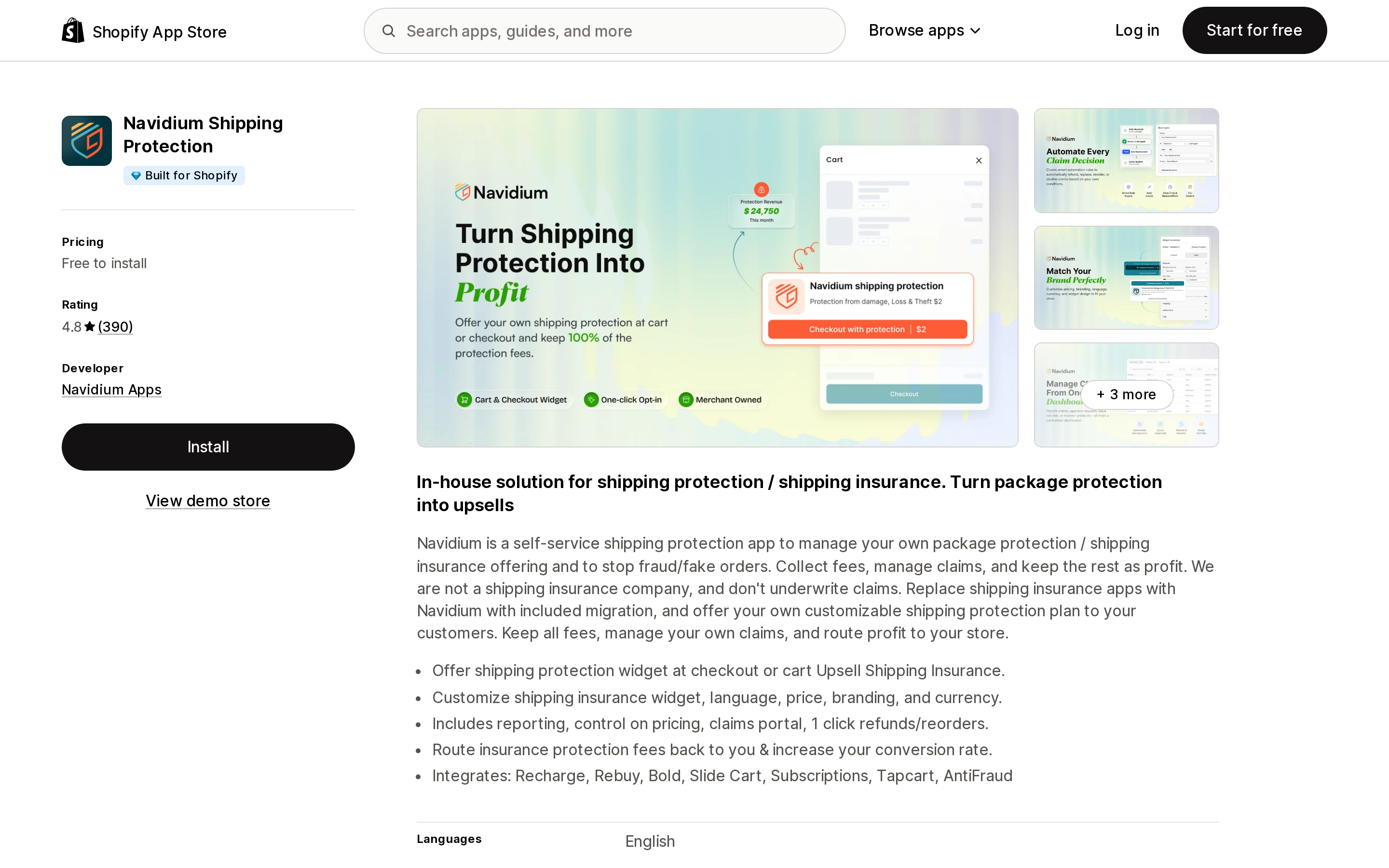
Source: Shopify App Store (Navidium Shipping Protection), retrieved September 2, 2026
The largest review base in the category at 390, launched November 26, 2021, by Navidium Apps. Pricing is a flat monthly ladder tied to order volume: free up to 50 orders a month, $29.99 up to 500, $49.99 up to 1,000, $99.99 for unlimited. Every tier repeats the same line: "No Rev Share. Keep 100% fees collected."
Two details are easy to miss. Plans auto-upgrade when you cross the order threshold inside a billing cycle, so a good month moves your bill without you doing anything. And the "Shopify Plus Checkout Widget" appears only on the $99.99 Enterprise tier — more on why below.
The recent low-rated reviews are worth reading rather than averaging away. One US merchant of over four years, in a review edited September 1, 2026, describes session recordings showing "shoppers directly confused by auto-added cart fees" and reports that custom code set express payment buttons to visibility: hidden. Another, in August 2026, reports two weeks of unresolved support. The developer replied publicly to both. Against 376 five-star reviews these are outliers, but the first one names a real failure mode of this category: the auto-opt-in widget.
Captain Shipping Protection
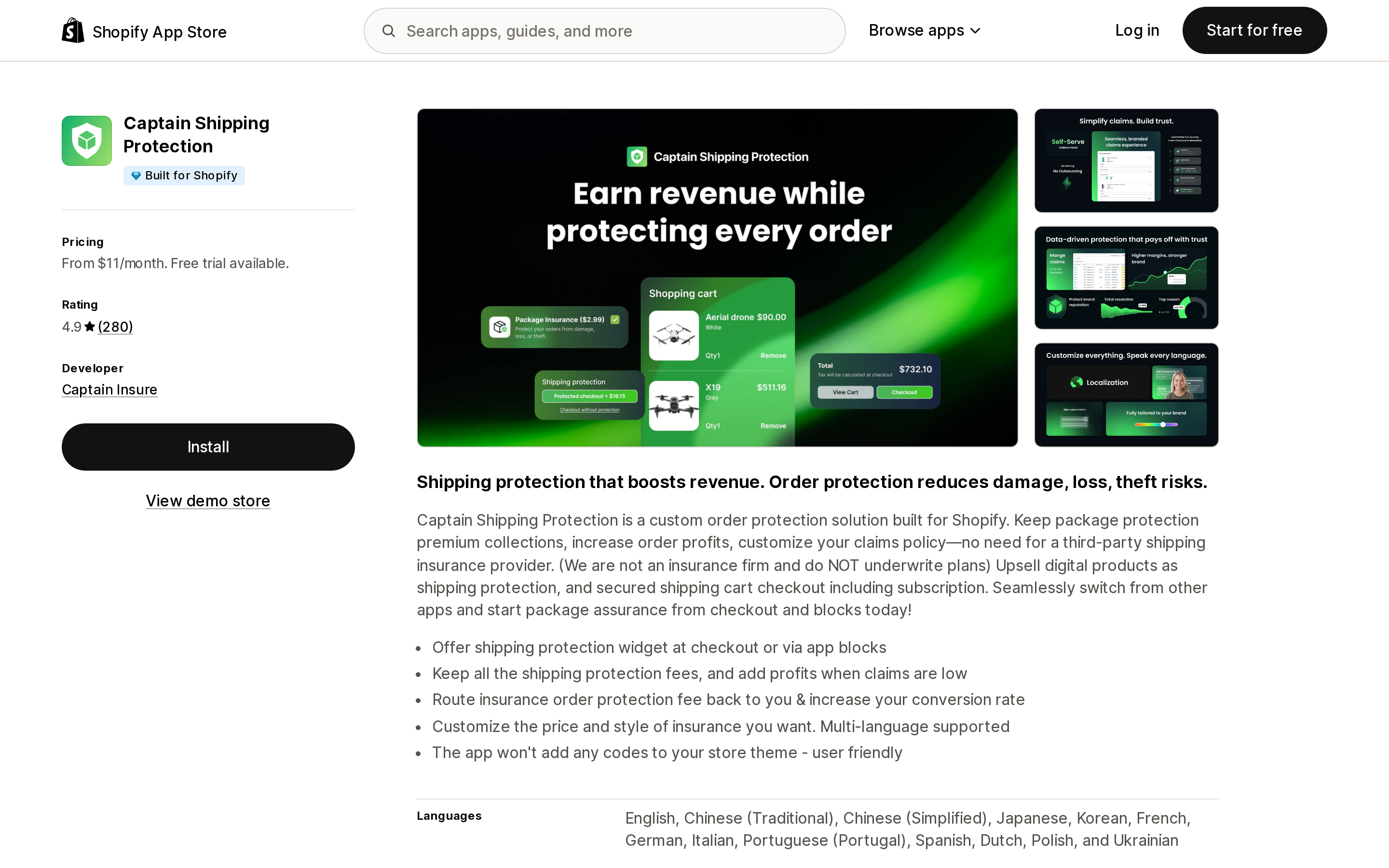
Source: Shopify App Store (Captain Shipping Protection), retrieved September 2, 2026
By Captain Insure, launched August 4, 2022, 4.9 from 280 reviews, Built for Shopify. The listing bullet says "Keep all the shipping protection fees, and add profits when claims are low."
Both published plans — Standard at $11/month and Plus at $49/month — carry the line "3.99% shipping protection fee" directly under the price. Read the monthly figure as a floor, not the total. On $10,000 of collected protection fees, 3.99% is roughly $399 a month on top of the $11 subscription. Whether that reconciles with "keep all the shipping protection fees" is a question worth putting to the vendor before you install, and it is exactly the kind of second denominator that makes flat-fee comparisons in this category misleading.
Captain implements protection as a digital product upsell, supports 13 storefront languages, and its listing states it adds no code to your theme.
Shipping Protection —Shipcheck
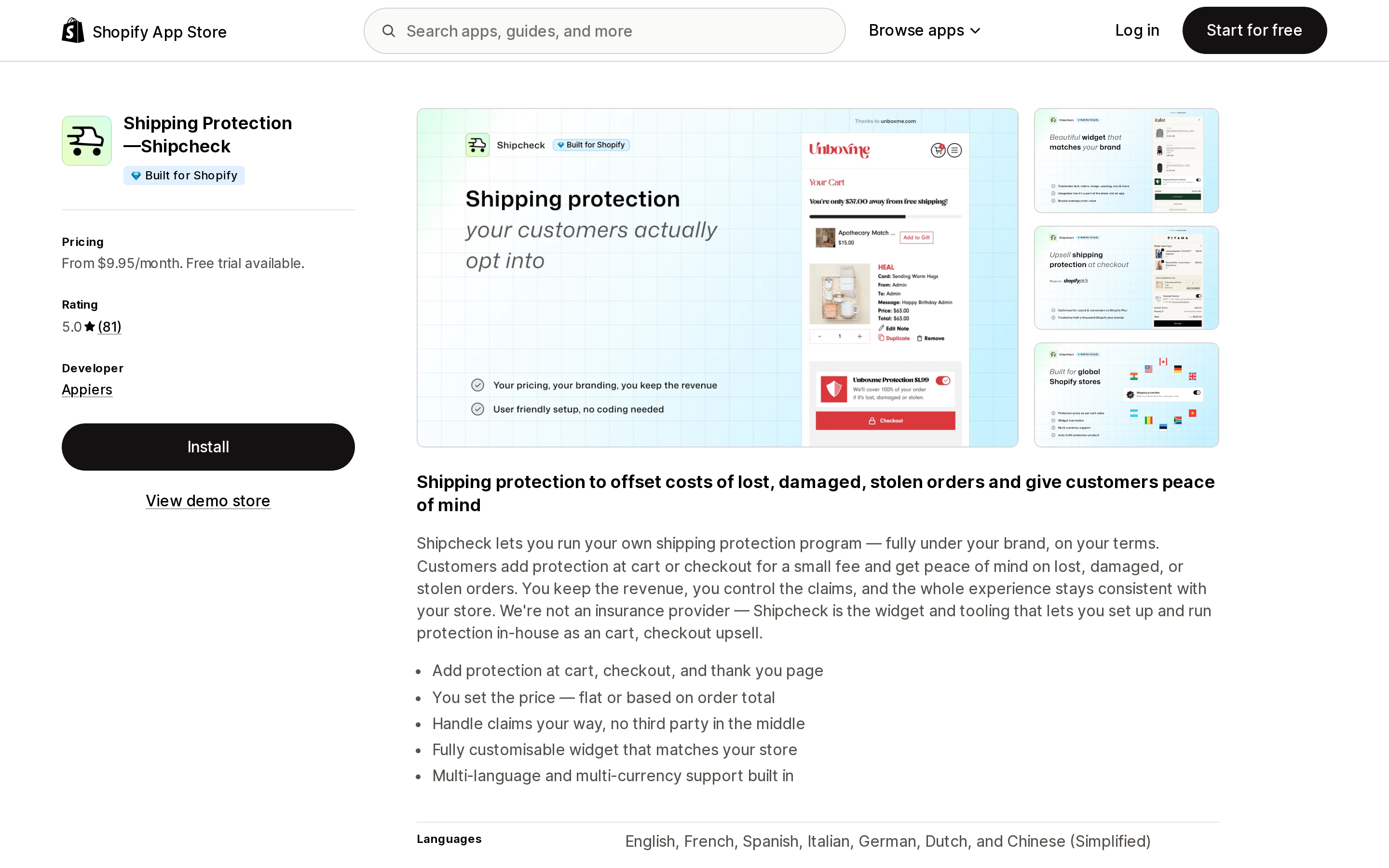
Source: Shopify App Store (Shipping Protection —Shipcheck), retrieved September 2, 2026
By Appiers, launched August 14, 2024 — the newest app here — 5.0 from 81 reviews, Built for Shopify. $9.95/month Standard, $39.95/month Plus, both with unlimited protected orders and a 14-day trial. No percentage is listed on either plan.
The clearest signal in its reviews is a limitation, not a strength. A US merchant asks for percentage-of-cart pricing, explaining that products ranging "from $1 to over $1,000" cannot sensibly share one flat protection price. If your catalogue has that kind of price spread, confirm the current pricing modes before committing; the listing advertises "incremental protection pricing" and flat or order-total-based pricing, which is not the same as a percentage rule.
Shipcheck's data access includes Shopify Functions (cart and checkout validations), which is a meaningful architectural difference from apps that work purely through theme widgets.
Insureful Shipping Protection
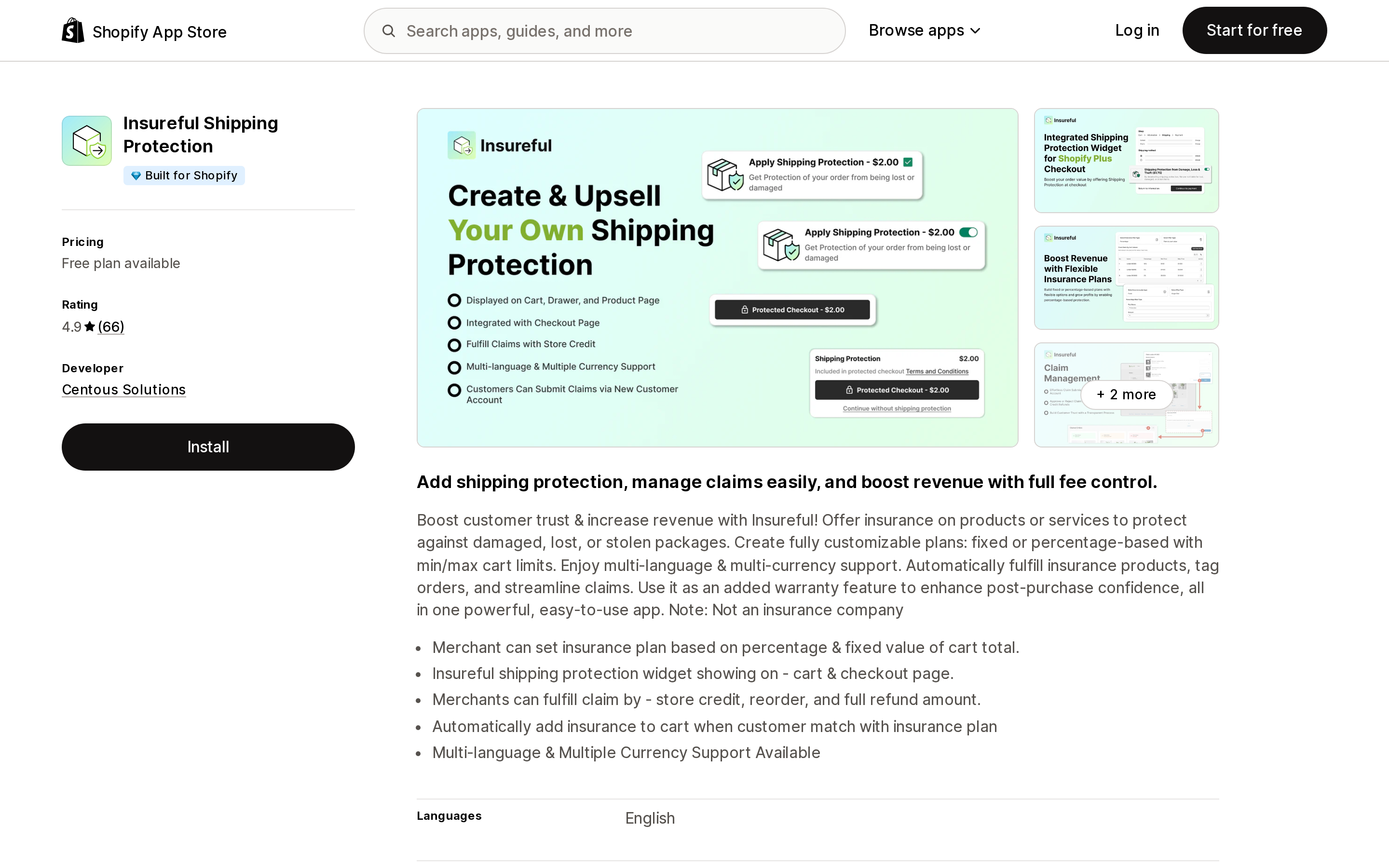
Source: Shopify App Store (Insureful Shipping Protection), retrieved September 2, 2026
By Centous Solutions, launched November 30, 2022, 4.9 from 66 reviews, Built for Shopify. It is the only app in this comparison with a genuinely usable free tier: 30 protected orders per month at $0, with fixed and percentage plans both available. Basic is $9.95/month for unlimited orders; Enterprise is $29.99/month and adds the checkout and thank-you-page widgets plus multi-language support.
Insureful also supports resolving a claim as store credit, alongside reorder and full refund — its data access scope includes store credit accounts. For a self-funded program, store credit is the cheapest way to honour a claim, and it is the option most merchants forget to configure.
The third-party-funded group
Route ‑ Protection & Tracking
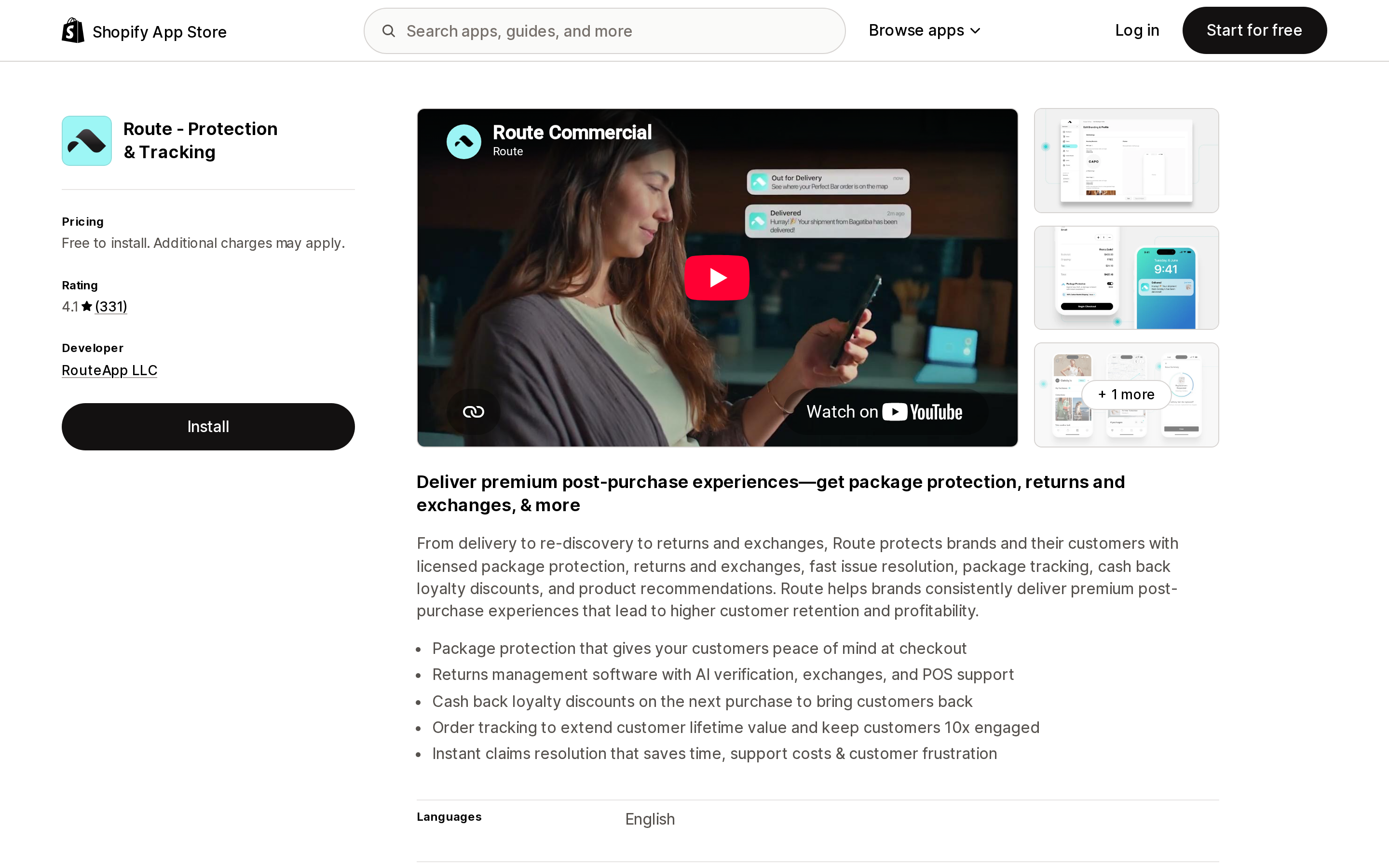
Source: Shopify App Store (Route ‑ Protection & Tracking), retrieved September 2, 2026
RouteApp LLC, Lehi, Utah, launched January 17, 2019 — the oldest app in this comparison and the most recognised name. It is a post-purchase platform, not only protection: package protection, returns and exchanges with AI verification, branded order tracking, and cash-back loyalty discounts.
Two facts to weigh. First, the App Store listing publishes no price. It says "Free to install" and adds that "External charges may be billed by RouteApp LLC separately from your Shopify invoice," pointing to route.com/pricing. Charges that do not appear on your Shopify bill are charges your monthly app-cost review will not catch.
Second, the rating distribution. Route sits at 4.1 with 62 one-star reviews out of 331 — roughly 19% of all ratings, against 234 five-star. That is a far wider spread than any self-funded app here, and it is the reason to read the one-star tail rather than the average before you install.
Guide Protection + Returns
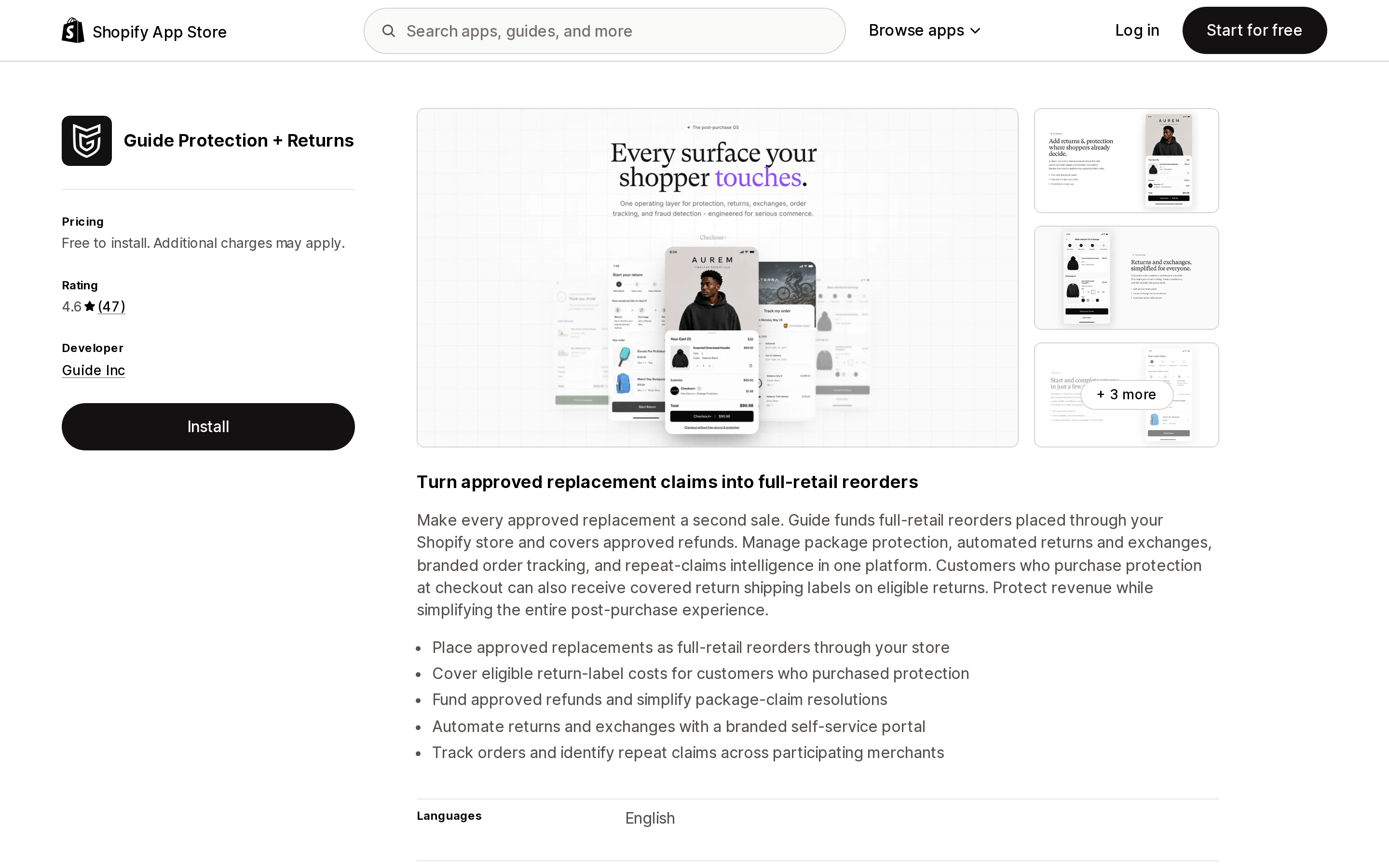
Source: Shopify App Store (Guide Protection + Returns), retrieved September 2, 2026
Guide Inc, Salt Lake City, launched October 14, 2020, 4.6 from 47 reviews. Its pricing section states the model in one sentence: "Customers pay for Guide when they add it at checkout. Charges are collected by the merchant and passed through to Guide." You are a collection agent, not a beneficiary.
What you get in exchange is unusual: Guide funds approved replacements as full-retail reorders placed through your store, so an approved claim becomes a second sale rather than a write-off, and covers approved refunds and eligible return-label costs for customers who bought protection.
The gap is named precisely by a merchant review from a Canadian store: "While Guide does cover the replacement product cost, it does not cover merchant fees required to ship out the replacement." If you offer free shipping over a threshold and ship long distances, model that outbound cost before you assume claims are cost-neutral.
Every checkout widget in this category requires Shopify Plus — and that isn't the vendors' choice
Look at the top tier of all four self-funded apps. Navidium's $99.99 Enterprise plan adds the "Shopify Plus Checkout Widget." Captain's $49 plan says "For Shopify Plus only." Shipcheck's $39.95 plan says "Shopify plus only." Insureful's $29.99 Enterprise plan is "recommended for Shopify Plus stores" and adds the checkout-page widget.
Four independent vendors, same gate. The reason is in Shopify's own developer documentation, which states that checkout UI extensions rendering on the information, shipping, and payment steps of checkout are available only to stores on a Shopify Plus plan. UI extensions on the Thank you and Order status pages are available on all plans except Starter.
The practical consequence for a Basic, Grow, or Advanced store: your protection offer lives in the cart, not in checkout. That is a materially different placement — it appears earlier, it is easier for a shopper to skip, and it interacts with cart drawers and express payment buttons, which is precisely where the Navidium review above reported breakage. If a vendor's demo shows the widget inside checkout and you are not on Plus, you are not looking at what you will get.
What the fee does to your Shopify data
Protection is implemented as a product line item. Captain describes it as upselling "digital products as shipping protection"; Insureful and Navidium both auto-fulfil the protection product so it does not block order fulfilment.
Three consequences follow, and none of them appear in app marketing:
- Payment processing applies. The protection fee runs through your gateway like any other line item, so your processor takes its cut of money that, in a self-funded model, is meant to be a claims reserve.
- Your reporting inflates. Protection revenue lands in gross sales. Average order value, conversion value in your ad platforms, and product-level reports all move. If you self-fund, that revenue is partly a liability you have not yet paid out.
- Refunds are not automatic. When you refund an order, decide deliberately whether the protection fee is refunded with it — for the fee to have done its job, in many programs it should not be.
Choosing
Ship from the US, moderate order value, and you mainly want to stop absorbing carrier losses. Start with Shopify's own insurance on labels. If you are on Grow, Advanced, or Plus with Shopify Payments, $200 per shipment is already included and costs you nothing. Many stores never need a protection app at all.
High order volume, low claim rate, and you want protection to be a margin line. A self-funded app is the model. Insureful's free 30-orders-a-month tier is the cheapest way to test demand; Shipcheck at $9.95/month is the cheapest flat unlimited option; Navidium has the deepest track record. If you look at Captain, get the 3.99% figure explained in writing first.
You do not want to hold claim risk, and support volume is the actual problem. Third-party funded is the point of the model. Guide is the most transparent about how the money moves and turns approved claims into reorders. Route brings tracking and returns in the same platform, but read the one-star reviews and find the price on route.com before installing, because it will not show up on your Shopify invoice.
You are on Basic, Grow, or Advanced and the whole plan depends on a checkout widget. It does not exist for you. Design for the cart, or budget for Plus.
You sell high-value goods and your risk is genuinely material. This is where self-funding stops being clever. Look at licensed coverage — Shopify's own Shipsurance option covers up to $5,000 per shipment — and treat customer-paid protection as a customer-experience feature rather than a risk-transfer mechanism.
One closing note that applies to every option here. Whether a customer-paid protection fee constitutes insurance under the law of the states you sell into is a legal question, not a product question. The NAIC alert is public, the vendors' disclaimers are public, and both are inputs to a conversation with your own counsel. Nothing in this article is legal advice.
Sources
- Shipping insurance for your shipping labels — Shopify Help Center
- Shipping labels in Shopify — Shopify Help Center
- About product offers — Shopify developer documentation
- Consumer Alert: Beware of Package Protection Insurance Scams — National Association of Insurance Commissioners, July 18, 2024
- Shopify App Store listings (en-US) for Navidium Shipping Protection, Captain Shipping Protection, Shipping Protection —Shipcheck, Insureful Shipping Protection, Route ‑ Protection & Tracking, Guide Protection + Returns, and SavedBy Package Protection, retrieved September 2, 2026
Shop Pay Installments is free to activate, needs no app, and Shopify never publishes what it costs you — the rate is visible only inside your own admin. It also refuses Capital One and Chase credit cards, restricts monthly plans to debit cards only, excludes gift cards and subscriptions, and can't be turned off for individual products. Affirm can suspend your account for being password-protected, for having a non-English storefront, or for being primarily B2B. And Shopify's Getting paid page says disputes appear in your admin while its FAQ says they don't. If you fail the eligibility gates, the alternative is on-site messaging apps from Klarna, Afterpay, Sezzle, Zip, and PayPal — a category rated between 1.0 and 3.2 stars. Researched September 2, 2026.