
What you will learn
On this pageContentsCloseOpen
Before you shop for a shoppable video app, it is worth knowing how much of the job Shopify already does. It hosts your video, transcodes it, serves it over HLS from a CDN, streams it at 480p, 720p or 1080p depending on the connection, accepts 4K source files up to 1 GB and 10 minutes, and lazy-loads anything below the fold. Autoplay, loop and muted are all supported by the video_tag Liquid filter. None of that costs extra.
What Shopify does not do is make video shoppable. There is no in-video product tagging, no vertical swipe feed, no stories widget, no UGC collection or rights flow, no Instagram or TikTok import, and no per-video analytics. That is the gap — and a "shoppable video" search on the Shopify App Store returns 909 apps, which tells you how well-known the gap is.
The apps that fill it charge on six different meters. That is the part worth reading carefully, because it decides whether the cheapest sticker price is the cheapest bill. Research date September 2, 2026; prices USD as published.
The short version
- Shopify caps product media at 250 items per product — images, video and 3D share one pool — and the Help Center states this limit cannot be raised.
- A second, less-known cap: 1,000 video uploads per store per week. It resets weekly and cannot be raised. For a brand importing a UGC backlog, this bites long before storage does.
- Autoplay, loop and muted work natively through
video_tag, but they are opt-in parameters your theme has to pass. And whenloopis enabled, Shopify stops using the HLS source and falls back to progressive download. - Six apps, six meters: impressions (Videowise, Tolstoy), views defined as 4 seconds of watching (ReelUp, Vidjet), clicks (Whatmore), and nothing at all (Moast, flat $15).
- Overage behaviour splits two ways. Tolstoy keeps your videos running and bills you automatically. Vidjet stops showing your videos until the next billing cycle.
- Only Moast keeps video on Shopify's own infrastructure. The other five host it themselves, which means switching requires re-uploading originals — through that 1,000-per-week ceiling.
- Two of the six carry Built for Shopify: ReelUp and Moast. The app with the most reviews (Whatmore, 366) does not.
What Shopify actually gives you
The native numbers are specific and worth having in front of you, because several of them are the real constraint rather than anything an app fixes.
| Attribute | Native limit |
|---|---|
| Media per product | 250, images + video + 3D combined. Cannot be raised |
| Video file size | 1 GB |
| Video length | 10 minutes max, 0.25 seconds min |
| Resolution | Up to 4K (4096 × 2160), 120 fps max |
| Accepted formats | MOV, MP4, WEBM — delivered as .mp4 or HLS |
| Streaming | 480p / 720p / 1080p by connection |
| Upload batch | 200 files per upload; picker selects 20 at a time |
| Weekly upload cap | 1,000 videos per store per week, resets weekly, cannot be raised |
| Variant media | Video and 3D cannot be used as variant media |
| External video | YouTube and Vimeo only — YouTube Shorts is not supported |
Video and 3D counts and storage scale with your plan: Basic gets 250 videos and 50 GB of video storage, Grow 1,000 and 500 GB, Advanced 5,000 and 500 GB, Plus 50,000 and 2 TB, Enterprise 100,000 and 10 TB. Video-specific storage increases are handled by contacting Shopify Support with no published price; the paid increases you can look up — $100/month per TB on Plus, $1,000/month per 10 TB on Enterprise — apply to general file storage.
Two implications people usually miss. First, on Basic the 250-video plan limit and the 250-media-per-product limit are the binding constraints, not the 50 GB of storage — you will hit a count ceiling with storage to spare. Second, the 1,000-videos-per-week cap means a 4,000-clip UGC library takes a month to load no matter what you pay anyone.
On playback: video_tag accepts autoplay, loop, muted and controls as opt-in parameters that the theme has to pass — none of them happen unless the theme asks — plus a loading parameter, and below-the-fold video is automatically set to loading="lazy". The detail worth knowing is that enabling loop disables the HLS source, so a looping background video is served as a progressive download rather than adaptive streaming. If your theme loops a hero video, that is a performance decision you have already made without being told.
The verdict: Shopify gives you a competent video gallery. If all you need is one video per product on the product page, with no tagging, native is free, fast and already CDN-backed. Everything past that — a feed, a carousel, hotspots, an Instagram import — is an app.
Six meters
This is where the money is, and where every ranked list in this category quietly breaks. "5,000 a month" means completely different amounts of traffic depending on the unit.
| App | Metered unit | Definition | Not metered | On overage |
|---|---|---|---|---|
| Videowise Shoppable Video UGC | Unique widget impressions | Not defined by the vendor | Videos, widgets | Charged; per-unit rate not stated |
| Tolstoy: Shoppable Video & UGC | Billable impressions | Displayed to unique visitors | Videos | Keeps running, auto-billed at $10 / $7 / $5 per 1,000 by tier |
| ReelUp‑Shoppable Videos+Reels | Video views | Watched more than 4 seconds | Impressions and clicks (unlimited) | $10 per 1,000 (Basic), $5 per 1,000 (Premium/Elite) |
| Vidjet Shoppable Videos +Story | Video views + hosted videos | Minimum 4 seconds of engagement | Impressions (unlimited) | Videos stop showing until next billing cycle |
| Moast Shoppable Video & UGC | Nothing on the paid tier | n/a | Views (unlimited on both tiers) | n/a — flat $15 |
| Whatmore Shoppable Videos&Reel | Video clicks + videos uploaded + AI matches | Not defined by the vendor | Impressions (not metered) | Not stated |
An impression is a page that rendered the widget. A view is a person who watched for four seconds. On a typical product page those differ by roughly an order of magnitude — and two of these apps bill the larger number.
The same store, priced six ways
Take 30,000 monthly product page sessions with the widget on every product page, and assume 10% of visitors actually watch for four seconds.
Impression-metered apps count roughly 30,000 units, engagement irrelevant. Tolstoy's Shoppable Plus plan at $19/month includes 5,000 impressions, so the remaining ~25,000 bill at $10 per 1,000 — about $250 in overage on top of $19, roughly $269 a month.
View-metered apps count roughly 3,000 units. That sits inside ReelUp Basic at $29.99/month (3,000 views) or Vidjet Starter at $49/month (4,000 views).
Click-metered (Whatmore) counts fewer still.
Unmetered (Moast) is $15, flat, regardless.
The $9 and $19 headline prices belong to the two apps that can produce the largest bill on a busy store. That inversion is the single most useful thing to carry into this category.
The apps
Moast Shoppable Video & UGC
Source: Shopify App Store (Moast Shoppable Video & UGC), retrieved September 2, 2026
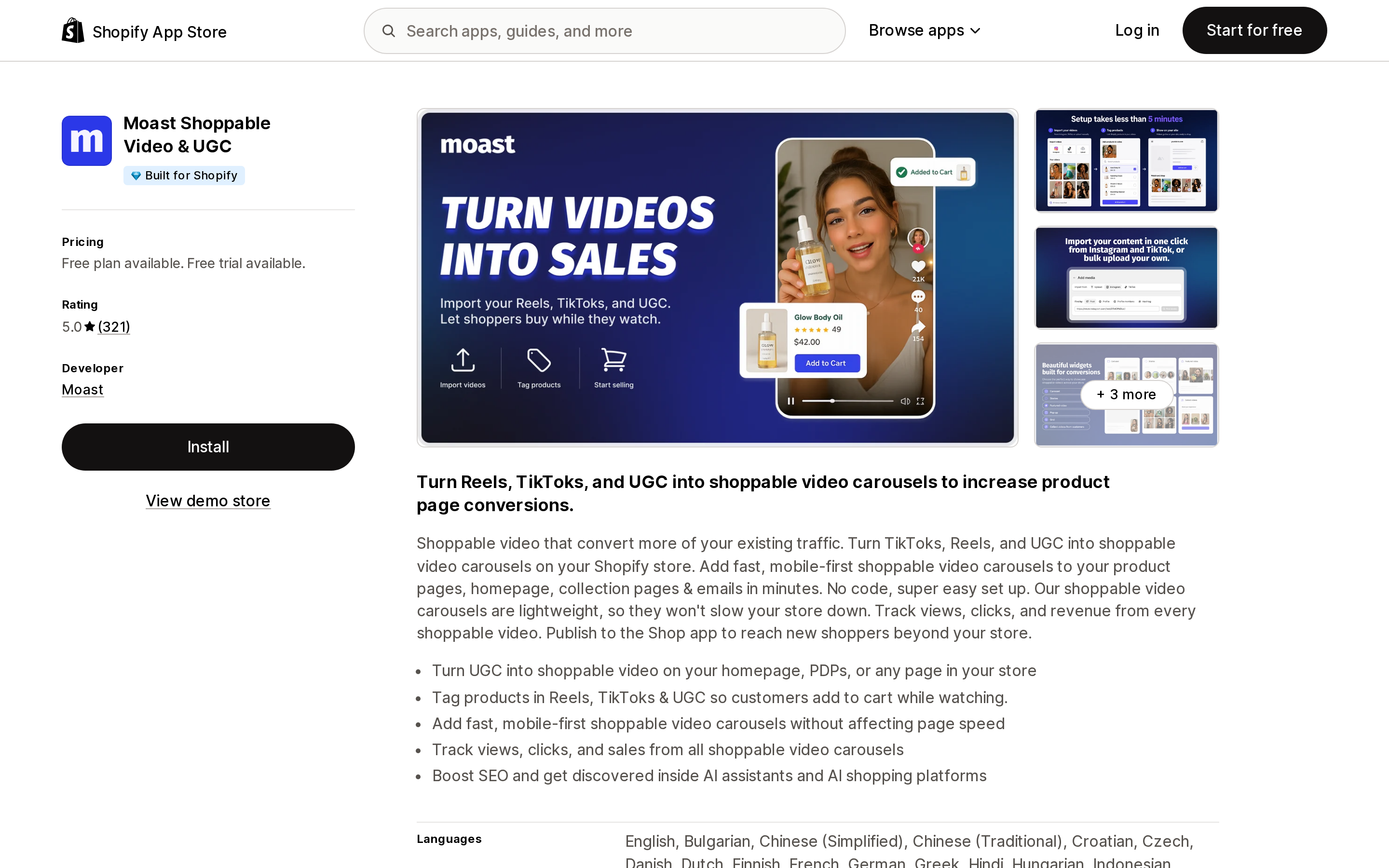
5.0 from 321 reviews with zero one- or two-star reviews — the cleanest distribution of the six — and a Built for Shopify badge. Developer Moast, based in Kirkland, Quebec. It is also the youngest app here, launched May 16, 2024, and supports around 20 interface languages.
Pricing is the outlier: Free Forever gives unlimited views, unlimited uploads, unlimited widgets, up to 10 videos per widget and a 50 MB upload limit. Pro is $15/month or $165/year, lifting the per-widget video cap, adding multi-product tagging, removing branding, adding UGC collection and a 200 MB upload limit. The vendor's wording is unambiguous: zero usage charges, never charged based on views, the most you will ever pay is $15/month.
The structural advantage is quieter but larger: Moast pulls videos straight from Shopify, so your video stays on Shopify's infrastructure. Every other app in this comparison hosts on its own servers, which means leaving requires re-uploading your library through Shopify's 1,000-videos-per-week ceiling. Moast is the only one where the exit is close to free.
Two things to weigh. It has no livestream or live selling, the narrowest feature set here. And its own pages carry a performance contradiction — one describes a 6 KB widget code, another reports 0.85 MB loaded — so if page weight is a hard requirement, measure it rather than trusting either number. It also requests the broadest data access of the six, including sensitive customer data, orders and discounts.
Best fit: most US DTC merchants who want a shoppable feed with a predictable invoice. Poor fit: livestream selling, or AI video generation.
ReelUp‑Shoppable Videos+Reels
Source: Shopify App Store (ReelUp‑Shoppable Videos+Reels), retrieved September 2, 2026
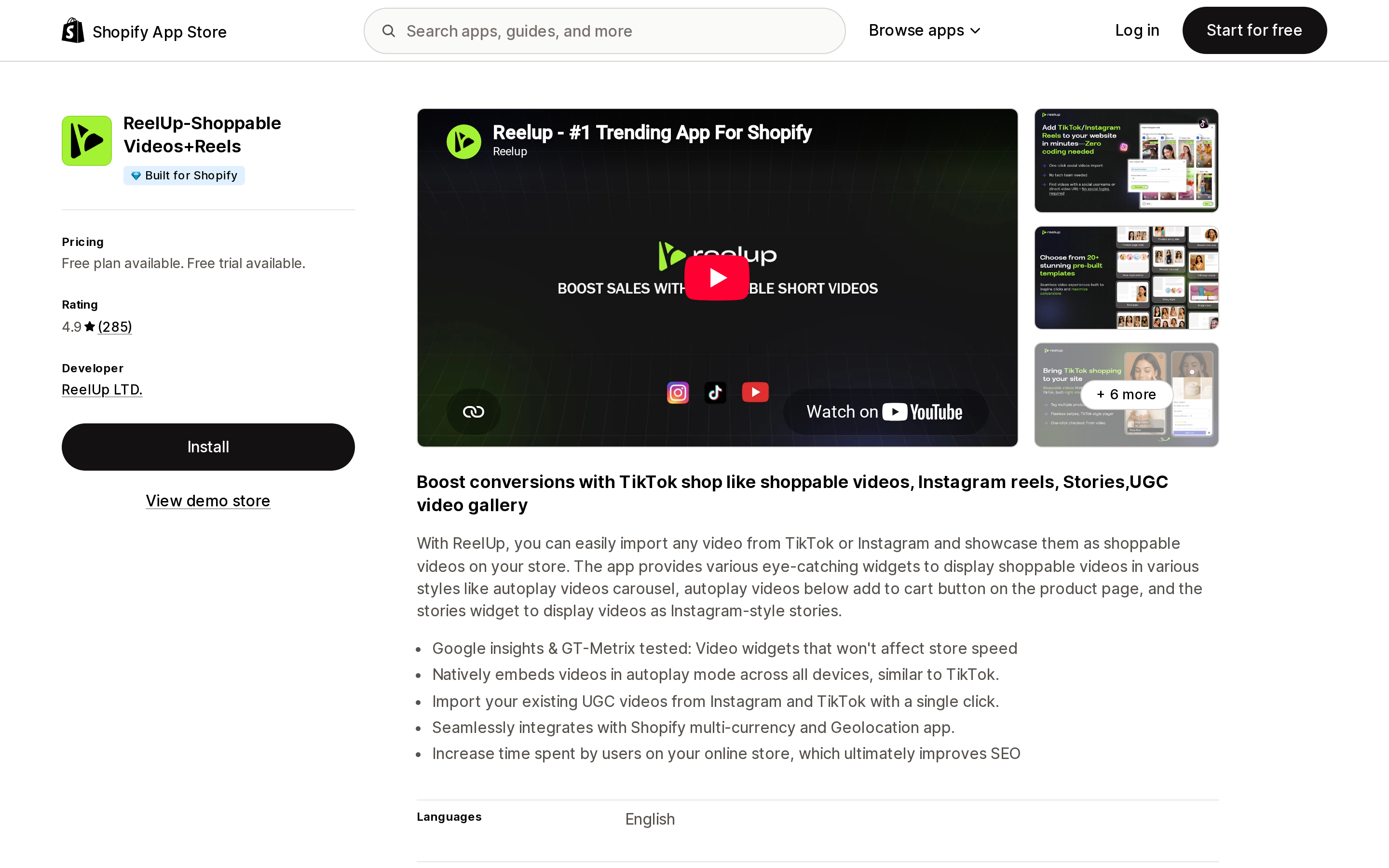
4.9 from 285 reviews, Built for Shopify badge, developer ReelUp LTD, English only. It is the most TikTok-like of the group, describing native autoplay embedding across all devices.
- Free Forever — 100 views, roughly 500 clicks, 10 videos
- Basic $29.99/month — 3,000 views, ~20,000 clicks, 100 videos
- Premium $99.99/month — 20,000 views, ~100,000 clicks, 250 videos
- Elite $199.99/month — 50,000 views, ~250,000 clicks, 1,000 videos
Impressions are unlimited on all tiers and a view requires more than four seconds of watching, which is the fairest-looking meter here on paper. Adaptive bitrate streaming is Premium and above; maximum video duration scales by tier from 5 to 30 minutes. Trial is 7 days.
Two cautions. The free tier's 100 views a month is not a usable pilot. And ReelUp has no documentation site — help, docs and support subdomains do not resolve, and the FAQ text exists only inside a client-side script bundle. Uninstall behaviour and theme integration model are entirely undocumented, and the listing says nothing about app blocks, Online Store 2.0, or vintage themes; the integrations it documents are page builders (PageFly, GemPages, Shogun, LayoutHub, EComposer). One August 2026 review from a UAE merchant disputes the metering in practice, describing being billed $40 against an expected $30 for a few hundred views — one review, not a pattern, but it is the exact failure mode a view-based meter is supposed to prevent, so verify your first invoice.
Best fit: merchants who want the closest thing to a real TikTok feed and prefer engagement-based billing. Poor fit: anyone who needs a written uninstall policy or documented theme integration before installing.
Vidjet Shoppable Videos +Story
Source: Shopify App Store (Vidjet Shoppable Videos +Story), retrieved September 2, 2026
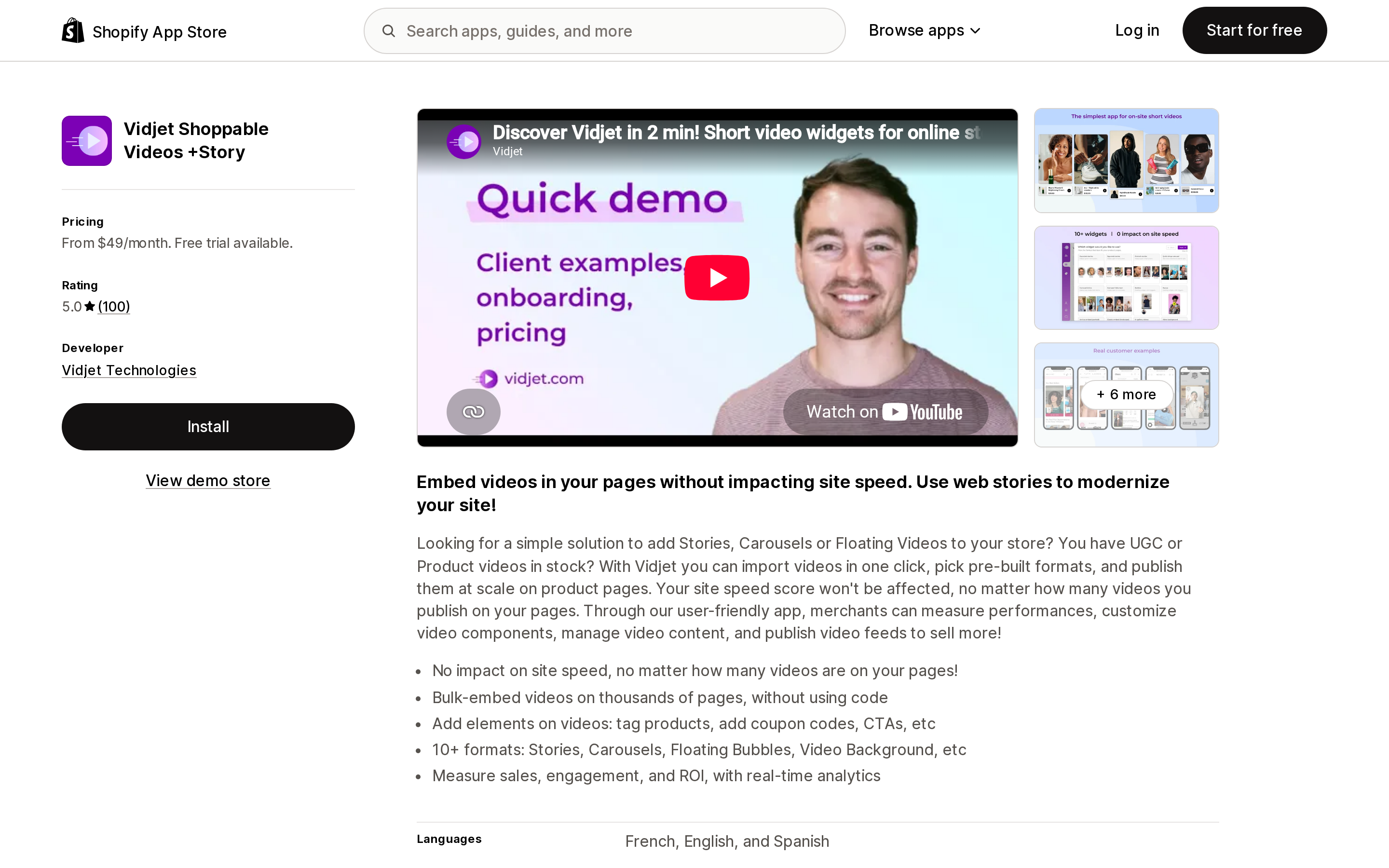
5.0 from 100 reviews — the smallest review base here — developer Vidjet Technologies, Barcelona, launched December 15, 2020. Interface in French, English and Spanish. It is the only app here with no free plan, trial only.
- Starter $49/month ($39 annual) — 4,000 views, 40 hosted videos
- Growth $99 ($79) — 10,000 views, 100 videos
- Scale $249 ($199) — 30,000 views, 300 videos
- Pro $499 ($399) — 60,000 views, 600 videos
Impressions and widgets are unlimited on every tier, and a view is again four seconds of engagement. It also requests narrower data access than most — no customer data.
Two structural risks. It meters two things at once: views and hosted videos. The video caps are the tightest here (40 on the entry tier), so a large UGC library is expensive before traffic is even considered. And the overage behaviour is the harshest in the group: exceed your view cap and videos stop showing until the next billing cycle. That is a merchandising outage triggered by success. There is also an unresolved contradiction in its own materials, with the plan table citing 500 MB to 1 GB upload sizes and the FAQ citing 300 MB.
Best fit: an established brand with a curated library under 100 videos and steady, predictable traffic. Poor fit: large UGC backlogs, or anyone who cannot accept video disappearing mid-month.
Tolstoy: Shoppable Video & UGC
Source: Shopify App Store (Tolstoy: Shoppable Video & UGC), retrieved September 2, 2026
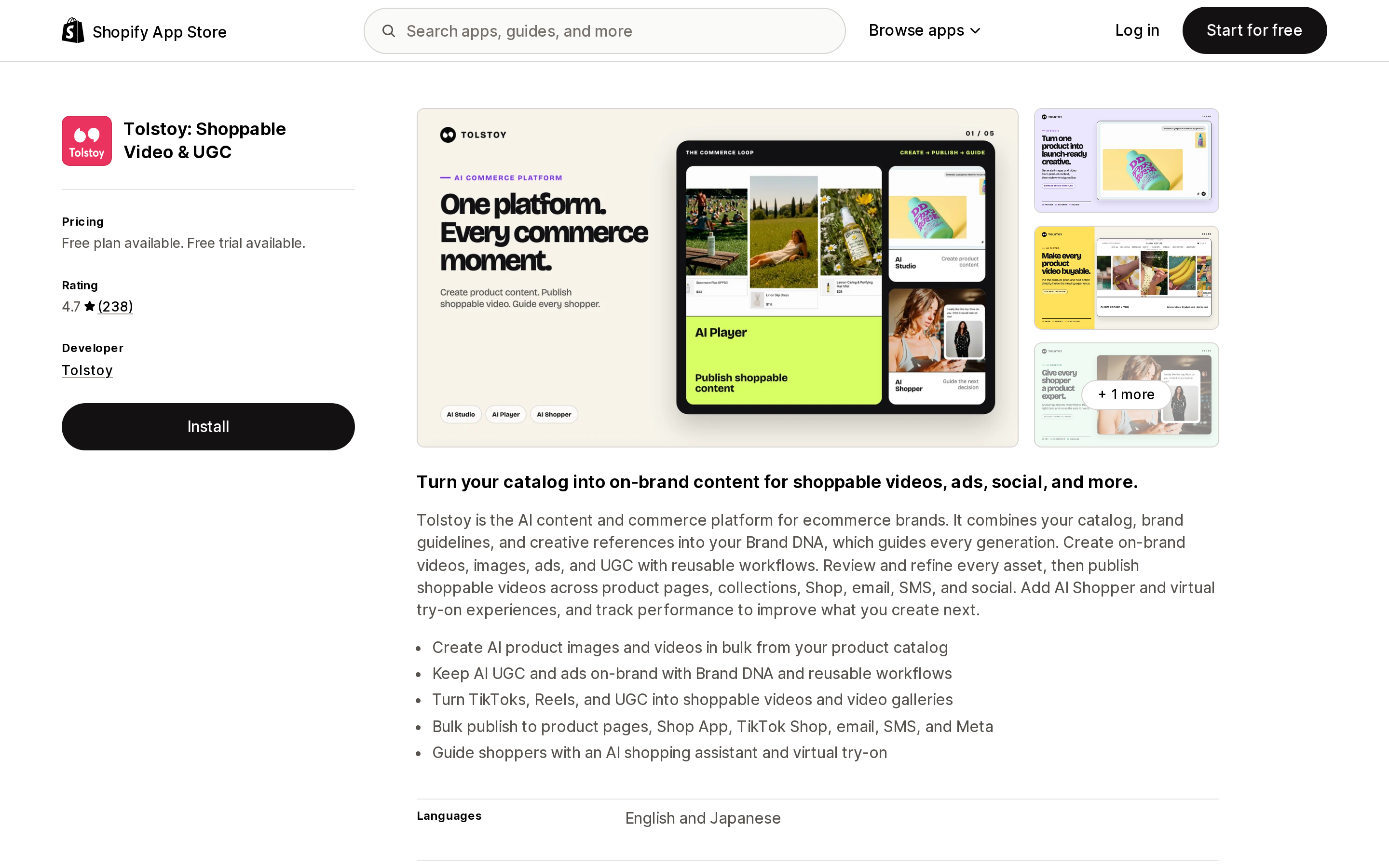
4.7 from 238 reviews — the lowest rating of the six, with 7 one-star reviews, the weakest tail here. Developer Tolstoy, interface in English and Japanese. It has repositioned as an AI content platform, with an AI Player, AI Studio and AI Shopper, virtual try-on, and a competitor-ad recreation feature.
Pricing on the App Store: Free; Shoppable Plus $19/month for 5,000 impressions with $10 per 1,000 overage; Bundle Plus $39 adding Studio and Shopper tokens; Bundle Pro $199 for 20,000 impressions. The vendor's standalone AI Player pricing runs Plus $19, Pro $99 (20,000 impressions, $7 per 1,000), Max $299 (50,000, $5 per 1,000).
Two things separate it. It is impression-metered, so as shown above it can be the most expensive option on a high-traffic store despite the low entry price — though unlike Vidjet, it keeps running and bills you rather than going dark. And it is the only vendor here that documents what happens when you leave: downgrading or cancelling to Free automatically unpublishes and removes all live Tolstoy widgets from the site, though the block or embed code still needs manual removal. In a category where four of six vendors say nothing about uninstalling, that is worth something.
The token system adds a second currency alongside impressions, which makes forecasting harder rather than easier. And a Swedish merchant of seven months notes that the UI is not straightforward and changes often, while praising support.
Best fit: brands that want AI content generation and multi-channel distribution alongside the on-site widget. Poor fit: high-traffic, budget-sensitive stores.
Videowise Shoppable Video UGC
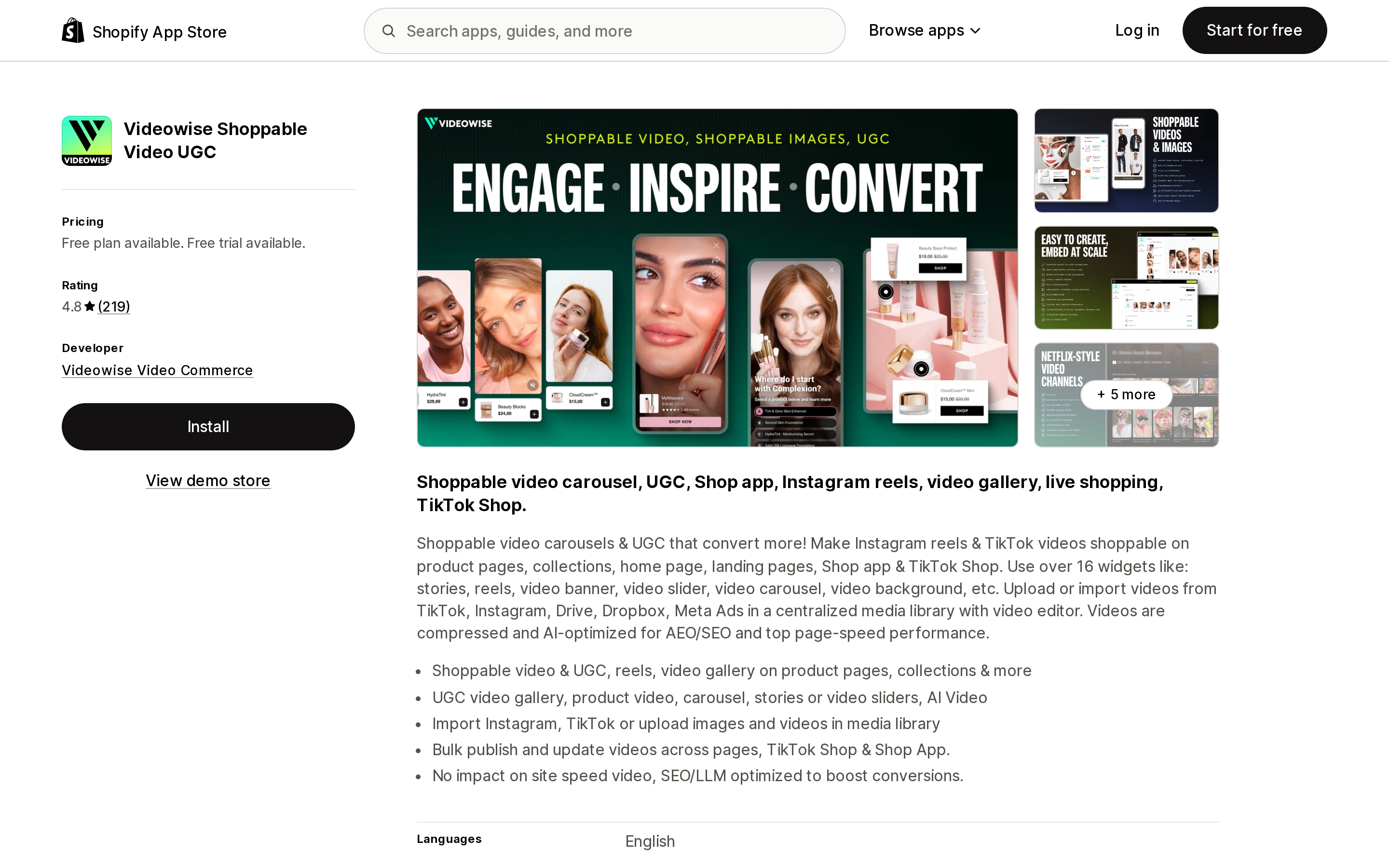
Source: Shopify App Store (Videowise Shoppable Video UGC), retrieved September 2, 2026
4.8 from 219 reviews, developer Videowise Video Commerce, Dover, Delaware, launched September 1, 2020. The broadest feature set: carousels, UGC galleries, stories, sliders, TikTok Shop and Shop App publishing, AI video — and it is the only app here with live shopping, which Videowise's own pricing page lists from $299/month ($239/month billed annually).
Pricing is where it gets difficult. The App Store listing shows Free (Shop App and TikTok Shop publishing, no on-site widgets) and Pro at $9/month for 5,000 impressions with extra impressions at $10. Videowise's own help centre lists Pro at $19/month and Advanced at $299 for 50,000 impressions. And videowise.com/pricing lists Shoppable Video from $299/month for up to 50,000 monthly visitors. Three official surfaces, three different numbers. The "unique impression" it bills on is never defined, and the per-unit overage rate is not published.
Two further limits. The widgets do not autoplay — the vendor states visitors must click first, which is a notable trade-off for an app in the TikTok-feed category. And on vintage, non-Online-Store-2.0 themes, installation requires editing product-template.liquid directly; even on OS 2.0 it needs the app embed, the block, and a pasted snippet. Uninstall behaviour is not documented, and an August 2026 US review reports being charged after uninstalling.
Best fit: mid-market and Plus brands that want live shopping and video from one vendor, on a negotiated contract. Poor fit: smaller merchants who need a predictable bill, or anyone on a vintage theme without dev time.
Whatmore Shoppable Videos&Reel
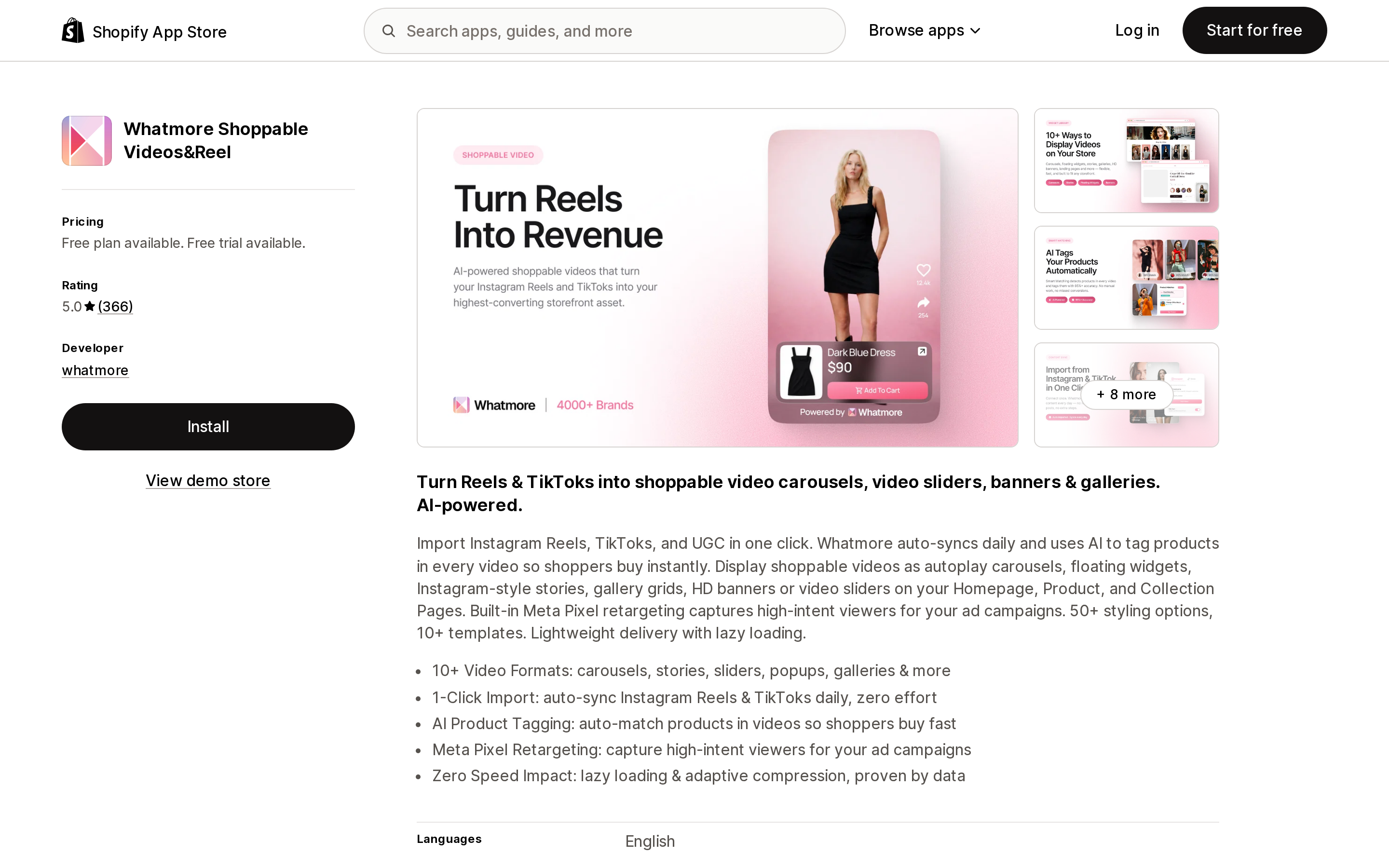
Source: Shopify App Store (Whatmore Shoppable Videos&Reel), retrieved September 2, 2026
5.0 from 366 reviews, the largest review base of the six, though no Built for Shopify badge. Developer whatmore, listed at an address in HSR Layout, Bangalore, English only. The most AI-forward on ingestion: daily automatic Instagram and TikTok sync, AI product tagging, and — unique here — Meta Pixel retargeting of video viewers.
- Free Forever — 300 clicks/month, 15 videos, 5 AI matches
- Starter $29/month ($278/year) — 3,000 clicks, 100 videos, 10 AI matches
- Growth $79 ($758/year) — 15,000 clicks, 300 videos, 20 AI matches
- Scale $149 ($1,430/year) — 40,000 clicks, unlimited videos and AI matches
On engagement allowance per dollar this is the most generous list here — 40,000 clicks for $149.
The caveats are about definition and evidence. A "video click" is never defined, which makes the bill unmodelable in advance. The free plan's allowance is stated as 300 clicks on the App Store and 500 in the vendor's own FAQ, and one review references an 8,000-click plan that matches no published tier. Uninstall behaviour and hosting are not stated. And for a US reader the review base is the weakest signal here: 366 reviews weighted heavily toward Indian merchants.
Best fit: merchants who want the largest engagement bundle per dollar plus Meta retargeting of viewers. Poor fit: anyone who needs to forecast the bill precisely, or who wants US peer references.
The costs nobody puts on the pricing page
Leaving is expensive for five of the six. Shopify's own guidance is explicit: uninstalling an app does not automatically remove its code from your theme, and you may need to contact the developer for removal instructions. Layer vendor-side hosting on top and switching means re-uploading your entire library — through the 1,000-videos-per-week cap. Only Moast keeps video on Shopify. Only Tolstoy documents cancellation cleanup. Videowise, ReelUp, Moast and Whatmore say nothing about uninstalling at all.
Vintage themes are a hidden line item. Videowise explicitly requires editing product-template.liquid on non-OS 2.0 themes. Tolstoy documents a Custom Liquid fallback and requires pasting a widget code even inside the app block. ReelUp, Moast and Whatmore do not state their vintage-theme path. None of this appears on the App Store listing, so ask before you install.
Every performance number here is vendor-stated. ReelUp's "100 PageSpeed" and "0ms load impact" carry no methodology. Moast's "200+ Shopify store tests" is unpublished. Conversion claims across all six — 2× higher, 3.5× lift, 17–33% — are marketing, not evidence. The one measurable performance fact in this article is Shopify's own: enabling loop on a native video disables HLS.
How to choose
If predictable cost matters most → Moast. Flat $15, no metering, one of two Built for Shopify badges, video stays on Shopify. On a store with real traffic it is often the cheapest option in absolute terms, not just the simplest.
If your traffic is high and engagement is unproven → avoid impression-metered apps. Videowise and Tolstoy are the two, and the worked example above is why.
If you want to pay only for people who actually watch → ReelUp or Vidjet. Both define a view as four seconds. ReelUp is cheaper to enter and has a free tier; Vidjet does not.
If you have a large UGC backlog → avoid Vidjet. Hosted-video caps of 40, 100, 300 and 600 are the tightest constraint in the group.
If a blank product page is worse than a surprise invoice → avoid Vidjet, prefer Tolstoy. One goes dark on overage; the other bills you and keeps serving.
If you need livestream selling → Videowise is the only option here.
If you want Instagram and TikTok pulled in automatically and viewers retargeted on Meta → Whatmore, with the caveat that you cannot model the bill from a unit the vendor does not define.
And if you only need one video per product with no tagging — native Shopify already does that, free, on a CDN, with lazy loading. Check that before you buy a meter.
Sources
- Shopify Help Center: Product media types, Adding product media, File uploads, Improving web performance
- shopify.dev:
video_tagfilter, Supporting media in themes, Theme app extensions - Shopify App Store listings for Videowise Shoppable Video UGC, Tolstoy: Shoppable Video & UGC, ReelUp‑Shoppable Videos+Reels, Vidjet Shoppable Videos +Story, Moast Shoppable Video & UGC, and Whatmore Shoppable Videos&Reel, retrieved September 2, 2026
- Vendor pricing: videowise.com/pricing, gotolstoy.com/pricing, reelup.io pricing, vidjet.com/pricing, moast.io/pricing, whatmore.ai/pricing
Shop Pay Installments is free to activate, needs no app, and Shopify never publishes what it costs you — the rate is visible only inside your own admin. It also refuses Capital One and Chase credit cards, restricts monthly plans to debit cards only, excludes gift cards and subscriptions, and can't be turned off for individual products. Affirm can suspend your account for being password-protected, for having a non-English storefront, or for being primarily B2B. And Shopify's Getting paid page says disputes appear in your admin while its FAQ says they don't. If you fail the eligibility gates, the alternative is on-site messaging apps from Klarna, Afterpay, Sezzle, Zip, and PayPal — a category rated between 1.0 and 3.2 stars. Researched September 2, 2026.