
What you will learn
On this pageContentsCloseOpen
There is a specific moment that makes US wholesale merchants go looking for a Shopify app: a state auditor asks for the resale certificates behind three years of untaxed sales, and the merchant discovers that Shopify recorded the decision and none of the evidence.
This is not a bug, and it is not the usual "Shopify has no native feature" story either. Shopify's B2B tax exemption handling is more capable than most write-ups admit — you get named exemption types per company location, not a single blunt toggle. What is missing is narrower and worse: there is nowhere in Shopify to put the certificate. No file field, no expiry date, no issuing state, no record of who approved it or when.
And when merchants go to the App Store to fix that, they hit the second problem. The App Store's own Exemption management feature filter returns 182 apps, and the first page of results is Indian GST invoicing, German fiscal receipt printers, French Factur-X, PDF invoice generators, and US sales tax filing platforms.
The short version
- Shopify B2B tax settings offer three states per company location: Collect tax, Don't collect tax, and Collect tax unless exemptions apply with named exemption types selected from a menu. That last option is a real jurisdiction-aware exemption, not a boolean.
- Exemptions are location-specific. Shopify's Help Center states plainly that changes made on the company page apply to all locations in bulk, "but some information, such as tax IDs and exemptions, is location-specific and must be updated from the location page."
- Nothing in Shopify stores the certificate document, its expiry, or its issuing state.
- The App Store's Exemption management filter returns 182 apps. Almost none of them collect US resale certificates.
- EU VAT exemption and US resale exemption are not the same product. The EU has VIES — a government API you can validate a VAT ID against in real time. The US has no equivalent. So EU exemption is a $9.99/month automated widget with a Built for Shopify badge, and US exemption is a PDF someone has to read.
- The one App Store app built specifically for US resale certificates, ExemptSync ‑ Auto Tax Certs, launched April 1, 2026 with zero reviews and requests only customer-edit access — meaning it can set the flag but cannot see whether the exemption was applied correctly on any order.
What Shopify actually does, which is more than you think
Set up a B2B company and open a company location. Per the Help Center page on creating and managing B2B customers using companies, the Taxes section gives you a Tax ID field and a Tax settings dropdown with three choices:
- Collect tax
- Don't collect tax
- Collect tax unless exemptions apply — then pick exemptions from a Select exemptions menu
That third option is the good one and the one most merchants never find. It means Shopify can hold "this location is exempt for these specific reasons" rather than "never charge this company tax anywhere for anything." If your buyer's resale certificate covers Texas but you also have nexus in California, the difference between option two and option three is the difference between a clean audit and an assessment.
Shopify also validates VAT numbers automatically for companies with a UK or EU shipping address when using Shopify Tax — the Tax ID field changes to VAT number and Shopify validates it. There is no US analogue, because there is nothing to validate against.
Three constraints worth writing down before you design a process:
Exemptions live on the location, not the company. From the Help Center: "Changes made from the company page apply to all company locations in bulk, but some information, such as tax IDs and exemptions, is location-specific and must be updated from the location page." The same page notes that plans supporting B2B "allow you to set tax exemptions at the company or location level," so the setting exists in both places — but edits made from the company page will not push a tax ID or an exemption down to the locations. A chain with fourteen store locations needs the exemption confirmed on each location record, and updating it later from the company page will not reach them.
A company location maxes out at 50 customers and 25 catalogs, and a company at 10,000 locations. Rarely binding, but worth knowing before you model a franchise.
Customer tax exemptions take precedence over tax overrides. If a customer is exempt, product-level tax overrides don't get a vote.
And then the gap. Search the entire Help Center flow above for a place to attach the actual document and there isn't one. Shopify stores the tax ID string and the exemption selection. The certificate — the thing the state actually wants — lives in someone's email, a shared drive, or a filing cabinet.
Why the App Store filter is useless here
Shopify tags apps with a feature filter called Exemption management under Taxes → Tax calculation. Filtering on it returns 182 apps. Here is what actually leads that list, in order, as displayed on September 2, 2026:
| Position | App | What it is |
|---|---|---|
| 1 | GST Pro: GST Invoice India | Indian GST invoicing |
| 2 | Oxilayer PDF Invoice Generator | PDF invoices |
| 3 | WebPlanex: GST Invoice India | Indian GST invoicing |
| 4 | OpenFiskal TSE & RKSV for POS | German/Austrian fiscal receipts |
| 5 | TaxCloud Sales Tax Automation | US sales tax filing |
| 6 | Numeral Sales Tax | US sales tax filing |
| 7 | FF: Factures Client en France | French invoicing |
| 8 | Simple Invoice ‑ Order Printer | PDF invoices |
| 9 | Sufio: Invoices You Can Trust | PDF invoices |
| 10 | VAT/ TAX Exemption & invoices | EU VAT ID validation |
Seven of the first ten results are invoicing tools or country-specific fiscal compliance. Two more, TaxCloud and Numeral, are US sales tax filing platforms — genuinely useful, and we come back to them below, but they are not certificate management. Exactly one result — at position ten — is an exemption product, and it is for the EU.
This matters more than a listicle grumble. If you are a US wholesale merchant who reasonably searches for the thing you need, the App Store's own taxonomy will hand you a stack of PDF invoice generators. The filter is measuring "this app touches tax exemptions somewhere in its logic," not "this app manages exemption certificates."
EU exemption and US exemption are different products
This is the structural fact underneath everything else, and it explains why one side of the category looks mature and the other looks empty.
The EU side, where a government API exists
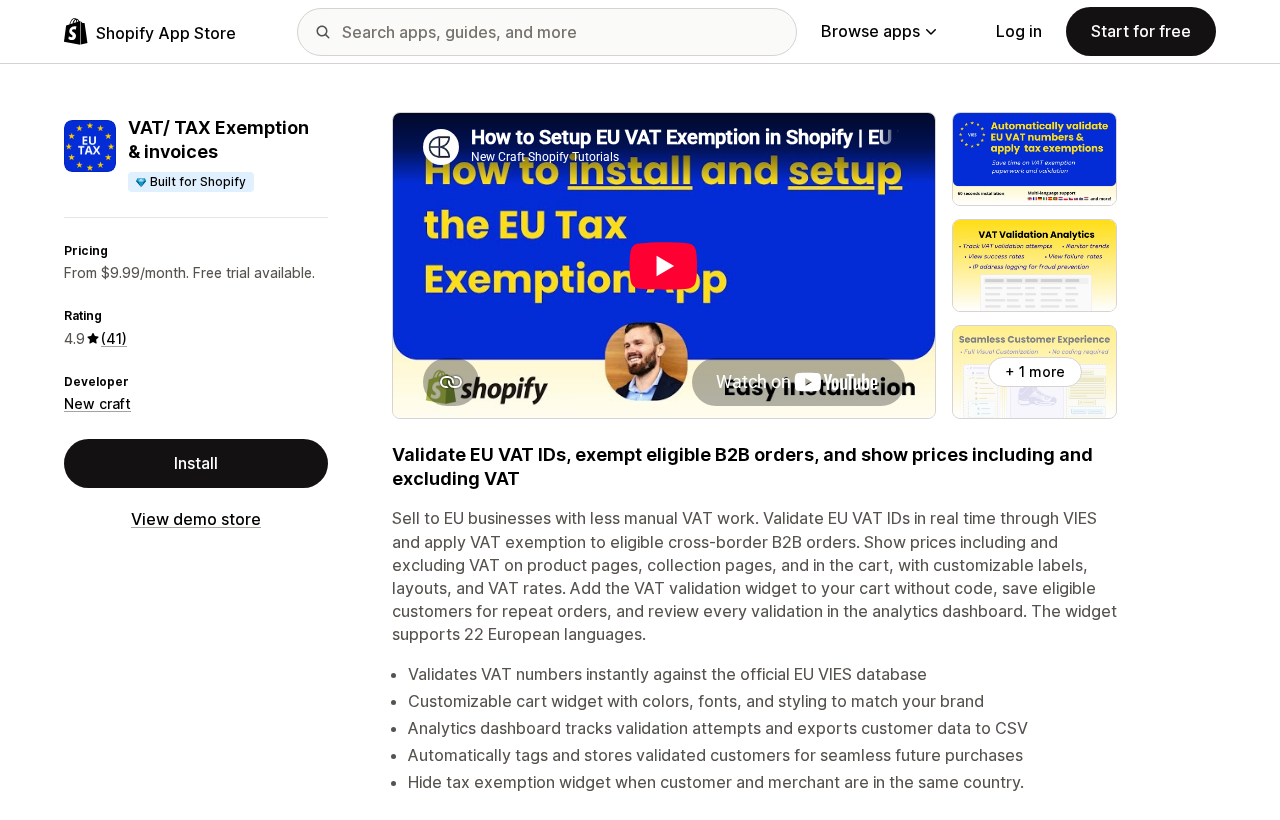
Source: Shopify App Store, retrieved September 2, 2026.
VAT/ TAX Exemption & invoices, from New craft in Barneveld, Netherlands, carries the Built for Shopify badge, rates 4.9 across 41 reviews, and launched October 24, 2025. It validates VAT numbers "instantly against the official EU VIES database," applies exemption to eligible cross-border B2B orders, and shows prices including and excluding VAT. Widget in 22 European languages.
Pricing: $9.99/month Starter, $24.99/month Professional, $49.99/month B2B Plus Portal (annual saves 17%). Note the gate on the middle tier — "Checkout VAT validation (Plus only)". The listing does not define "Plus," and the app has its own tier named B2B Plus Portal, so confirm with the developer whether that means Shopify Plus or their own plan. Either way, cart-level validation is on the entry tier and checkout-level validation is not.
The reason this product can exist, be cheap, and be automatic is that the European Commission runs VIES, a public service that will tell you in real time whether a VAT number is valid. Exemption becomes a lookup.
The US side, where no registry exists
There is no national resale certificate registry in the United States. Certificates are issued per state, in different formats, some with expiry dates and some without, some accepting a multi-state form and some not. No API will tell you whether the certificate a buyer uploaded is real and current. Verification, where it is available at all, is a state-by-state web form.
So the US product cannot be a validator. It can only be a filing cabinet with reminders — collect the document, extract what you can from it, store it, chase it before it expires, and produce it on demand.
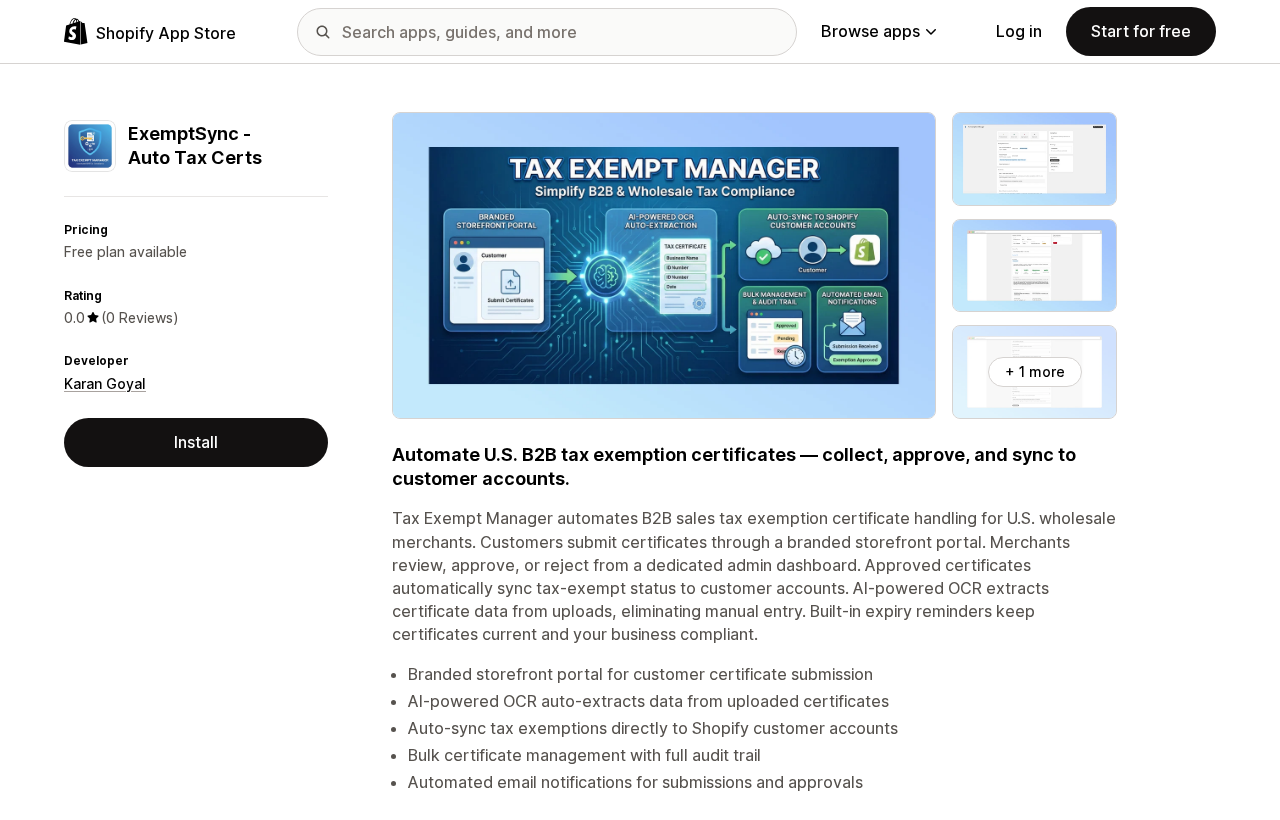
Source: Shopify App Store, retrieved September 2, 2026.
ExemptSync ‑ Auto Tax Certs is the App Store app built for exactly that. Launched April 1, 2026, developer Karan Goyal, based in Nabha, Punjab, India. Rating 0.0 across zero reviews.
Pricing is metered by certificates on file, which is the right unit:
| Plan | Price | Certificates |
|---|---|---|
| Free | Free | Up to 5 |
| Starter | $9.99/month | Up to 50 |
| Professional | $19.99/month | Unlimited |
Every tier includes the same features — customer portal, AI-powered OCR, auto-sync to Shopify — so you are only paying for volume. For a wholesaler with 200 exempt accounts, $19.99/month is a rounding error against the exposure.
Two things to weigh honestly. First, zero reviews on a five-month-old app from a solo developer, holding your compliance evidence. That is a diligence question, not a disqualification, but it is the question.
Second, and more concrete: its requested data access is only "Edit customers." Not orders, not taxes. Which tells you exactly what it does and does not do. It can collect a certificate and flip the customer's exempt status. It cannot look at your orders to tell you that an exemption got applied in a state the certificate doesn't cover, or that you shipped $40,000 untaxed against a certificate that expired in March. The expiry reminders it advertises run off the certificate record it holds, not off your tax liability.
There are also products off the App Store in this space — Exemptra and EXEMPTAX among them — and the big tax engines (Avalara, Vertex) sell certificate management as a separate module. Those live outside the App Store listing data this article is built from, so we have not priced them.
The third path: let the tax engine own it
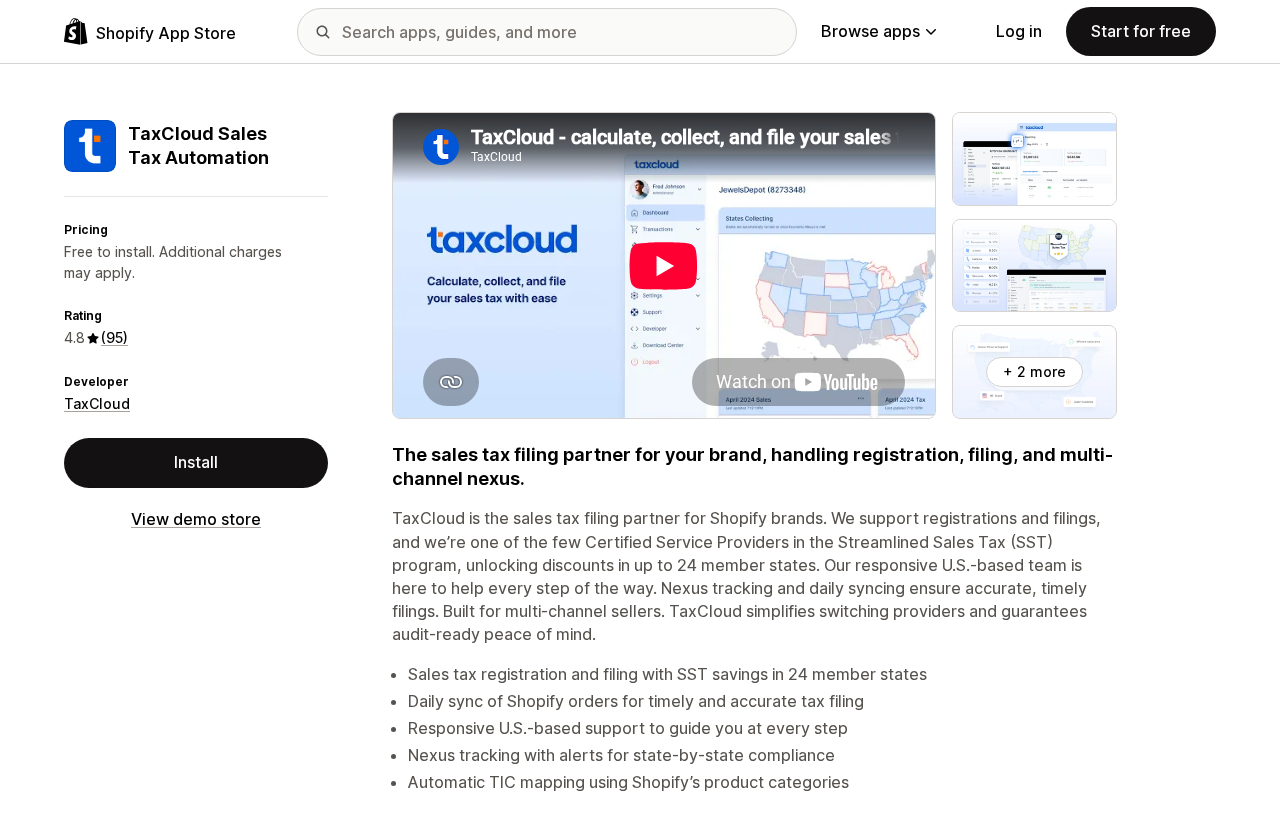
Source: Shopify App Store, retrieved September 2, 2026.
The US sales tax platforms that carry the Exemption management tag — TaxCloud (4.8, 95 reviews, free to install), Numeral (4.5, 129 reviews), Kintsugi (4.7, 26 reviews), Sidr (5.0, 63 reviews), TaxRex (5.0, 118 reviews) — approach it from the other end. They own tax calculation and filing, so an exemption is a rule inside their engine rather than a flag on a Shopify customer. If they hold the exemption, the exempt sale shows up correctly on the return they file for you.
That is the meaningful architectural difference. A certificate app writes to Shopify's customer record. A tax engine writes to the return. If you are already paying one of these to file, ask what their certificate handling covers before you add a second app — and note that Shopify Tax itself now files US returns, which we covered separately in our Shopify Tax filing comparison.
How to choose
Selling B2B into the EU → the VIES route. Real-time validation exists; use it. VAT/ TAX Exemption & invoices at $9.99/month is Built for Shopify with 41 reviews. Budget the Professional tier if you need validation at checkout rather than in the cart, and note that path is Plus-only.
US wholesale, fewer than ~5 exempt accounts → do it manually, but do it properly. Set the company location to "Collect tax unless exemptions apply" with the correct exemption types, store the PDF somewhere you will find it in three years, and put the expiry dates in a calendar. An app buys you a portal and reminders, not a legal position.
US wholesale, dozens of exempt accounts → you need a system, and the App Store has one candidate. ExemptSync is priced correctly and does the right job. Its zero reviews are a real risk on a compliance workflow; ask the developer about data export before you put 200 certificates in it, so you can leave.
Already paying a US tax engine to file → start there, not with a certificate app. An exemption your filing platform doesn't know about is an exemption that will not reconcile on the return.
Whatever you choose, verify the exemption on each company location. Updates made from the company page do not carry tax IDs or exemptions down to locations, and the failure is silent — tax keeps getting charged, or worse, doesn't.
What we could not confirm
- Whether Shopify's "Select exemptions" menu offers jurisdiction-scoped US exemption types (per-state resale, nonprofit, government) or a shorter generic list. The Help Center describes the control but does not enumerate the options.
- Whether ExemptSync's OCR extraction populates an expiry date it can act on, or only stores what it read.
- What Avalara's and Vertex's certificate management modules cost for a Shopify merchant. Neither publishes Shopify-specific pricing we could verify.
- Whether any App Store app checks a submitted certificate against a state verification service. None of the listings we read claim to.
- Nothing in this article is tax advice. Exemption validity is a question for a tax professional in the states where you have nexus.
References
- Creating and managing B2B customers using companies — Shopify Help Center
- Creating B2B orders using draft orders — Shopify Help Center
- Tax apps with Exemption management features — Shopify App Store
- ExemptSync ‑ Auto Tax Certs — Shopify App Store
- VAT/ TAX Exemption & invoices — Shopify App Store
- TaxCloud Sales Tax Automation — Shopify App Store
All App Store figures retrieved September 2, 2026.
Shop Pay Installments is free to activate, needs no app, and Shopify never publishes what it costs you — the rate is visible only inside your own admin. It also refuses Capital One and Chase credit cards, restricts monthly plans to debit cards only, excludes gift cards and subscriptions, and can't be turned off for individual products. Affirm can suspend your account for being password-protected, for having a non-English storefront, or for being primarily B2B. And Shopify's Getting paid page says disputes appear in your admin while its FAQ says they don't. If you fail the eligibility gates, the alternative is on-site messaging apps from Klarna, Afterpay, Sezzle, Zip, and PayPal — a category rated between 1.0 and 3.2 stars. Researched September 2, 2026.