
What you will learn
On this pageContentsCloseOpen
A trade-in is not a return. A return is an order coming backwards: Shopify knows the customer, the line item, the price paid, and the fulfillment. A trade-in is an inbound purchase of something Shopify has never seen — possibly bought from a competitor, in unknown condition, with no order behind it and no agreed price until someone looks at it.
Shopify models the first and not the second. There is native returns and exchanges, and there is native store credit, but there is no object for "customer offers me an item," no condition grading, and no way to generate an inbound shipping label for a product with no order attached.
So the recommerce category lives entirely in apps. And the App Store files three of the four apps in this comparison under Returns and exchanges, which tells you the taxonomy has not caught up either.
Research date: September 2, 2026. All prices are USD from the English (?locale=en) App Store listings.
The short version
Every trade-in program has to hand the customer something in exchange for their old jacket. That instrument — gift card, native store credit, discount code, or bank transfer — is the single decision that shapes the rest of the program, and the four apps here resolve it four different ways.
Reading each listing's Data access section rather than its marketing copy makes the difference concrete:
| App | Scopes requested that relate to payout | What the customer effectively receives |
|---|---|---|
| Tern Trade‑in | Edit gift cards, Edit store credit (store credit accounts and transactions), Edit discounts | Native store credit or a gift card |
| ReSelly | Edit gift cards (adjusting, transactions, gift cards) | Gift card |
| Recommerce by Relished | Edit discounts (discount codes and promotions) — no gift card or store credit scope listed | A discount code, or cash by bank transfer |
| Furloop (Trade‑In | Consign) | Data access section not published on the listing | Bank transfer, PayID, cash, one-time discount code, or Shopify gift card per the listing copy |
Scopes quoted from the Data access section of each Shopify App Store listing, US locale, retrieved September 2, 2026.
Tern Trade-in is the only app in this set requesting access to Shopify store credit accounts and transactions.
Why the instrument decides the program
Give a customer $200 of trade-in value and then watch them shop for a $150 jacket. What happens next depends entirely on which instrument you issued.
A gift card is money. It has a balance, it partially redeems, the remaining $50 stays on the card, and it sits in your books as a liability. It also survives across orders, which is what most customers expect from "credit."
Native store credit is money with a customer attached. Shopify tracks it as an account with transactions, tied to the customer record rather than a code someone can forward. That is better for fraud and better for reporting, and it is the instrument Tern requests scopes for.
A discount code is not money. It has no balance to carry forward, it is subject to Shopify's discount combination rules, and issuing $200 as a code against a $150 order usually means the remaining $50 evaporates. It is also the cheapest thing to implement, which is why it keeps showing up in this category.
Recommerce by Relished markets "automated store credit vouchers," and the Data access section of its listing requests Edit discounts — discount codes and promotions — without listing gift card or store credit scopes. If you need the balance to carry over between orders, ask Relished directly how the voucher behaves on a partial redemption before you launch. This is exactly the kind of thing that is invisible in a demo and very visible in a support inbox.
The price of a trade-in, once you count overages
The headline prices in this category span eleven times over, from $29 to $299 a month, and the headline is not the number you will pay. Three of the four meter items or orders and charge per unit above the included allowance.
| App | Base | Included | Overage |
|---|---|---|---|
| Furloop (Trade‑In | Consign) | $29/month Basic | 500 trade-in/consign orders, 1 location | — (unlimited at $79 Plus) |
| Recommerce by Relished | $89.70/month | 30 items/month | $2.99 per additional item |
| ReSelly | $150/month Starter | 1 store, 10 contract items | Not stated; Premium is $300/month |
| Tern Trade‑in | $299/month Standard | 100 trade-in orders + 5 users | $3.00 per additional order, shipping billed separately |
| Tern Trade‑in | $499/month Pro: Resale | 200 trade-in orders + 10 users | $2.50 per additional order |
All figures from each app's Shopify App Store listing, US locale, retrieved September 2, 2026.
Run 100 trade-ins in a month and the two mid-market options land on the same number:
- Recommerce by Relished: $89.70 + (70 × $2.99) = $299.00
- Tern Trade‑in Standard: $299 flat, 100 included = $299.00
To the cent. Two independent teams in London and Barnet arrived at the same monthly price for the same volume through completely different structures — Relished with a low base and a steep per-item charge, Tern with a high base and everything included. That is what a category looks like once everyone benchmarks everyone.
The structures separate hard in both directions. At 30 items a month Relished costs $89.70 and Tern still costs $299. At 500 items a month Relished costs $1,495.00, Tern Standard costs $1,499.00, Tern Pro costs $1,249.00 — and Furloop costs $29.
What $29 does not buy
A fifty-fold price difference always has an explanation, and here it is legible from the listing.
Furloop launched May 2, 2025, is published by an individual developer (Evan Gan, Melbourne), and has no reviews at all. Its "Works with" list contains one entry, easy post. It does not list Shopify Flow, Customer accounts, or POS. And its listing does not publish a Data access section, so you cannot audit the permissions before installing the way you can with the other three.
None of that makes it a bad app. It makes it an app with no third-party evidence behind it, holding a workflow where you are wiring money to strangers based on photographs. Price that risk deliberately rather than by accident.
The reverse also holds: Tern's $299 base is not just a bigger number, it is a different product. Five user seats, role assignment, in-store as well as online trade-in, conditional pricing by item condition, image-upload validation, Shopify Flow, and analytics with data export. If your trade-in desk has three people on it, per-seat capability stops being a luxury.
Intake and resale are two products
The word "recommerce" hides a seam. Taking an item in is one job; putting it back on the site is a different one, and the apps price them separately.
Tern Trade‑in draws the line explicitly: the $299 Standard plan is intake only, and Automated Shopify resale relisting, Upload new images for resale relisting, and Restock items against original SKU all live on the $499 Pro: Resale tier. So the honest price of a full trade-in-to-resale loop with Tern is $499/month, not $299.
Furloop publishes relisting on its $29 Basic plan — "Publish accepted stock to Shopify and take it down the moment it sells" — which is the cheapest published path from intake to live listing in this set.
Recommerce by Relished does not name relisting automation on its listing. Its three headline features are automated store credit vouchers, automated shipping labels, and smart pricing rules. Read it as an intake product.
ReSelly is not really a trade-in app at all, which is worth saying plainly before anyone compares its $150 to Furloop's $29.
ReSelly is a consignment platform, and consignment is a different business
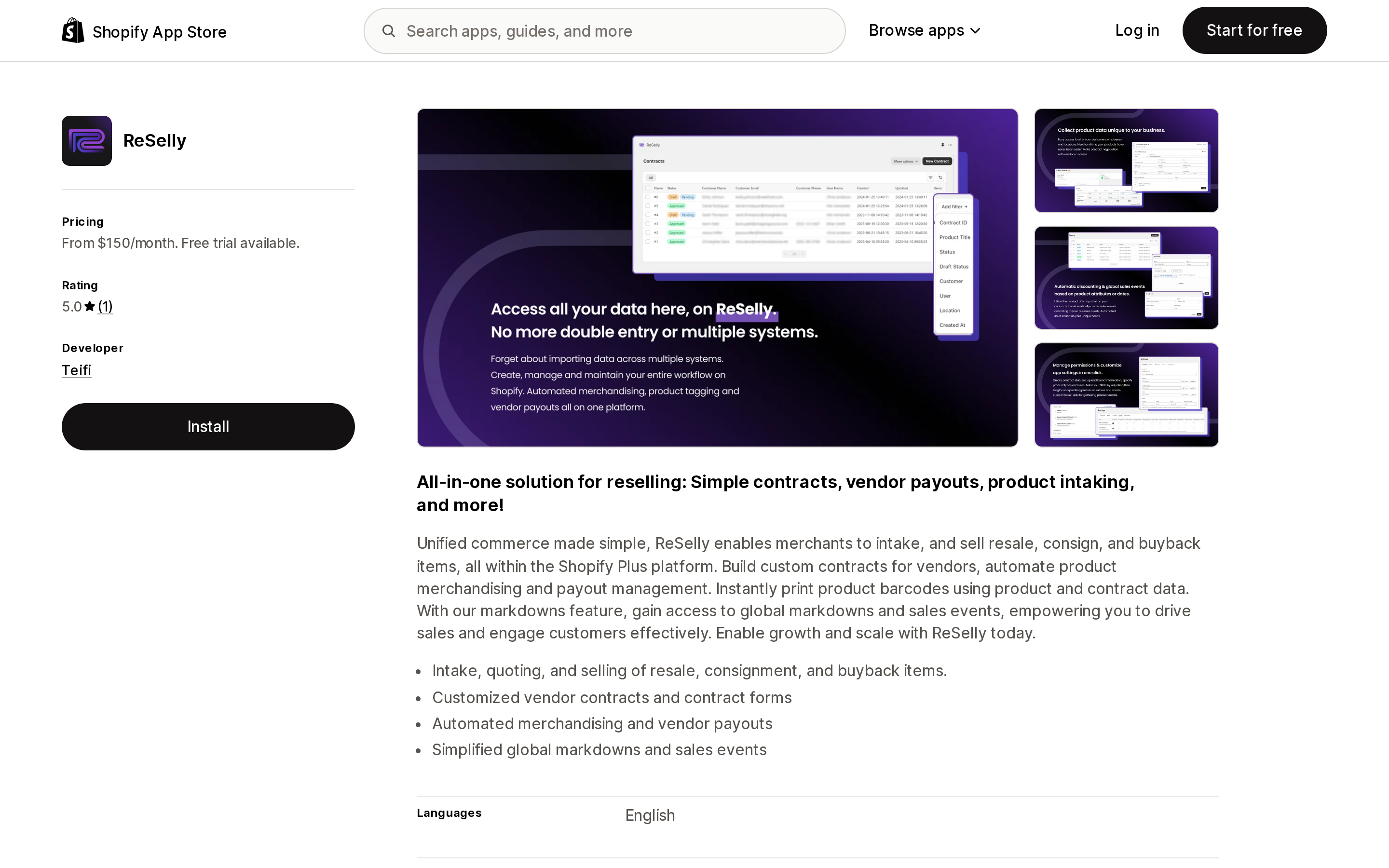
Source: Shopify App Store (ReSelly), retrieved September 2, 2026
ReSelly, by Teifi (Vancouver), launched February 14, 2024 and is rated 5.0 across 1 review. The listing describes intake, quoting, and selling of resale, consignment, and buyback items "all within the Shopify Plus platform," and it is built around custom vendor contracts, seller splits, and automated vendor payouts.
In a buyback you purchase the item and own it. In consignment you never own it — you hold it, sell it, and remit the seller's share. Those are different tax positions, different inventory accounting, and different risk. The features ReSelly leads with (contract forms, contract overview, vendor payouts, custom barcodes printed from contract data, global markdowns) only make sense for the second one.
The pricing follows the business model rather than the volume: Starter $150/month with a 10 contract item limit, Premium $300/month, then PRO tiers explicitly gated on revenue — $999/month for stores above $10M and $1,999/month above $25M. Revenue-banded pricing is rare in the App Store and tells you who this is sold to.
It also lists Shopify POS and QuickBooks under "Works with," and requests View staff accounts — the only app here that does. For a physical resale floor with staff intake, that combination is the point.
Poor fit: any store that just wants customers to mail in old products for credit. You would be paying for contract management you never open.
The apps
Tern Trade‑in — the only one wired into native store credit
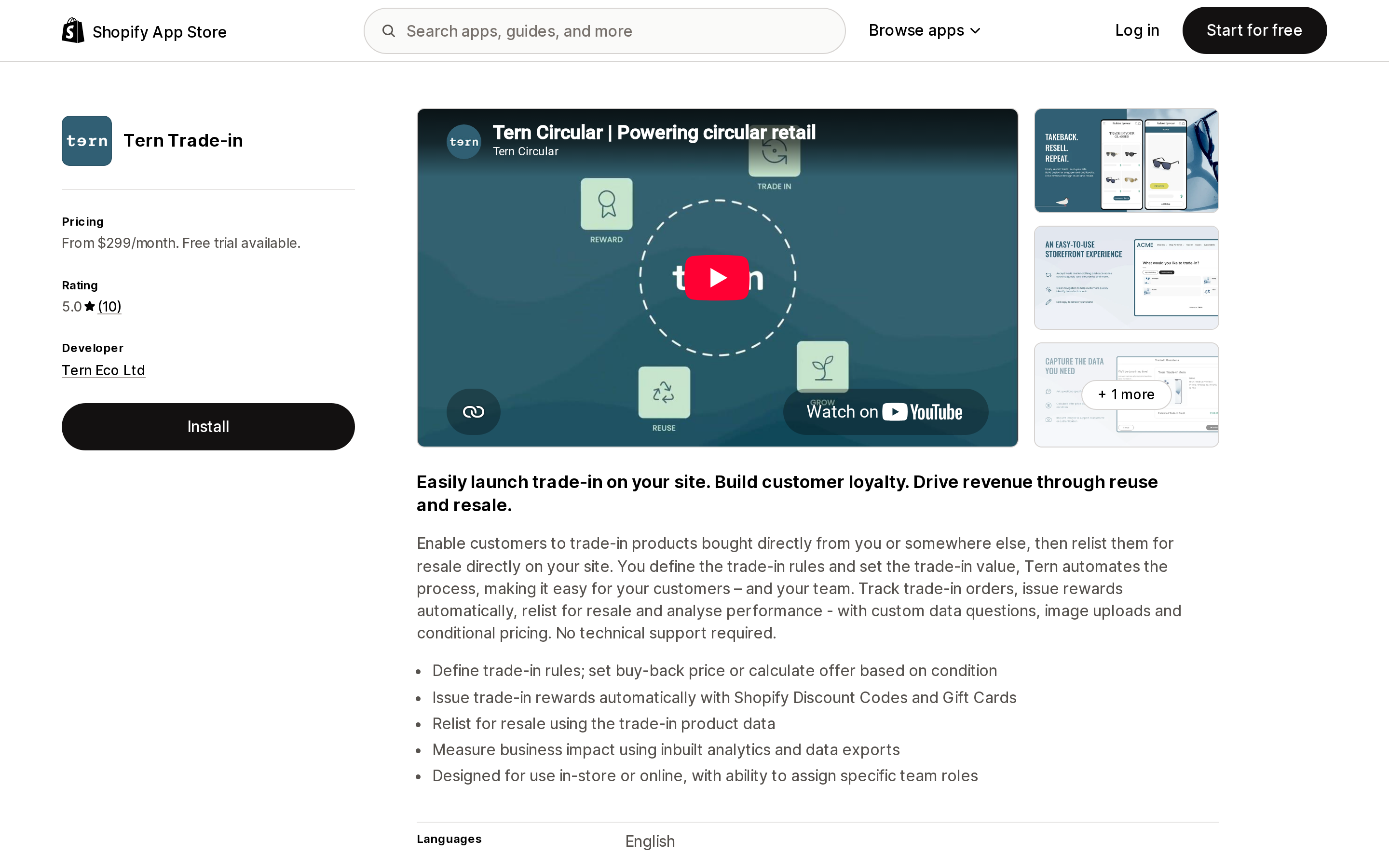
Source: Shopify App Store (Tern Trade‑in), retrieved September 2, 2026
Tern Eco Ltd, based in Barnet, England, launched Tern Trade‑in on August 6, 2021 — the oldest app in this comparison — and it holds 5.0 across 10 reviews. Two published tiers, $299 Standard and $499 Pro: Resale, both with a 30-day free trial.
Three things separate it from the rest of the set.
It accepts items you did not sell. The listing states customers can trade in products "bought directly from you or somewhere else," and Standard includes building a custom trade-in catalog as well as pulling from Shopify products or order history. Most trade-in tooling assumes the item is in your catalog; brands that want to take competitor product in exchange for credit need the catalog to be independent of the order history.
It grades condition and prices accordingly: fixed price or a percentage of RRP, with Calculate dynamic values by condition and image-upload validation. That is the mechanism that stops a trade-in program from being a refund program with extra steps.
And it requests Edit store credit — store credit accounts and transactions — alongside gift cards and discount codes, so the payout instrument is yours to choose rather than the app's to impose.
The integration list is the broadest here: Customer accounts, Shopify Flow, Google Analytics, Slack, and Webhooks. Flow in particular matters — a trade-in that lands as a Flow trigger can drive your existing Klaviyo and support automations rather than living in a silo.
Poor fit: small programs. At 30 trade-ins a month you are paying roughly $10 per trade-in for capability built for ten times that volume.
Recommerce by Relished — the low base, and read the voucher carefully
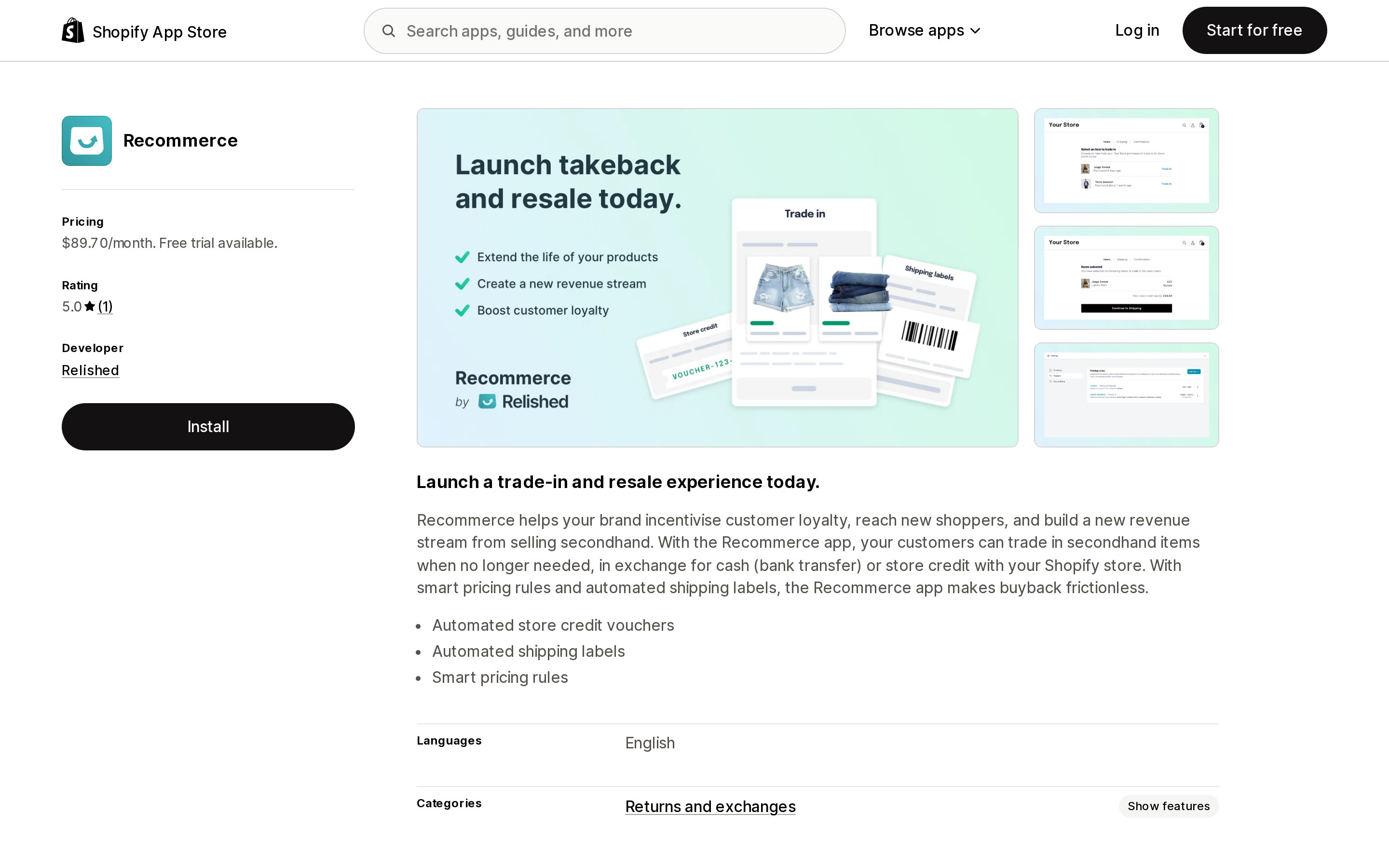
Source: Shopify App Store (Recommerce), retrieved September 2, 2026
Relished, based in London, launched Recommerce on July 26, 2022 and holds 5.0 across 1 review. A single plan at $89.70/month with 30 items included and $2.99 per additional item, on a 30-day free trial.
The three published features are the right three for a mail-in program: smart pricing rules, automated shipping labels, and instant store credit quotes. "Instant" is doing real work in that sentence — quoting at the moment the customer submits, rather than after a human inspects, is what makes trade-in feel like a transaction instead of an application.
It offers cash by bank transfer as an alternative to credit, which Tern's listing does not name. For categories where customers genuinely want money rather than another purchase — tools, instruments, used equipment — that matters.
The open question stays the payout instrument. Marketing copy says store credit vouchers; the Data access section lists discount codes and promotions, and neither gift cards nor store credit. Ask before you launch.
Poor fit: in-store intake, or anything needing staff roles. Neither is named on the listing.
Furloop — the cheapest complete loop, with the least evidence
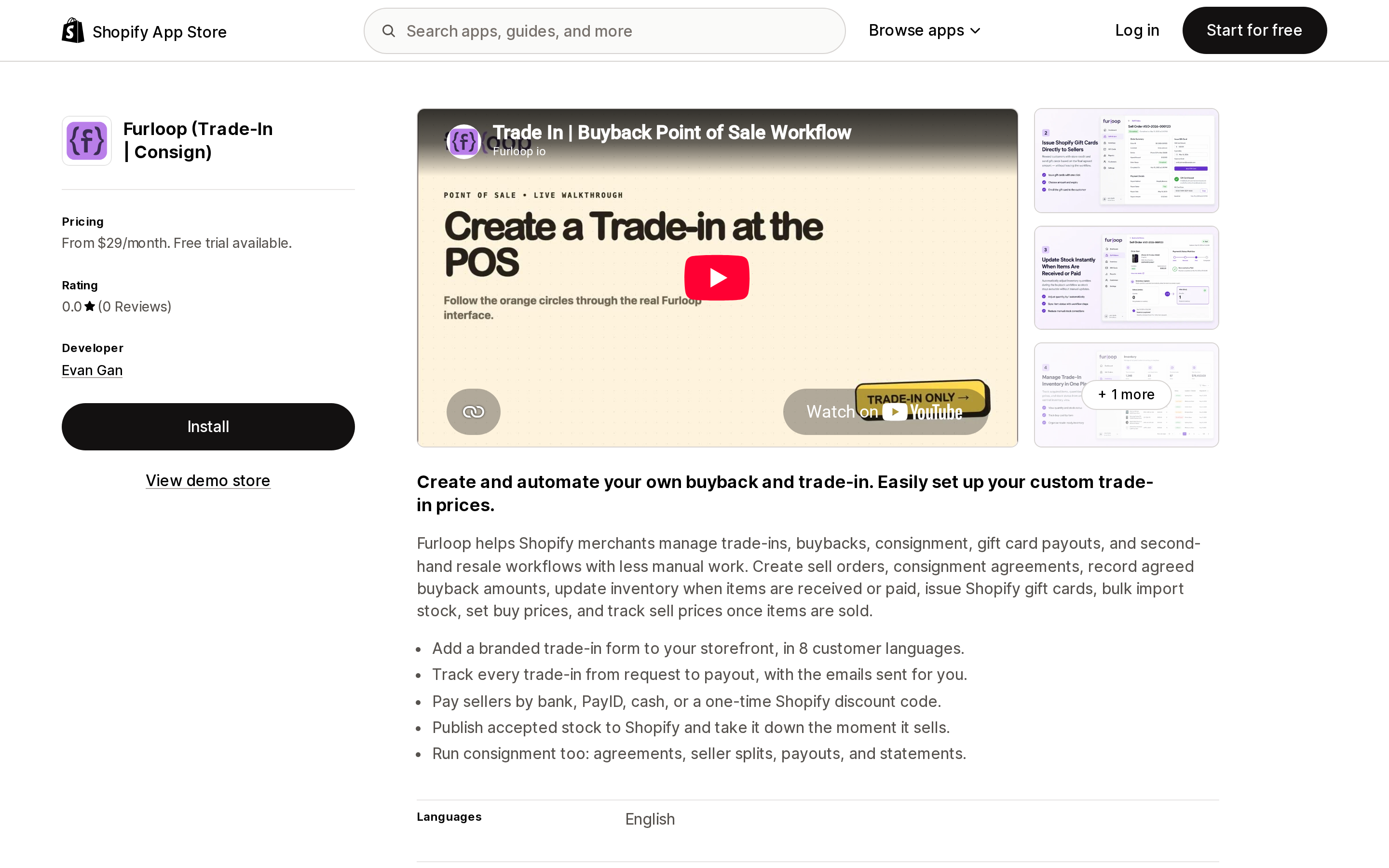
Source: Shopify App Store (Furloop (Trade‑In | Consign)), retrieved September 2, 2026
Furloop, by Evan Gan (Melbourne), launched May 2, 2025 with no reviews to date. Basic is $29/month or $250/year for up to 500 trade-in or consignment orders at one location; Plus is $79/month or $800/year for unlimited orders and up to three locations, plus bulk inventory import and multi-location support. Both carry a 14-day trial.
On paper the feature list is remarkably complete for the price: a branded trade-in form in eight customer languages, request-to-payout tracking with automated emails, payouts by bank, PayID, cash, or one-time discount code, publish-to-Shopify and auto-delist on sale, and full consignment with agreements, seller splits, payouts, and statements. It is the only app here that does both buyback and consignment below $150/month.
What you are trading away is evidence and support surface: no reviews, an individual developer, one named integration, and no published Data access section. For a store testing whether customers will even mail things back, that may be an acceptable trade. For a program you intend to advertise, it is a conversation to have with the developer first.
Poor fit: programs that need auditable permissions before install, or Flow-driven automation.
How to choose
- You want the trade-in value to behave like money across multiple orders: Tern Trade‑in, the only app requesting native store credit scopes, or ReSelly if gift cards are acceptable.
- You want customers to trade in competitor products: Tern Trade‑in. Its custom trade-in catalog is independent of your order history.
- Mail-in program, moderate volume, budget matters: Recommerce by Relished below about 70 items a month; above that, its overage catches Tern's flat plan.
- You need intake and automated relisting in one bill: Tern Pro: Resale at $499/month, or Furloop Basic at $29/month if you can accept an unreviewed app.
- You take goods on consignment rather than buying them: ReSelly. Nothing else here manages vendor contracts and payout splits.
- In-store intake with staff roles: Tern Trade‑in (5 users on Standard, role assignment) or ReSelly (Shopify POS, staff account access).
- You are testing whether the idea works at all: Furloop Basic at $29/month, with your eyes open about the review count.
What the listings do not say
How the payout instrument behaves on partial redemption. No listing in this set states what happens to the remaining balance when a $200 credit meets a $150 order. This is the most consequential undocumented behavior in the category.
Whether trade-in credit is exempt from your discount combination rules. Not stated by any of the four.
What happens to open trade-ins at uninstall. Not stated by any of the four. An in-flight trade-in is an item in the post that you have promised to pay for.
Furloop's permission set. Its listing does not publish a Data access section, so it cannot be compared with the other three before install.
Sources
Shop Pay Installments is free to activate, needs no app, and Shopify never publishes what it costs you — the rate is visible only inside your own admin. It also refuses Capital One and Chase credit cards, restricts monthly plans to debit cards only, excludes gift cards and subscriptions, and can't be turned off for individual products. Affirm can suspend your account for being password-protected, for having a non-English storefront, or for being primarily B2B. And Shopify's Getting paid page says disputes appear in your admin while its FAQ says they don't. If you fail the eligibility gates, the alternative is on-site messaging apps from Klarna, Afterpay, Sezzle, Zip, and PayPal — a category rated between 1.0 and 3.2 stars. Researched September 2, 2026.