
What you will learn
On this pageContentsCloseOpen
A customer emails you. Her unit failed, the sticker on the underside reads serial 4A11-8827, and she wants to know whether it is still covered. To answer, you need to know which order that unit shipped on, who bought it, and when its term started.
Shopify cannot tell you any of that. Not on Basic, not on Plus.
barcode and sku are fields on ProductVariant — they describe a kind of thing, not the specific one in a customer's hands. Five hundred units of one variant share one barcode. inventoryQuantity is documented as "The total sellable quantity of the variant": a number, not a set of serials. And there is no object to hang the answer on. On shopify.dev's Admin GraphQL object reference, /objects/Warranty, /objects/WarrantyClaim, /objects/ProductRegistration, /objects/Registration, and /objects/SerialNumber all return 404, while /objects/Order returns 200.
First, the boundary that wastes the most shopping time
This article is about registering a unit against your own included warranty: the customer proves they own a specific unit, the clock starts, claims are filed against you.
It is not about selling protection plans at checkout. Extend Shopper Operations and SureBright Product Protection are underwriter-backed upsells with revenue share — SureBright's listing states the merchant "gets a commission on each extended warranty policy sold." Different product, different vendor conversation, covered in the extended warranty apps that are free to install. You can need both. They are still two purchases.
Exactly where the native data model stops
barcodeandskuare variant-scoped. Shopify's Help Center states that "Each product and variant must have its own unique SKU" — a uniqueness rule per variant, the opposite of a per-unit field.- One variant per unit dies at 100. Shopify's own SKU page points merchants to third-party apps at the 100-variant limit, and the approach wrecks merchandising long before that.
- Inventory is a quantity, not a set.
InventoryLevelconnects oneInventoryItemto oneLocationand tracks quantity states. There is no native list of which physical units are in stock, so there is nothing native to validate a submitted serial against. The same wall stops lot, batch, and expiry tracking. - Metafields can hold a serial but cannot police one. You can define a
serial_numbermetafield on Order or Customer. You cannot natively enforce uniqueness, check a submission against a manufacturing list, or derive a per-unit expiry. Stores are capped at 250 metafield definitions. - Shopify Flow is glue with plan gates. Flow is free on Basic, Grow, Advanced, and Plus, but "Stores on the Grow, Advanced, and Plus plans can use the Send HTTP Request action." On Basic you cannot even POST a registration outward. Flow has no per-unit record and no customer-facing form.
- Shopify Forms is lead capture. Its own positioning is "Capture customer information to grow your marketing list." It writes metafields and tags customers; it does not validate a serial or start a clock.
One native-only setup is defensible: very low volume, one channel, no validation requirement — Shopify Forms into a customer metafield, a Flow tag, manual reconciliation. Below roughly 50 units a month that is fine. It is a stopgap, not a system.
Two jobs that get sold as one category
Serialization engines assign a serial to a unit at order or fulfillment time, on your side of the counter: SerializeIt, Serializer, SeriaLogic. Order-driven by design, no claims workflow.
Registration and claims portals collect a submission from the customer after purchase, then run statuses, certificates, and claims: Dyrect, My Product Registration, Product Registration Supreme, Propel, Warrantix, ProfitFire.
A brand with pre-printed serials selling through both Shopify and dealers may run one of each. Roundups present these as one interchangeable list, and that is the core reader error.
The nine, on the axes that decide it
Verified from the listings on September 3, 2026. "Not stated" means no primary source located answers the question — it never means "no."
| App | Rating (n) | BFS badge | Entry price | Validation vs. uploaded list | Claims | No-Shopify-order registration |
|---|---|---|---|---|---|---|
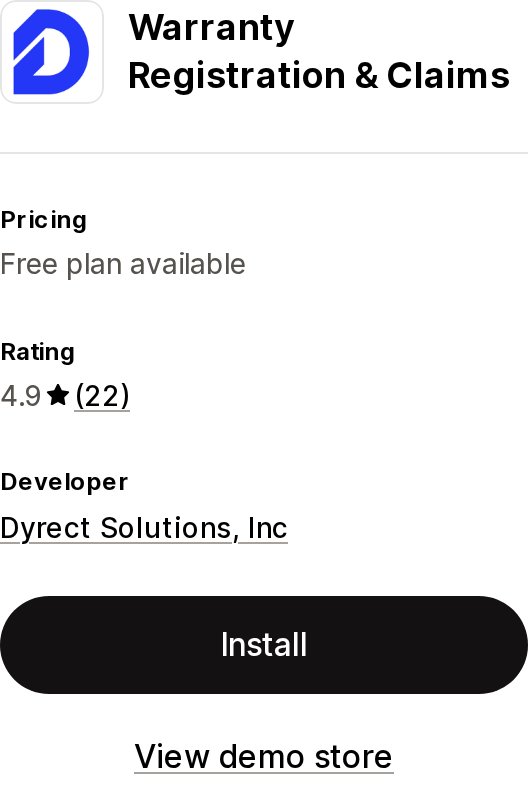
| Warranty Registration & Claims | 4.9 (22) | No | Free / $19/mo | Yes | Yes | Yes — QR, dealer, bulk |
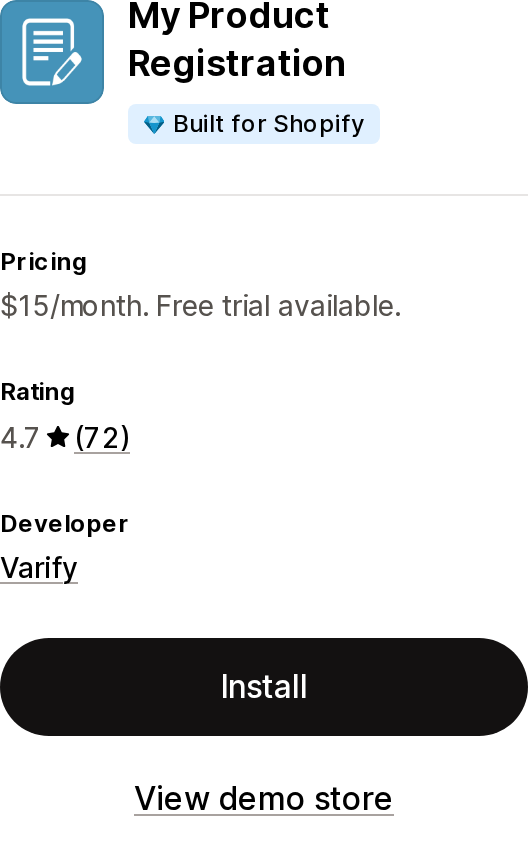
| My Product Registration | 4.7 (72) | Yes | $15/mo flat | Supported (review) | Yes | Not stated |
| Product Registration Supreme | 4.1 (9) | No | $9.99/mo | Yes, $19.99 tier only | Request form | Not stated |
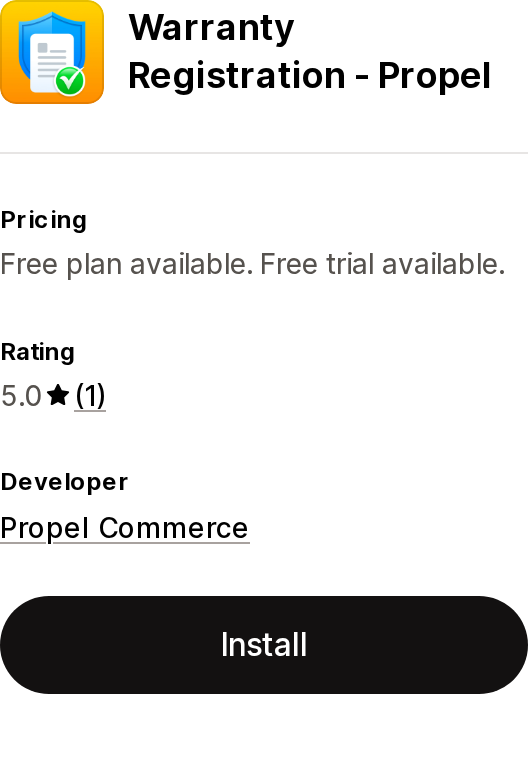
| Warranty Registration ‑ Propel | 5.0 (1) | No | Free / $9.95/mo | Yes (CSV) | Pro only | Not stated |
| SerializeIt ‑ Serial Numbering | 5.0 (3) | No | $9.99/mo | Own generated set | No | No — order driven |
| Serializer ‑ Product Tracking | 4.9 (6) | No | $9/mo | Own generated set | No | No — order driven |
| SeriaLogic ‑ Order Serializer | 4.0 (15) | Yes | $9.99/mo | Pre-import yes; rest not stated | No | No — order driven |
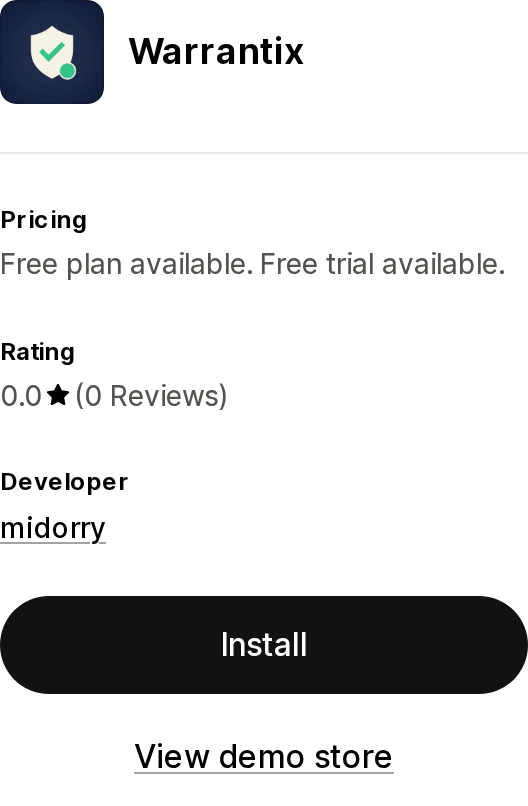
| Warrantix | 0 reviews | No | Free / $15/mo | Yes — duplicate flags | Yes (Pro) | Not stated |
| Warranty Registration | Profit | 2.5 (19) | No | $14.99/mo flat | No — free text | No | Yes — retail, Amazon |
Read the review counts again: 22, 72, 9, 1, 3, 6, 15, 0, 19. Only My Product Registration's 72 carries statistical weight. Propel's 5.0 rests on one review written after 42 minutes of use. Warrantix has no rating at all, which is different from a bad one — it launched August 18, 2026. Nothing here should be bought on stars.
Where the serial lives decides what survives uninstall
Serializer ‑ Product Tracking is the only app in this set whose documentation states where the data is written. Its docs specify that "All metafields saved by the app are stored under the serializer namespace," on order metafields, as JSON under the properties key, with fields including serialNumber, warrantyDuration, and customFields.
Read the caveat in the same document: "The data first saved in the app's database is updated in the Shopify metafields. Metafield edits are not synchronised with the database." The app database is master; the metafields are a one-way mirror you are told not to edit. It documents writing to order metafields — Shopify's own app-uninstall retention behavior is a separate question we did not verify.
Warranty Registration | Profit makes the other affirmative claim: "Stores customer information directly in Shopify 'customers', not in our app." Note the noun. Customer information, not serial numbers.
Warrantix requests no write scopes at all, only view access to products, orders, and customer email, with the qualifier "All order history for the last 60 days." Whether order verification behaves differently for a unit bought more than 60 days ago is not stated.
And the finding that should shape your diligence: five of the nine listings publish no Data access section at all — Propel, My Product Registration, Product Registration Supreme, SeriaLogic, and ProfitFire. For those five, where the serial lives is not stated. Not "no." Get it in writing before onboarding.
One myth to kill in passing: Built for Shopify does not mean data lives in Shopify. SeriaLogic carries the badge and publishes no Data access section. Serializer does not carry the badge and is the one documenting its writes.
The billing denominators differ in kind, not just in price
| App | Denominator | Entry paid | The detail that moves the bill |
|---|---|---|---|
| Warranty Registration & Claims | Credits | $19/mo, 100 credits | "1 credit = 1 action… Automatic Shopify registrations are free." |
| My Product Registration | Flat, unlimited | $15/mo | Unlimited registrations and forms; 5-day trial |
| Product Registration Supreme | Flat, feature-gated | $9.99/mo | Validation only from $19.99; $15.99 tier caps downloads at 500 |
| Warranty Registration ‑ Propel | Free forms, then flat | $0 / $9.95/mo | Free plan lists serial validation and one form; $83.58/year |
| SerializeIt ‑ Serial Numbering | Serials created/month | $9.99/mo (100) | $0.05 per serial over 100; $24.99 (500); $49.99 unlimited |
| Serializer ‑ Product Tracking | Tracked items/month | $9/mo (50) | $0.25 per item over 50; $19/mo unlimited |
| SeriaLogic ‑ Order Serializer | Orders/month | $9.99/mo | Starter allowance not stated; Scale $49.99 at 1,000/mo, $0.03 beyond |
| Warrantix | Registrations + serials | $0 / $15/mo | Free covers 30 registrations/month, 1 form, 100 serials |
| Warranty Registration | Profit | Flat | $14.99/mo | Custom fields (order ID, model number) require emailing support |
Two crossovers are worth a napkin. SerializeIt at about 1,000 serials a month costs $9.99 + 900 × $0.05 = $54.99 on Starter, more than the $49.99 Unlimited tier. Serializer crosses over at roughly 90 tracked items: $9 + 40 × $0.25 = $19, exactly the Unlimited price.
Dyrect's rule cuts in a direction that surprises people: "1 credit = 1 action. Each customer-completed registration, claim, or repair/replacement uses 1 credit. Automatic Shopify registrations are free." An omnichannel brand's credit burn is front-loaded on exactly the channel it bought the app for.
The decisive question for wholesale brands
If you sell 40% through Shopify and 60% through dealers and Amazon, one question outranks the rest: can a registration complete when there is no matching Shopify order?
Warranty Registration & Claims documents five channels — self-registration, QR code ("QR codes can be printed on packaging, product labels, manuals, inserts, or retail material"), dealer registration at the point of purchase, bulk import for offline and corporate sales, and automatic registration from Shopify orders. Warranty Registration | Profit is built on the premise, describing customers who bought "from retailers or Amazon." The three serialization engines are order driven and are the wrong tool for units that never touched a Shopify checkout.
For My Product Registration, Product Registration Supreme, Warranty Registration ‑ Propel, and Warrantix, this is not stated. Propel's demo mockup shows a Retailer field and Warrantix advertises QR registration alongside order verification, but neither establishes that a registration completes without an order. Four vendor emails, one question, before you install anything.
The portals
Warranty Registration & Claims
Source: Shopify App Store listing — captured September 3, 2026
The deepest documented feature set here, from a Sunnyvale, CA developer. Free, then $19, $49, and $149 tiers, each paid tier including 100 credits. Serial validation is documented, with rejection reasons including "invalid serial number, duplicate registration." Coverage start "may derive from the recorded purchase date, order date, manufacturing date, registration date, or another approved policy date" — delivery date is not among them. Its Data access shows the broadest write footprint in the set, but whether it writes serials to metafields is not stated. Resolve one ambiguity with the vendor: the Free card names Claims Management, while claims tracking in the customer portal appears at $49.
My Product Registration
Source: Shopify App Store listing — captured September 3, 2026
Launched June 2017, Built for Shopify, 4.7 from 72 reviews. One plan at $15/month with unlimited registrations and forms, and the broadest declared Shopify surface coverage in the set: Customer accounts, Shopify POS, Shopify Flow, Shopify Admin, plus Klaviyo, Mailchimp, and SMTP.
Serial validation is evidenced by a merchant rather than by vendor docs: 7 Daze MFG (United States, over 6 years using the app, July 2026) describes uploading production serial numbers and authentication codes so customers can verify authenticity. Supported, not confirmed. A separate 2026 report from a US merchant describes the app failing to load across browsers and storefronts; the developer publicly disputes it. One disputed report — but test the install hard during the 5-day trial.
Warranty Registration ‑ Propel
Source: Shopify App Store listing — captured September 3, 2026
The cheapest route to genuine validation: the Free plan lists one registration form and Serial # validation. The mechanism is the most concretely documented anywhere here — a two-column CSV of serial_number and sku, with the docs stating "Capture serial numbers, validate them against your inventory." Pro at $9.95/month adds claims and unlimited forms. The evidence base is one review, 42 minutes of usage, and no Data access section.
Warrantix
Source: Shopify App Store listing — captured September 3, 2026
On paper the most complete feature-per-dollar offer: "Serial number validation with CSV import, duplicate and unknown-serial flags," branded certificate PDFs with a verification QR, a claims queue with photo uploads, expiry reminder emails. Free covers 30 registrations a month; Pro is $15/month. It launched two weeks before this research with zero reviews. Unrated, not badly rated — pilot it. Its GPSR traceability export is an EU compliance feature, not a US selling point.
Product Registration Supreme deserves a line for one pricing trap: roundups quote "from $9.99," and serial validation does not appear until the $19.99 Supreme tier. Nine reviews, 4.1, a third of them one-star, nothing visible from 2026.
Warranty Registration | Profit is honest about what it is: capture who bought what, off-Shopify, into native customer records, for $14.99/month. No validation, no claims, custom fields by support request. Its 2.5 from 19 reviews includes an August 2026 report from a five-year US merchant that support had not replied in six weeks — weigh that against a workflow that depends on emailing support to add a field.
The serialization engines
Serializer ‑ Product Tracking
Source: Shopify App Store listing — captured September 3, 2026
$9/month for 50 tracked items, $19/month unlimited — the cheapest unlimited per-unit ledger here, with the best documentation. Enter item data at fulfillment or preload inventory, per-variant tracking preferences, custom item fields, CSV import, storefront lookup via the app proxy, serials on order printer templates. A reviewer captures the native gap better than we can: it tracks "per physical item (not per product line)." What it is not: no registration form, no claims queue, no certificate. A merchant-side ledger from a single developer.
SerializeIt ‑ Serial Numbering
Source: Shopify App Store listing — captured September 3, 2026
The clearest per-unit warranty statement in the category: "Set a warranty once per product; every unit gets its own start and expiry date as it ships." Fulfillment-based, not confirmed-delivery-based. Serials, IMEIs, or lot codes, auto-generated or CSV-imported; customers register from the storefront; POS and Flow are declared.
One caution: the vendor site's footer line "Built for Shopify merchants worldwide" is marketing copy. The listing does not carry the Built for Shopify badge. Only My Product Registration and SeriaLogic do.
SeriaLogic ‑ Order Serializer rounds out the engines: Built for Shopify, serials assigned "on creation, fulfilment, or manually," multi-location, surfaced on packing slips and customer accounts, and the most Flow-forward listing here. 4.0 from 15 reviews, the widest spread in the set. Its Starter order allowance is not published — Professional is described as 5× Starter at 500 orders a month. Confirm the Starter number with the developer rather than inferring it.
Two gaps that belong to the whole category
No app in this set documents warranty transfer on resale. If you sell e-bikes, tools, or instruments that get resold, the second owner's coverage is manual whichever app you pick. Dyrect's knowledge base mentions "transfer conditions" only as something your written policy should cover.
No app documents a confirmed-delivery-date warranty start. SerializeIt's ship-time start is the closest available. If your units go freight, that gap is yours to absorb.
Decide in this order
- Selling coverage, or administering your own? If the customer pays extra at checkout for underwritten coverage, that is a different product.
- Under about 50 units a month, one channel, no validation? Shopify Forms plus a customer metafield plus a Flow tag. Revisit at volume.
- Ledger, portal, or both? Engines will never run your claims. Portals will never assign serials at fulfillment.
- Can a registration complete with no Shopify order? Documented yes for Dyrect and ProfitFire; not stated for four others.
- Where does the serial live? Serializer documents order metafields under the
serializernamespace. Five listings have no Data access section to check. - What is the denominator? Credits, serials created, tracked items, orders, or flat. Model your worst month.
- Does the price you saw include validation? For Product Registration Supreme it does not until $19.99.
- How much evidence exists? Zero to 72 reviews. A 5.0 built on one 42-minute review is an absence of signal, not a good one.
Sources
- shopify.dev Admin GraphQL API: ProductVariant, InventoryItem, InventoryLevel, Order
- Shopify Help Center: SKU, Inventory setup, Metafield definitions, Shopify Flow
- Shopify Forms App Store listing
- Vendor docs: Dyrect pricing, Dyrect registration guide, Serializer metafields, Propel serial numbers
- Shopify App Store listings, pricing tabs, and public reviews for all nine apps named, retrieved September 3, 2026
Shopify Flow adds and removes product tags for free on every paid plan, but its Get product data action returns at most 100 products per run, so backfilling an existing catalog becomes a scheduled loop. Flow also has no generic Product updated trigger, which means it structurally cannot re-tag a product after you edit its type, vendor, or price. Shopify Magic suggests a product category and fills category metafields, but product tag generation is not on its published feature list. The six apps compared here meter completely different units: Leap Auto Tags counts every tag added and every tag removed as one credit against 2,000 per month at $8, FilterTag meters 500 to 50,000 generated tags per month at $9 to $59, TAGit AI works out to 3 to 9 cents per generated tag, and Helium charges $9.99 one-time per 100 products. Mechanic and Matrixify charge flat fees of $16 to $199 and $20 to $200 with no per-tag metering at all. Check the denominator before you check the price. Researched September 3, 2026.