
What you will learn
On this pageContentsCloseOpen
Since August 29, 2025, de minimis no longer applies to shipments into the United States. Shopify puts a caution box about it on three separate places on its duties documentation: duties and import taxes now apply to all US imports regardless of shipment value.
The obvious response is to turn on Collect duties and import taxes at checkout so your customers are not ambushed by a customs bill at the door. Before you do, read the requirements page — and then read the sentence after the carrier list.
The four-carrier list, and the sentence after it
Shopify's documentation states that DDP (Delivered Duty Paid) labels are supported only for specific carriers when you buy labels through Shopify's carrier accounts. The full list:
- Canada Post — USA destinations only
- DHL Express
- DHL Express Canada
- DHL eCommerce
That is it. USPS, UPS, and FedEx are not on the list.
The sentence that follows is the one that matters operationally:
"If you use any other carrier with Shopify's carrier accounts, then you can't purchase a label for orders where duties have been collected. You need to purchase the label externally or refund the order."
Read it literally, because it is meant literally. You collect duties from a customer at checkout, the order lands in your admin, and Shopify will not sell you a label for it through any carrier outside that list of four. Your options are to buy the label somewhere else entirely, or to refund the order.
For a US store whose entire outbound stack is USPS and UPS, that is not a small caveat. It is the difference between "turn this on" and "rebuild your fulfillment first."
This also appears as a hard prerequisite rather than a warning. Shopify's requirements for collecting duties at checkout are three:
- If your store uses shipping labels, you must use a carrier that supports DDP labels.
- Your store must not use Shopify Fulfillment Network.
- Your products must have Harmonized System (HS) codes applied.
Requirement two is worth pausing on. Using Shopify's own fulfillment network disqualifies you from Shopify's own duties-at-checkout feature.
You pay a fee on every order with duties calculated — including the $0 ones
Duties at checkout is not a free feature. Shopify charges a transaction fee on every order that has duties and import taxes calculated:
- 0.85% where Shopify Payments is the gateway — including orders paid through a third-party provider such as PayPal, as long as Shopify Payments is the primary gateway.
- 1.5% where another provider is the gateway — including stores using Shop Pay as an accelerated checkout when Shopify Payments is not primary.
Since February 2, 2025, both rates have been temporarily lowered to 0.5% for all merchants regardless of payment provider. Shopify's page does not publish an end date, so treat 0.85% / 1.5% as the number you should be modelling against, not 0.5%.
Then the detail that changes the math:
"The transaction fee is applied for every order that has duties and import taxes calculated at checkout, even if the calculated amount is zero."
Three exemptions exist: orders shipped to the same country as the store, orders shipped between EU member countries, and abandoned checkouts. Everything else counts. If you enable duties for a market where most orders fall under that country's de minimis and calculate to zero duty, you are still paying a percentage of order value on each one.
There is a second cost the feature does not cover at all. Carriers charge brokerage and disbursement fees, and Shopify states plainly that this charge is not included when duties-at-checkout is active. If you want to recover it, you have to bury it in your shipping rates.
Two Shopify pages disagree about missing HS codes
This one is worth checking against your own catalogue, because the two pages tell you opposite things.
The Duties and import taxes overview page says:
"If a product doesn't have an HS code, description, or category, then duties and import taxes aren't calculated for that order even if you've set orders from a country or region to collect duties and import taxes at checkout."
The Collecting international duties and import taxes at checkout page says:
"If a product doesn't have an HS code, description, or category, then duties and import taxes are still calculated, but are likely to be inaccurate."
Not calculated, versus calculated but inaccurate. Both pages were live on September 2, 2026. These are very different failure modes: one silently under-charges the customer to zero, the other silently charges a number you cannot defend. Neither is something you want to discover from a customs invoice.
The practical takeaway does not depend on which page is right: add HS codes and country of origin to every product before you switch the feature on. Shopify supports three routes — the product page, the bulk editor, and a dedicated duties CSV with Country of origin and HS code columns that you can export pre-filtered to products missing information.
Three settings that behave more globally than they look
Section 232 steel and aluminum defaults to 100%. If you sell into the US and your products contain steel or aluminum, you can declare what percentage of the product is made of those metals so tariffs are calculated on the metal content rather than the full product value. The default is 100%, the setting is store-wide, and you cannot set it per product. A store selling one steel-framed item alongside a hundred textiles is declaring all Section 232-eligible products as fully metal until someone changes it.
Postal duty rates apply to every US-bound checkout once toggled. The setting calculates duties into the US ad valorem and by country of origin, which can lower duties. But Shopify notes it "applies to all international checkouts with the United States as the destination, regardless of the shipping options that are available to your customers." If you then ship that order with a commercial carrier, you cover the difference in what customs actually charges.
Preferential treaties are on by default. USMCA and similar agreements are included in the calculation unless you turn them off — and if customs asks for a certificate of origin you cannot produce, that reduction was not yours to take. Shopify provides the toggle in Settings → Taxes and duties → Duties and import taxes → Manage.
Managed Markets is the other native answer, and it reassigns your HS codes
Managed Markets makes Global-e the merchant of record: it remits tax to local authorities, provides the tax registrations so you do not need your own, accepts local payment methods, and manages duties and import tax. It is available only to merchants based in the continental United States, and to certain stores in Canada and the United Kingdom.
One activation-time change deserves more attention than it gets. Managed Markets automatically assigns HS codes to your products. Shopify's wording:
"If your products already have HS codes assigned to them, then they're taken into account when determining the HS codes that Managed Markets applies to your products. However, it isn't guaranteed that the exact HS code that you entered for your product is the same that will be used by Managed Markets."
If a customs broker classified your catalogue, that classification is an input, not a decision. You can compare the two in the product's Shipping section under Managed Markets codes.
A useful side benefit, documented on a page most merchants never connect to this one: with Managed Markets on Grow, Advanced, or Plus, labels purchased for those orders include up to $200 USD of shipping insurance at no cost. On Basic, they include none.
The apps, and the second plan gate
If your store fails Shopify's requirements — the wrong carrier, Shopify Fulfillment Network, or you simply need guaranteed rather than estimated duties — the App Store has real options. Note the gate that appears in most of them: Carrier-Calculated Shipping (CCS), which Shopify makes available on Advanced and Plus, with Grow able to add it for an extra monthly fee or by switching to annual billing. We covered that limit in detail in Live carrier rates need Advanced or higher.
| App | Developer | Rating (reviews) | Pricing (USD) | Notable requirement |
|---|---|---|---|---|
| Zonos Duty and Tax | Zonos | 4.5 (151) | From $2,500/year, plus $2 per order and 10% of duties, taxes and fees; Premium $4,000/year | CCS required; external charges billed separately from your Shopify invoice |
| FedEx Duty & Tax | FedEx | No reviews yet | $99/month, 14-day trial | Launched July 16, 2026 |
| UPS Global Checkout | United Parcel Service, Inc. | No reviews yet | Free | Requires your own UPS account |
| Dutify Duty & Tax Calculator | DUTIFY | No reviews yet | $30/month (400 calculations), $100/month (2,000), $300/month (7,500); 17% off annual | CCS required |
| Crossborderit IOSS and DDP | Crossborderit AB | 1.4 (16) | Free to install; external charges billed separately | EU IOSS focus, not a general US answer |
Zonos Duty and Tax
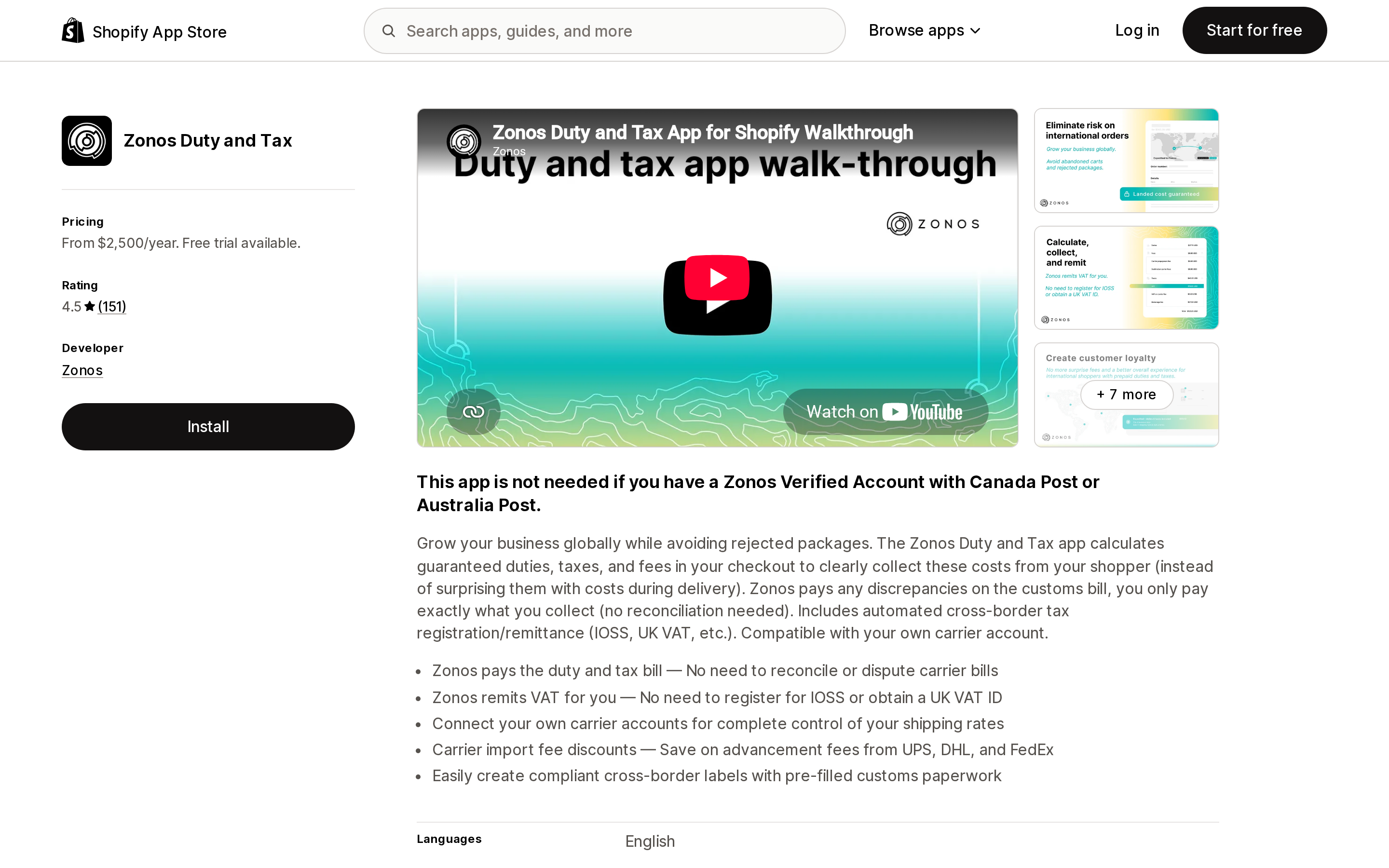
Source: Shopify App Store (Zonos Duty and Tax), retrieved September 2, 2026
The oldest and most reviewed option here, launched November 14, 2017, from St George, Utah. Its listing URL still carries a legacy slug (duty-and-tax-calculator-iglobal-stores) that no longer matches the product name — worth knowing if you are matching listings to vendors.
The differentiator is guarantee plus reconciliation: Zonos states it "pays any discrepancies on the customs bill, you only pay exactly what you collect (no reconciliation needed)," and includes automated cross-border tax registration and remittance such as IOSS and UK VAT. It works with your own carrier account.
Price it honestly. Standard is $2,500/year plus $2 per order plus 10% of the duties, taxes and fees collected, and those charges are billed by Zonos separately from your Shopify invoice. At 1,000 international orders a year with $40,000 in collected duties, the annual subscription is the smallest of the three numbers.
The rating spread is instructive: 133 five-star against 6 one-star and 4 two-star. A German merchant of over five years, writing July 21, 2026, describes non-EU customers unable to check out when using a discount code and a support reply they characterised as automated. A US Shopify Plus merchant writing June 26, 2026 describes migrating from Global-e — the engine behind Managed Markets — to Zonos specifically to own their carrier relationship. Both reviews are about the same trade-off from opposite ends.
FedEx Duty & Tax
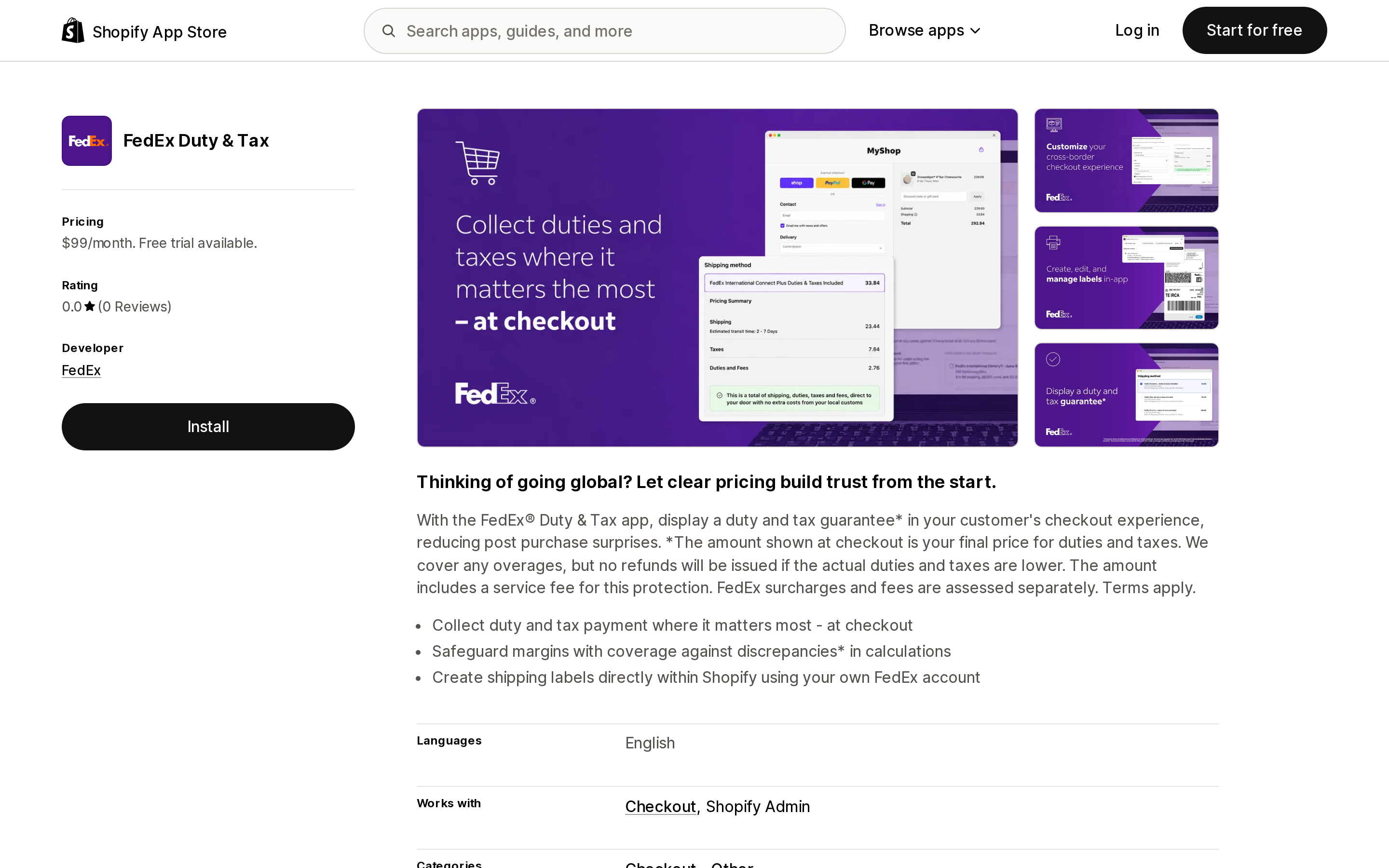
Source: Shopify App Store (FedEx Duty & Tax), retrieved September 2, 2026
Published by FedEx itself and launched July 16, 2026, with no reviews at the time of writing. $99/month flat, 14-day trial, and a duty-and-tax guarantee described in the listing's own footnote:
"The amount shown at checkout is your final price for duties and taxes. We cover any overages, but no refunds will be issued if the actual duties and taxes are lower."
That is a one-directional guarantee, stated up front. Overages are absorbed; overcollection is kept, and the listing says the displayed amount "includes a service fee for this protection." FedEx surcharges and fees are assessed separately.
Two things to weigh: FedEx is not on Shopify's DDP label list, so this app is how FedEx solves that for its own customers; and a first-party carrier app with zero reviews is a different risk profile from a nine-year-old vendor with 151.
UPS Global Checkout
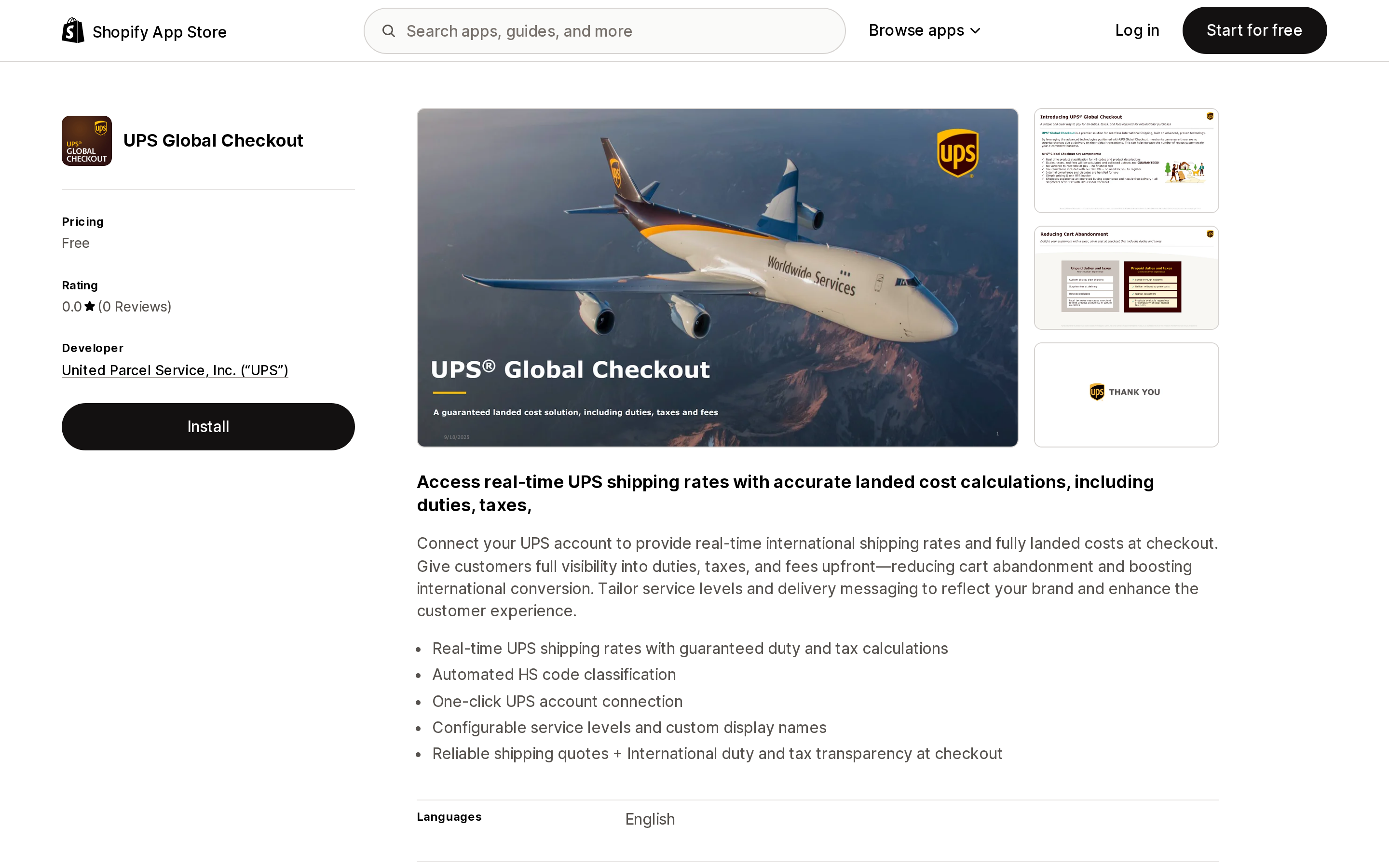
Source: Shopify App Store (UPS Global Checkout), retrieved September 2, 2026
UPS's own app, launched September 19, 2025, free, with no reviews yet. It connects your UPS account to deliver real-time UPS rates together with landed cost — duties, taxes, and fees — at checkout, and advertises automated HS code classification.
Free plus first-party plus automated classification is the most interesting combination in this table for a US store already shipping UPS. The absence of reviews after roughly a year on the store is the thing to weigh against it.
Dutify Duty & Tax Calculator
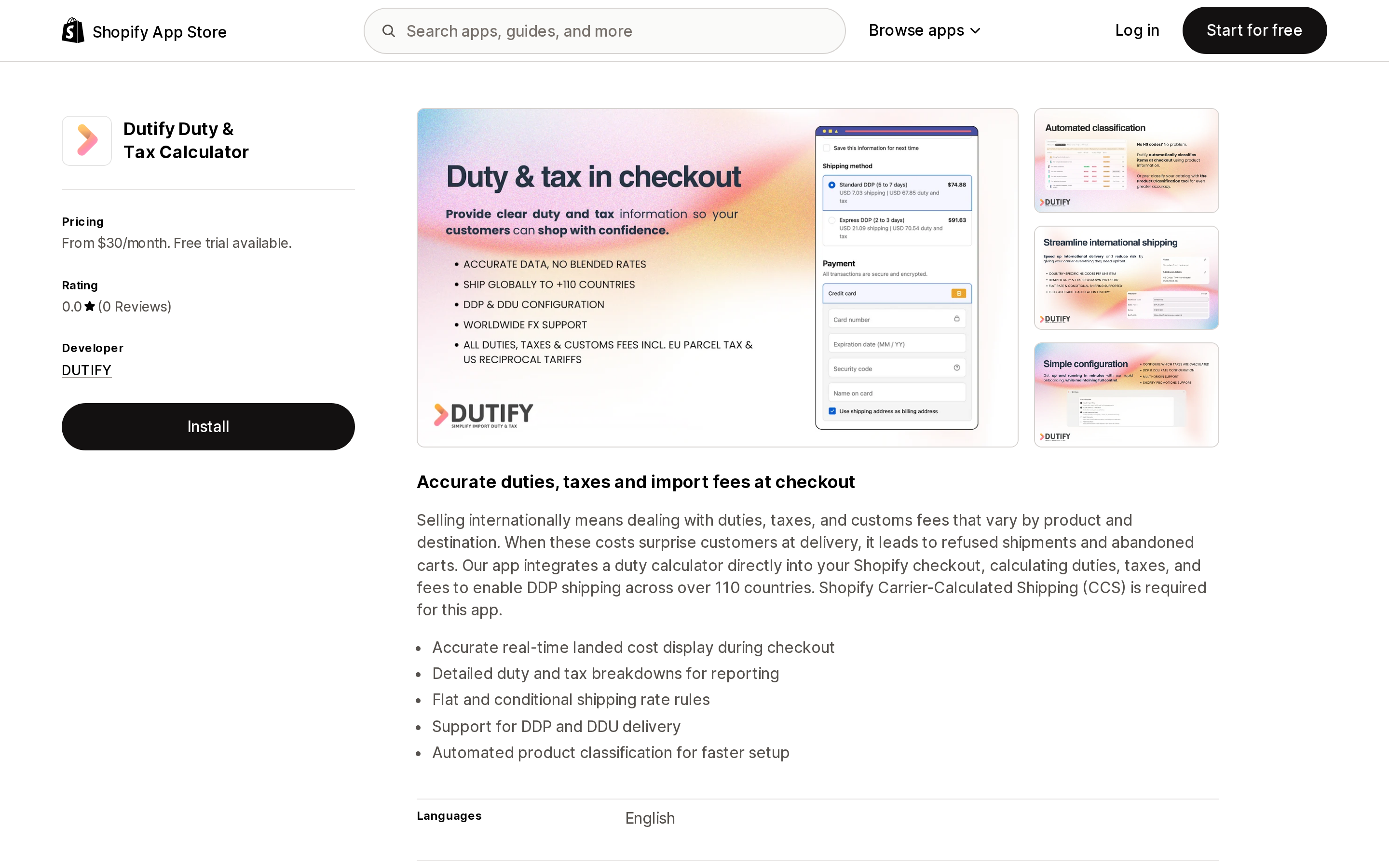
Source: Shopify App Store (Dutify Duty & Tax Calculator), retrieved September 2, 2026
Launched May 1, 2026, from Port Melbourne, Australia. The only app here that meters on calculations rather than orders or revenue: $30/month for 400 calculations and 200 product classifications, $100 for 2,000, $300 for 7,500. It supports DDP across more than 110 countries and requires CCS.
A calculation is not the same as an order. Every checkout that reaches the shipping step consumes quota whether or not it converts, so size the tier against your international checkout volume, not your international order count.
Crossborderit IOSS and DDP
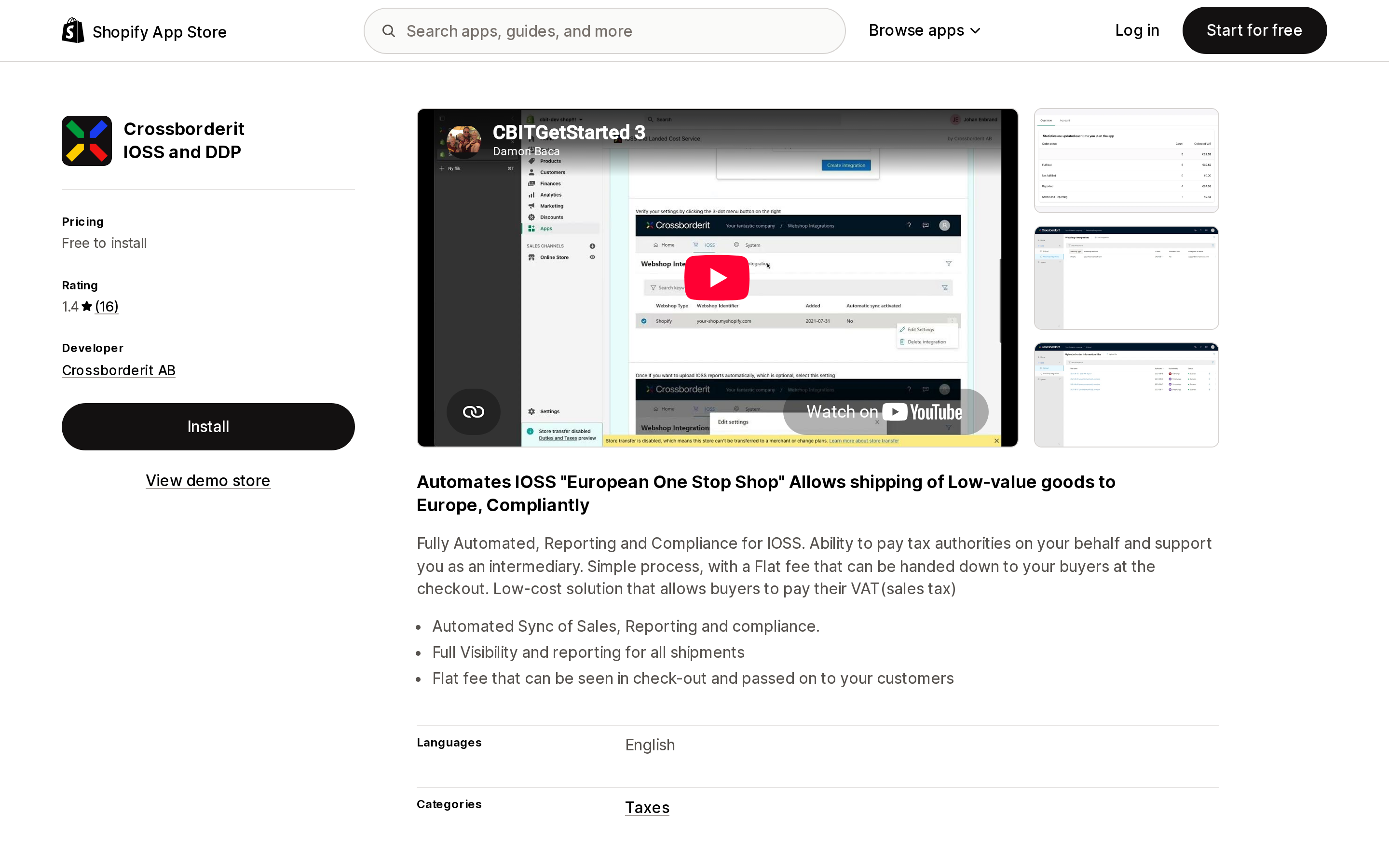
Source: Shopify App Store (Crossborderit IOSS and DDP), retrieved September 2, 2026
Included for completeness and as a caution. It solves EU IOSS rather than US-bound duty, and it sits at 1.4 from 16 reviews — 12 of them one-star. The recurring theme across the negative reviews is pricing changes and a period where data stopped syncing; one UK merchant describes collecting VAT for months while the integration was broken. If IOSS is your problem, evaluate this one carefully and look at alternatives.
Choosing
You ship internationally with DHL Express or DHL eCommerce, or Canada Post into the US. Shopify's native duties at checkout fits your stack. Add HS codes and country of origin first, budget the transaction fee against total international order value rather than duty collected, and add brokerage fees to your shipping rates.
You ship USPS, UPS, or FedEx and want DDP. Shopify's native feature will leave you unable to buy the label. Use the carrier's own app — UPS Global Checkout is free, FedEx Duty & Tax is $99/month — or a vendor like Zonos that works with your own carrier account.
You want a guarantee rather than an estimate. Estimates are what Shopify provides, and it says so: charges are "estimates based on the available information at the time that the customer places an order." Zonos and FedEx both sell guarantees, with different economics. FedEx keeps overcollection; Zonos charges 10% of the duties and taxes collected.
You are on Basic or Grow, or you use Shopify Fulfillment Network. Native duties at checkout is not available to you if you use SFN, and most apps here need CCS, which starts at Advanced. Costing out the plan change is part of costing out the feature.
You are a continental US merchant who would rather not own any of this. Managed Markets hands merchant-of-record status to Global-e, including the tax registrations. The prices are set by adaptive pricing, the HS codes may not be yours, and the trade-off is control — which is exactly the trade one Plus merchant described reversing in a Zonos review this June.
One last thing worth saying plainly. Duties are a compliance area, not a settings area. Shopify's own de minimis table is published with a caution that it "doesn't constitute tax or customs advice," and Shopify tells you to review official government sources and consult customs brokers or trade attorneys. That advice is correct, and this article does not replace it.
Sources
- Duties and import taxes — Shopify Help Center
- Collecting international duties and import taxes at checkout — Shopify Help Center
- Managed Markets — Shopify Help Center
- Shipping insurance for your shipping labels — Shopify Help Center
- Third-party carrier-calculated shipping — Shopify Help Center
- Shopify App Store listings (en-US) for Zonos Duty and Tax, FedEx Duty & Tax, UPS Global Checkout, Dutify Duty & Tax Calculator, and Crossborderit IOSS and DDP, retrieved September 2, 2026
Shop Pay Installments is free to activate, needs no app, and Shopify never publishes what it costs you — the rate is visible only inside your own admin. It also refuses Capital One and Chase credit cards, restricts monthly plans to debit cards only, excludes gift cards and subscriptions, and can't be turned off for individual products. Affirm can suspend your account for being password-protected, for having a non-English storefront, or for being primarily B2B. And Shopify's Getting paid page says disputes appear in your admin while its FAQ says they don't. If you fail the eligibility gates, the alternative is on-site messaging apps from Klarna, Afterpay, Sezzle, Zip, and PayPal — a category rated between 1.0 and 3.2 stars. Researched September 2, 2026.