
What you will learn
On this pageContentsCloseOpen
Open the three main extended warranty apps on the US Shopify App Store and the price field tells you almost nothing:
- Extend Shopper Operations — Free
- SureBright Product Protection — Free to install. Additional charges may apply.
- Anycover Extended Warranty — Free to install. Additional charges may apply.
Read the pricing sections rather than the price field and the picture inverts. SureBright's says "Merchant gets a commission on each extended warranty policy sold." Anycover's says "we charge a small service fee for each plan sold through our platform."
One of those sends money to you. The other takes money from you. Both are labelled free.
What Shopify gives you natively: nothing shaped like a warranty
There is no warranty object in Shopify. No product type, no coverage term, no claim record, no link between a policy and the order it was sold against.
What you can do without an app is sell a warranty as an ordinary product or variant. That produces a line item and a payment. It produces no obligation tracking, no claims workflow, and — the part merchants underestimate — no way to hand the risk to anyone else. If you sell your own two-year coverage as a $39 product, you have just taken a two-year liability onto your own balance sheet, and in the United States that arrangement is a service contract regulated at the state level, not a feature you switch on in an admin.
That is the actual reason these apps exist. You are not buying a widget. You are buying access to somebody else's underwriter and somebody else's claims desk, and the widget is the part they give away.
It also explains why the App Store category is called "Warranties and insurance" and why all three apps here also tick coverage-type filters for lost, stolen, and damaged packages. Product protection and shipping protection are sold by overlapping vendors and are two completely different products. If your problem is packages going missing in transit, this is the wrong article.
The three apps, on the axes that decide the outcome
| Extend Shopper Operations | SureBright Product Protection | Anycover Extended Warranty | |
|---|---|---|---|
| Developer | Extend (San Francisco, CA, US) | Surebright (Toronto, ON, CA) | Anycover (Singapore, SG) |
| Launched | November 18, 2021 | April 18, 2022 | May 10, 2022 |
| Rating | 4.8 (19 reviews) | 4.8 (50 reviews) | 5.0 (12 reviews) |
| Listing price | Free | Free to install | Free to install |
| Money direction | Merchant is paid | Merchant is paid a commission per policy | Merchant pays a service fee per plan |
| Charges outside the Shopify invoice | Not stated | Stated explicitly | Not stated |
| POS support on the listing | Yes | Yes | Yes — and POS is the only integration listed |
| Interface languages | English | English | English, Malay, Thai, Vietnamese, Filipino |
| Data access section published | Yes, extensive | Yes | No |
| Built for Shopify | No | No | No |
Extend Shopper Operations
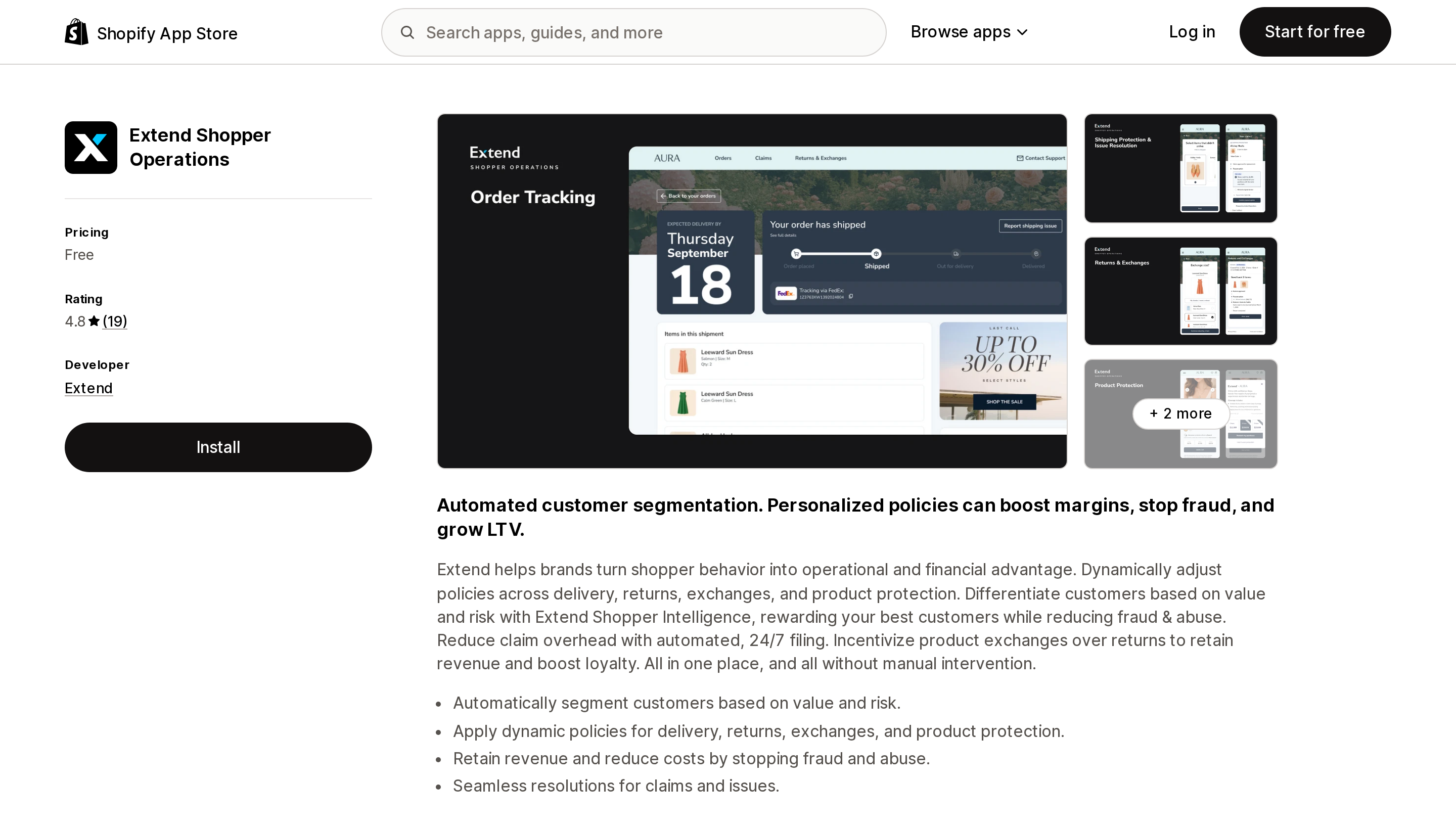
Source: Shopify App Store (Extend Shopper Operations), retrieved September 2, 2026
The most notable fact about Extend's listing in September 2026 is its name. The app that third-party roundups still describe as an extended warranty app is now titled Extend Shopper Operations, and the headline reads "Turn shopper behavior into operational & financial advantage." Product protection is one screenshot among five, alongside order tracking, returns and exchanges, shipping protection, and a branded portal. The pitch is customer segmentation and fraud reduction; warranties are a module inside it.
If you install this expecting a warranty program and get a policy-orchestration platform, the listing did warn you — just not in the way most roundups describe it.
Two other things stand out. The data access section is the broadest of the three by a wide margin: all order history, returns, order edits, discount codes, Shopify Payments disputes, cart and checkout validations, cart transforms, and Online Store script tags. Note the script tags, given that Shopify has documented script tags ceasing to run on all API versions on March 1, 2027.
And then there is the review from Eclipse Optics, a US store, dated May 29, 2024, after 20 days using the app:
Then nearly a month later, we get an email from someone stating that they cannot work with us because our store does not have $3 million in revenue.
That is one review, and we cannot confirm from Extend's own materials that a $3 million floor is a current or general policy. But it points at something no listing in this category discloses: installing the app is not the same as being accepted into the program. A warranty vendor is underwriting risk against your catalogue, and it gets to decline you. If you are a $400k-a-year store, budget for the possibility that the answer is no, and find that out before you write it into your product pages.
SureBright Product Protection
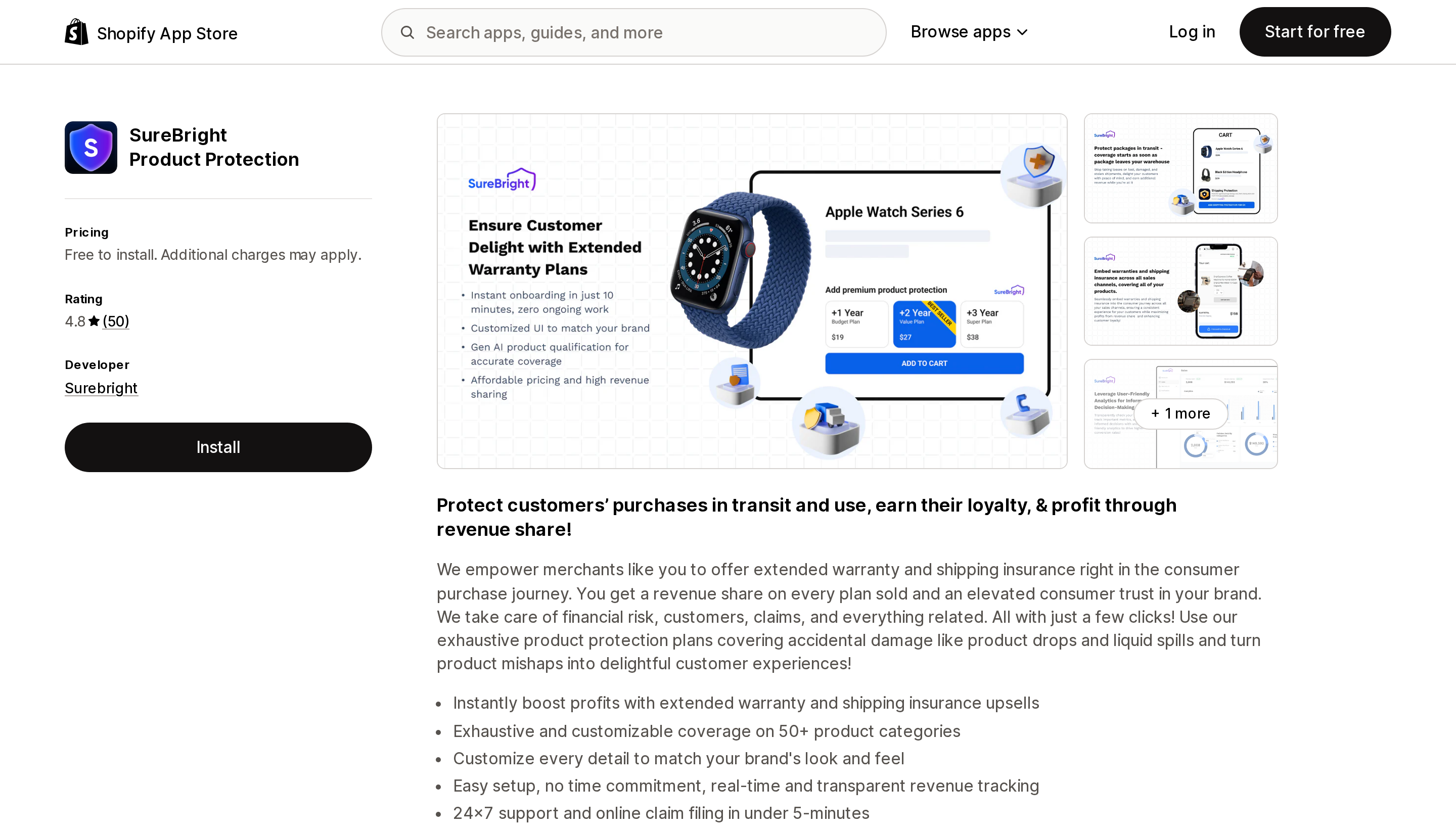
Source: Shopify App Store (SureBright Product Protection), retrieved September 2, 2026
The best-reviewed of the three at 4.8 across 50 reviews, and the only one whose pricing block spells out both halves of the arrangement: the merchant earns a commission per policy, and "External charges may be billed by Surebright separately from your Shopify invoice."
That second sentence is worth pausing on. Shopify's own billing machinery — the part that shows up on your Shopify invoice, that you can cap with a spending limit, that gets prorated when you change plans — does not cover these charges. They are a separate commercial relationship, settled outside Shopify. Whatever the net economics turn out to be, they will not appear in the place you look for app costs.
The listing claims customizable coverage across 50+ product categories and ticks integration surfaces the others do not: Checkout, Shopify POS, Draft Orders, Marketplaces, Email Tools, and Product Registration. Draft orders matter more than they sound — if you take orders by phone or quote, an app that only lives on the product page cannot attach coverage to them.
The three most recent reviews on the listing are all from North American stores. Two describe going live quickly — one states the store was running "in under a week" — while a third describes a formal RFP process running over several months. Both onboarding paths appear to exist.
Anycover Extended Warranty
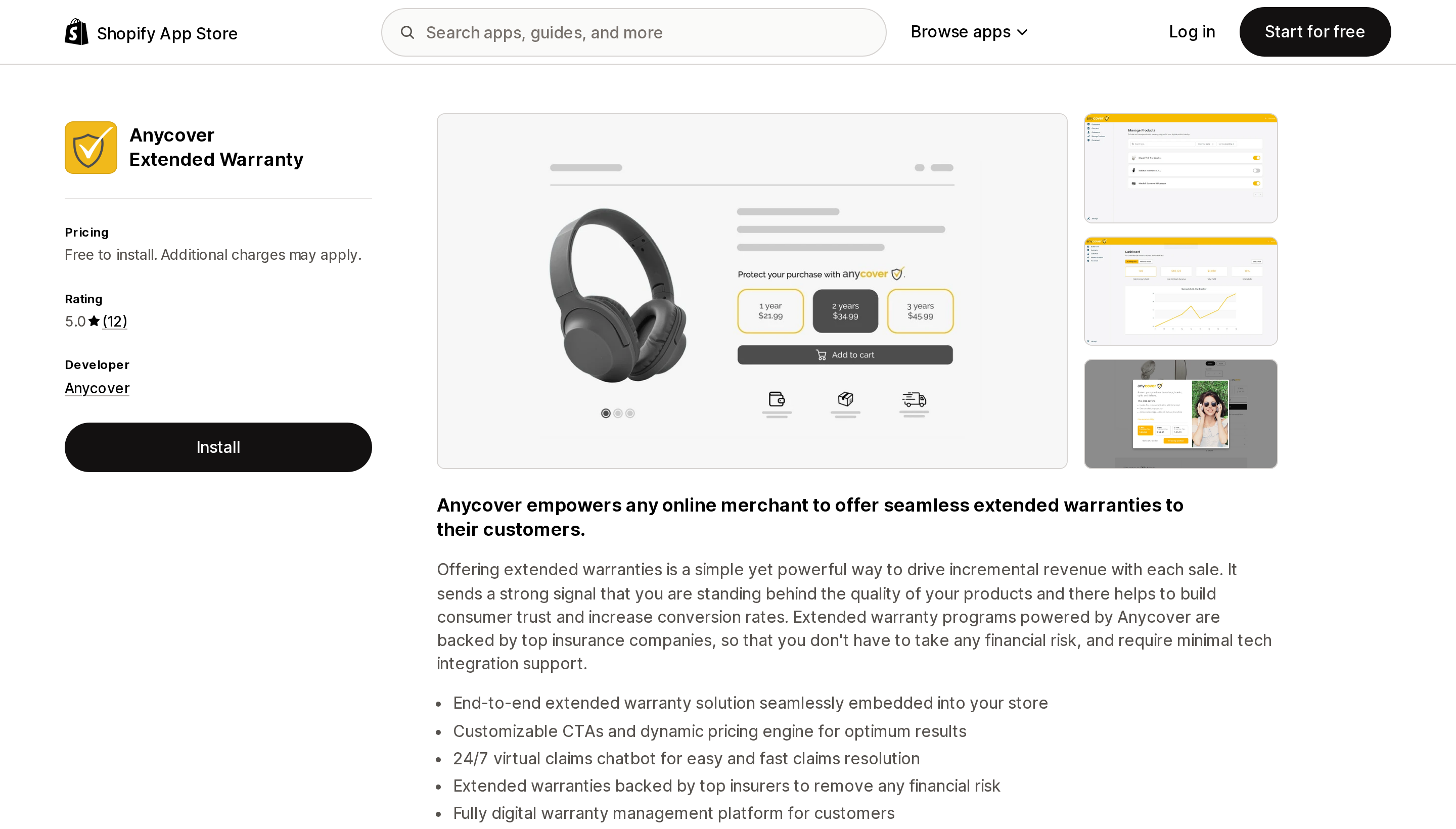
Source: Shopify App Store (Anycover Extended Warranty), retrieved September 2, 2026
Anycover is the one to read carefully if you are a US merchant, because two signals on the listing point somewhere else entirely.
First, the interface languages: English, Malay, Thai, Vietnamese, and Filipino. Second, the three reviews surfaced on the listing are from Airbot Singapore, Mayer Singapore, and Living DNA Singapore. The developer address is in Singapore. This is a Southeast Asia–focused program that is also listed in the US store.
The pricing model is the inverse of the other two — Anycover charges the merchant a service fee per plan sold rather than paying a commission — and the listing states that programs are "backed by top insurance companies, so that you don't have to take any financial risk," without naming the insurers. Its only listed Shopify integration is Shopify POS, and it publishes no data access section at all.
None of that makes it a bad app; the reviews it does have are unanimous and detailed. It makes it a poor default for a US store, and a reasonable one to shortlist if you sell into Southeast Asia.
The questions the listings do not answer
Ask every vendor these before you build a program around them. None of the three answers them on the App Store:
- What is your merchant qualification threshold? Revenue, category, average order value, claim history. Get it in writing before you announce anything to customers.
- Who underwrites, and are they admitted in the states I sell into? Service contracts are state-regulated in the US. "Backed by top insurers" is not an answer.
- Whose name is on the contract the customer signs? If your customer's claim is denied, do they blame the vendor or your brand?
- What is my actual share? Published third-party figures for merchant share in this category vary widely, and we found no revenue-share percentage published on any of the three App Store listings. Treat any number you have read elsewhere — including in this paragraph — as unverified until the vendor puts it in your contract.
- What happens to live policies if I uninstall? Coverage a customer already paid for outlives your app subscription. Find out who honours it.
How to choose
You are a US store doing meaningful volume in a claim-prone category — electronics, furniture, e-bikes, powered equipment. Extend and SureBright are both plausible. Extend if you also want the returns, tracking, and segmentation layer and can meet whatever qualification bar they set. SureBright if you want warranties specifically, want draft orders and POS covered, and want the commission arrangement stated up front.
You are a smaller US store. Assume you may be declined, and ask about the qualification threshold in your first email rather than after a month of integration work. SureBright's review base includes stores that were live inside a week, which is a useful signal about the size of merchant it takes on.
You sell into Southeast Asia. Anycover is the only one of the three whose listing, languages, and review base point at that market.
You want the customer to deal with you, not a third party. None of these. You are looking at self-administered coverage, which means taking the liability yourself and getting state-by-state regulatory advice first. That is a legal project, not an app install.
You are actually worried about parcels, not products. Wrong category — the shipping protection apps are a separate comparison with a separate question at the centre of it: who pays the claim.
What we could not confirm
Whether Extend's $3 million revenue threshold, reported in a single review from May 2024, is current or general policy. Any of the three vendors' actual revenue-share percentages, none of which are published on their App Store listings. The identity of the insurers behind Anycover's programs. Whether Anycover serves US merchants in practice despite being listed in the US store. And what happens to in-force policies after uninstall for any of the three.
Researched September 2, 2026, from the US (English) Shopify App Store. All charges are billed in USD.
Sources
Shop Pay Installments is free to activate, needs no app, and Shopify never publishes what it costs you — the rate is visible only inside your own admin. It also refuses Capital One and Chase credit cards, restricts monthly plans to debit cards only, excludes gift cards and subscriptions, and can't be turned off for individual products. Affirm can suspend your account for being password-protected, for having a non-English storefront, or for being primarily B2B. And Shopify's Getting paid page says disputes appear in your admin while its FAQ says they don't. If you fail the eligibility gates, the alternative is on-site messaging apps from Klarna, Afterpay, Sezzle, Zip, and PayPal — a category rated between 1.0 and 3.2 stars. Researched September 2, 2026.