
What you will learn
On this pageContentsCloseOpen
A customer with $2,400 sitting in a flexible spending account adds your $180 recovery device to the cart, enters a card with a Visa logo on it, and gets declined. Nothing is wrong with the card. Nothing is wrong with your Shopify Payments account. The transaction was declined on purpose, by the card issuer, before it ever reached you.
This is the single most misunderstood thing about selling to the roughly 70 million Americans holding HSA and FSA balances: the card looks like an ordinary card, but it is governed by a rule that sits outside commerce entirely. Understanding that rule is what separates a merchant who picks the right vendor from one who installs a free app, sees nothing happen, and concludes the category does not work.
Research date: September 2, 2026. All figures and quotations are from primary sources, linked at the end.
The rule that actually decides this
Health benefit cards run on the Visa and Mastercard rails, but the IRS constrains where they may be authorized. The Special Interest Group for IIAS Standards (SIGIS), the industry body that maintains the standard, states the constraint plainly:
"It is required that attempts to use FSA/HRA cards at merchants or service providers without a health care related MCC code and who have not implemented an IIAS be declined."
Two escape hatches exist, and SIGIS documents both. The first is a healthcare-related merchant category code — the MCC assigned to physicians, dentists, vision practices, and hospitals. A DTC wellness brand does not have one, and cannot simply request one. The second is an Inventory Information Approval System (IIAS): a certified system that flags eligible items line by line and passes the health care amount inside the authorization request, so the issuer can auto-substantiate the purchase in real time.
SIGIS also lists what implementing an IIAS requires of a merchant, and it is not a plugin-scale project: using the SIGIS Eligible Product List to flag inventory, changing card processing to add FSA amounts to transactions, supporting a list of FSA/HRA BINs to identify which cards need those data fields, and storing approved transaction detail for five years in case of an IRS audit.
There is a third path SIGIS describes, the 90% Rule, but it is explicitly closed to online sellers. It is limited to drug stores and pharmacies under MCC 5912 and 5122 whose store locations draw 90% or more of gross receipts from prescriptions and eligible medical items — and SIGIS notes the IRS singled out "mail order vendors and web-based vendors" as merchants that must implement an IIAS instead.
So the practical position of a Shopify merchant selling saunas, supplements, or red light panels is: no healthcare MCC, no IIAS, therefore declines by design. That is the problem these apps exist to solve, and it is a compliance problem wearing a payments costume.
What Shopify does natively: nothing here
Shopify has no native HSA/FSA payment method. There is no toggle in Settings → Payments, no card-type checkbox, and no Shopify-operated substantiation service. Truemed states this directly in the FAQ on its Shopify partner page: "Shopify does not natively support HSA and FSA payments."
That is not a gap Shopify is likely to close, because closing it would mean Shopify becoming an IIAS-certified party and taking on clinical review. What Shopify does provide is the additional payment method slot in checkout, which is the seam every vendor in this category plugs into.
Worth being precise about what natively "works" today: if your store already sells items on the SIGIS Eligible Product List and you happen to hold a healthcare MCC, cards may authorize without any app. Almost no Shopify DTC brand is in that position. Sika Health's own merchant FAQ addresses exactly this population — companies already running health cards on their own — and notes that retailers "of glasses, sunscreens, hearing aids, exercise equipment, and more" are required to implement and operate an IIAS.
Two very different eligibility paths
Everything downstream depends on which of two buckets a product lands in, and merchants routinely conflate them.
Auto-substantiation covers products already recognized as qualified medical expenses — the SIGIS-listed items. The card authorizes, the issuer substantiates automatically, and the customer never sees a survey. Sunscreen, thermometers, OTC medication, and prescription eyewear live here.
Letter of Medical Necessity (LMN) covers dual-purpose products: fitness equipment, sleep technology, supplements, recovery tools. These are not inherently medical. They qualify only when an independent licensed provider confirms the item treats, mitigates, or prevents a diagnosed condition for that specific customer. Truemed's documentation is unambiguous that this is per-customer and conditional:
"Not every customer will qualify. This is why all marketing messaging must treat eligibility as conditional ('may be eligible,' 'if you qualify') rather than guaranteed."
That constraint is worth internalizing before you build a landing page. The eligibility you are enabling is not a property of your catalog. It is a property of each shopper's medical circumstances, adjudicated after they place the order.
Flex's documentation shows how granular this classification gets, sorting every synced product into auto_substantiation, letter_of_medical_necessity, prescription, vision, or not_eligible.
The regulatory temperature here is rising, not falling. The IRS Office of Chief Counsel memorandum CCA 202323006, issued June 9, 2023, dealt with employer-funded fixed-indemnity wellness plans rather than with merchants — but its reasoning is the relevant one: without an actual Section 213(d) medical expense behind a payment, the pre-tax treatment does not hold. A merchant marketing "HSA/FSA eligible" as a blanket promise, rather than a conditional one, is leaning on a distinction the IRS has shown it takes seriously.
The App Store listing is not the product
This is where most merchants lose a week. Search the Shopify App Store for HSA or FSA and you will find free apps from all three vendors. Install one and nothing happens at checkout, because in two of three cases the listing is a marketing or post-purchase add-on, not the payment integration.
Truemed
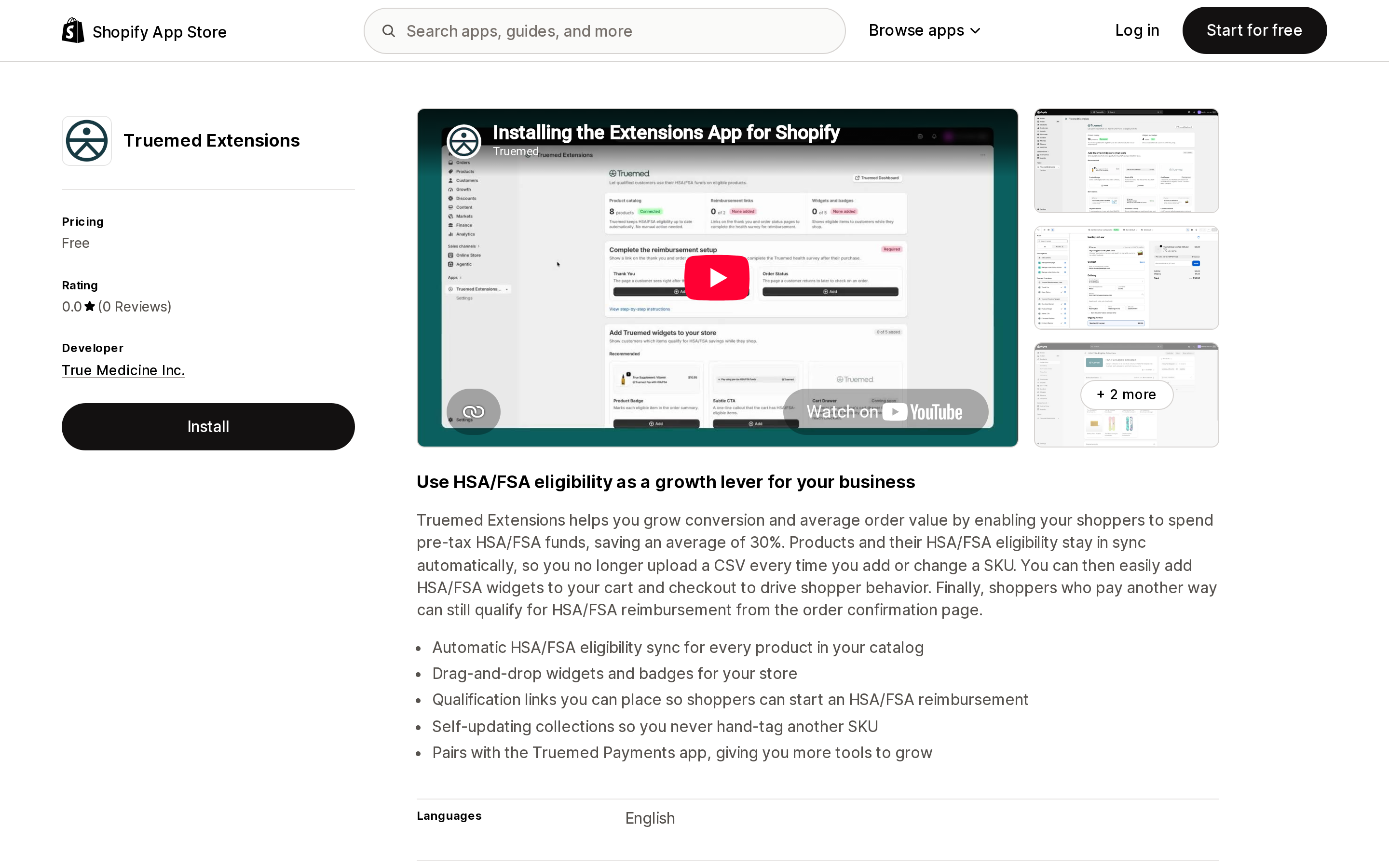
Source: Shopify App Store (Truemed Extensions), retrieved September 2, 2026
Truemed Extensions is free, launched March 14, 2025, and carries no reviews. What it does is narrow: it places a qualification link on the order confirmation page so customers can take a health survey after the fact and pursue reimbursement. That is the post-purchase path, not acceptance at checkout.
The actual payment integration is the Truemed Payments App, which Truemed's documentation describes as an additional payment method activated in Settings → Payments, installed via a link Truemed provides after onboarding — which includes uploading your product catalog as a CSV for a SKU-level compliance review, and completing Stripe Express onboarding. Truemed operates from Austin, Texas, as True Medicine Inc.
Three operational details from Truemed's own docs deserve more attention than any conversion statistic:
Customers "must check out as a guest, not via Shop Pay." If accelerated checkout carries a meaningful share of your orders, this is a real trade, not a footnote.
Orders move through Shopify financial statuses on a clock. Payment pending means the health survey is under review and you cannot capture. Authorized means the LMN was issued — and you must capture within seven days or the authorization expires and the funds release, permanently. Expired means the LMN was rejected or the window elapsed: no funds were collected, and Truemed instructs merchants not to fulfill those orders.
Money moves outside Shopify Payments. Payouts arrive "in batches on a rolling two-day basis" to a bank account linked through a Stripe Express account, less Truemed's fees, and refunds run back through that same Stripe account. Your Shopify payouts report will not reconcile these for you.
One contradiction is worth flagging because a merchant could be burned by it. Truemed's Shopify marketing page advertises "Support for One-Time and Subscriptions Orders." Truemed's Shopify documentation states the opposite for this specific integration: "At this time, the Truemed Shopify Payments App does not support subscription purchases. If a customer's cart contains a subscription item, Truemed will not appear as an available payment option at checkout." Truemed does support subscriptions through its API, so both statements can be true of the company — but if you sell on Shopify with a subscription app, verify this in writing before launch.
Sika Health
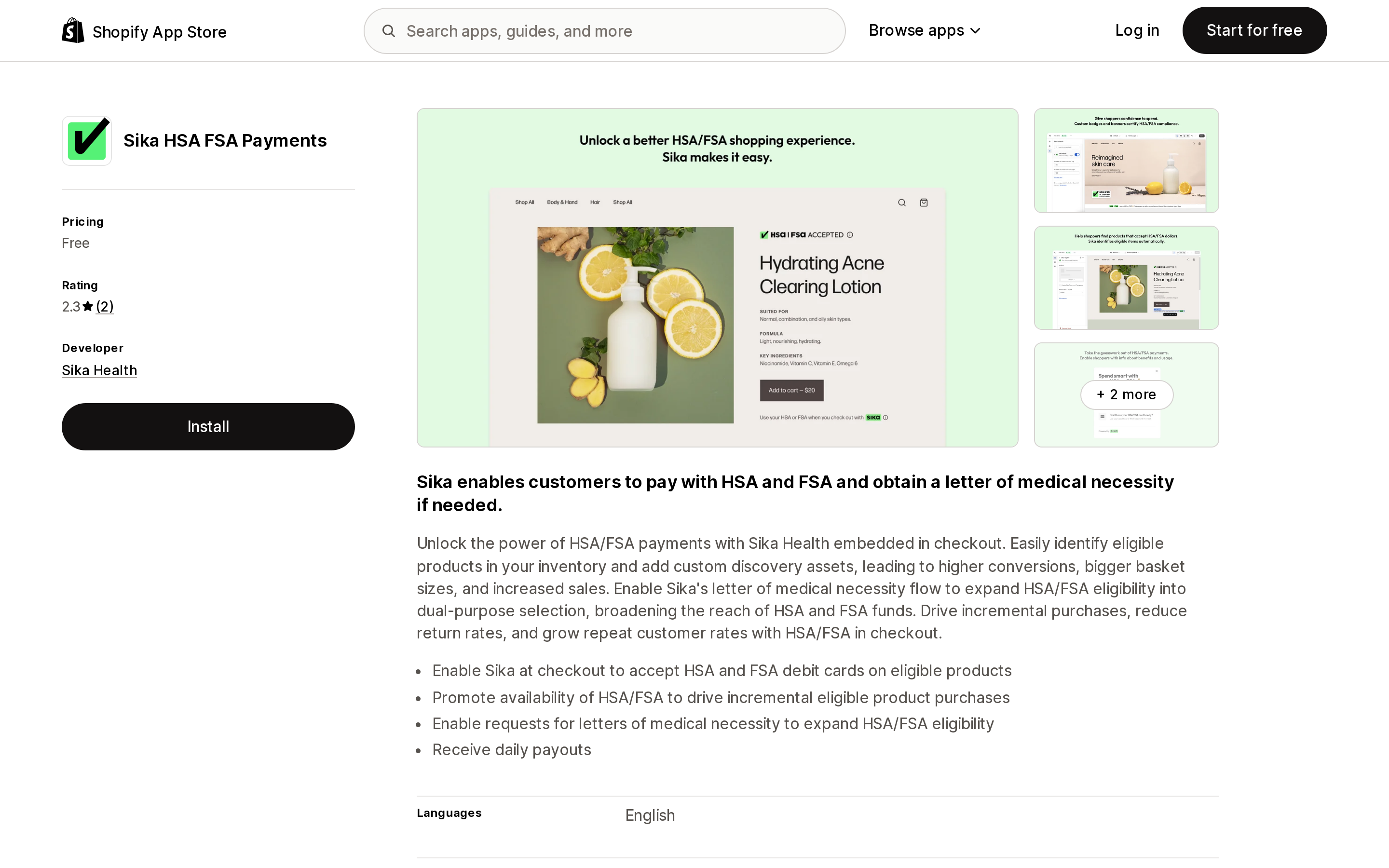
Source: Shopify App Store (Sika HSA FSA Payments), retrieved September 2, 2026
Sika HSA FSA Payments is the only one of the three whose App Store listing is the payment integration itself. It is free to install, launched June 9, 2023, and works with Checkout, Shopify Admin, and Stripe Connect. Its listed capabilities include accepting HSA and FSA debit cards on eligible products, an LMN request flow, eligibility badges, and daily payouts.
Sika describes itself as a SIGIS member and Integrated Payment Provider, and positions its IIAS as software-as-a-service that integrates with existing inventory management to update eligibility in real time — which is the cleanest description any of the three gives of what is actually being outsourced. Its merchant FAQ also makes the useful point that with Sika "there's no need to change your Merchant Category Codes (MCC) to work around this."
The review record is thin and mixed: 2.3 stars from two reviews. One from June 2025 calls implementation easy. One from January 2026, from a US merchant who had used the app for seven months, describes withheld payments and difficulty reaching support. Two reviews cannot establish a pattern, and it would be wrong to generalize from either — but a payments vendor holding funds is the specific failure mode worth asking about in a reference call.
Flex
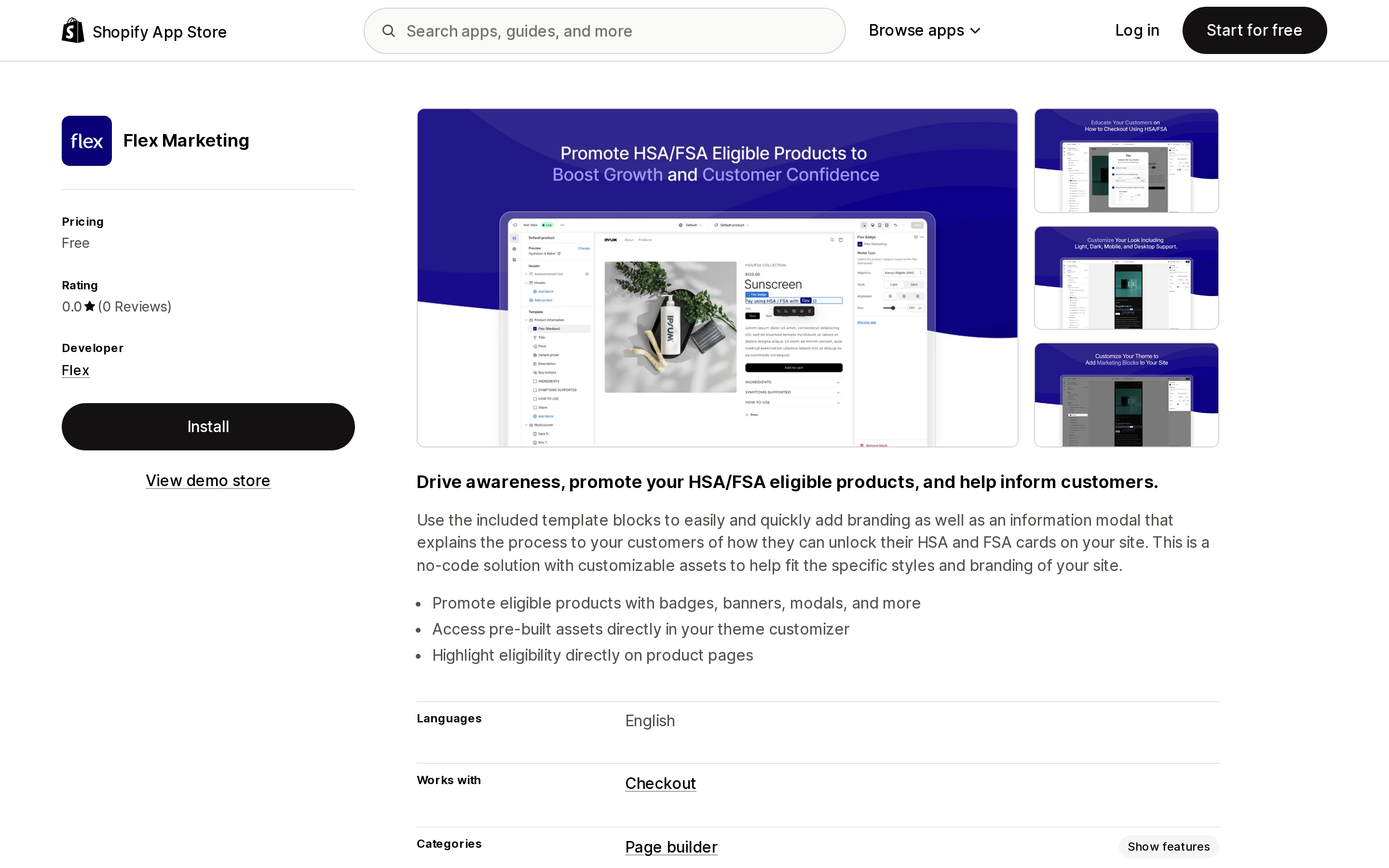
Source: Shopify App Store (Flex Marketing), retrieved September 2, 2026
Flex Marketing is the only app listed under Flex Technology Co. on the App Store, and like Truemed Extensions it is not the payment path — it adds badges, banners, and modals that promote HSA/FSA acceptance. The payment integration is the Flex Shopify Payments App, installed from the Flex dashboard under Settings → Integrations → Shopify, after which "Pay with Flex" must show as Active in Shopify's Settings → Payments.
Flex documents its split-cart behavior more explicitly than the others, and the sequence matters for anyone with mixed baskets: place a temporary hold on the HSA/FSA-eligible amount, process the credit or debit card for the ineligible amount, capture the held HSA/FSA funds, then redirect to the order completion page. On the Shopify side "this appears as a single order," with the payment gateway shown as "Flex."
Flex also states a deliberate conversion choice for fully ineligible carts: rather than restarting checkout, it prompts the customer for a credit card, because "directing the customer to start the checkout session process all over again does not convert as well."
Installation requires a Web Pixel to read cart contents, plus a full product sync that Flex warns "can take several minutes or longer depending on the number of products in your store."
What none of them publish: the price
None of the three publishes merchant pricing on its Shopify App Store listing or public site. All three listings say "Free," which refers only to the app install. The economics live in a merchant agreement negotiated after a sales conversation, and Truemed confirms only that payouts arrive "less Truemed's fees."
Third-party comparison sites circulate figures in the mid-single-digit percentage range for this category. None of that is confirmable from primary sources, so treat any number you have read — including here — as unverified until it is in your contract.
What you can do is frame the question correctly. You are not comparing against 2.9% + 30¢, because the alternative is not a cheaper processor. The alternative is the decline. The comparison that matters is the vendor's rate against the incremental margin on orders that would not otherwise close, minus the operational cost of orders that stall in Payment pending and the ones that expire unfulfilled.
Choosing between them
Stay native and skip the category if your catalog is general merchandise with no credible clinical rationale. Truemed states it "does not partner with products that cannot be connected to the treatment or prevention of a medical condition," and no vendor can manufacture eligibility that the IRS framework does not support.
Prioritize Sika Health if you want the shortest path from App Store listing to a working payment method, and if IIAS certification and eligible-inventory management is the specific piece you want outsourced. It is the only one of the three where installing the listed app is the integration. Ask directly about payout timing and holds.
Prioritize Truemed if your catalog is dual-purpose wellness where nearly every order needs an LMN, and if you want the deepest published operational documentation — the financial status model, capture windows, reconciliation, and dispute handling are all written down, which is rarer than it should be. Confirm the subscription limitation and accept the Shop Pay trade-off.
Prioritize Flex if mixed-eligibility carts are your normal case rather than an edge case, or if you also sell outside Shopify. Its split-tender flow is the most explicitly documented, and it lists integrations spanning WooCommerce, BigCommerce, Salesforce, Adobe Commerce, and Stripe.
Whichever you choose, three questions belong in the contract rather than the demo: the all-in merchant rate and who absorbs card processing on the non-HSA portion of split payments; who is liable if a plan administrator later reverses a substantiated transaction; and what happens to in-flight authorizations if you switch vendors or uninstall.
Sources
- SIGIS — IIAS vs 90% Comparison
- SIGIS — Merchants
- IRS Office of Chief Counsel Memorandum 202323006 (PDF)
- Truemed — HSA/FSA Payments for Shopify
- Truemed Docs — Intro to Truemed on Shopify
- Truemed Docs — Financial statuses
- Truemed Docs — Subscriptions
- Truemed Docs — Eligibility & what businesses qualify
- Shopify App Store — Truemed Extensions
- Shopify App Store — Sika HSA FSA Payments
- Sika Health — Merchants
- Shopify App Store — Flex Marketing
- Flex Docs — How Flex Shopify Payments Work
- Flex Docs — Flex Shopify Payments App Installation
Shop Pay Installments is free to activate, needs no app, and Shopify never publishes what it costs you — the rate is visible only inside your own admin. It also refuses Capital One and Chase credit cards, restricts monthly plans to debit cards only, excludes gift cards and subscriptions, and can't be turned off for individual products. Affirm can suspend your account for being password-protected, for having a non-English storefront, or for being primarily B2B. And Shopify's Getting paid page says disputes appear in your admin while its FAQ says they don't. If you fail the eligibility gates, the alternative is on-site messaging apps from Klarna, Afterpay, Sezzle, Zip, and PayPal — a category rated between 1.0 and 3.2 stars. Researched September 2, 2026.