
What you will learn
On this pageContentsCloseOpen
Almost every "best Shopify SMS app" article published this year opens on the same assumption: Shopify does not send text messages, so you need an app. That is no longer true, and the numbers Shopify published while nobody was looking are the interesting part.
Shopify Messaging sends SMS marketing campaigns to opted-in customers in twelve countries. The US rate is $0.012 per message. The toll-free number required to send to the US and Canada costs $2.15 per month. There is no platform fee, no minimum spend, and no contact-count tier.
For comparison, Postscript SMS Marketing — 4.7 stars across 1,144 reviews, the most-reviewed SMS-only app in this comparison — charges $0.009 per SMS on its entry plan, plus carrier fees that Postscript itself puts at an average of $0.00418 per SMS in the US, plus a $49 monthly minimum spend. Add those together and Shopify's flat $0.012 is cheaper per message than Postscript's cheapest tier.
That is not the whole story, and the rest of it is where merchants will actually make their decision. Shopify's toll-free number cannot receive customer replies. Fourteen content categories are prohibited outright. Puerto Rico is excluded from US coverage. This article works through all of it with the published numbers.
Research date: September 2, 2026. All prices are USD as published by Shopify, by the vendors, or on the Shopify App Store in the US locale.
The short version
- Shopify Messaging sends SMS marketing campaigns natively. It is not a partner integration and it is not an app you install separately — Messaging is the app formerly known as Shopify Email.
- US: $0.012 per SMS. Canada: $0.025. The most expensive supported country is Luxembourg at $0.13.
- A $2.15 monthly charge applies to each approved toll-free number used for US and Canada SMS marketing. Billing starts once the number is activated.
- To send to the US or Canada you must complete a toll-free registration form. It takes 2 to 5 business days, and your number is randomly assigned and for delivery purposes only — you cannot receive customer replies to it.
- Only twelve recipient countries are supported, and the United States entry explicitly reads "excluding Puerto Rico."
- Fourteen content categories are banned, including alcohol, cannabis and CBD, tobacco and vaping, firearms and accessories, fireworks, gambling, cryptocurrency, and political content.
- If your store sells age-restricted products, Shopify's own registration failure guidance tells you to install a third-party age verification app — a native feature that requires an app to unlock.
- 25 free test messages per week. Messages exceeding the single-message character limit are billed as multiple messages.
- You need an active paid Shopify plan, the Online Store sales channel installed, and a payment provider configured. Pause and Build and free trial stores can compose and self-test but cannot send.
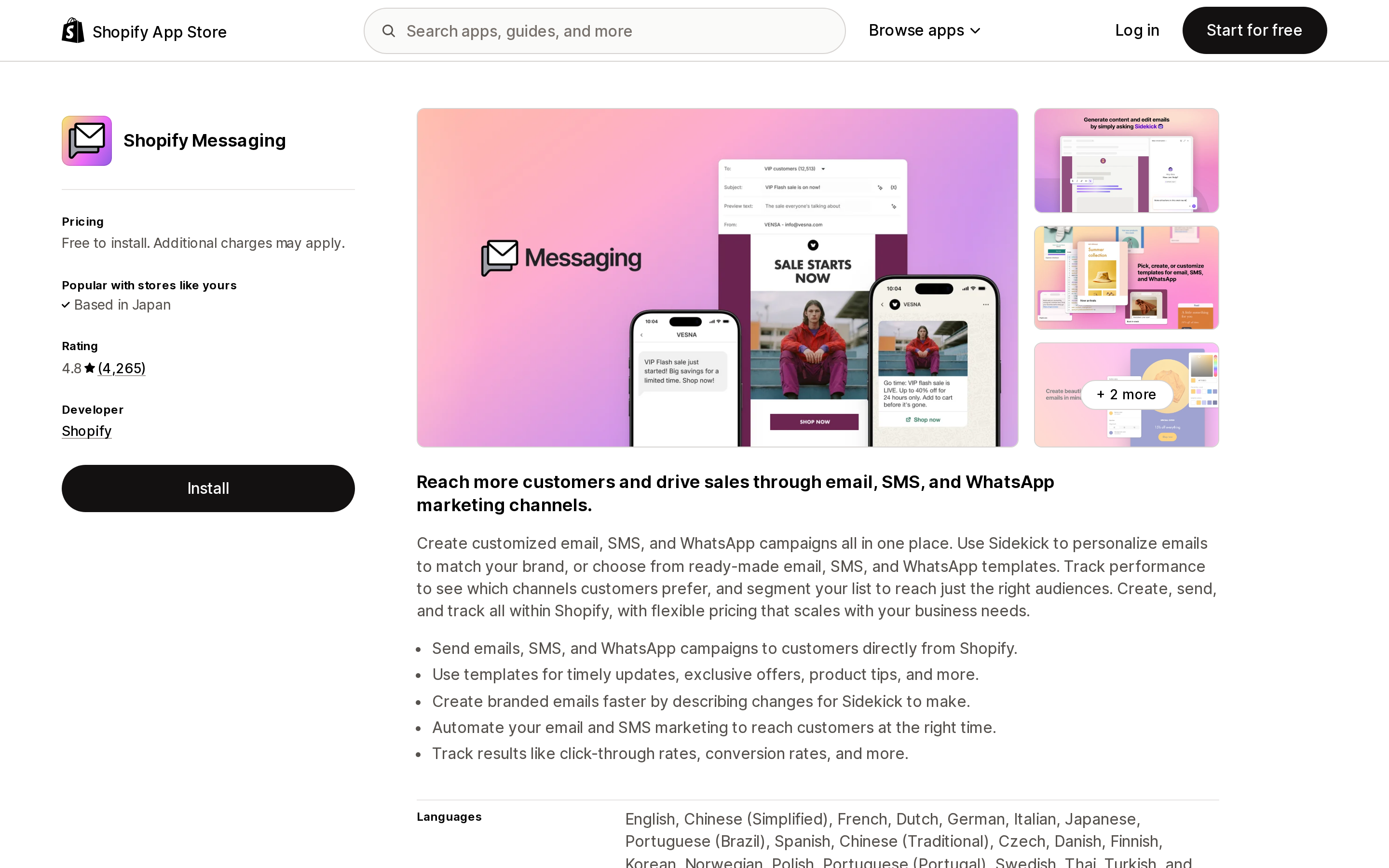
Source: Shopify App Store, Shopify Messaging listing. Retrieved September 2, 2026.
What Shopify actually charges
Shopify's pricing page for SMS marketing campaigns publishes a per-country table. The full list:
| Country | Price per SMS |
|---|---|
| United States | $0.012 |
| Canada | $0.025 |
| Poland | $0.041 |
| Portugal | $0.045 |
| Spain | $0.06 |
| United Kingdom | $0.06 |
| Sweden | $0.072 |
| Italy | $0.075 |
| Denmark | $0.08 |
| Austria | $0.092 |
| Finland | $0.108 |
| Luxembourg | $0.13 |
Two billing details matter more than the headline number.
Long messages cost more than one message. If a campaign exceeds the character limit for a single SMS, the customer sees one continuous message but you are charged per segment. Shopify's own example: a campaign split into 2 messages for 100 recipients is billed as 200 messages. Emoji shorten the limit sharply, which is how a "one text" campaign quietly becomes a two-text campaign.
Automated messages are billable too. Subscriber confirmation messages, double opt-in messages, and replies to keyword requests like INFO or HELP are all charged per SMS. Those are compliance messages you cannot skip, so treat them as a fixed percentage on top of your campaign volume.
There is a spending-threshold alert for SMS automations, but read what it does carefully: it emails the store owner when automation costs cross a number you set, it applies to all automations combined, and — Shopify states this plainly — setting a threshold does not prevent your account from being billed when costs exceed it. It is an alarm, not a cap. It also ignores campaign sends entirely; only automations count toward it.
The toll-free number is the real constraint
To send SMS marketing to the United States or Canada, Shopify requires you to complete a toll-free registration form covering contact information, business information, privacy policy, and terms of service. Registration takes 2 to 5 business days.
Then comes the sentence that should decide this for a lot of brands:
Your toll-free sender number is randomly assigned and is for delivery purposes only. You can't receive customer replies to your toll-free sender number.
One-way only. A customer who replies "what size is this in men's" gets nothing back and, as far as they can tell, is being ignored by your brand. The dedicated SMS apps in this comparison treat two-way conversation as core product — Postscript lists "response management (reply to texts from subscribers)" on every plan, plus opt-in keywords that require inbound messages to work at all.
If your SMS program is broadcast-only promotional sends, this is a non-issue. If your plan involves conversational SMS, a concierge flow, or keyword-based list growth, Shopify's native SMS cannot do it, at any price.
Registration gets rejected, and the reasons are documented
Shopify publishes a table of common toll-free registration rejections. It is worth reading before you apply, because three of the four are avoidable in an afternoon:
- "Business email requires an official domain." Gmail and Yahoo addresses may be rejected unless the address is visibly published on your storefront as an official contact method.
- "Contact must be a business representative." Generic names and titles — Admin, Support, partial names — are not accepted. Use a real authorized person's full name.
- "Could not validate business information." Business name, address, phone, website URL, and website email must match what is displayed on your online store. A placeholder URL or a mismatch fails.
- "Age verification." If you sell alcohol or other restricted items, you are told to add an age verification app that collects a full date of birth or uses a third-party verification service. A checkbox or confirmation button is explicitly not accepted.
That last one is worth pausing on. Shopify's native SMS feature can require you to buy a third-party app before it will let you send — and the age verification category exists precisely because Shopify has no native age gate.
Fourteen banned content categories
Shopify prohibits SMS marketing content in these categories: alcohol; debt collection and forgiveness; firearms, ammunition, accessories and depictions of violence; fireworks; fraudulent messages; gambling; hateful content; high-risk financial services including cryptocurrency and payday loans; illegal substances including cannabis, CBD, THC, tobacco, vaping and paraphernalia; malicious content; multi-level marketing; obscene or offensive material; political content; and third-party lead generation.
Read that as a list of DTC categories that cannot use this feature: every wine and spirits brand, every CBD and hemp brand, every vape and nicotine-alternative brand, every firearms accessory and outdoors brand carrying ammunition, every crypto-adjacent product. These are not fringe segments of US ecommerce, and several of them are the exact categories that lean hardest on SMS because paid social bans them too.
Carriers impose these restrictions on everyone, so a third-party app is not automatically a way around them — but apps that work in regulated verticals do exist, and they will tell you what they can register. Shopify's answer here is a flat no.
The cost comparison, with the fees included
Shopify's number is all-in for the message itself. Most SMS apps quote a per-message rate and then add carrier pass-through fees on top. Comparing quoted rates without adding those fees produces the wrong winner.
Published rates as of today:
| Provider | Platform fee | Per US SMS | Carrier fees | Minimum |
|---|---|---|---|---|
| Shopify Messaging | $0 | $0.012 | included in the rate | none, + $2.15/mo toll-free |
| Postscript Starter | $0 | $0.009 | + ~$0.00418 avg | $49/mo minimum spend |
| Postscript Growth | $100/mo | $0.008 | + ~$0.00418 avg | — |
| Postscript Professional | $500/mo | $0.007 | + ~$0.00418 avg | — |
| Omnisend Pro | $59/mo and up | from $0.007 | not published | Pro plan required |
| Attentive | not published | not published | not published | 30-day free trial, then agreement |
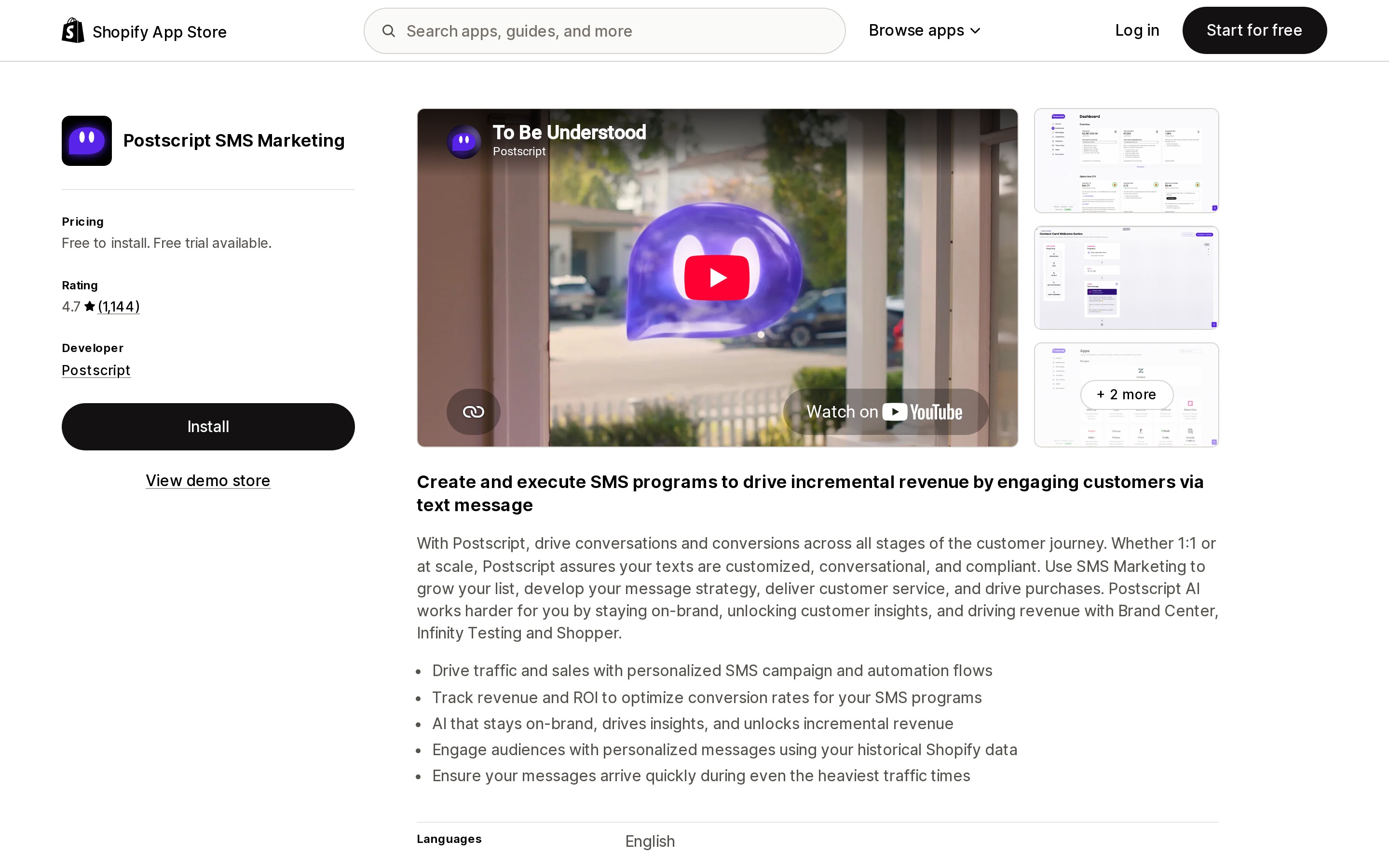
Source: Shopify App Store, Postscript SMS Marketing listing. Retrieved September 2, 2026.
The carrier-fee figure is Postscript's own: its pricing page footnotes "Average US Carrier fees are $0.00418 for SMS and $0.00841 for MMS," and notes listed rates cover the US 50 states and Canada only. Postscript's public pricing page currently shows the Starter SMS rate as $0.015 struck through to $0.009, so treat $0.009 as a promotional rate rather than a permanent one.
Running it at two volumes, US-only, single-segment messages:
10,000 SMS per month
| Provider | Monthly total |
|---|---|
| Shopify Messaging | $122.15 |
| Postscript Starter | $131.80 |
| Omnisend Pro (2,500 contacts) | from $129.00 |
| Postscript Growth | $221.80 |
| Postscript Professional | $611.80 |
50,000 SMS per month
| Provider | Monthly total |
|---|---|
| Shopify Messaging | $602.15 |
| Omnisend Pro (2,500 contacts) | from $409.00 |
| Postscript Starter | $659.00 |
| Postscript Growth | $709.00 |
| Postscript Professional | $1,059.00 |
Omnisend's SMS rate is bundled into a plan whose price rises with contact count, so its total climbs as your list grows in a way Shopify's and Postscript's do not — a $59 Pro plan covers up to 2,500 contacts. Attentive publishes no per-message price at all on its App Store listing; the plan card says "Free to install, additional charges may apply" with a minimum 30-day free trial, then month-to-month or long-term agreements, and notes that external charges are billed by Attentive separately from your Shopify invoice. You cannot model it without a sales call, which is itself a data point.
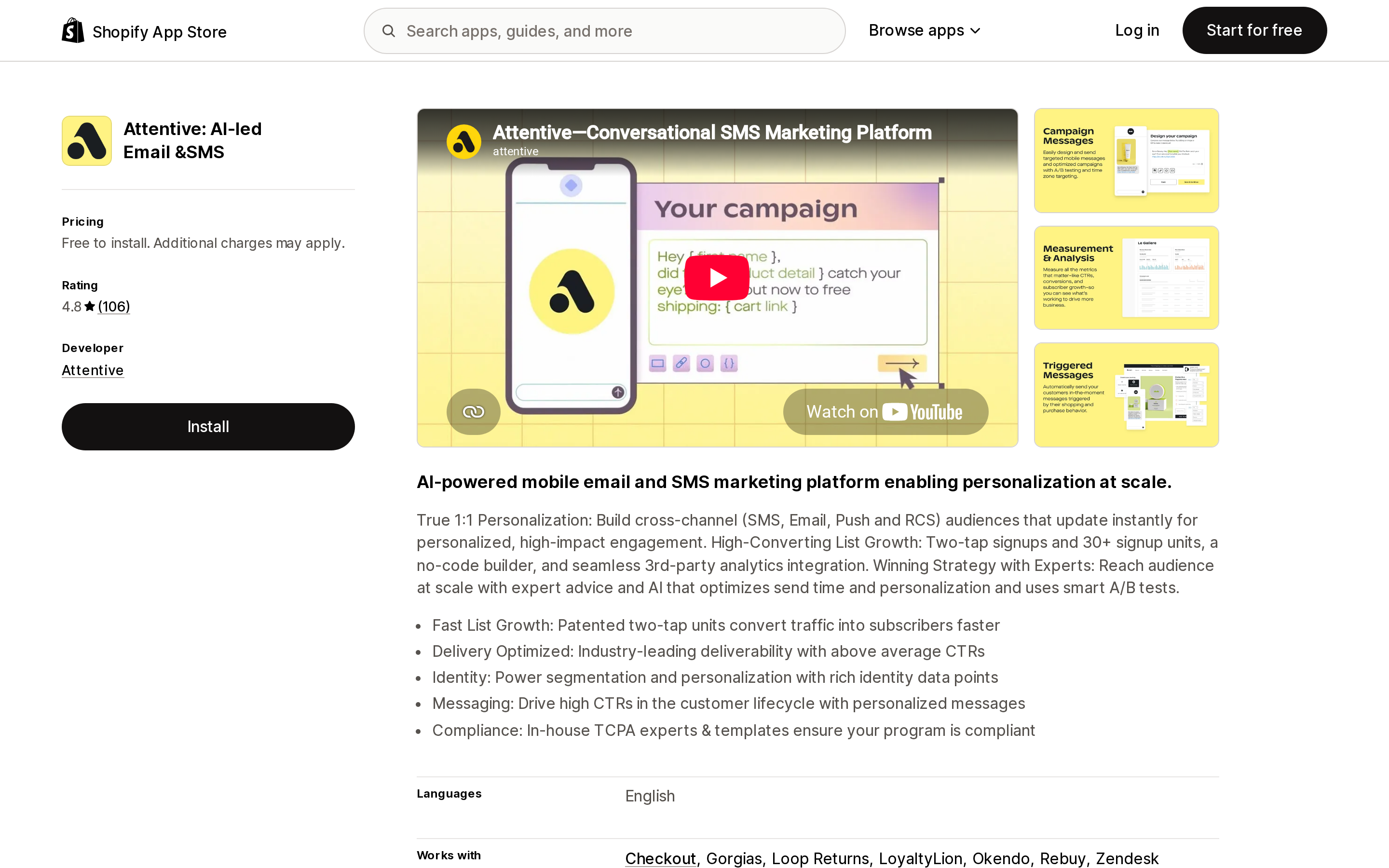
Source: Shopify App Store, Attentive listing. Retrieved September 2, 2026.
The pattern: at low-to-mid volume, Shopify's flat rate wins or ties on price. Dedicated platforms only pull ahead when volume is high enough to amortize a platform fee, and even then Postscript's Professional tier needs roughly 600,000 messages a month before its $0.007 rate closes a $500 gap against Shopify's $0.012.
One more thing about the category list
The SMS app market moved while this was happening. Yotpo's SMS product — long marketed as SMSBump — is no longer on the Shopify App Store: apps.shopify.com/smsbump returns a 404, and an App Store search for "Yotpo SMS" today returns Yotpo's reviews and loyalty apps with no SMS product among them. Postscript is running a dedicated migration landing page titled "Yotpo SMS is ending" with discounted rates for switchers.
If you are on Yotpo SMS, migration is not optional and your evaluation window is now. That is also the moment where Shopify's native option is worth pricing seriously, because you are already paying the switching cost either way.
Which to choose
Shopify Messaging SMS fits a store sending broadcast promotional campaigns to US customers, in a category that is not on the banned list, that does not need inbound replies or keyword opt-ins, and that would rather not carry a platform fee or a contact-count tier. The $2.15 toll-free line and $0.012 per message is close to the cheapest structure available, and it bills on your Shopify invoice under "Messaging."
A dedicated SMS app fits you if any one of these is true: you need two-way conversation, you want keyword-based list growth, you sell in a prohibited category, you send to countries outside Shopify's twelve, you need MMS at a published rate (Shopify's pricing page lists SMS only), or you are at a volume where a platform fee buys a materially lower per-message rate.
Run the registration first either way. Toll-free approval takes 2 to 5 business days and the rejection reasons are mostly about your store's public business information matching your application. Fixing that is worth doing regardless of which provider you pick, because every US SMS provider registers a sender on your behalf against the same carrier requirements.
Sources
- Shopify Messaging SMS marketing campaigns — Shopify Help Center
- Pricing and billing for SMS marketing campaigns — Shopify Help Center
- Requirements and guidelines for sending SMS marketing campaigns — Shopify Help Center
- Setting up and creating SMS marketing campaigns with Shopify Messaging — Shopify Help Center
- Requirements for using Shopify Messaging — Shopify Help Center
- Postscript pricing and Yotpo SMS is ending — Postscript
- Shopify App Store listings for Shopify Messaging, Postscript SMS Marketing, Attentive, and Omnisend, retrieved September 2, 2026
Shop Pay Installments is free to activate, needs no app, and Shopify never publishes what it costs you — the rate is visible only inside your own admin. It also refuses Capital One and Chase credit cards, restricts monthly plans to debit cards only, excludes gift cards and subscriptions, and can't be turned off for individual products. Affirm can suspend your account for being password-protected, for having a non-English storefront, or for being primarily B2B. And Shopify's Getting paid page says disputes appear in your admin while its FAQ says they don't. If you fail the eligibility gates, the alternative is on-site messaging apps from Klarna, Afterpay, Sezzle, Zip, and PayPal — a category rated between 1.0 and 3.2 stars. Researched September 2, 2026.