
What you will learn
On this pageContentsCloseOpen
A product finder quiz is one of the few on-site tools that does two jobs at once: it moves a hesitant shopper toward a specific SKU, and it collects declared preference data you can segment on later. That combination is why merchants keep asking whether Shopify can do it natively.
It cannot, and Shopify says so in unusually plain language. Two sentences in the Forms documentation end the conversation:
"Multi-step forms aren't supported."
"Conditional logic isn't supported on forms."
Without branching and without steps, there is no quiz. What follows is where the native line actually sits, and then the part that matters once you accept you're buying an app: every one of these vendors meters you by a unit it defines itself, and the definitions are not the same.
Research date: September 2, 2026. Prices are USD from the English App Store listings.
The short version
- Shopify Forms supports rich field types — dropdown, radio, multiple choice, date, number, file upload — but no branching and no steps, and caps you at 25 forms per store and 31 fields per form.
- Forms can write submissions to customer or company metafields and apply a customer tag. That tag is fixed per form, not per answer.
- Search & Discovery filters are shopper-driven narrowing, not guided selling. They cap at 25 filters per store, 100 values per filter, and stop displaying entirely on collections over 5,000 products or searches returning over 100,000 results.
- Native Related and Complementary products cap at 10 each, and the Storefront API
productRecommendationsquery "Returns up to ten Product objects." - Six real quiz apps, six billing units. A "response," an "engagement," a "quiz taker," and a "credit" are four different things, and one of them is charged before the shopper finishes.
- Entry-tier cost per unit runs $0.05 to $0.125. The ranking changes once you account for what each unit means.
- One free plan is meaningfully usable at 100 responses a month. One "Free" plan is development stores only.
Where the native line sits
Shopify Forms
Shopify Forms is better than its reputation for what it is designed to do. Field types include single-line text, dropdown, radio buttons, multi-line text, multiple choice, date, number, and file upload. Custom fields can be stored as customer or company metafields, which means answers land in structured data you can segment on. You can apply a customer tag on submission and trigger Flow automations.
The ceiling is architectural, not incidental. Without conditional logic, question three cannot depend on the answer to question one. Without multi-step, everything sits on one screen. A quiz is precisely the shape Forms is documented not to take.
Two other constraints worth noting: up to 25 forms per store, up to 31 fields per form. And one that bites in practice — when an existing customer submits a form, their email and phone on file aren't modified, and other fields such as marketing consent might not update either.
Filters and recommendations
Search & Discovery filters are sometimes proposed as a quiz substitute. They aren't the same interaction — filters ask the shopper to already know their criteria; a quiz infers criteria from questions about the shopper. They also have hard limits: a maximum of 25 filters per store, up to 100 values per filter, no filters displayed on collections over 5,000 products, and none on searches returning over 100,000 results.
Native recommendations sit on the other side of the funnel. You can select up to 10 Complementary products and up to 10 Related products per product, and the Storefront API's productRecommendations query returns at most ten. These are product-anchored: they answer what goes with this, not which of these is right for you.
Verdict: an app is required for anything with branching logic that maps answers to a result set.
The unit problem
Here is the thing that makes cross-shopping these apps harder than it looks. Every vendor advertises a monthly allowance. None of them means the same thing by it.
- RevenueHunt and Quizify count quiz responses.
- Prehook counts engagements.
- Lantern counts quiz takers, and defines one as someone who has started and answered at least one question of the funnel. Not completed — answered one question.
- Octane AI counts credits, where one credit is one quiz engagement, and AI features consume additional fractions on top: roughly 0.3 credit for Smart Products, 0.1 for Smart Copy, 0.2 for Image Analyzer.
- Quiz Kit meters by quiz engagements across a sliding scale published on the vendor's own site.
Lantern's definition is the one to sit with. On a quiz where 60% of starters abandon after question one — a completely normal drop-off — a "500 quiz takers" allowance may represent only about 200 completed quizzes. Against a competitor billing completions, the same headline number is worth less than half as much. Neither vendor is being dishonest; they are measuring different events with the same-sounding word.
Octane AI's is the other one to check. Turning on the AI features that are the app's main pitch reduces the effective number of quizzes per plan. At roughly 1.3 credits per engagement with Smart Products enabled, the 400-credit Basic plan yields closer to 307 quizzes than 400.
Cost per response
Entry paid tier, tier price divided by the stated allowance:
| App | Entry tier | Allowance | Cost per unit | Unit definition |
|---|---|---|---|---|
| Quizify ‑ Product Quiz Builder | $9.99/mo | 200 responses | $0.050 | Response |
| Prehook: Quiz Funnel Builder | $45/mo | 600 engagements | $0.075 | Engagement |
| RevenueHunt Product Quiz Maker | $39/mo | 500 responses | $0.078 | Response |
| Lantern Product Quiz Builder | $39/mo | 500 quiz takers | $0.078 | One answered question |
| Quiz Kit: Product Quiz Maker | $59/mo | ~500 engagements | $0.118 | Engagement |
| Octane AI: Advanced Quiz Maker | $50/mo | 400 credits | $0.125 | Credit; AI costs extra |
Then check what happens when you run over, because the two behaviors are completely different. Quizify ($0.05, $0.04, $0.03 by tier), Prehook ($0.07, $0.04, $0.02) and Octane AI ($0.10/credit) charge overage. RevenueHunt, Lantern, and Quiz Kit move you up a tier instead. Overage pricing is friendlier to a spiky month; tiering is friendlier to a budget you have to forecast.
The six apps
RevenueHunt Product Quiz Maker
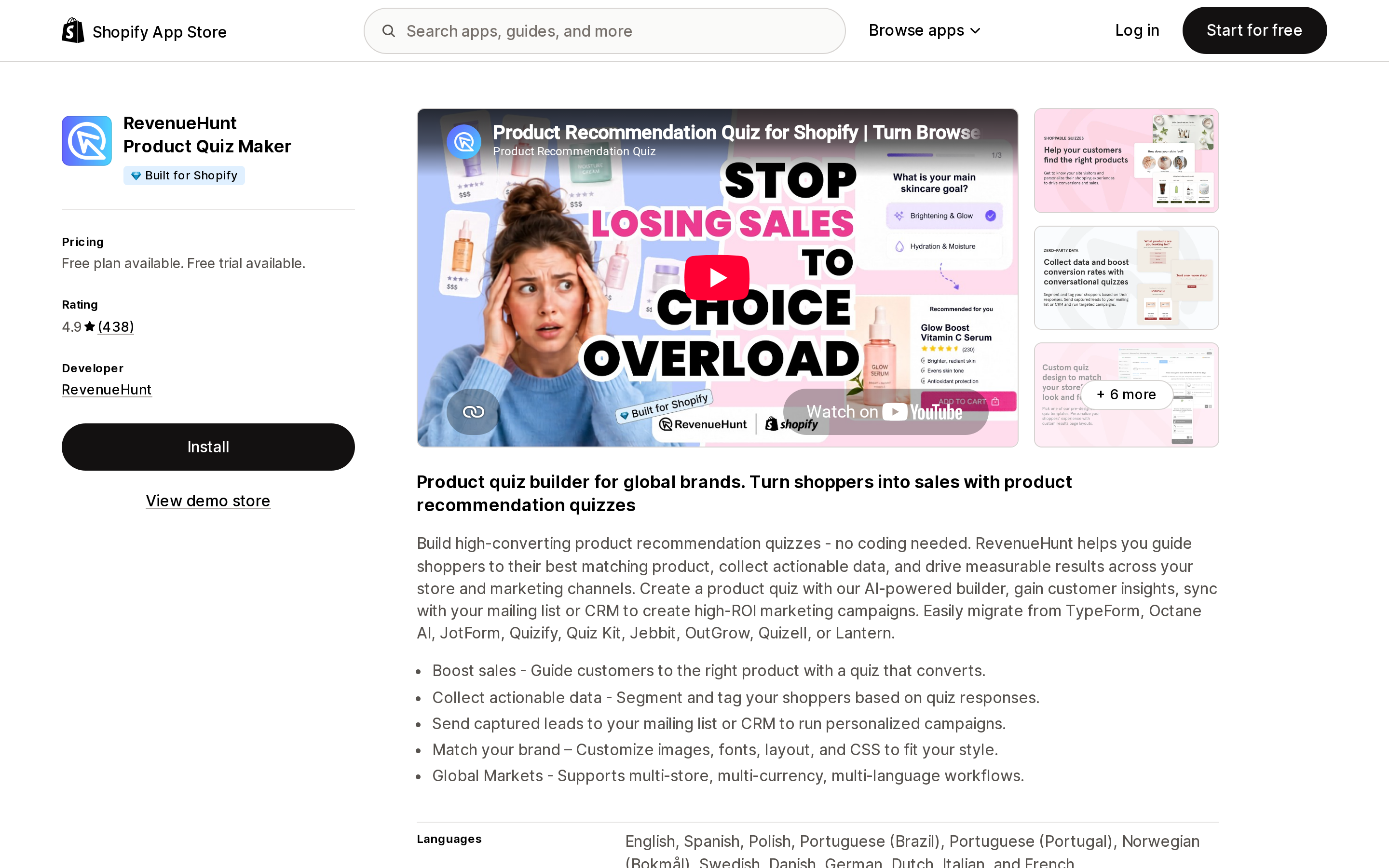
Source: Shopify App Store (RevenueHunt Product Quiz Maker), retrieved September 2, 2026
RevenueHunt Product Quiz Maker has a Built for Shopify badge and the most reviews in this group: 4.9 across 438.
Its free plan is the most substantial here — 100 quiz responses per month with unlimited quizzes, conditional logic, custom design, quiz analytics, Shopify Markets integration, and CSV lead export. That is a real production tier for a small store, not a demo. Basic is $39/month for 500 responses and adds live chat, custom HTML/CSS/JS, GA4 and Meta Pixel, webhooks and Zapier, and Klaviyo and Omnisend. Pro is $99/month for 1,000; Premium is $199/month for 2,500, with 20% off annual across the paid tiers.
The differentiator that matters if you care about CRM: RevenueHunt is the only app here whose own documentation states that quiz tags appear on Shopify customer profiles, and that a customer profile is updated with name, email, phone, and tags once someone leaves their email in the quiz. It also documents order tagging. For the other five, the equivalent behaviour is either unstated or named without a mechanism.
One negative review from late 2025 describes a Klaviyo integration issue that took weeks and outside developers to resolve. It is a single account's experience, not a pattern in the reviews we read.
Octane AI: Advanced Quiz Maker
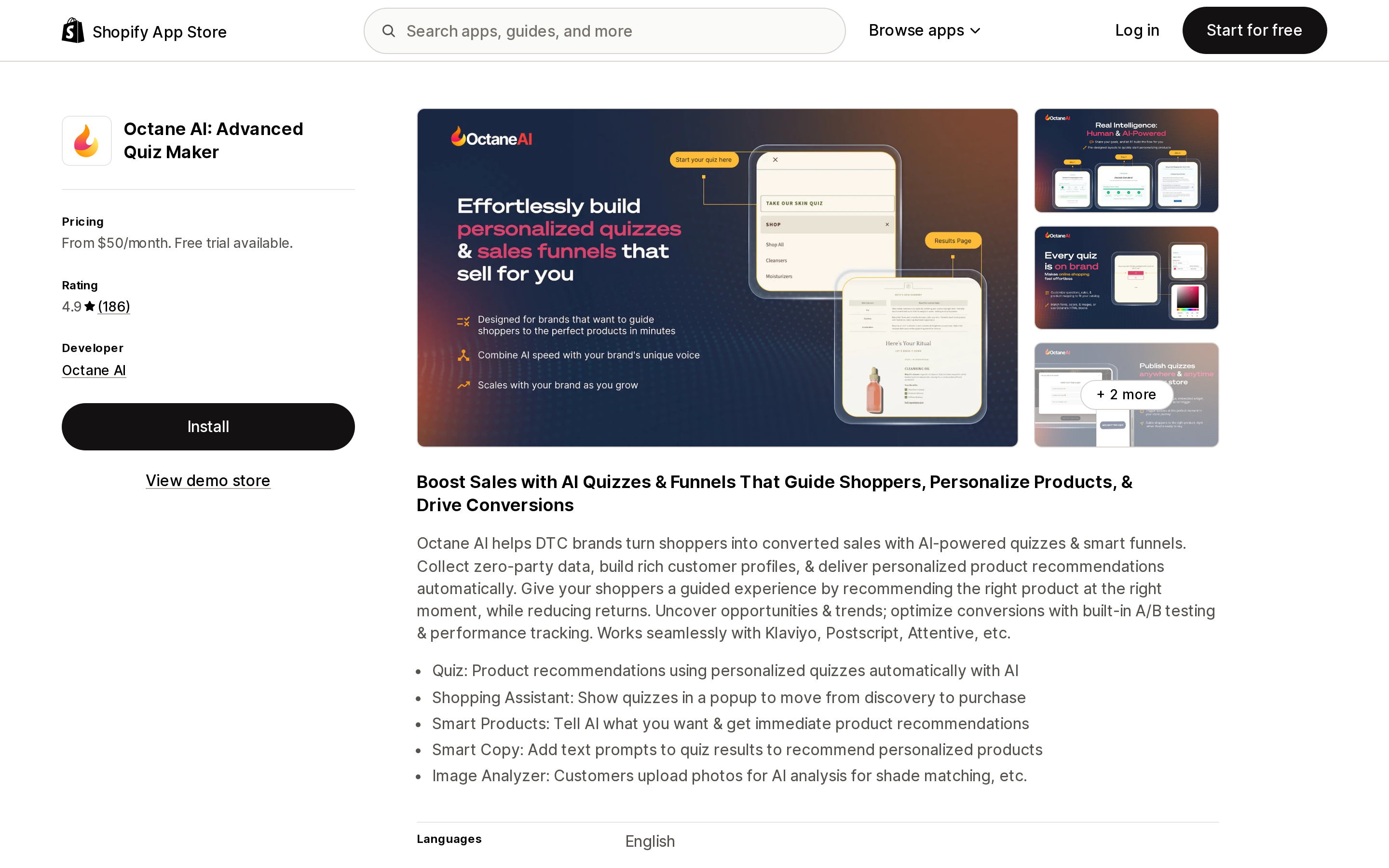
Source: Shopify App Store (Octane AI: Advanced Quiz Maker), retrieved September 2, 2026
4.9 across 186 reviews, no free plan, and the highest floor: $50/month, with a 14-day trial. Octane Basic is $50 or $100/month for 400 or 900 credits and is limited to two quizzes. Octane Plus is $200 or $350/month for 2,200 or 4,500 credits, adding unlimited quizzes, A/B testing, custom CSS, and removal of the Octane AI logo. Enterprise starts at $500/month.
The listing carries an explicit warning worth reading: "External charges may be billed by Octane AI separately from your Shopify invoice." Combined with $0.10-per-credit overage and AI features consuming fractional credits, this is the app in the set where the number on your card is least predictable from the plan name.
What you get for that is the widest marketing stack in the group. The integration list names Attentive, Postscript, Klaviyo, Gorgias, Recharge, and Tapcart — the only listing here besides Prehook to name both Attentive and Postscript. If your zero-party data has to land in an SMS platform on the day it's captured, that list is the reason to look.
No Built for Shopify badge in the listing header.
Quiz Kit: Product Quiz Maker
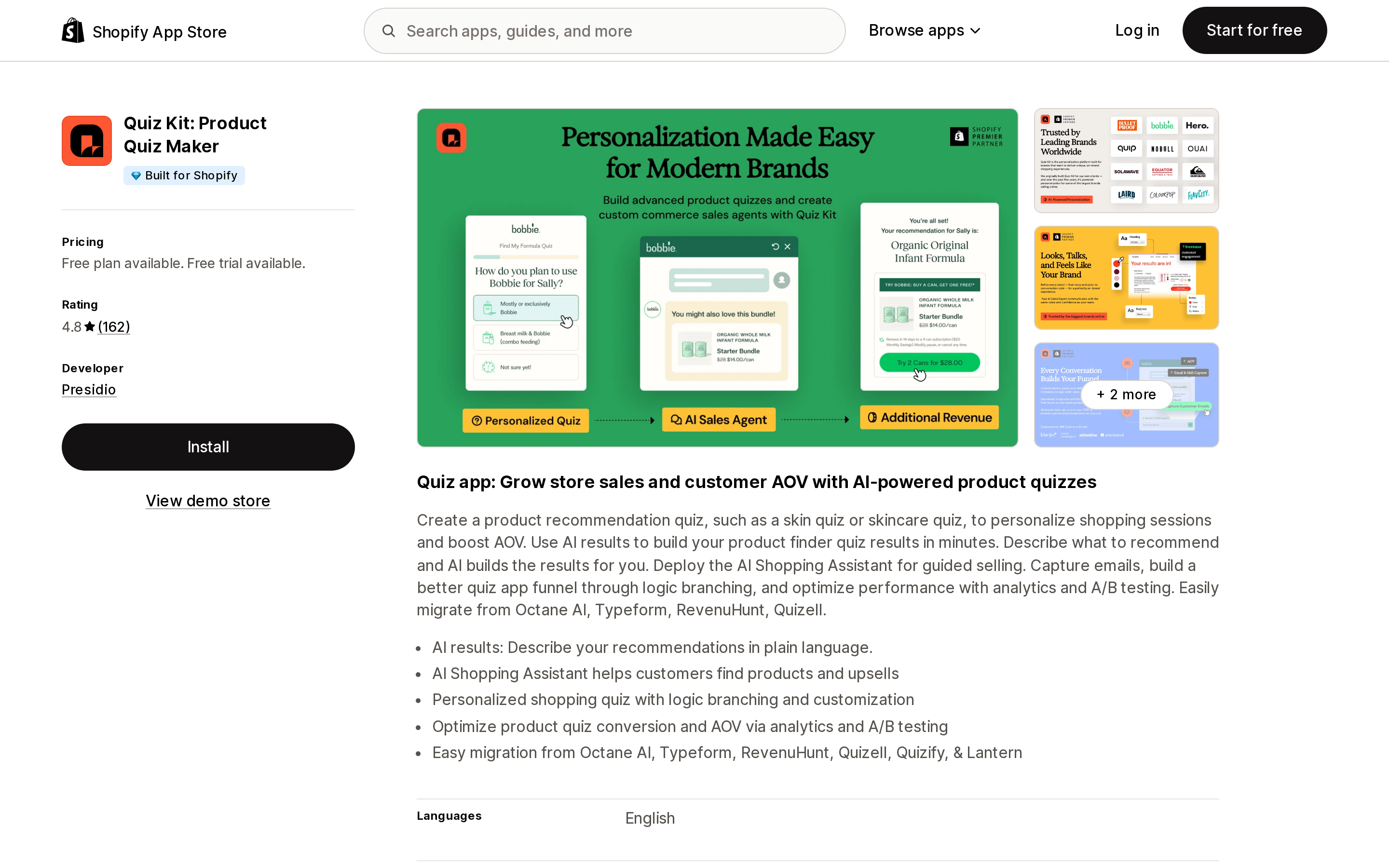
Source: Shopify App Store (Quiz Kit: Product Quiz Maker), retrieved September 2, 2026
Built for Shopify badge, 4.8 across 162 reviews, from developer Presidio. Read the pricing carefully: the App Store shows two entries, "Free - Dev Stores" and Scale at $59/month. The free plan is "Free for development stores" — there is no permanent free tier for a live store. A merchant scanning listings for "free plan available" will misread this one.
Scale is a sliding tier that starts at $59/month for up to about 500 engagements and climbs on the vendor's own site as volume grows, with a 10-day trial. It includes AI-driven quiz generation, post-quiz personalization, end-to-end conversion tracking, A/B testing, unlimited quizzes, and full CSS/JS control.
The listing also advertises easy migration from Octane AI, Typeform, RevenueHunt, Quizell, Quizify, and Lantern — the only app here explicitly positioning itself as a switch target. If you're already on one of those and unhappy, that is a deliberate signal.
Lantern Product Quiz Builder
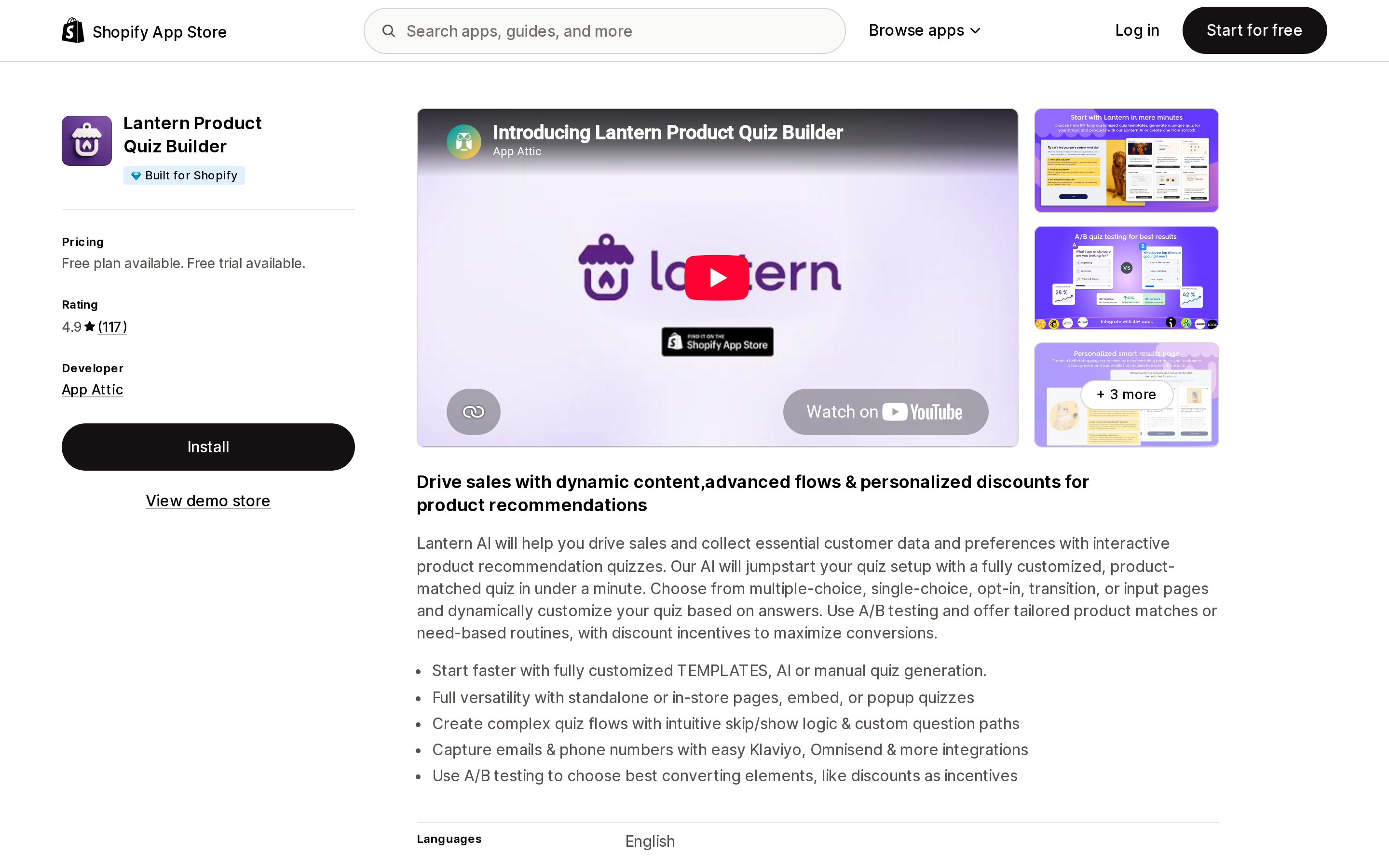
Source: Shopify App Store (Lantern Product Quiz Builder), retrieved September 2, 2026
Built for Shopify, 4.9 across 117 reviews, from App Attic. Free plan at 50 quiz takers with access to all features — including logic jumps, A/B testing, advanced analytics, and 30+ integrations. Scale runs from $39/month and slides up to $399/month by volume; Unlimited is $499/month for unlimited quiz takers.
Two things set it apart. The first is the billing definition discussed above — a quiz taker is counted at the first answered question, so model your drop-off before comparing its $39 to anyone else's.
The second is genuinely novel: the listing offers MCP support to manage quizzes from Claude or ChatGPT, and it is available from the free plan. No other app in this set exposes an agent-facing control surface. If you are already running store operations through an assistant, that changes the workflow rather than just the feature list.
The listing also states it supports standalone pages, in-store pages, embeds, and popups — the only app here that spells out its placement options rather than leaving them to be discovered on install.
Prehook: Quiz Funnel Builder
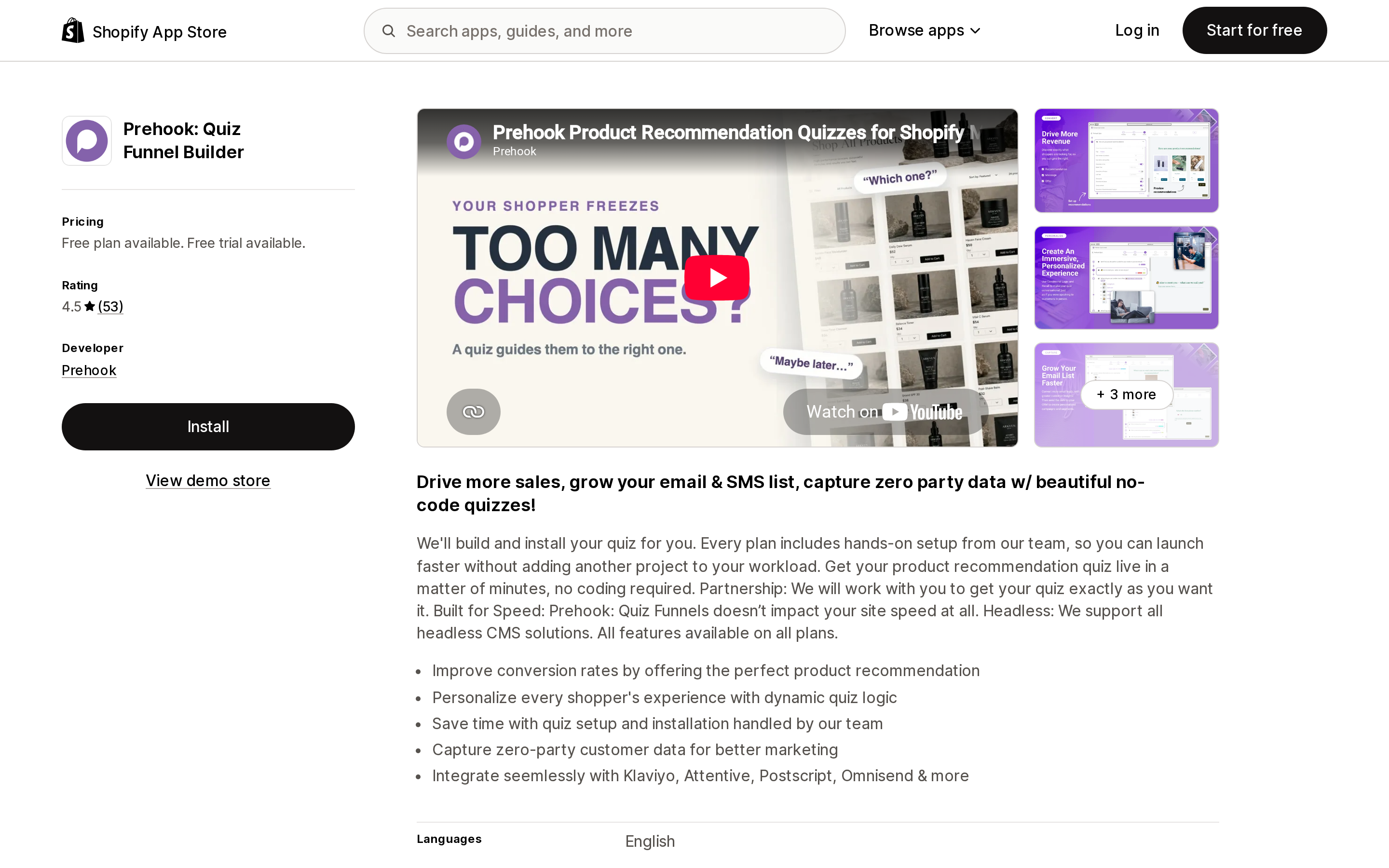
Source: Shopify App Store (Prehook: Quiz Funnel Builder), retrieved September 2, 2026
4.5 across 53 reviews, the smallest review base of the six with a real free tier. Free covers 10 engagements a month with conditional logic, quiz recall, and all premium templates. Basic is $45/month for 600 engagements with $0.07 overage; Standard $95/month for 2,000 with $0.04 and headless integration; Pro $195/month for 6,000 with $0.02 and concierge onboarding. Annual billing cuts 34–49% depending on tier.
Its pitch is explicitly zero-party data — "Capture zero party customer data for better marketing" — and it names Klaviyo, Attentive, Postscript, and Omnisend directly. The unusual inclusion is service: every paid tier states "We build your quiz for you!". If nobody on your team wants to own quiz logic, you are buying labour as much as software, and $45/month reads differently in that light.
Overage rates drop as you tier up, which is the right shape: the plan that expects volume charges less for exceeding it.
No Built for Shopify badge in the listing header.
Quizify ‑ Product Quiz Builder
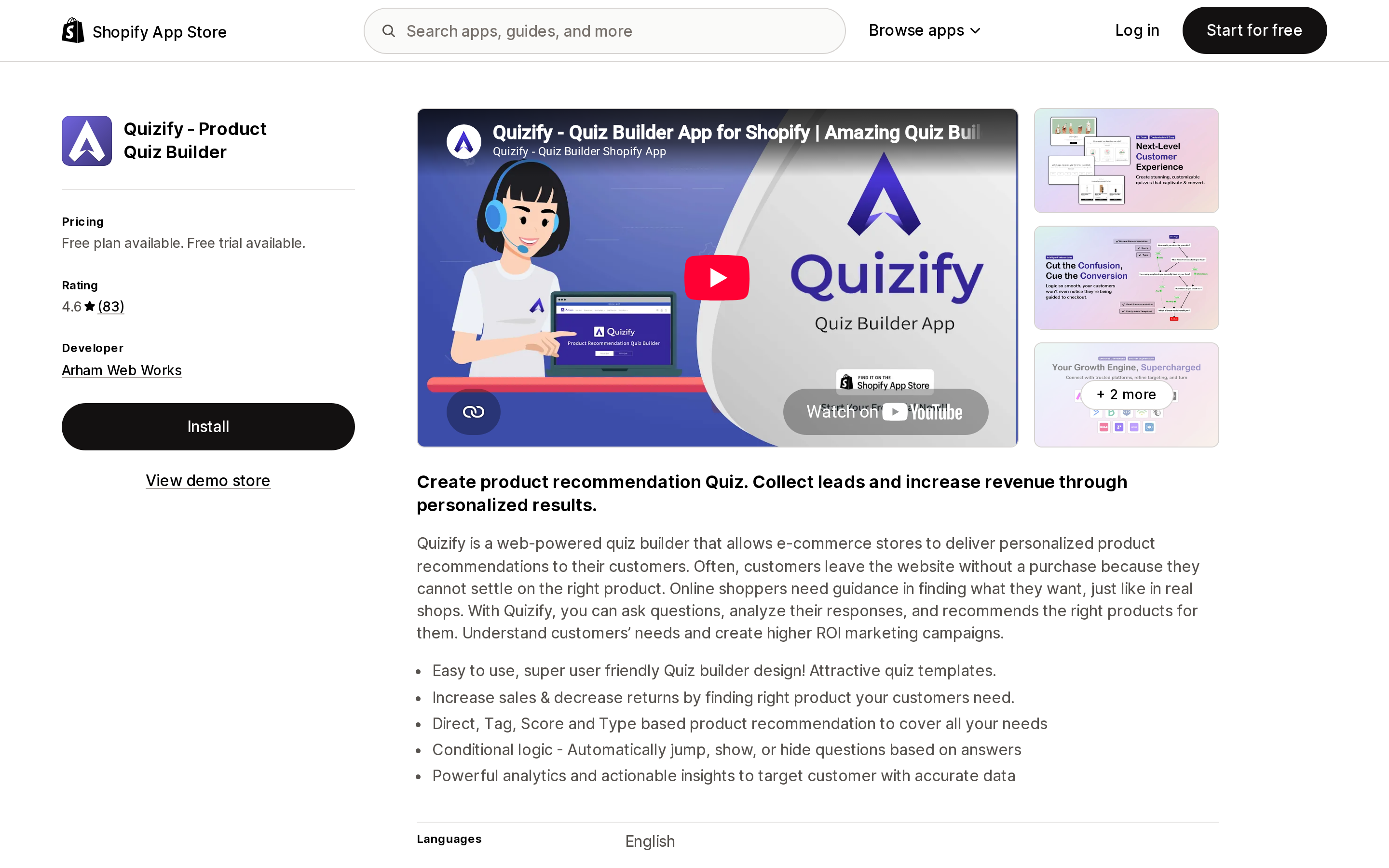
Source: Shopify App Store (Quizify ‑ Product Quiz Builder), retrieved September 2, 2026
4.6 across 83 reviews, from Arham Web Works, and the cheapest entry in the group by a factor of four. Free covers 50 responses, one quiz, five questions, with product recommendations and logic jumps. Starter is $9.99/month for 200 responses ($0.05 overage) with unlimited quizzes and questions. Growth is $29.99/month for 500 ($0.04) and adds score-and-type recommendations, answer tags, drop-off analytics, Mailchimp and Klaviyo, GA and Facebook Pixel. Pro is $49.99/month for 1,500 ($0.03) and adds Shopify Customer Integration, Zapier and Make.
Note where the integrations sit. At $9.99 you get a working quiz and nothing downstream — Klaviyo starts at $29.99, and anything writing back to Shopify customers starts at $49.99. Compared against RevenueHunt's $39 tier, which includes Klaviyo and documented customer tagging, the cheapest headline stops being the cheapest bill as soon as the quiz answers need to go anywhere.
No Built for Shopify badge in the listing header.
Comparison
| RevenueHunt | Octane AI | Quiz Kit | Lantern | Prehook | Quizify | |
|---|---|---|---|---|---|---|
| Built for Shopify (header) | Yes | No | Yes | Yes | No | No |
| Rating / reviews | 4.9 / 438 | 4.9 / 186 | 4.8 / 162 | 4.9 / 117 | 4.5 / 53 | 4.6 / 83 |
| Free plan | 100/mo | None | Dev stores only | 50/mo | 10/mo | 50/mo |
| Entry paid tier | $39 / 500 | $50 / 400 credits | $59 / ~500 | $39 / 500 | $45 / 600 | $9.99 / 200 |
| Cost per unit | $0.078 | $0.125 | $0.118 | $0.078 | $0.075 | $0.050 |
| Billing unit | Response | Credit (AI costs more) | Engagement | Taker, at 1 answer | Engagement | Response |
| Over the limit | Tier up | $0.10/credit | Tier up | Tier up | $0.07 → $0.02 | $0.05 → $0.03 |
| Klaviyo | Basic ($39) | Basic ($50) | Included | Free plan | Basic ($45) | Growth ($29.99) |
| Attentive / Postscript | Not listed | Both | Attentive | Not listed | Both | Not listed |
| Writes to Shopify customer | Documented | "Shopify sync" | Not stated | Not stated | Not stated | Pro ($49.99) |
| Trial | 15 days | 14 days | 10 days | 7 days | 14 days | 14 days |
How to choose
You want to find out whether a quiz works at all, without paying. RevenueHunt's 100 free responses per month with conditional logic and unlimited quizzes is the largest genuinely free tier here. Lantern's 50 with all features unlocked is the runner-up and lets you evaluate the paid feature set honestly.
Quiz answers must land on the Shopify customer record. RevenueHunt is the only one that documents it — customer profile updates and order tagging both. Quizify offers "Shopify Customer Integration" but only from $49.99/month and without published mechanics. If segmentation inside Shopify is the point of the project, this narrows to one.
SMS is the destination. Octane AI and Prehook are the only two naming Attentive and Postscript. Between them, Octane AI is the AI-heavy, higher-floor option; Prehook is cheaper and includes building the quiz for you.
Small store, low volume, quiz is a standalone experiment. Quizify at $9.99/month for 200 responses is the cheapest way to run a real quiz. Budget for $29.99 the moment you want Klaviyo.
Nobody on the team will own the quiz. Prehook states it builds the quiz for you on every paid tier. That is not a feature that shows up in a cost-per-response table.
You run store operations through an AI assistant. Lantern's MCP support, available from the free plan, is unique in this set.
You are already on a quiz app and unhappy. Quiz Kit names migration from Octane AI, Typeform, RevenueHunt, Quizell, Quizify, and Lantern on its listing. Just don't read its "Free" as a live-store tier.
Before you install
Convert the price into your own unit. Take your monthly sessions on the page where the quiz will live, apply a realistic start rate, then a realistic completion rate. Compare vendors on the number of completed quizzes each plan supports, not on the advertised allowance.
Decide overage versus tiering deliberately. A quiz on a homepage before a holiday weekend does not produce a flat monthly volume. Overage pricing absorbs a spike; tiering makes you upgrade for a month you can't repeat.
Check where the answers can go, at the tier you'll actually buy. Klaviyo appears on every listing here, but at $29.99 on one and $50 on another. The integration you need may be two tiers above the one you priced.
Ask what happens on uninstall before you have 6,000 responses. None of the six states on its listing what becomes of collected responses if you leave, or whether the quiz installs as an app block or a hosted page. Export a sample during the trial and confirm you can get your data out in a format you can use.
Sources
- Shopify Help Center — Create forms
- Shopify Help Center — Form settings
- Shopify Help Center — Search & Discovery filters
- Shopify Help Center — Search & Discovery recommendations
- Shopify.dev — productRecommendations query
- Shopify App Store — RevenueHunt Product Quiz Maker
- Shopify App Store — Octane AI: Advanced Quiz Maker
- Shopify App Store — Quiz Kit: Product Quiz Maker
- Shopify App Store — Lantern Product Quiz Builder
- Shopify App Store — Prehook: Quiz Funnel Builder
- Shopify App Store — Quizify ‑ Product Quiz Builder
- Octane AI — Pricing
- Lantern — Pricing
- Quiz Kit — quizkitapp.com
- RevenueHunt Docs — Send leads to Shopify customers
Prices, allowances, ratings, and review counts were verified against the English App Store listings on September 2, 2026 and change often. Re-check the listing before you commit to a tier.
Shop Pay Installments is free to activate, needs no app, and Shopify never publishes what it costs you — the rate is visible only inside your own admin. It also refuses Capital One and Chase credit cards, restricts monthly plans to debit cards only, excludes gift cards and subscriptions, and can't be turned off for individual products. Affirm can suspend your account for being password-protected, for having a non-English storefront, or for being primarily B2B. And Shopify's Getting paid page says disputes appear in your admin while its FAQ says they don't. If you fail the eligibility gates, the alternative is on-site messaging apps from Klarna, Afterpay, Sezzle, Zip, and PayPal — a category rated between 1.0 and 3.2 stars. Researched September 2, 2026.