
What you will learn
On this pageContentsCloseOpen
Every print-on-demand app on the Shopify App Store shows you the same two numbers: base cost and your retail price. Subtract, and there's your profit. That subtraction is wrong, and the vendors know it is.
The same white Bella+Canvas 3001 t-shirt, printed in the United States and sold at the same price, produces a materially different margin depending on which app you install — and the difference is not mostly the base cost. It is the membership fee you may or may not be paying, the shipping formula, and who eats the cost when a shirt comes out crooked. Four of the five apps below sell a paid tier that lowers base costs by "up to" 33–40%. None of them tells you how many shirts a month you need to sell before that fee pays for itself.
The vendors also disagree about something more basic: whether they print your shirt themselves. Printful runs seven of its own factories. CustomCat prints everything in one building in Detroit. Printify does not print anything — it brokers a marketplace of 70 third-party providers, one of which is Printful. Gelato routes to 250+ partner printers. That single architectural choice changes your cost, your consistency, and who you argue with when an order goes wrong.
And one of the five will not tell you what a shirt costs until you create an account.
Research date: September 2, 2026. All prices are USD as shown on the English (US) Shopify App Store and on each vendor's own site. Nothing here is tax advice.
The short version
- Shopify has no native print-on-demand. The Help Center lists five fulfillment methods — self-fulfillment, Shopify's own Fulfillment Network, third-party services connected with an app, custom fulfillment services, and Amazon MCF. None of them prints anything. POD is always a third-party app.
- Published base cost, Bella+Canvas 3001 unisex tee: Printify $10.98, Printful $11.25, CustomCat Lite $11.47, CustomCat Pro $8.67, Gelato $12.47. Gooten does not publish base costs publicly.
- Published US shipping, one t-shirt: Printful $4.75; Printify via SwiftPOD $4.75 standard / $4.29 economy; Gooten $4.95; CustomCat $3.99–$4.99 economy depending on weight class.
- At a $28.00 retail price with free shipping to the buyer, landed cost runs $13.66 (CustomCat Pro) to $16.46 (CustomCat Lite) — gross margin 51.2% down to 41.2% on the identical shirt.
- Membership break-even: CustomCat Pro ($30/mo) pays for itself at 11 shirts a month on published prices. Printful Growth ($24.99/mo) needs $75.73 of monthly product spend at its 33% cap; Gelato+ ($29.99/mo) needs $90.88; Printify Premium ($39/mo) needs $118.18.
- Ratings (EN listing headers): Printful 4.8 (3,811), Printify 4.7 (4,333), Gelato 4.8 (1,026), CustomCat 4.6 (106), Gooten 3.4 (139). None of the five carries a Built for Shopify badge.
- SPOD is gone as a name. The old
spod-spreadshirt-print-on-demandURL now resolves to Spreadconnect: Print on Demand, 3.8 (129).
Shopify has no print-on-demand of its own
Shopify's Fulfilling orders page enumerates every native path: self-fulfillment, Shopify's own Fulfillment Network, third-party fulfillment services connected with an app, custom fulfillment services that "receive orders by email," and Amazon Multi-Channel Fulfillment. Printing is not on the list and never has been.
Shopify Fulfillment Network is not a substitute either. The Help Center page describes it as a way to "connect with third-party logistics providers (3PLs) that store your inventory and fulfill orders on your behalf" — Flexport, which is wired straight into the admin, plus a short list of 3PL apps. It is a 3PL connector for inventory you already own — the opposite of print-on-demand, which exists precisely so you own nothing.
What this means operationally: your POD app registers as a fulfillment service and becomes a location in your Shopify admin. Inventory at that location is not real stock. Orders route to it automatically. If your shipping settings use per-location rates rather than the general profile, you have to add the app to your shipping settings by hand — a step that quietly breaks checkout rates for a lot of first-time POD stores.
One shirt, five vendors, one retail price
The comparison product: a white unisex Bella+Canvas 3001, one front print, US fulfillment, sold at $28.00 with free shipping to the customer. Held constant across all five.
| App (EN listing) | Rating (reviews) | Base cost, BC 3001 | US shipping, 1 item | Landed cost | Gross profit @ $28 | Margin |
|---|---|---|---|---|---|---|
| Printify: Print on Demand — Free | 4.7 (4,333) | $10.98 | $4.75 (SwiftPOD standard) | $15.73 | $12.27 | 43.8% |
| Printful: Print on Demand — Free | 4.8 (3,811) | $11.25 | $4.75 | $16.00 | $12.00 | 42.9% |
| CustomCat: Print on Demand — Lite | 4.6 (106) | $11.47 | $4.99 (economy) | $16.46 | $11.54 | 41.2% |
| CustomCat — Pro ($30/mo) | — | $8.67 | $4.99 (economy) | $13.66 | $14.34 | 51.2% |
| Gooten: Print on Demand | 3.4 (139) | not published | $4.95 flat | — | — | — |
| Gelato: Print on Demand | 4.8 (1,026) | $12.47 | no published rate table | — | — | — |
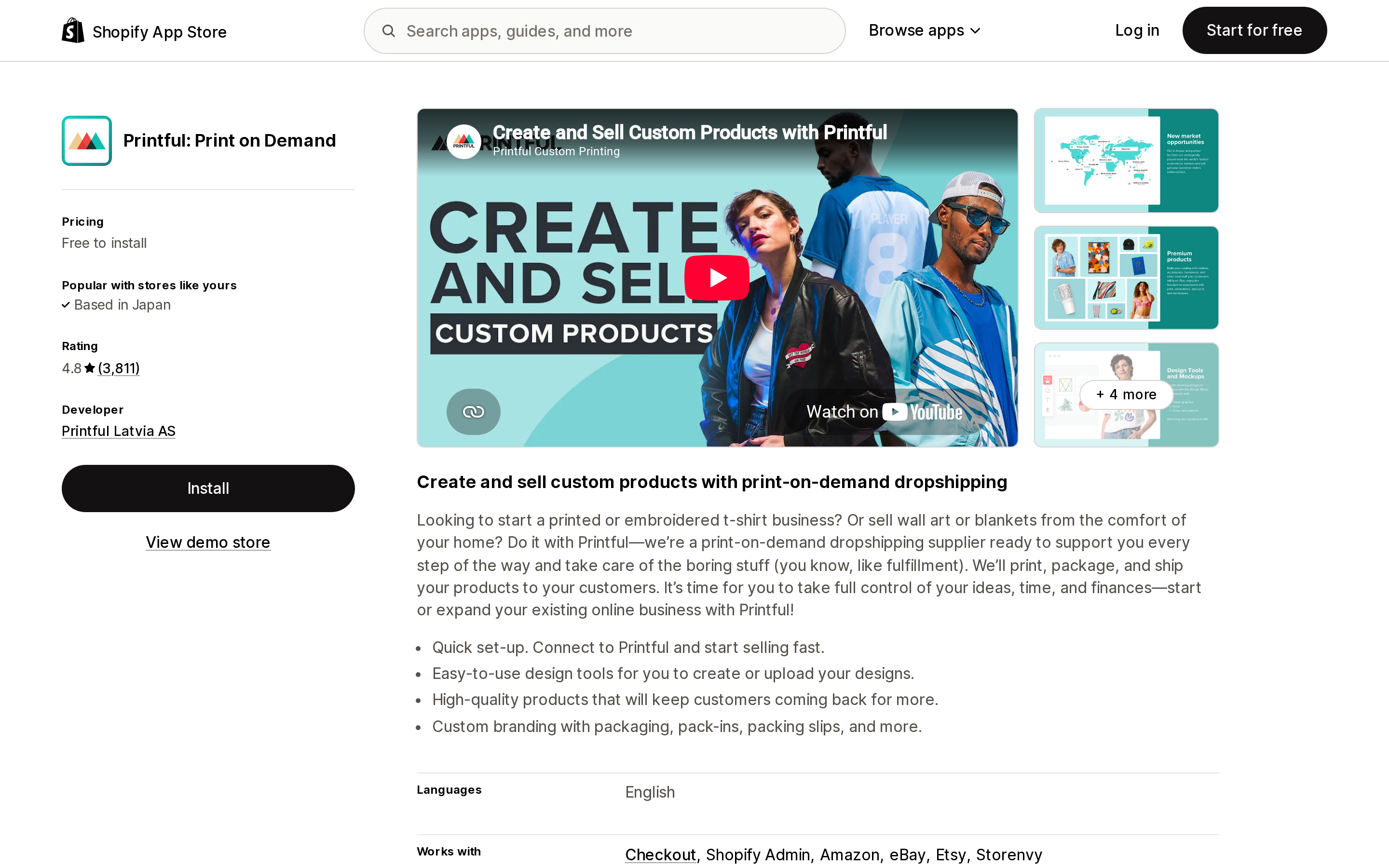
Source: Shopify App Store, Printful: Print on Demand listing (English). Captured September 2, 2026.
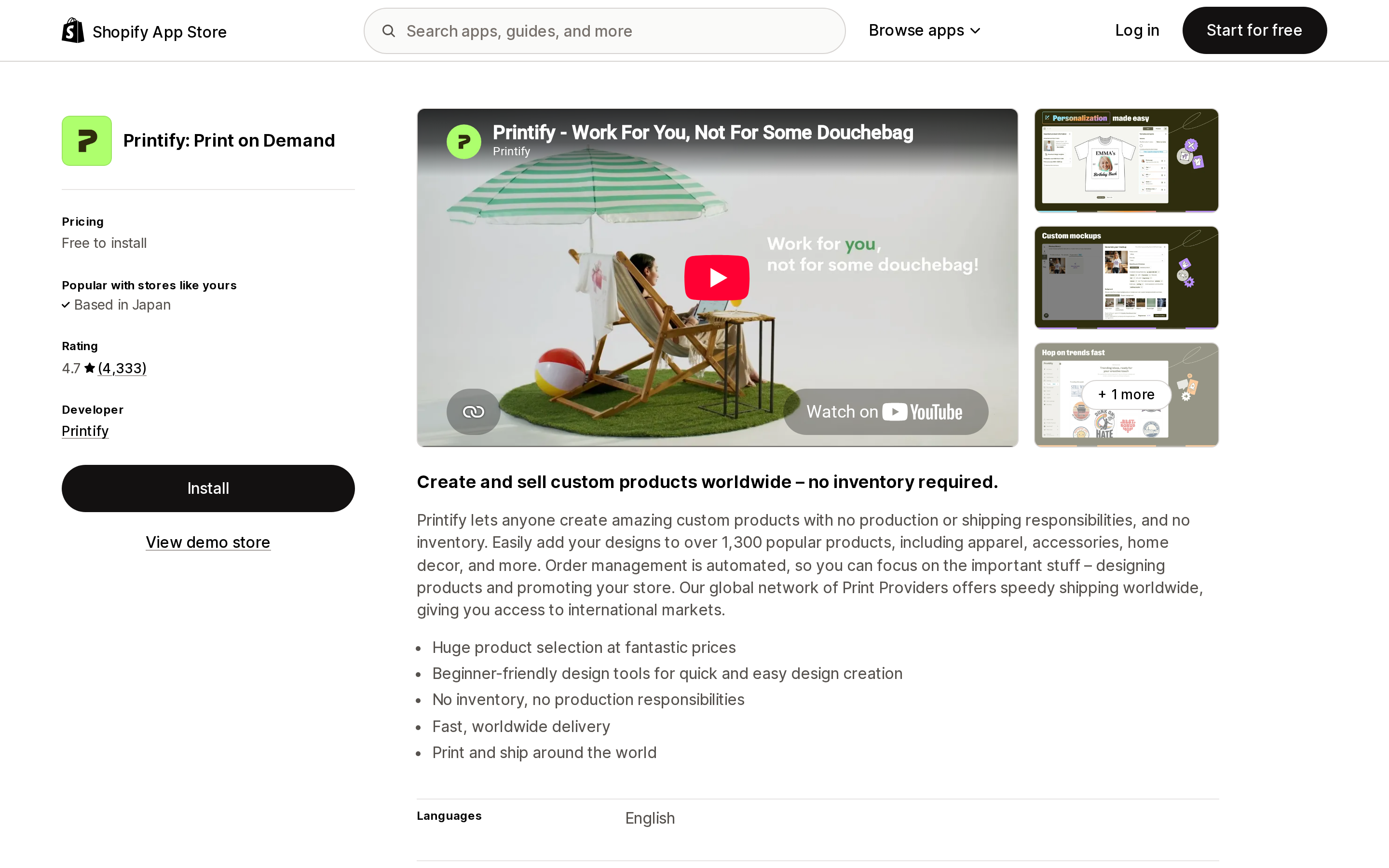
Source: Shopify App Store, Printify: Print on Demand listing (English). Captured September 2, 2026.
Three things fall out of that table.
The free tiers are nearly identical. $15.73 to $16.46 is a spread of 73 cents — about 2.6 points of margin. If you are choosing between Printful, Printify and CustomCat on free plans and expecting a cost breakthrough, there isn't one on this garment.
The membership tier is the whole story. CustomCat Pro cuts $2.80 off every shirt. That is 10.0 margin points — nearly four times the spread across the three free plans.
One vendor won't show you the number. Gooten requires an account to see base costs: it publishes flat shipping rates in a public spreadsheet, but not a single price appears in its public catalog. Gelato is the mirror image — its public catalog lists the Bella+Canvas 3001 at $12.47 for North America without a login, but shipping is quoted only through an interactive calculator, with no rate table to copy into a spreadsheet. Either way, you cannot model a full landed cost from published figures alone.
A note on the Printify row: $10.98 is Printify's own published figure for the Bella+Canvas 3001, and $4.75 is SwiftPOD's published US standard rate — SwiftPOD is one of Printify's US print providers. Printify's base cost varies by provider, which is the point of the next section.
Variable 1: the membership fee, and the unit count where it pays for itself
Every paid tier here is a discount subscription, not a feature subscription. And every one is capped with the word "up to."
| Plan | Price | Claimed discount | Free trial |
|---|---|---|---|
| Printful Growth | $24.99/month | "Up to 33% off all products"; "FREE once you reach $12K in yearly sales" | 90 days |
| Gelato+ | $29.99/month, or $239.88/year | "Up to 33% off products" | 14 days |
| CustomCat Pro | $30/month, or $300/year | "Up to 40% discount on all products" | 60 days |
| Printify Premium | $39/month, or $299.88/year | "Up to 33% discount on products" | none listed |
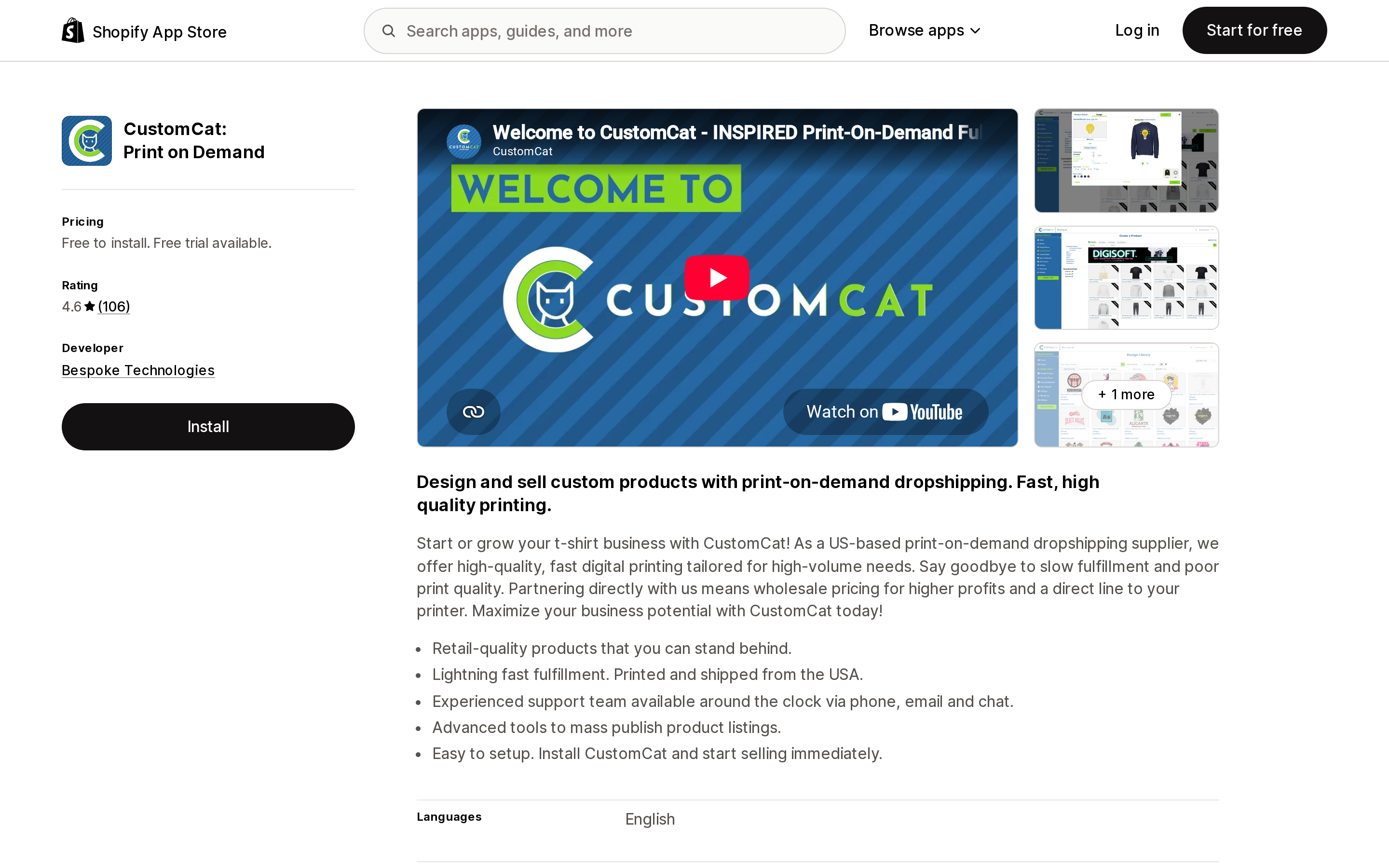
Source: Shopify App Store, CustomCat: Print on Demand listing (English). Captured September 2, 2026.
Two break-even calculations matter, and they answer different questions.
Units per month. CustomCat is the only vendor that publishes both tiers per product, so it is the only one where you can compute this honestly. Lite $11.47 minus Pro $8.67 is a $2.80 saving per shirt. At $30/month that is 30 ÷ 2.80 = 10.7 — you need 11 shirts a month to break even, or 9 a month if you pay $300 annually. Note also that CustomCat's real discount on this shirt is 24.4%, not the headline 40%. "Up to" is doing a lot of work.
Dollars of product spend per month. For the vendors that don't publish member prices, use the cap. A 33% discount saves 33 cents per dollar of list product cost, so the fee is covered when monthly list spend reaches fee ÷ 0.33:
- Printful Growth: $24.99 ÷ 0.33 = $75.73/month of product cost — roughly 7 shirts.
- Gelato+: $29.99 ÷ 0.33 = $90.88/month.
- Printify Premium: $39 ÷ 0.33 = $118.18/month — roughly 11 shirts at $10.98.
- CustomCat Pro: $30 ÷ 0.40 = $75.00/month.
These are best cases. Every real discount will be smaller, so treat each as a floor. Printify Premium's floor is 56% higher than Printful Growth's, which is a straightforward consequence of Printify raising Premium to $39/month while Printful's Growth plan sits at $24.99 with the sales-threshold waiver on top.
Variable 2: owned factories or brokered marketplace
This is the structural difference the marketing copy obscures.
Printful owns its plants. Its Help Center: "We operate seven in-house fulfillment centers across Europe and North America." Charlotte, NC and Coppell, TX serve the US, with Tijuana, Mexico feeding US domestic shipping across the border. One company, one quality standard, one place to complain.
CustomCat owns one plant. Its shipping page is blunt: "Everything ships out from Detroit, MI." That is maximal consistency and minimal redundancy. One facility means every US order has the same print quality and the same failure mode.
Printify brokers. Its public shipping-rates page lists 70 print providers as of September 2, 2026 — Monster Digital, SwiftPOD, Fifth Sun, SPOKE, Dimona Tee, and, tellingly, Printful itself. Your Bella+Canvas 3001 is a different physical product depending on which provider your product is bound to. That is why Printify's base cost is a range and why print consistency complaints cluster around provider switches rather than around Printify.
Gelato brokers at larger scale. Its own site claims "250+ print providers across 32 countries" and "90% of all orders are produced locally." The Shopify listing says 140+ local production hubs in 32 countries. Gelato's advantage is geographic reach; its exposure is that the printer is never Gelato.
Gooten brokers too, and its 3.4 rating over 139 reviews is the lowest of the five. Its listing is published by OrderMesh Inc., not Gooten — worth knowing before you build a catalog on it.
Variable 3: how shipping is priced
Three formulas are in play, and they diverge on multi-item orders, which is where POD margin usually dies.
- Printful — flat per category, first + additional. Its Help Center: "Shipping one t-shirt to the USA costs USD 4.75." Multi-item orders take the highest single-product rate plus each additional item's category rate.
- Printify — set by each print provider. SwiftPOD publishes $4.75 first / $2.40 additional for shirts on Standard, $4.29 / $2.09 on Economy. Change provider, change the rate table.
- Gooten — flat rate. Its policy article: "Flat-rate shipping means you will be charged a set shipping rate for a product, regardless of its specifications." T-shirts to the USA: $4.95 first item, $2.50 each additional.
- CustomCat — first product + additional product, by weight class. "The item with the highest base shipping rate is used as the 'First Product.'" Its published US Economy chart shows $3.99/$0.75 for Super Lightweight and $4.99/$1.50 for Lightweight; CustomCat's own 3001C product page lists the shirt as Lightweight, so the table above uses $4.99.
- Gelato quotes US shipping through an interactive calculator on its public site rather than publishing a rate table.
The practical consequence: a two-shirt order costs $7.15 to ship via SwiftPOD, $7.45 via Gooten, and $6.49 via CustomCat Lightweight economy. If your average order is one item, ignore this. If you sell couple sets or family bundles, it compounds fast.
Variable 4: US footprint, and what happens when an order leaves the country
Printful's US coverage is two owned facilities plus Tijuana. Its system picks the plant: "It's not possible to manually select a fulfillment center." If your design is only available in Europe, your US customer's order is fulfilled from Europe, and your $4.75 assumption evaporates.
CustomCat has one building. Every US order ships from Detroit; every international order also ships from Detroit, at International Economy rates ($9.25 first item for Lightweight) and "1-4 weeks" transit.
Printify's US depth is a function of provider choice — SwiftPOD alone lists California, Texas, Virginia and Ensenada, Mexico. Gelato's whole pitch is that overseas orders never travel: local hubs in 32 countries, with "90% of orders arrive within 5 days of ordering."
Production time, for the record: Printful states 2–5 business days for direct-to-garment with "Over 97% of orders ship within 5 business days." CustomCat's listing headline is "48-Hour US Printing." Spreadconnect claims 48 hours.
Variable 5: who pays for the reprint
This is where the five disagree the most, and it is the least-read page on every vendor's site.
| Vendor | Misprint / defect | Claim window | Buyer's remorse | Returns |
|---|---|---|---|---|
| Printful | Free reshipment or refund | 30 days from delivery | Not covered | No returns for wrong size/color |
| Printify | Free reprint or refund | 30 days from delivery | Not covered | "There is no need to return the damaged product" |
| Gelato | Complimentary replacement, refund if replacement not feasible | 30 days | Not covered | "We currently do not support returns or provide a return address" |
| Gooten | Reprint or refund | 4 weeks | Not covered | "We're not able to issue refunds for returned orders" |
| CustomCat | "Replacement at no charge", prioritized in production | not stated publicly | Not covered | Returned items "will be donated immediately", no refund |
Printful's wording is the clearest: "Since every Printful product is made to order, we don't accept returns or exchanges for buyer's remorse, wrong size, or wrong color. If an order arrives damaged, defective, or misprinted, you can request a free reshipment or a refund; there is no need to send the item back."
Printify adds a tolerance that catches people out: "For DTG (direct-to-garment) products, there is a tolerance of 0.5" for print placement, meaning that minor variations in the placement of the print will not be considered as defects."
Gelato's public Quality and Delivery Guarantee Policy is narrower than its help centre. The legal policy's "Eligible Products" clause covers "cards, calendars, photobooks, posters, framed posters, canvas prints, and framed canvases" — apparel is not in that list. The help centre describes a broader 30-day quality guarantee across orders. If you sell shirts through Gelato, know which document you are relying on.
CustomCat is the most generous on defects and the harshest on everything else: "We stand behind the quality of our products & guarantee our workmanship 100%. Any defects or errors on our part will result in a replacement at no charge." But: "If an item is returned to CustomCat's fulfillment center for any reason, it will be donated immediately... no refunds will be issued for these items."
Gooten gives the widest claim window — four weeks — and the least protection on delivery disputes: "If the order is marked as delivered to the correct address, but the end customer reports it wasn't received, the costs are the responsibility of our Merchant partners."
The takeaway for your spreadsheet: every one of these vendors covers misprints and none covers buyer's remorse. Your return rate on wrong-size apparel is a cost you absorb entirely, and it belongs in your margin model as a percentage of units, not as a rounding error.
The tax line nobody puts in the spreadsheet
Printful states it plainly: "Yes, you'll be charged sales tax on orders that are fulfilled and shipped within the US, based on the delivery address of the order. However, if you've submitted a valid resale certificate for a state you're selling to, we won't charge you sales tax on orders going to that state."
You are the buyer in that transaction. Unless you register for a sales tax permit and upload a resale certificate, the POD vendor charges you sales tax on the landed cost — on top of whatever you collect from your customer. On a $16.00 landed cost that is a real line item on every order, and it is the single most common reason a merchant's actual margin comes in below the calculator's. A certificate only takes effect once Printful approves it, so file it before you start ordering. This is not tax advice — talk to an accountant about nexus before you rely on any of it.
When you don't need any of this
Skip POD apps entirely if any of these describe you:
- You already hold inventory. If you have stock, you want a 3PL — the Fulfillment Network app and Flexport, or a direct integration — not a printer.
- You sell fewer than roughly 5 units a month. No membership tier can pay for itself, and the free plans are within 73 cents of each other on the shirt above. Pick on catalog and support quality, not price.
- Your margin depends on print consistency across a long product life. Brokered networks reassign providers. If you need the shirt you sell in March to match the shirt you sell in November, an owned-factory vendor (Printful, CustomCat) is structurally safer than a marketplace (Printify, Gelato, Gooten).
- You need a Built for Shopify app. None of the five carries the badge in its listing header. If BFS is a procurement requirement, POD is not a category where you'll satisfy it.
- You are selling one design to one event. A single bulk order from a local screen printer will beat any per-unit POD price at 50+ units, and you'll get better print.
Bottom line
On one white Bella+Canvas 3001 at $28.00 retail with US fulfillment, the three vendors that publish both a free-tier base cost and a shipping rate land within 73 cents of each other — $15.73 (Printify), $16.00 (Printful), $16.46 (CustomCat Lite). The choice between them is not a cost decision.
The cost decision is the membership. CustomCat Pro at $30/month is the only tier where the arithmetic is fully verifiable from published prices, and it breaks even at 11 shirts a month ($300/year billing drops that to 9). Printful Growth needs the least monthly product spend to justify itself ($75.73 at its 33% cap, plus a waiver at $12K in yearly sales); Printify Premium needs the most ($118.18). If you are not clearing those numbers every month, stay on the free plan and re-run the math quarterly.
Beyond price: pick Printful if you want owned factories, the clearest returns wording, and the shallowest membership break-even. Pick Printify if you want catalog breadth and are willing to manage provider selection yourself. Pick CustomCat if you sell volume from one design family and want the lowest member unit cost in the US — accepting a single Detroit facility as your only point of failure. Pick Gelato if a meaningful share of your orders ship outside the US, and read its Quality Guarantee product list before you commit to apparel. Gooten at 3.4 stars, with no public pricing and a policy that puts "delivered but not received" disputes on you, needs a specific reason before it beats the other four.
And whatever you pick, file the resale certificate first.
Sources
- Printful: Print on Demand — Shopify App Store
- Printify: Print on Demand — Shopify App Store
- Gelato: Print on Demand — Shopify App Store
- Gooten: Print on Demand — Shopify App Store
- CustomCat: Print on Demand — Shopify App Store
- Spreadconnect: Print on Demand — Shopify App Store
- Shopify Help Center — Fulfilling orders
- Shopify Help Center — Fulfillment Network
- Shopify Help Center — Fulfillment Network logistics partners
- Printful — Unisex Staple T-Shirt, Bella + Canvas 3001
- Printful Help Center — How do I calculate shipping costs for different types of orders?
- Printful Help Center — What is Printful's return and refund policy?
- Printful Help Center — Where are the Printful fulfillment centers located?
- Printful Help Center — How long does fulfillment take?
- Printful Help Center — How does sales tax affect me?
- Printify — Custom t-shirts
- Printify — Shipping Rates (print provider list)
- Printify — SwiftPOD shipping rates
- Printify Help Center — How does Printify handle refunds and returns?
- Gelato — Print on demand t-shirts
- Gelato — Custom t-shirts for men (public catalog pricing)
- Gelato — Shipping and delivery
- Gelato — Quality and Delivery Guarantee Policy
- Gelato Help Center — What is your return policy and quality guarantee?
- Gooten Help Center — Product & Order Support Policies
- Gooten Help Center — Flat Rate Shipping
- CustomCat — All About Shipping
- CustomCat — Returns FAQ
- CustomCat — T-Shirts catalog with CC Lite / CC Pro pricing
- CustomCat Help — How Are Shipping Charges Calculated for Multiple Items?
Shopify's admin address validation is on by default, free, on every plan, and supports the US. Checkout-time validation is one toggle away. Shopify's own documentation then warns that running a third-party address validation app at the same time can create conflicting suggestions and reduce checkout conversion — you are meant to pick one. That reframes the whole category: apps are not there to duplicate deliverability checking, they are there to enforce policy Shopify's validator does not enforce, like blocking PO boxes or requiring an apartment number. We priced four real apps from the US App Store on September 2, 2026, spanning $4.99/month flat, $0.04 per order, and one that requires a separate subscription billed outside Shopify.