
What you will learn
On this pageContentsCloseOpen
A shopper wants to know whether the jacket runs small. Shopify has an answer to that question, and in 2026 it can even generate it: the Shopify Inbox agent answers questions about products, shipping, returns, sizing, and store policies using your catalog, your policies, and your published storefront content.
Then it tells exactly one person, in a chat window, and the answer disappears.
That is the whole gap. The missing native object is not the answer — it is the public artifact: a question one customer asked, an answer you approved, sitting on the product page where the next two hundred shoppers with the same doubt can read it without contacting anyone.
Shopify does not model that. Reviews are close but wrong-shaped — Shop product reviews are only open to customers who bought the item, and a review is not a question. So product Q&A lives entirely in apps, and this comparison is limited to that one thing: customer-submitted questions published on a product page.
Research date: September 2, 2026. All prices are USD from the English (?locale=en) App Store listings.
The short version
Six apps in this set can put a question-and-answer block on a product page. What separates them is not the widget. It is who writes the answer, what has to happen before it goes live, and what you are billed per.
| App | Who drafts the answer | Publishing flow, as described on the listing |
|---|---|---|
| Answer It ‑ Product Q&A | AI, from your product data | Three explicit modes: publish automatically, require review, or stay fully manual |
| CB‑Ask Product Question & FAQ | You | Customer asks, you answer; Publish answer is a listed plan feature |
| Webkul Ask A Question | You | Private thread first; you then "convert common asked queries into FAQ's and show them on product page" |
| Answerbase Product Knowledge | AI drafts, your experts refine | "Publish AI-assisted FAQs, product content, and buying guidance" |
| Judge.me Product Reviews App | Not stated on the listing | Q&A is one of "16 widgets"; the moderation flow is not described |
| Okendo: Reviews & Loyalty | Not stated on the listing | Q&A Widget is a plan feature; Review Moderation is listed for reviews, not for Q&A |
Quoted phrasing from each Shopify App Store listing, US locale, retrieved September 2, 2026.
Only one app in this set publishes its moderation model as a first-class choice. That is the difference between a Q&A section and a liability.
Shopify answers the question. It just never publishes the answer.
Start with what you already have, because two native features get mistaken for product Q&A and neither one is.
Shop product reviews are the only native shopper-generated content attached to your products. Per the Shopify Help Center, a customer can leave a 1-to-5 star rating and a comment of up to 1,000 characters, "Only Shop customers that have purchased a product from you are allowed to submit a review," and the reviews are "displayed on the product details page in the Shop app." Three mismatches at once: purchase-gated, review-shaped rather than question-shaped, and surfaced in the Shop app rather than authored for your storefront. A pre-purchase question comes from someone who has bought nothing, which is precisely the population Shop reviews exclude.
Shopify Inbox goes the other way. Its Inbox agent — currently early access, available only to certain merchants — "answers customer questions about your products, shipping, returns, sizing, and store policies by using your product catalog, store policies, Knowledge Base facts and files, and published storefront content." That is a genuinely good answer engine. It is also one-to-one and ephemeral. Nothing about a resolved conversation becomes readable to the next visitor.
Shopify's position on shopper-generated product content is legible in its own Help Center: the page on syncing Shop product reviews names five supported partner apps — Judge.me, Loox, Okendo, Stamped.io, and Yotpo — and hands the collection and management of reviews to them. Questions are not even in that conversation. There is no native object for "a public question against a product," no native moderation queue for shopper-submitted content on your storefront, and no native way to seed a product page with the twelve questions your support inbox answers every week.
One thing worth ruling out before you shop: Product Q&A by Buddy Apps is a $29.99 one-time charge and reads like the cheapest option in the category, but its listing describes adding "your own questions and answers directly on the product page." That is a merchant-authored FAQ block, not customer Q&A, and it is excluded from this comparison for that reason. Separately, SMPS Product Question & Answer by Simprosys InfoMedia — an app that still appears in older roundups — now returns "This app is not currently available on the Shopify App Store."
Five apps, five different denominators
Source: Shopify App Store (Answer It ‑ Product Q&A), retrieved September 2, 2026
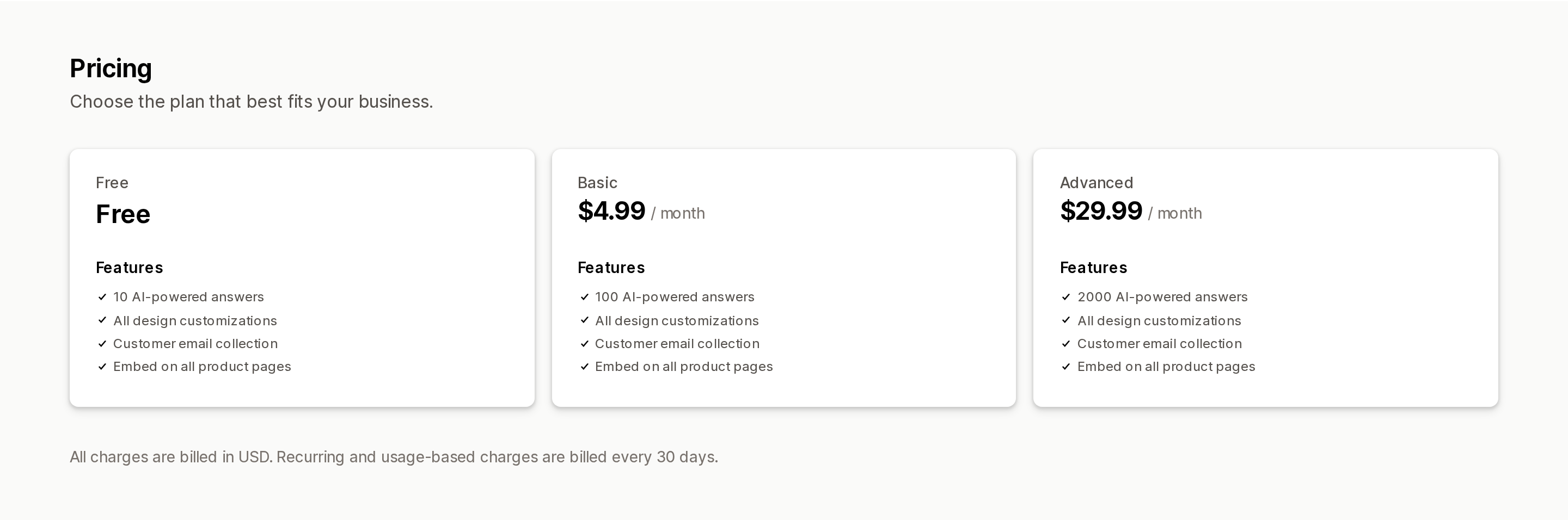
The headline prices in this category run from free to $799 a month, which tells you nothing until you look at what each app counts.
| App | You are billed per | Published tiers (USD) |
|---|---|---|
| Answer It ‑ Product Q&A | AI-powered answers | Free: 10 AI-powered answers · Basic $4.99/month: 100 · Advanced $29.99/month: 2,000 |
| CB‑Ask Product Question & FAQ | Q&As per month on Free; features on paid | Free: 15 Q&As per month · Starter $3.99/month · Pro $6.99/month |
| Webkul Ask A Question | Nothing — flat | $15/month or $165/year; the listing adds that add-ons for advanced features are available with extra pricing, without stating what that pricing is |
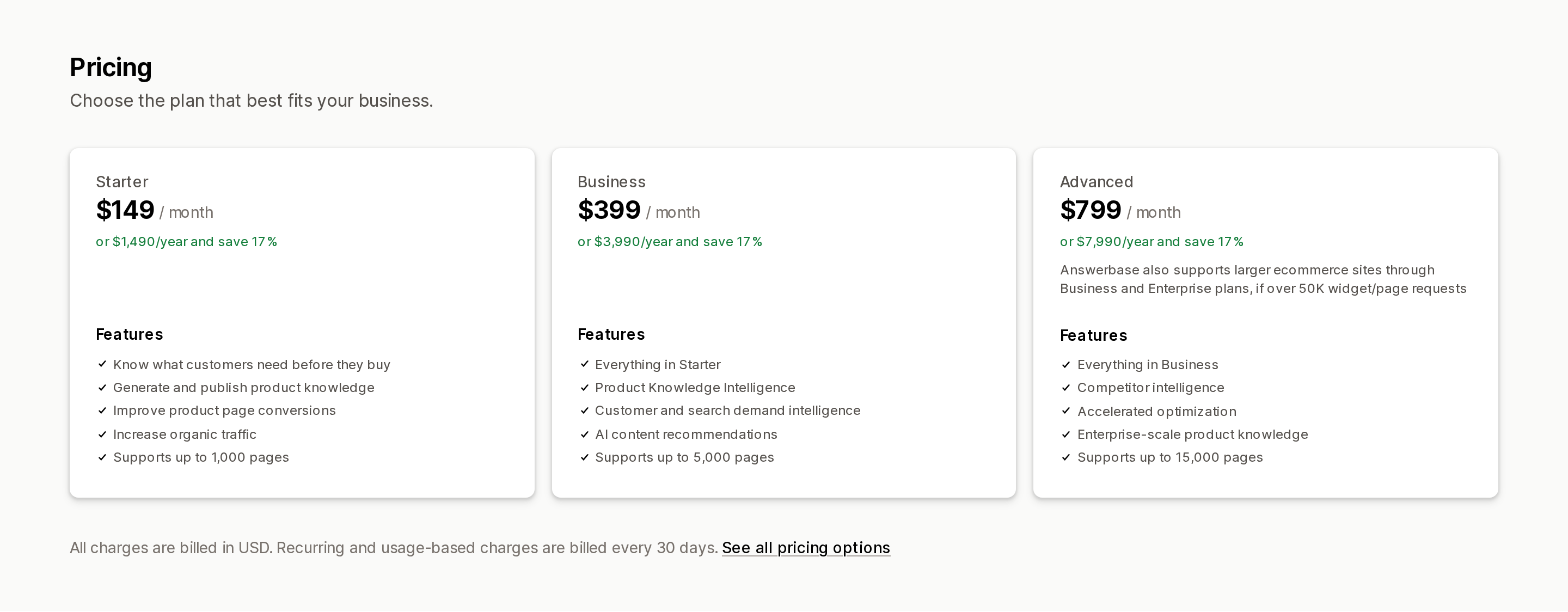
| Answerbase Product Knowledge | Pages supported | Starter $149/month: up to 1,000 pages · Business $399/month: up to 5,000 · Advanced $799/month: up to 15,000 |
| Judge.me Product Reviews App | Nothing — flat, but Q&A is gated | Forever Free: no Q&A · Awesome $15/month: "16 widgets (Snippets, Q&A, Reviews Page)" |
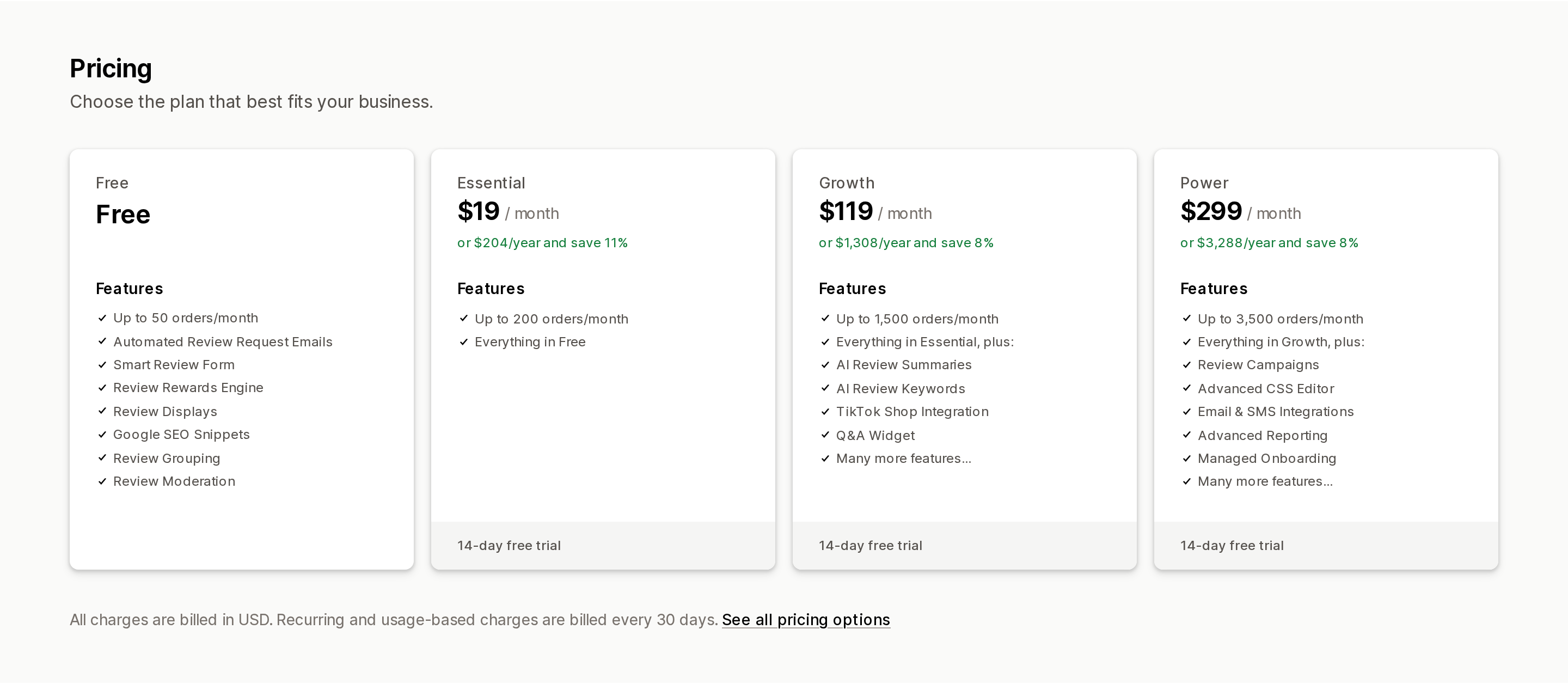
| Okendo: Reviews & Loyalty | Orders per month, and Q&A is gated | Free: 50 orders · Essential $19/month: 200 · Growth $119/month: 1,500, first tier with Q&A Widget · Power $299/month: 3,500 |
All figures from each app's Shopify App Store listing, US locale, retrieved September 2, 2026.
Five denominators for one widget. That matters because your Q&A volume, your catalog size, and your order count move independently of each other.
Run the same scenario through all six. Say a hundred customer questions land in a month:
- CB‑Ask Free covers 15 of them; Starter is $3.99 and Pro is $6.99, and neither tier states a monthly Q&A cap.
- Answer It Basic covers exactly 100 AI answers for $4.99 — about five cents per answered question.
- Judge.me Awesome is $15 flat, and the hundredth question costs the same as the first.
- Webkul is $15 flat.
- Okendo Growth is $119, because you cannot reach the
Q&A Widgetbelow it. - Answerbase Starter is $149, because there is no lower plan.
Now change one variable. Take the same hundred questions to a catalog of 6,000 products: Answerbase moves from $149 to $399, and nothing else in the table moves at all. Take them to a store doing 2,000 orders a month: Okendo moves from $119 to $299, and nothing else moves. Metering by AI answers is the only structure that tracks question volume, which is the one number a Q&A program actually generates.
What "free" gets you, precisely
Four of the six advertise a free plan. Only one of those free plans publishes customer questions.
CB‑Ask Free is the real one: 15 Q&As per month, and the Free tier explicitly lists Publish answer, Able to update question, Paginated questions, and Improved SEO. Fifteen a month is roughly one question every other day, which is a plausible steady state for a store under a few hundred orders a month.
Answer It Free includes 10 AI-powered answers and all design customizations, embedded on all product pages. The listing does not state whether those 10 answers are per month or a lifetime allowance, and that distinction decides whether the free tier is a trial or a plan.
Judge.me Forever Free is generous on reviews — unlimited product and store reviews, unlimited photo and video — and does not include Q&A. Q&A appears one tier up, in the $15/month Awesome plan's widget bundle.
Okendo Free covers up to 50 orders a month and includes Review Moderation, but the Q&A Widget is four features into the Growth plan.
Source: Shopify App Store (Okendo: Reviews & Loyalty), retrieved September 2, 2026
That is the single most consequential line in this article for anyone already running a reviews app: Q&A is an upsell tier in both major reviews platforms here, and the gap between them is $104 a month. Judge.me asks $15 to unlock it. Okendo asks $119. Neither free plan includes it.
Trials, for completeness: Webkul and CB‑Ask publish 7-day trials, Okendo 14 days, Judge.me 15 days. Answer It's listing does not state a trial. Answerbase's listing does not state a trial either.
Google explicitly says a product page with customer questions is not eligible for QAPage markup
This is where most of the category's SEO marketing quietly falls apart, and it is worth reading Google's own words rather than an app's.
Google's structured data documentation for QAPage lists valid and invalid use cases. Among the invalid ones: a product page where users can submit multiple questions and answers on a single page. The guidance then adds that QAPage markup should not be used for pages with multiple questions per page, because the type is for pages whose focus is a single question with user-submitted answers — a forum thread, a support thread.
A Shopify product page with a customer Q&A block is, structurally, exactly the thing Google names as ineligible. It has one product and many questions. Whatever an app emits there, it is not a path to a Q&A rich result.
The neighbouring escape hatch is closed too. Google added a deprecation notice to its FAQ rich result documentation, and per its own documentation-updates log the feature no longer appears in Google Search as of May 7, 2026.
So: treat "SEO-friendly" and "improves your SEO score" in these listings as claims about page content, not about search features. The defensible version of the argument is that customer questions are the only source of product copy written in the buyer's own words, covering the specific long-tail phrasing your product description never uses, and refreshed continuously without a content brief. That is a real asset. It just will not draw a rich result on a product page, and any app implying otherwise should be asked to point at the documentation.
Answerbase is the one app here that argues the SEO case on different ground — it markets its output as content that AI answer engines cite, rather than as schema that earns a rich result. Whether that pays off is not something a listing can establish, and its measured-outcome figures are its own.
The permissions range is enormous for one widget
Source: Shopify App Store (Webkul Ask A Question), retrieved September 2, 2026
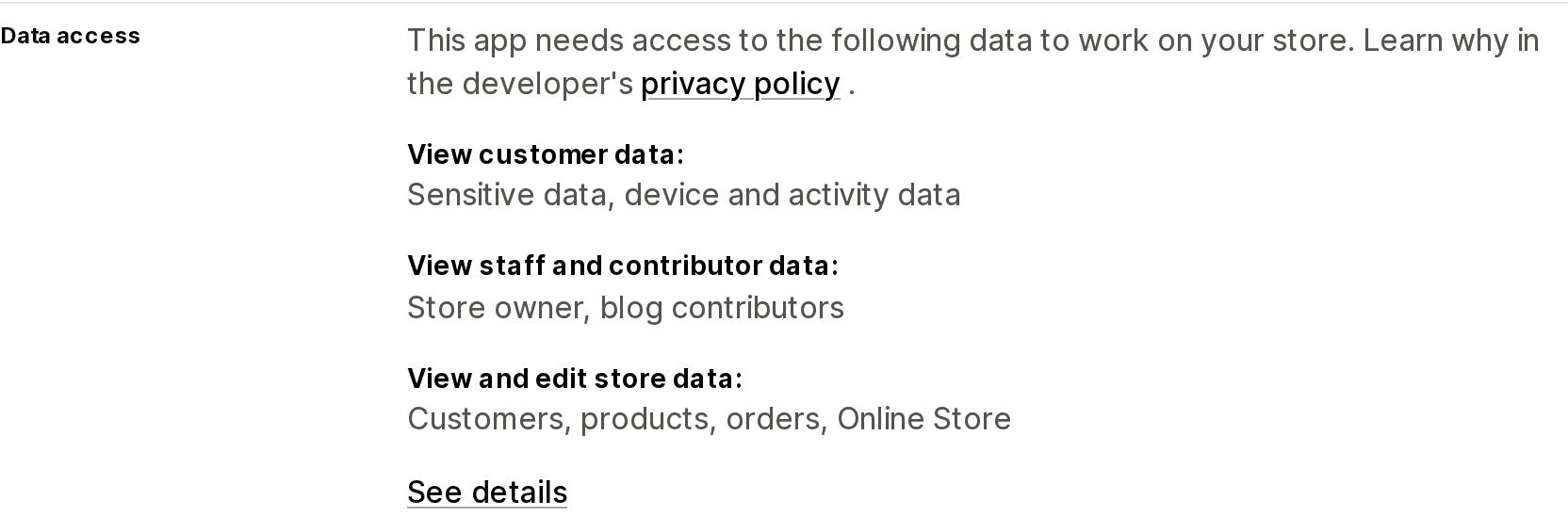
Three of the six publish a Data access section. What they ask for is not remotely comparable.
Answer It requests no customer data at all. Its listed scopes are Edit products, View Online Store (theme), Edit custom data (metaobject definitions, metaobjects), View Shopify admin (legal policies), plus store owner details. The metaobject scope is the interesting one: it implies the questions and answers are stored as Shopify metaobjects, in your store's own data, rather than solely in the vendor's database. For an app launched June 1, 2026 with no track record, that is a meaningful reduction in what you are trusting.
Webkul Ask A Question is at the other end. It requests View customer data covering sensitive data (name, email address) and device and activity data (geolocation, IP address, browser and operating system); Edit orders (all order history for the last 60 days, order fulfillments); Edit products including inventory; Edit Online Store (Online Store pages, script tags, theme); and Edit other data (Locations). Inventory write access and script tags are a wide surface for a question form.
Okendo requests the broadest set, but it is a five-app platform: Edit customers, Edit orders (all order history, subscription contracts), Edit discounts, Edit store credit, Edit Shopify Functions (cart and checkout validations), Edit store analytics (web pixels), Edit Online Store, and more. Reasonable for Reviews plus Loyalty; a great deal to grant if all you wanted was a Q&A tab.
Judge.me, Answerbase, CB‑Ask, and Product Q&A by Buddy Apps do not publish a Data access section on their listing pages, so their permissions cannot be audited before install the way the other three can.
The evidence problem nobody mentions
Here is the finding that should shape how you buy in this category.
Every dedicated customer-Q&A app in this comparison has zero reviews. Answer It: 0.0 (0 reviews), launched June 1, 2026. CB‑Ask: 0.0 (0 reviews), launched September 7, 2020 — nearly six years listed without a single published review. Webkul Ask A Question: 0.0 (0 reviews), launched February 3, 2016. Product Q&A by Buddy Apps: 0.0 (0 reviews), listed since December 9, 2015.
The three apps with merchant evidence behind them are all platforms that do Q&A as one feature among many:
- Judge.me Product Reviews App: 5.0 across 44,586 reviews, launched June 25, 2015, and the only Built for Shopify app in this set.
- Okendo: Reviews & Loyalty: 4.9 across 1,333 reviews, launched June 12, 2018.
- Answerbase Product Knowledge: 5.0 across 11 reviews, launched April 25, 2018, developer Lumin Creative in Barcelona.
Source: Shopify App Store (Answerbase Product Knowledge), retrieved September 2, 2026
Answerbase's eleven reviews are worth reading rather than counting. Multiple US merchants describe Q&A as a support-deflection mechanism rather than a content play — one, a pet nutrition retailer, credits it with "taking a significant load off of our support staff" while converting visitors who engage with it; another frames the published answers as keyword-rich content supporting their SEO strategy. Eleven is a small number and this is a $149/month entry point, but it is eleven more data points than the dedicated apps have between them.
How to choose
- You already run Judge.me. Q&A is inside the $15/month Awesome plan you may already be paying for. Check before you install anything else.
- You already run Okendo on Free or Essential. The
Q&A Widgetstarts at Growth, $119/month. A dedicated Q&A app is cheaper unless you want the rest of Growth. - Low volume, minimum spend, human answers. CB‑Ask Free at 15 Q&As per month, then $3.99 Starter. It is the only free plan here that actually publishes customer questions.
- You want AI to draft but not to publish unsupervised. Answer It is the only app that publishes automatic, review-required, and fully manual as an explicit choice — and it requests no customer data. Weigh that against zero reviews and a June 2026 launch.
- You want questions triaged privately before anything goes public. Webkul Ask A Question, $15/month flat, where the thread is private and promotion to the product page is a separate deliberate act. Read its Data access section first.
- Large catalog, Q&A as a content and AI-visibility program with a budget behind it. Answerbase, from $149/month, priced by pages rather than by questions.
- You are testing whether customers will ask at all. CB‑Ask Free or Answer It Free, for a month, on your twenty highest-traffic products. If nobody asks, you have your answer for the price of an install.
What the listings do not say
Whether Answer It's 10 free AI answers are monthly or lifetime. Not stated. This decides whether the free plan is usable or a demo.
What happens when an AI-drafted answer is wrong. No listing in this set describes a correction, retraction, or audit trail for a published answer. On a product page, an incorrect answer about fit, compatibility, or ingredients is a returns problem and potentially a compliance one.
Whether Q&A content survives uninstall. Not stated by any of the six. Answer It's metaobject scope suggests its data sits in your store; nothing on any listing confirms what remains readable after removal.
Q&A moderation for Judge.me and Okendo. Both publish moderation for reviews. Neither describes the moderation flow for Q&A on its listing.
Webkul's add-on pricing. The listing says advanced features are available "with extra pricing" and does not state what that pricing is.
Whether any of these apps emits structured data on the product page, and of what type. Not stated on any of the six listings, which matters given Google's stated QAPage restrictions.
Sources
- Answer It ‑ Product Q&A — Shopify App Store
- CB‑Ask Product Question & FAQ — Shopify App Store
- Webkul Ask A Question — Shopify App Store
- Answerbase Product Knowledge — Shopify App Store
- Judge.me Product Reviews App — Shopify App Store
- Okendo: Reviews & Loyalty — Shopify App Store
- Product Q&A by Buddy Apps — Shopify App Store
- Shop product reviews — Shopify Help Center
- Syncing Shop product reviews with partner apps — Shopify Help Center
- Shopify Inbox — Shopify Help Center
- Q&A (QAPage) structured data — Google Search Central
- Latest Google Search documentation updates — Google Search Central
Six Shopify direct mail apps priced on incompatible denominators, normalized. Direct Mail Manager lists $0/$5/$10 per month on the App Store while its own pricing page shows $0 or $199 per month plus $0.686 to $0.873 per 4x6 postcard. PostPilot lists as free to install but charges $99 or $499 per month plus per-piece. Poplar Mail's App Store per-piece prices run 8 to 11 percent below its own page, and identity resolution is a separate line at $0.07 per match. Postage is stated as included by only three of the six. Shopify itself has no postal channel, no Flow mail action, and no ZIP code segment filter. Researched September 3, 2026.