
What you will learn
On this pageContentsCloseOpen
Every "best Shopify sales tax app" list still opens the same way: Shopify calculates tax but does not file it, so you need an app. That sentence is now wrong.
Shopify Tax supports automated filing for all US states that collect sales tax, generating and submitting monthly, quarterly, semi-annual, and annual returns from your admin. The price is published: $75 per return on Basic, Grow, and Advanced, and $50 per return on Plus.
That single number reframes the whole category. Numeral charges $75 per filing. Sidr charges $60. Sales Tax Automation by TaxRex charges $25. Shopify's own service is now the most expensive per-return option among the apps that publish a per-return price at all — and it is the only one that cannot register you with a state.
Below: what Shopify Tax actually does and does not do, the eligibility rule that locks out most merchants who already bought an app, the free-tier contradiction sitting between two Shopify help pages, and six real apps compared. Research date: September 2, 2026. All prices are USD as published by Shopify or listed on the Shopify App Store.
The short version
- Shopify Tax now files returns. It did not before. Automated filing covers every US state that collects sales tax.
- Filing costs $75 per generated return ($50 on Plus). You are charged for generated returns, not filed ones — if a return is generated but blocked by unresolved errors, you still pay, and the charge is not refundable.
- If you used Basic Tax, Manual Tax, or a third-party tax app at any point in 2025, you are not eligible for automated filing. This is stated as a hard parameter that "can't be adjusted."
- Shopify Tax does not register you with a state. Every app in this comparison does, at $99 to $150 per state.
- The free tier changed on May 13, 2026. Stores created before that date get $100,000 in sales per calendar year free. Stores created on or after it get $100,000 in lifetime sales free — a one-time allowance, not an annual one.
- Two Shopify help pages currently disagree on that point.
What Shopify Tax gives you before you pay anything
Under $100,000 in sales, Shopify Tax costs nothing, and the free feature set is wider than most comparison articles credit.
Rooftop accuracy. Rates are calculated by street address rather than ZIP code. Shopify states this is included only in Shopify Tax, not Manual Tax.
Tax liability insights. Shopify tracks your sales against each state's economic nexus threshold and flags two statuses: Action required for states where you may already owe registration, and Monitoring for states where your Shopify sales have reached at least 80% of the threshold. Nexus tracking is the headline feature of nearly every paid tax app. Shopify does it for free.
State fees and tax holidays. Colorado's retail delivery fee and Texas's August sales tax holiday are handled automatically. Manual Tax handles neither.
B2B and customer tax exemptions, and automatic product category recommendations that drive taxability.
The limits are equally specific. Liability insights only see transactions inside Shopify plus imported orders that carry a valid shipping address — an imported order with no address is invisible to nexus tracking. Nexus is not tracked for local taxes, which matters in Alaska and Colorado where local filing requirements sit separately from the state's. And if you delete a location, physical nexus from that location disappears from the report, even though trailing nexus in many states keeps your liability alive for a quarter or a full year after the activity stops.
The threshold changed, and the docs have not caught up
This is the detail most likely to produce an unexpected invoice.
Stores created before May 13, 2026 get $100,000 USD in global sales free per calendar year. After that, a 0.35% calculation fee applies on orders in states where you have collection turned on (0.25% on Plus), capped at $0.99 per order and $5,000 per year per region.
Stores created on or after May 13, 2026 get $100,000 USD in lifetime sales free. Same percentages, same $0.99 per-order cap — but the published table for new stores contains no annual maximum at all. The $5,000-per-year ceiling appears only in the table for older stores.
For a store doing $3M a year, the difference between an annual reset and a one-time allowance is the difference between crossing the threshold once a year and crossing it once, forever.
Meanwhile, Shopify's Choose a tax service page still says, in the present tense: "Each calendar year, Shopify Tax is free until you reach the following thresholds in global GMV per store." That statement is accurate only for stores created before May 13, 2026. Two official pages, two different answers. If your store is new, trust the pricing page.
One more thing worth knowing before you plan around the free tier: gift cards, in-person POS sales, Shop channel sales, non-taxable products, and the tax and shipping charged on orders all count toward the threshold. It is gross platform volume, not taxable revenue.
Automated filing: the eligibility wall
Shopify's filing service is genuinely competitive on capability. The problem is who can use it.
Automated filing is not available if you used a tax service other than Shopify Tax in 2025, such as Basic Tax, Manual Tax, or third-party tax apps.
Read that literally. A merchant who ran TaxJar through 2025 and wants to consolidate onto Shopify in 2026 is not eligible, and Shopify states the eligibility parameters "can't be adjusted." The merchants best positioned to use Shopify's filing are the ones who never bought a tax app — which is close to the inverse of who is searching for one.
The other constraints, all published:
- No Streamlined Sales Tax (SST). This is a real cost difference. TaxCloud Sales Tax Automation is an SST-certified provider in 24 member states, where the states themselves pay the provider's fee.
- No prepayments in any state, and no past or amended returns.
- One store at a time. Filing cannot run across multiple stores in an organization.
- Not compatible with the Loop Returns & Exchanges app.
- For returns to be accurate, tax-inclusive pricing must be off and store currency must be USD for the entire period you file for. Shopify lists these under accuracy rather than eligibility, but the practical effect is the same.
- Only sales where you are the merchant of record. Amazon, TikTok, and imported orders are excluded — but 23 states plus the District of Columbia still require you to report marketplace sales on your return, and Shopify explicitly does not check your marketplace settings when deciding eligibility.
- Since August 26, 2025, Meta no longer acts as a marketplace facilitator. Facebook and Instagram orders created after that date are your compliance problem, not Meta's.
And the billing rule that stings: fees are charged on returns generated, not returns filed. If a return is generated for a period and then blocked by an unresolved error, you pay $75 for it anyway, non-refundable. The only escape is skipping the return before the 9th of the month.
Six apps, and what a return actually costs
Third-party tax apps replace Shopify's tax service entirely for your store — you cannot run both. Shopify also closed Basic Tax to new US enrollment on July 14, 2025, and warns that switching services can be permanent: if Basic Tax is no longer available to your store, you cannot switch back to it once you save something else.
| Service | App Store rating | Per return | Per registration | Monthly base |
|---|---|---|---|---|
| Shopify Tax automated filing | n/a (first-party) | $75 ($50 on Plus) | not offered | $0 under threshold |
| Sales Tax Automation by TaxRex | 5.0 (118) | $25 | $99 | $10 to $100 by order volume |
| Sidr ‑ Sales Tax Automation | 5.0 (63) | $60 | $150 | $60 (Plus plan) |
| Numeral Sales Tax | 4.5 (129) | $75 | $150 | free to install |
| TaxCloud Sales Tax Automation | 4.8 (95) | not published | included | by order volume and return count |
| Kintsugi Sales Tax Automation | 4.7 (26) | not published on the listing | not published | free listed plan |
| TaxJar Sales Tax Automation | 2.4 (64) | included as AutoFile credits | not published | $39 or $99 |
Ratings and prices were read from the Shopify App Store on September 2, 2026.
Sales Tax Automation by TaxRex
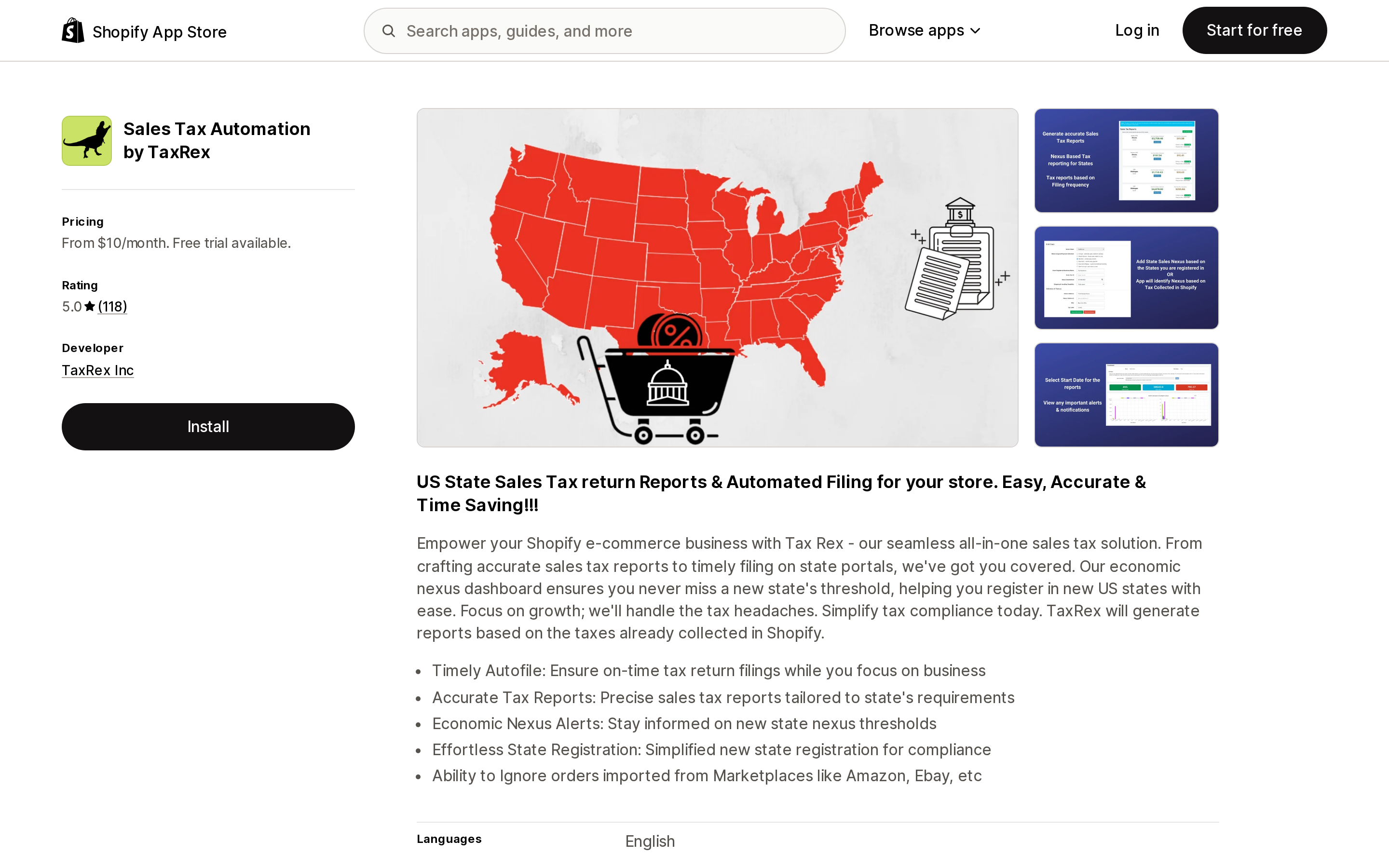
Source: Shopify App Store (Sales Tax Automation by TaxRex), retrieved September 2, 2026
The cheapest published per-return price in the category: $25 per filing per state, $99 per state registration, on top of a subscription that scales with order volume — $10/month for 200 orders, $20 for 500, $30 for 1,500, $100 for 10,000, with per-order overage from $0.05 down to $0.01. It rates 5.0 across 118 reviews, with a single 4-star and no rating below it.
For a merchant filing in eight states monthly, that is $200/month in filings against Shopify's $600. The listing does show "This app isn't compatible with your store" for some stores, so check compatibility before planning around the price.
Sidr ‑ Sales Tax Automation
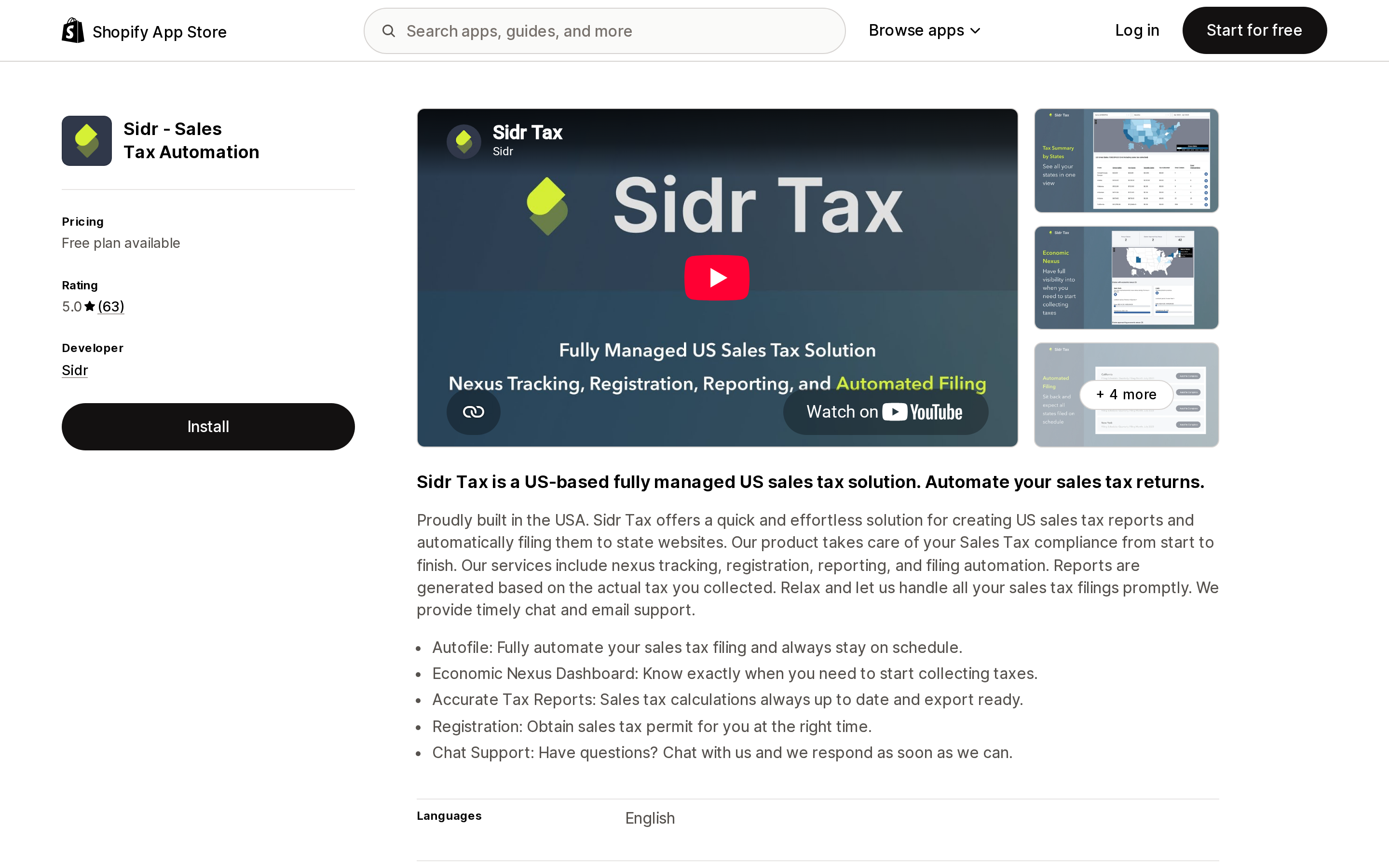
Source: Shopify App Store (Sidr ‑ Sales Tax Automation), retrieved September 2, 2026
Sidr's Free plan is the most useful free tier here: nexus monitoring across all states, historical liability analysis, address validation, and live chat, with no payment method required. The Plus plan is $60/month, plus $60 per filing and $150 per registration, and adds automated filing and remittance, a virtual mailbox for state notices, backfiling and amendments, and notice resolution.
Backfiling and amendments matter, because Shopify's own service explicitly refuses both. A merchant who discovers three years of unregistered nexus cannot fix it with Shopify Tax. Sidr rates 5.0 across 63 reviews with no rating below 5.
Numeral Sales Tax
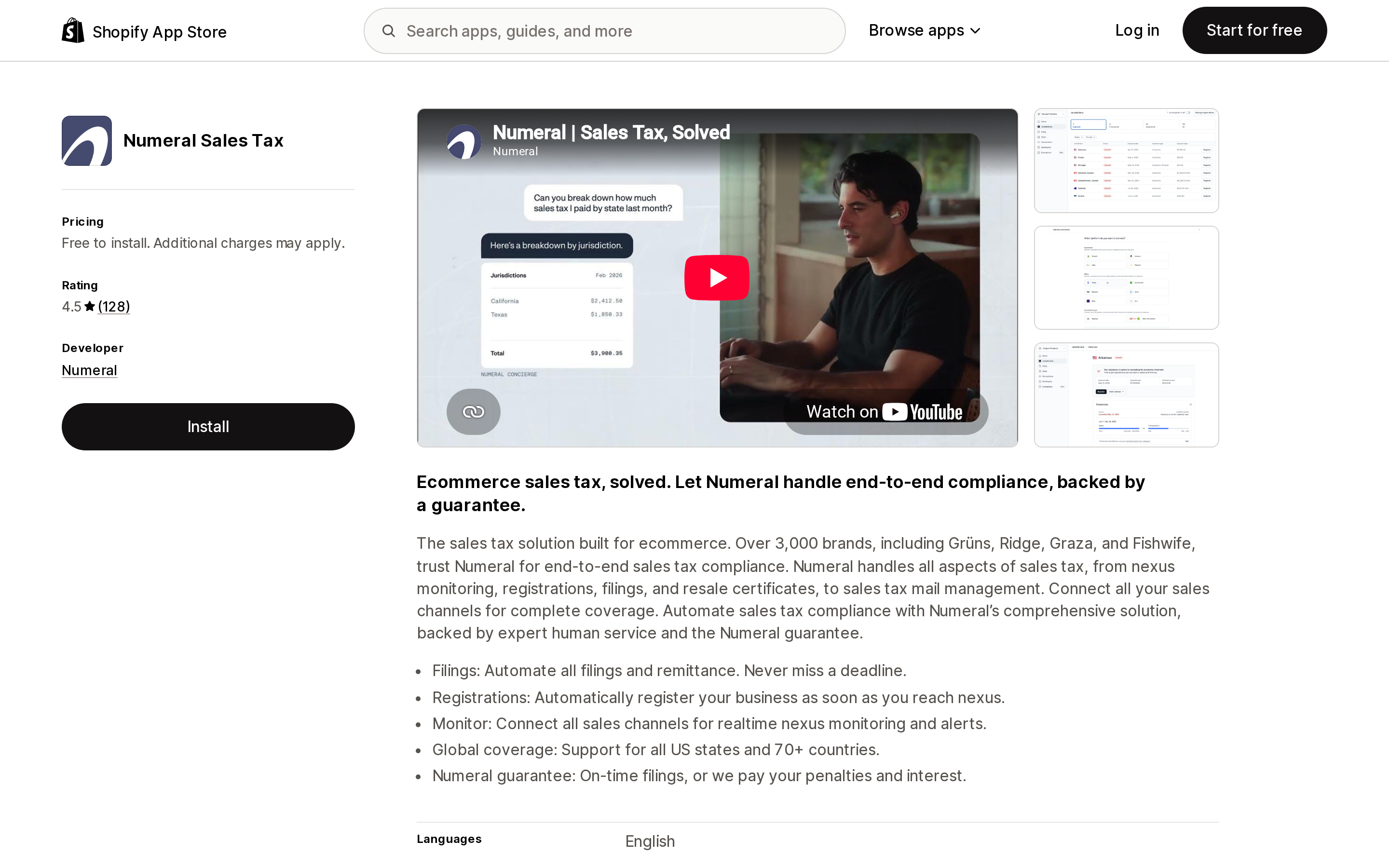
Source: Shopify App Store (Numeral Sales Tax), retrieved September 2, 2026
Free to install, $75 per US filing and $150 per registration, with global VAT and GST priced custom across 70+ countries. The listing advertises a guarantee: on-time filings, or Numeral pays your penalties and interest.
The rating is 4.5 from 129 reviews, and the distribution is unusual — 102 five-star, 13 four-star, zero three- and two-star, and 14 one-star. That barbell shape shows up in the review text. One recent one-star review from a US merchant states that Numeral would only file monthly despite the store having annual, quarterly, and monthly filing frequencies across states, and that they moved to Kintsugi at roughly half the per-filing cost. Ask about filing frequency handling before you sign.
TaxCloud Sales Tax Automation
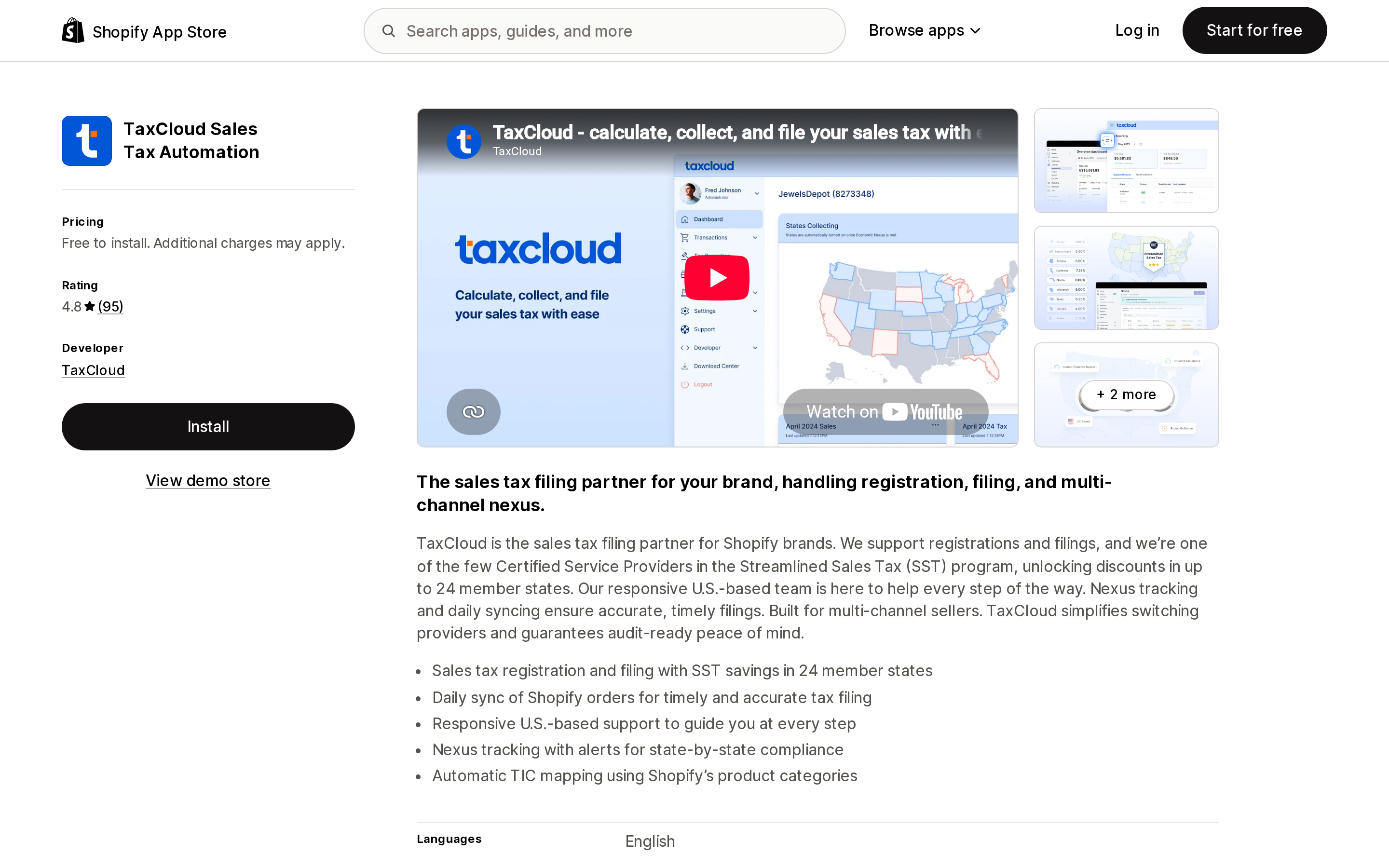
Source: Shopify App Store (TaxCloud Sales Tax Automation), retrieved September 2, 2026
The SST angle is TaxCloud's structural advantage. As a certified service provider in the 24 Streamlined Sales Tax member states, the state compensates TaxCloud rather than you. It also maps Shopify product categories to TICs automatically and syncs orders daily. Pricing is a subscription based on order volume and number of returns, with 100 orders included and external charges billed by TaxCloud outside your Shopify invoice — so the total is not visible from the listing.
It rates 4.8 across 95 reviews (91 five-star, 4 one-star). One long five-star review from a US merchant describes migrating 23 states off a traditional accountant; one one-star review from a merchant of over a year describes spending over $2,000 without results.
Kintsugi Sales Tax Automation
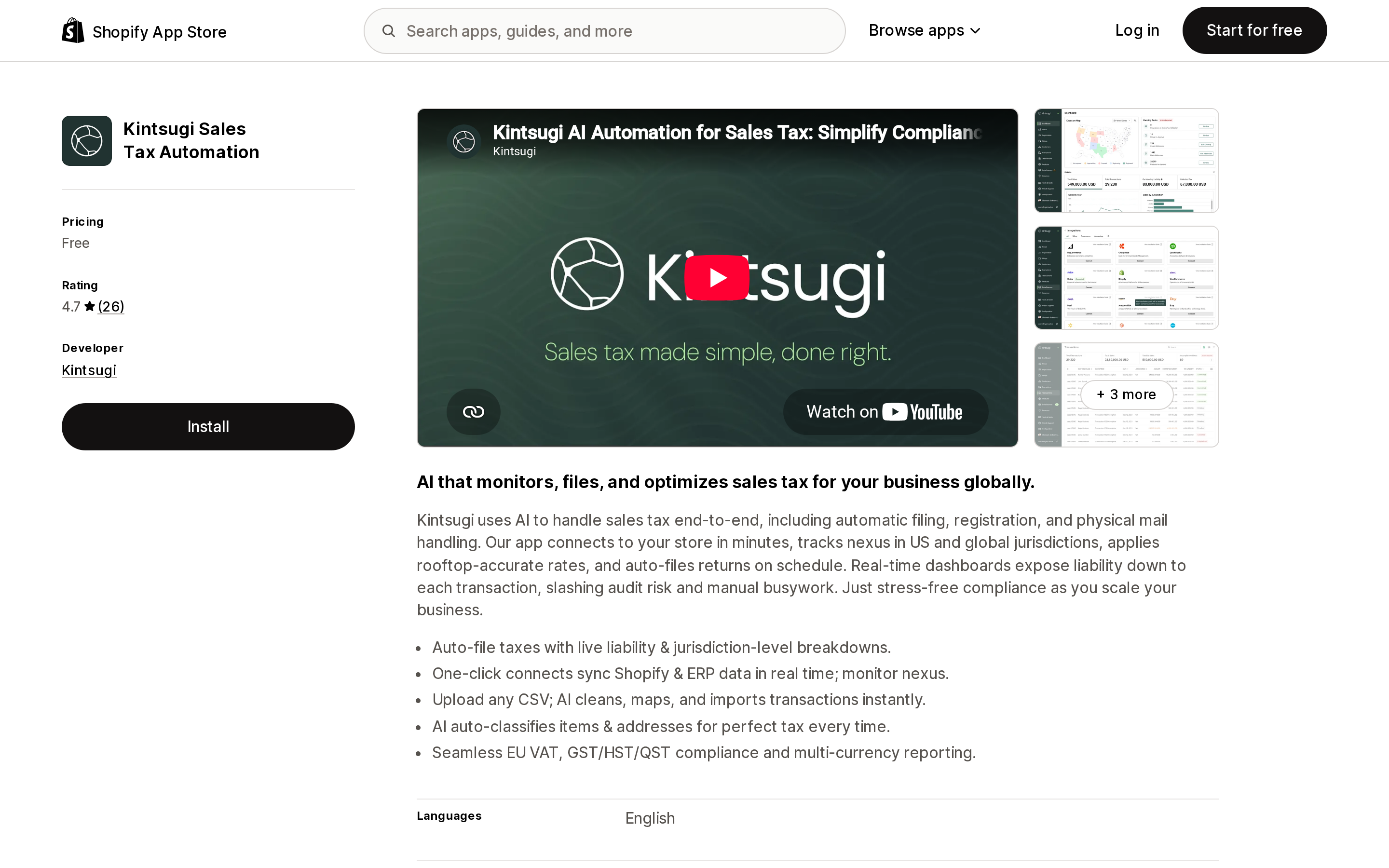
Source: Shopify App Store (Kintsugi Sales Tax Automation), retrieved September 2, 2026
Kintsugi lists a single Free plan covering nexus monitoring, exposure and historical liability auditing, risk assessment, new nexus alerts, address validation, and CSV import. Filing and registration prices are not stated on the App Store listing, so treat any per-filing figure you see elsewhere as unconfirmed until you get it in writing.
It rates 4.7 across 26 reviews. Note the data access disclosure on the listing: the app requests sensitive customer data along with device and activity data, and read-write access to customers, products, orders, and discounts.
TaxJar Sales Tax Automation
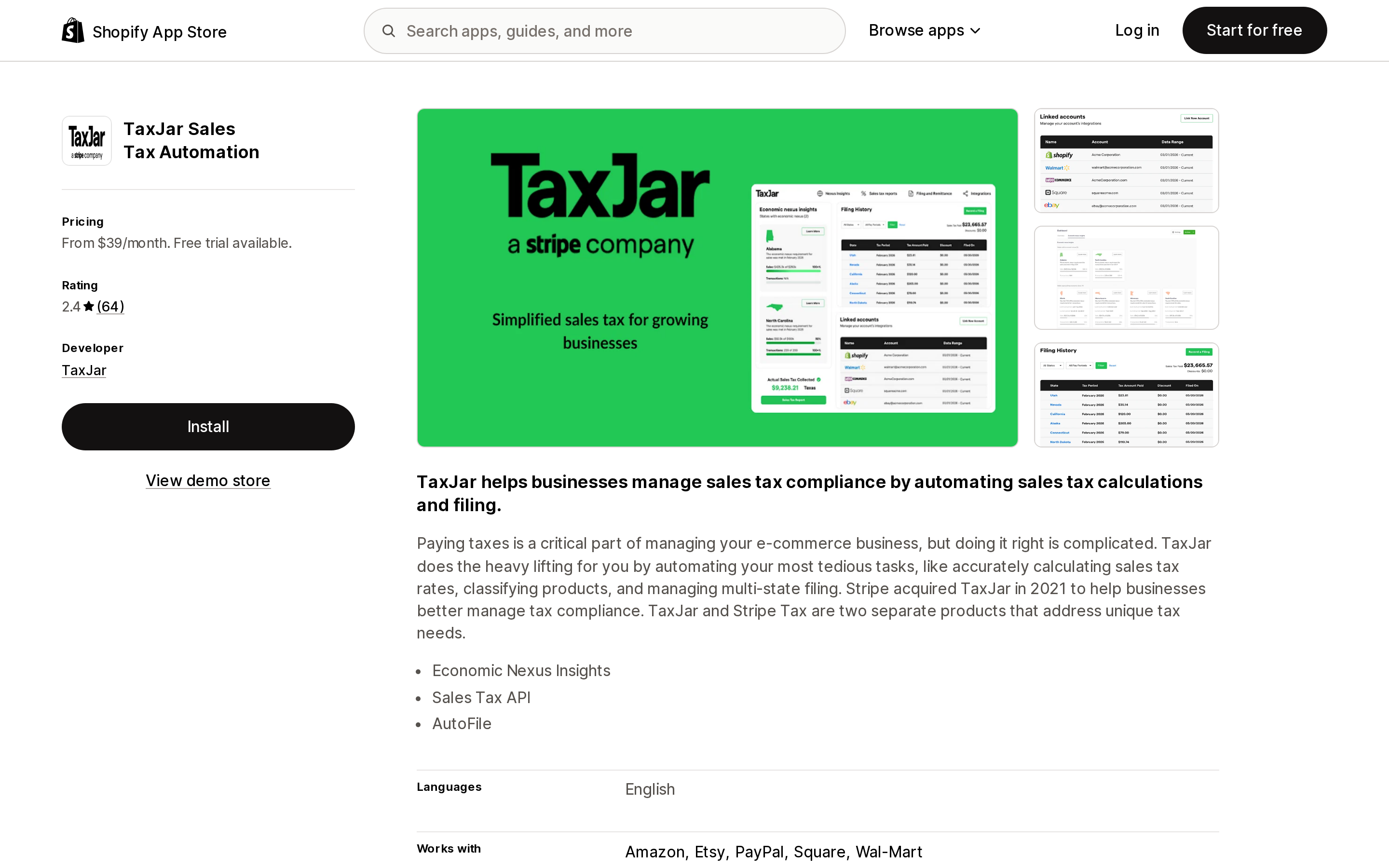
Source: Shopify App Store (TaxJar Sales Tax Automation), retrieved September 2, 2026
TaxJar is the most-recommended sales tax app on the open web and the lowest-rated one on the Shopify App Store: 2.4 stars across 64 reviews, with 24 one-star ratings against 32 five-star. Listed since August 28, 2013, and owned by Stripe since 2021.
The pricing structure has an oddity worth checking before you buy: the Starter plan at $39/month and the Professional plan at $99/month both state "Up to 200 orders" on the listing. The difference shown is the economic nexus dashboard and the number of included AutoFiles — two per year on Starter, four on Professional. Beyond those credits, AutoFile pricing is not published on the listing.
Recent one-star reviews cluster on two themes: support responsiveness, and exemption handling. One US merchant of over six years writes that customer exemptions set in Shopify were ignored at filing time, forcing state amendments. TaxJar replies publicly to these reviews.
How to choose
You are under $100,000 in sales and not registered anywhere yet. Use Shopify Tax and nothing else. Nexus tracking, rooftop accuracy, and tax holidays are free, and buying an app now buys you monitoring you already have.
You have nexus in one to three states and have never used another tax service. Shopify's automated filing is the least-moving-parts option, at $75 per return. Register with each state yourself, then turn it on.
You need to register in new states as you cross thresholds. Shopify does not register you. TaxRex ($99/state) and Sidr or Numeral ($150/state) do.
You are filing in many states every month. Per-return price is the whole game. Eight monthly filings cost $200 on TaxRex, $480 on Sidr, and $600 on Shopify or Numeral. Confirm the app is compatible with your store first.
You sell into Streamlined Sales Tax states. TaxCloud's SST certification shifts the fee to the state in 24 of them. Shopify's automated filing does not support SST at all.
You have back taxes, amended returns, or unregistered historical nexus. Shopify explicitly will not touch past or amended returns. Sidr lists backfiling and amendments; otherwise this is accountant territory.
You are on Manual Tax, or used a tax app in 2025. You are outside Shopify's filing eligibility, and switching tax services can be irreversible. Decide once.
One caveat that applies to all of it: none of these tools decide where you owe tax. Shopify says so on every tax page it publishes, and it is right. Liability insights and nexus dashboards are inputs to that decision, not the decision.
Sources
- Shopify Tax pricing — Shopify Help Center
- Automated filing with Shopify Tax — Shopify Help Center
- Pricing for automated filing with Shopify Tax — Shopify Help Center
- Eligibility and considerations for using automated filing with Shopify Tax — Shopify Help Center
- Choose a tax service — Shopify Help Center
- Review your US tax liability insights — Shopify Help Center
- Tax apps — Shopify Help Center
- Avalara Tax Compliance — Shopify Help Center
- Shopify App Store listings for TaxJar Sales Tax Automation, Numeral Sales Tax, Sidr ‑ Sales Tax Automation, Sales Tax Automation by TaxRex, TaxCloud Sales Tax Automation, and Kintsugi Sales Tax Automation, retrieved September 2, 2026
Every Shopify variant has a barcode field, and Shopify now has native bin locations and a native pick list. What it still has no screen for is the one moment that actually prevents a mispick: scanning an item at the packing bench and having Shopify say yes or no. Shopify POS barcode scanning is documented for adding products to a cart, searching, and receiving transfers — not for verifying the line items of an online order. We priced seven real US App Store apps on September 2, 2026 and found they meter five different things: orders, scanning stations, users, fulfillments, and flat rate. At 5,000 orders a month the same job costs $14.99 with Fulfil-IT ‑ Scan & Pack and $938 with Pickware ERP & WMS.