
What you will learn
On this pageContentsCloseOpen
A customer emails about unit SN-00042. It is in warranty or it is not, and it went to this person or to someone else. You open the Shopify admin to check, and there is nowhere to check. The order records that one unit of that variant shipped. It does not record which one.
That is a data model property, not a missing setting. Shopify's GraphQL Admin API reference for InventoryItem documents SKU, tracked, unit cost, measurement, country of origin, HS code, and inventory levels — no field identifying one physical unit. Inventory is counts: unavailable, committed, available, on hand, incoming. The barcode field looks like a candidate until you read the Help Center, which says the identifier needs to be "a new or existing Global Trade Item Number (GTIN)". A GTIN identifies a product model, one value per variant.
So merchants search the App Store for a warranty app and get a category that is really three separate jobs: (a) assigning and recording a serial at fulfillment, (b) a page where customers register what they bought, and (c) taking claims through to repair or replacement. Almost nothing does all three, and the apps marketing hardest on serial numbers are often doing job (b).
The listing copy makes that worse in ways that cost money. Dyrect's App Store listing markets serial tracking, while Dyrect's own pricing page lists Serialization and QR Codes as an Enterprise add-on. Product Registration Supreme describes serial validation in its feature bullets, but the plan cards put serial import and validation on the $19.99 Supreme tier, not the $9.99 Standard tier. And Warranty Registration ‑ Propel shows a 5.0 rating built from exactly one review, left by a store that had used the app for 42 minutes.
Below: what Shopify's documentation describes, why four common workarounds break, the (a)/(b)/(c) split across six apps, and which of them documents registering a unit bought on Amazon or in a store. Pricing, ratings, and review counts were verified on the Shopify App Store listings on September 3, 2026, in USD.
What Shopify's documentation describes, and what it does not
Shopify gives you two identifiers, both at variant level. SKU is defined as an optional code identifying the product within your business; barcode is defined as a GTIN. Both describe a model, not a unit. The GraphQL API even exposes duplicateSkuCount, counting inventory items that share a SKU — a fair signal that SKU was never a unique key for one thing on a shelf.
Four workarounds circulate, and each fails for a documented reason.
One variant per unit. The Help Center states: "You can create up to 2,048 variants for a product." Softer problems arrive earlier — above 100 variants, Shopify notes some third-party themes, theme app extensions, public apps, and sales channels may not support the product, naming Stocky and the legacy Order Printer. Sell 3,000 units a year of one SKU and this expires inside twelve months.
Line item properties. Shopify's own suggested workaround for exceeding variant limits, framed in the Help Center as theme code that extracts custom requirements from your customers. Wrong direction: it captures what a buyer types, not what your warehouse assigns while packing.
Order notes. A serial in a note is free text on one order, with nothing in the documentation describing a link back to an inventory item or a way to search units by serial.
Metafields and metaobjects. This one could genuinely hold the data. Metaobjects are standalone entities referenced from multiple resources, and Shopify's documented example use cases include warranty information with terms and conditions, with limits of up to 1,000,000 entries and 40 fields per definition. But storage is not operation. Automatic assignment at fulfillment, POS scanning into a cart line, a customer registration form, and serials on a packing slip are not described as native features anywhere, so choosing metaobjects means building all of that.
One more gap before you plan a claims process: Shopify's Returns and exchanges documentation describes returns created from the items on an order, and unit selection by serial is not part of it.
The three jobs, and which app does which
| App | (a) Serial assignment at fulfillment | (b) Customer-facing registration | (c) Claim workflow | Entry price | Rating (reviews) |
|---|---|---|---|---|---|
| SerializeIt ‑ Serial Numbering | Yes, auto-assign on fulfillment | Yes, storefront registration | Not described | $9.99/month | 5.0 (3) |
| SeriaLogic ‑ Order Serializer | Yes, on creation, fulfilment, or manual | Not described | Not described | $9.99/month | 4.0 (15) |
| Serializer ‑ Product Tracking | Partial, completed orders and POS cart | Not described, lookup only | Not described | $9/month | 4.9 (6) |
| Warranty Registration & Claims | Not described | Yes | Yes, deepest in this set | $0 free, $19/month paid | 4.9 (22) |
| Product Registration Supreme | Not described | Yes | Request form only | $9.99/month | 4.1 (9) |
| Warranty Registration ‑ Propel | Not described, CSV serial pool only | Yes | Yes, on Pro | $0 free, $9.95/month paid | 5.0 (1) |
Read the three job columns before the price column.
SerializeIt ‑ Serial Numbering
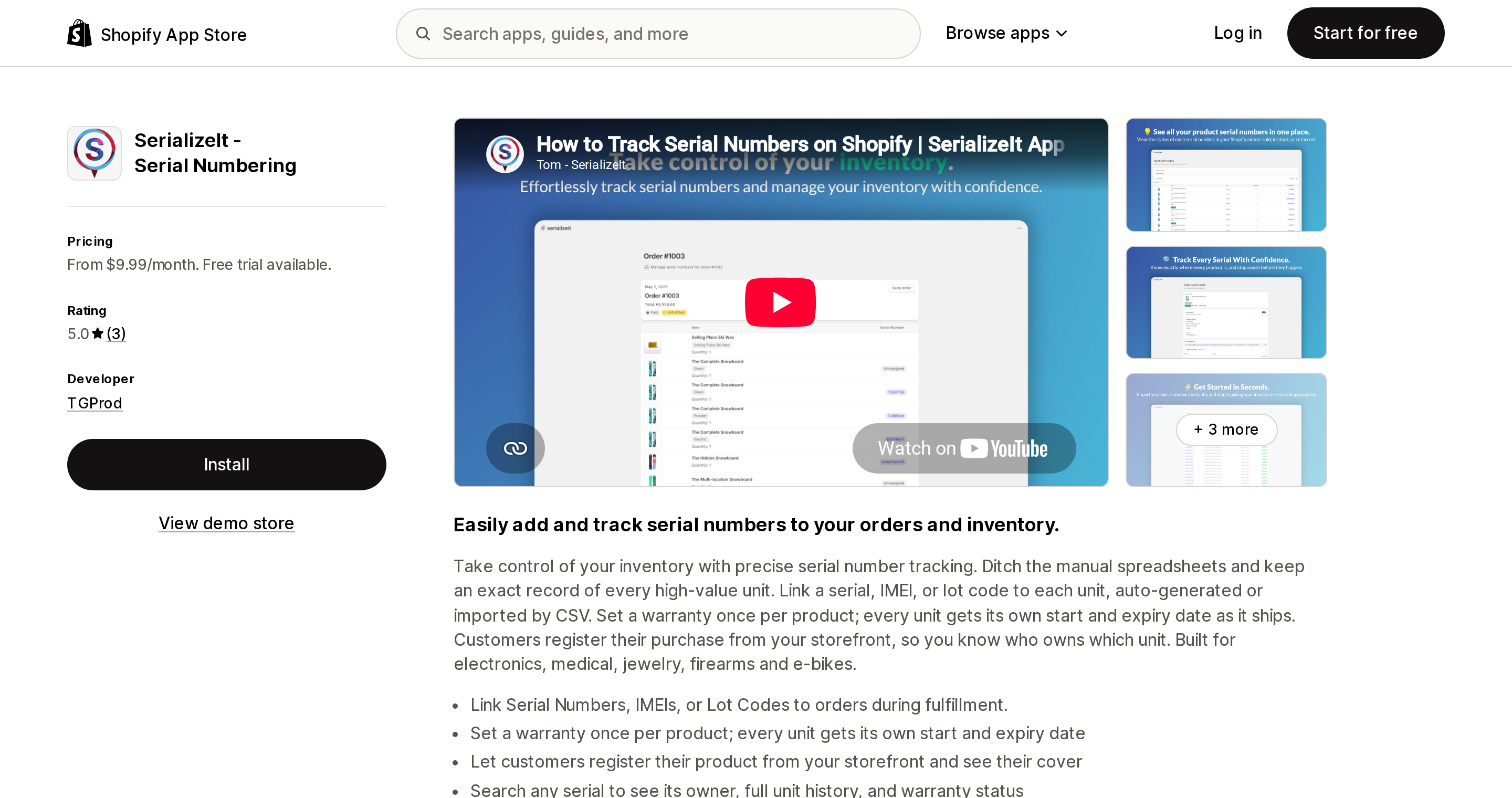
Source: Shopify App Store (SerializeIt ‑ Serial Numbering), retrieved September 3, 2026
Built by TGProd and launched June 6, 2024, this is the only listing among the six here that describes both fulfillment-side assignment and a storefront registration page. Serials, IMEIs, or lot codes are auto-generated or imported by CSV, and the warranty model is unusually clean: "Set a warranty once per product; every unit gets its own start and expiry date as it ships." Serial lookup returns owner, history, and warranty state — the exact query a claims desk runs. Shopify POS and Shopify Flow both appear under Works with.
Starter is $9.99/month with 100 serials, Growth $24.99/month with 500, Unlimited $49.99/month with no per-serial fees, each also annual at 17% off, on a 14-day free trial with no free plan. Overage is $0.05 per serial on Starter and $0.04 on Growth, and the vendor site publishes break-even points: Growth beats Starter from 401 serials a month, Unlimited beats Growth from 1,126. REST API access is Unlimited only. Constraints: 5.0 across 3 reviews is not a base to generalize from, no claims workflow is described, and off-Shopify registration is not stated in the app's official documentation.
SeriaLogic ‑ Order Serializer
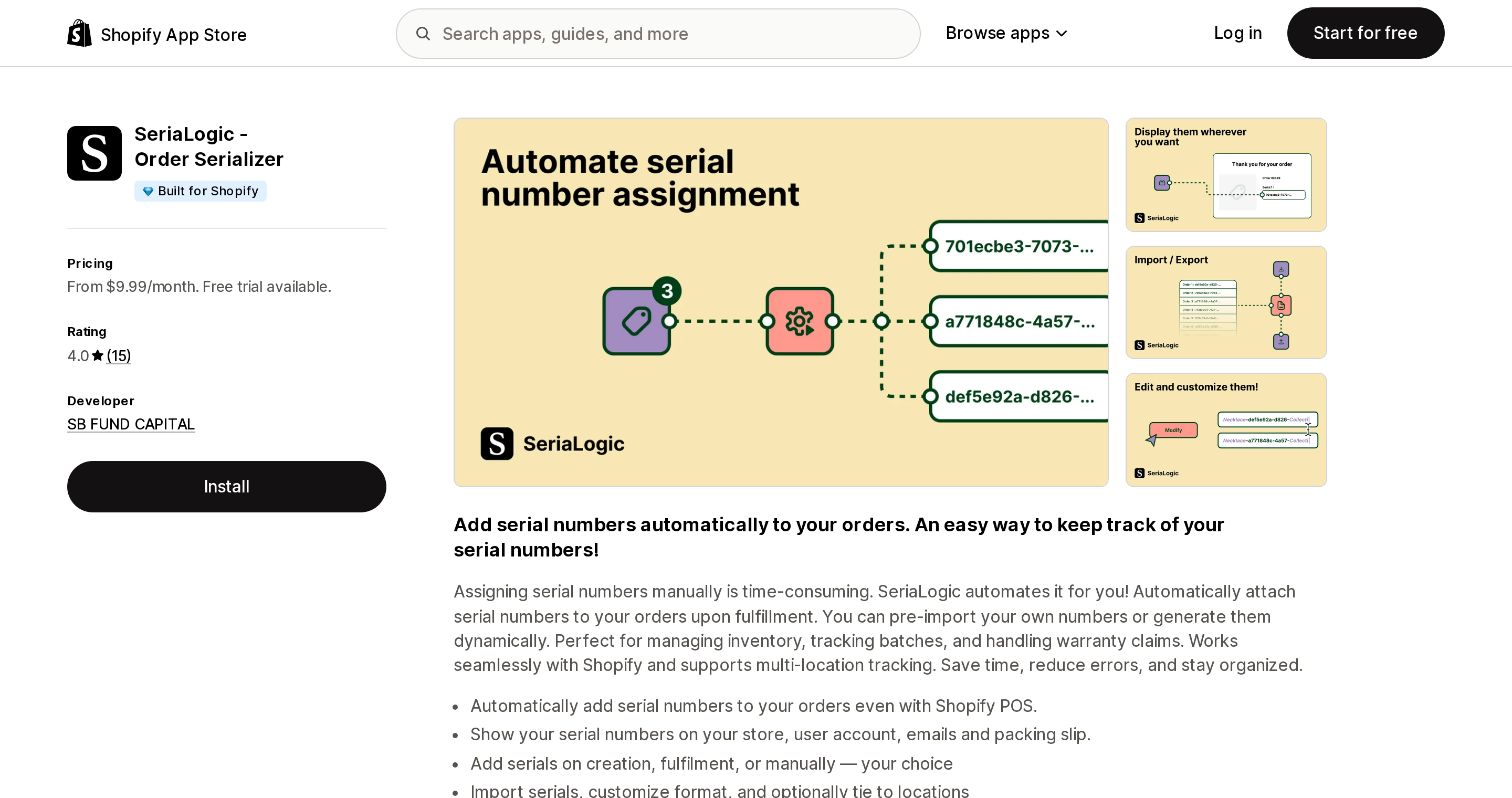
Source: Shopify App Store (SeriaLogic ‑ Order Serializer), retrieved September 3, 2026
From SB FUND CAPITAL, launched October 21, 2022, and the only app among the six here carrying the Built for Shopify badge as of September 3, 2026 — relevant if procurement treats that badge as a requirement. Its description is exact: "Automatically attach serial numbers to your orders upon fulfillment." You can pre-import numbers or generate them with a custom prefix and suffix, and assign at order creation, at fulfilment, or manually. Its listing is also specific about where serials come out — store, user account, emails, and packing slip — which for a regulated category matters more than feature count.
Starter is $9.99/month, Professional $24.99/month described as 5x more orders at 500 per month, and Scale $49.99/month described as 10x more orders at 1,000 per month with $0.03 per order beyond that. There is a 14-day trial and no free plan. The Starter order allowance is not printed as a number on the plan card, and billing counts orders rather than units, which changes your cost model if one order carries several serialized units. Constraints: no customer registration form is described, so ownership is only ever the Shopify customer on the order. Claims-management tags appear in the listing's category taxonomy, but no claim handling appears in the feature bullets, and those tags are developer-declared. At 4.0 across 15 reviews this is the lowest rating in the set, with 2 of 15 at one star.
Serializer ‑ Product Tracking
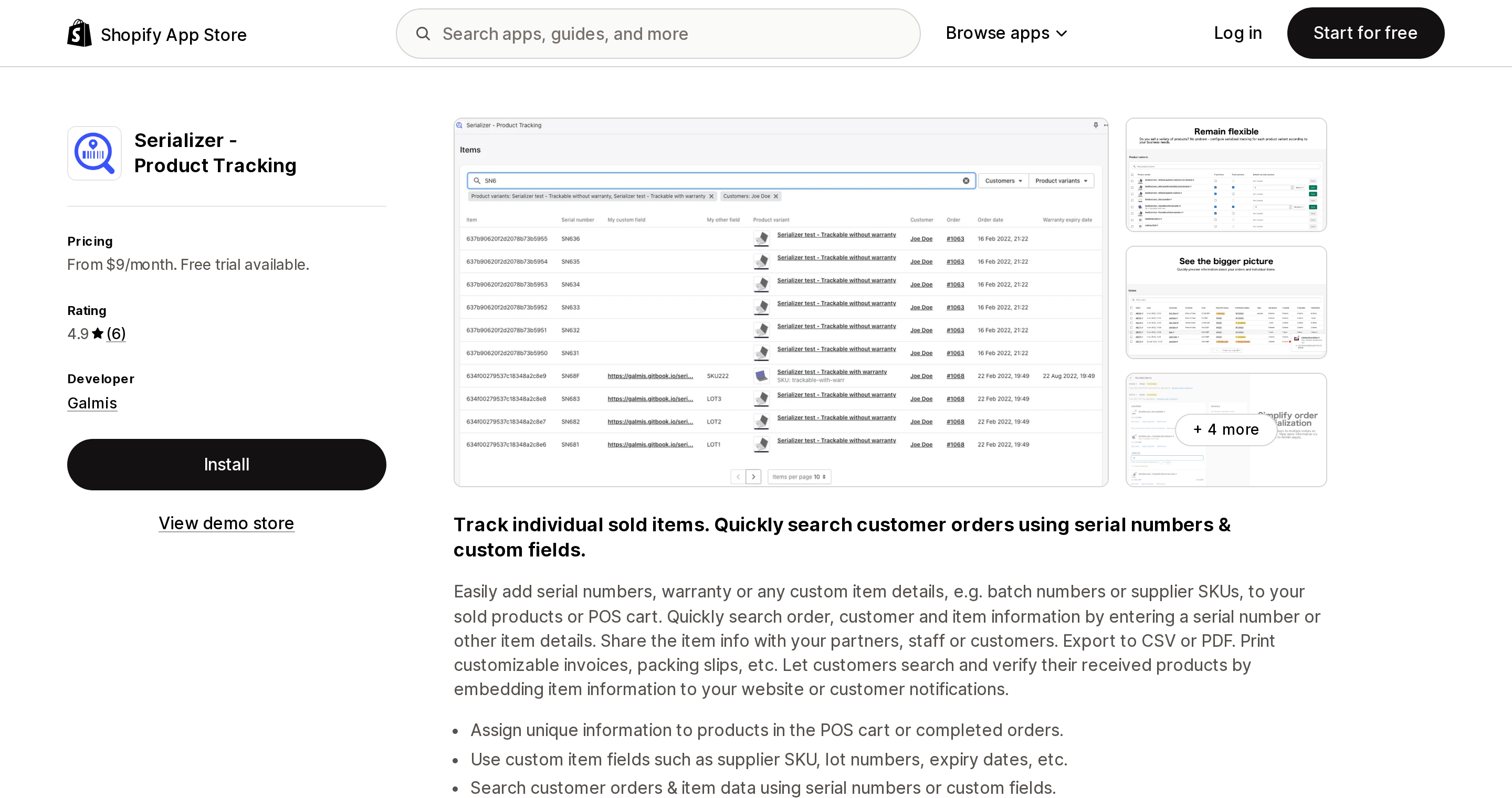
Source: Shopify App Store (Serializer ‑ Product Tracking), retrieved September 3, 2026
Galmis launched this on June 16, 2022, and it solves a narrower problem well. Rather than serials alone, it attaches arbitrary per-item fields — supplier SKU, lot number, expiry date — to items in a POS cart or on completed orders, then makes them searchable. An Australian reviewer selling watches and jewellery put the value in the phrase this article is about: fields "you need to track per physical item (not per product line)". Order printer template customization is the other differentiator, with serials on receipts and invoices in bulk or as PDF, plus a customer-facing order lookup page and public GitBook documentation.
Starter is $9/month including 50 tracked items, Unlimited $19/month with no usage fees, on a 7-day trial with no free plan. Do the arithmetic before choosing Starter: at 200 tracked items a month you pay $9 plus 150 items at $0.25, which is $46.50 — more than twice Unlimited, and that $0.25 per item is the steepest overage rate among the listings here that publish one. Constraints: attachment is described for completed orders and the POS cart, not a pre-fulfillment inventory pool, making this a record-what-you-sold tool rather than an assign-as-you-pack tool. No registration form, no claim workflow, and Shopify Flow is not under Works with. Six reviews is thin, and one of them is one-star.
Warranty Registration & Claims
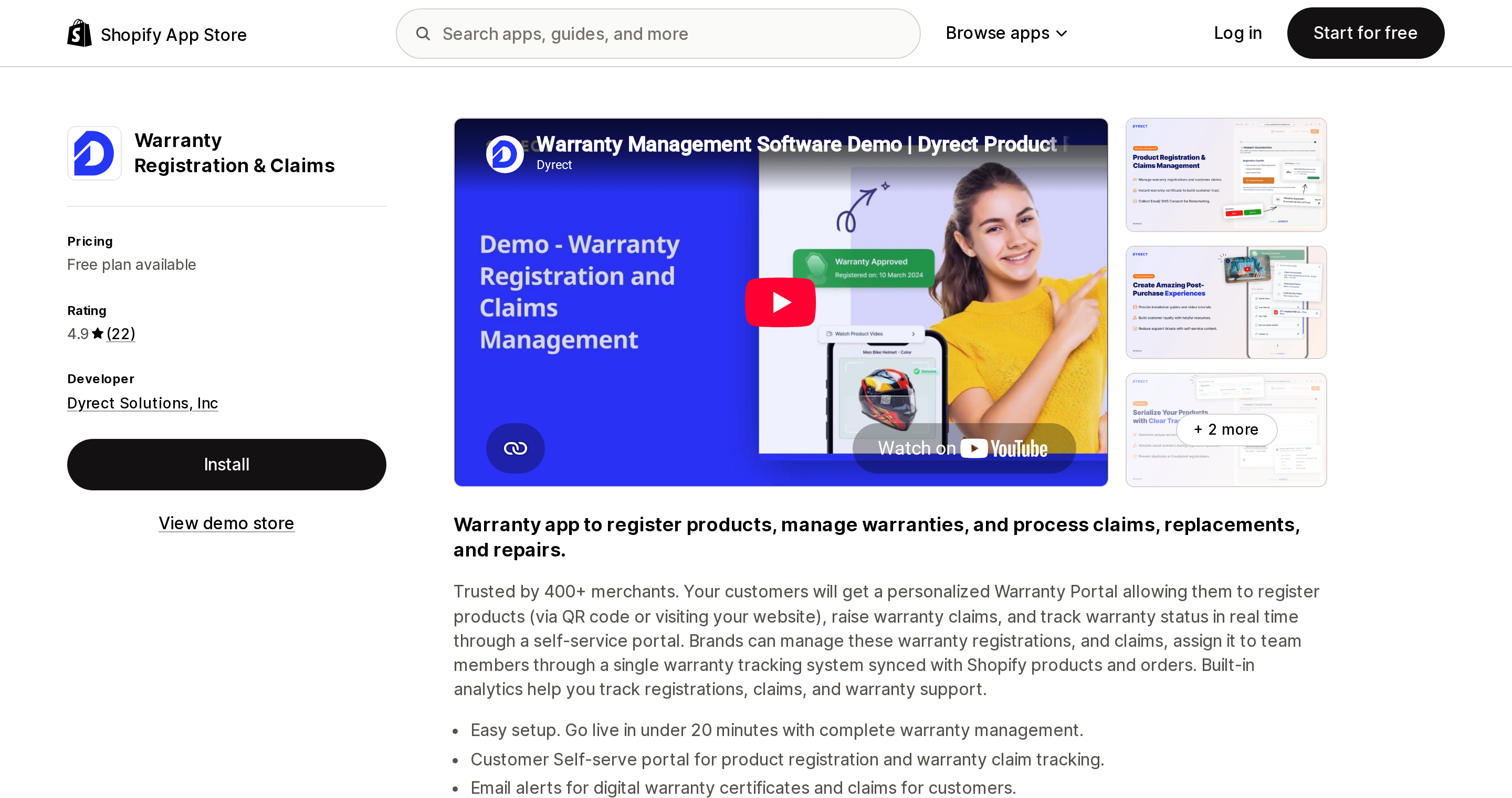
Source: Shopify App Store (Warranty Registration & Claims), retrieved September 3, 2026
Warranty Registration & Claims by Dyrect Solutions, Inc — Dyrect is the company, not the app name — launched May 26, 2025 and is the deepest job (c) implementation here, at 4.9 across 22 reviews, the largest review base in this set. It runs a self-serve portal for registration and claim tracking, a digital warranty certificate, an approval workflow, and on Claims Pro, repair and replacement workflows that generate the corresponding orders. Listed integrations are Gorgias, HubSpot, Klaviyo, MailChimp, Zendesk, and Zoho Desk, and the developer is US-based in Sunnyvale, California.
There is a free plan, then Registration at $19/month, Claims at $49/month, and Claims Pro at $149/month — and all three paid tiers include the same 100 credits per month and the same single business user. Dyrect's pricing page defines a credit as one action, meaning one customer-completed registration, claim, or repair or replacement, and states that "Automatic Shopify registrations are free". The actions that consume credits are therefore exactly the off-Shopify registrations and the claims. Above roughly 100 actions a month you are into Enterprise, which starts at 500 credits and 5 business users and whose price is not published.
The App Store listing and the vendor's own pricing page disagree in two places. First, serialization: the listing markets serial tracking, including a screenshot themed around serializing products, but on Dyrect's pricing page at dyrect.co/pricing, Serialization and QR Codes appear as an Enterprise add-on, and no serial validation appears in the $19, $49, or $149 feature lists. Do not budget for serial-validated registration at $19/month here. Second, claims on the free plan: the listing includes Claims Management in the Free plan's features and also as the differentiator of the $49 Claims plan, while the vendor's comparison table shows claim credit consumption only on Claims and Claims Pro and marks it N/A for Free and Registration. The vendor table is the more specific source, so treat claims as paid.
Other constraints: fulfillment-side assignment is not described, so job (a) is uncovered. Custom branding, API access, and extra business user licenses are add-ons at unpublished prices. Of the listings here that publish a data access section, this one requests the most, including editing orders with returns and order edits, and editing discounts — flag that to whoever runs your app security review. Shopify POS and Shopify Flow do not appear under Works with.
Product Registration Supreme
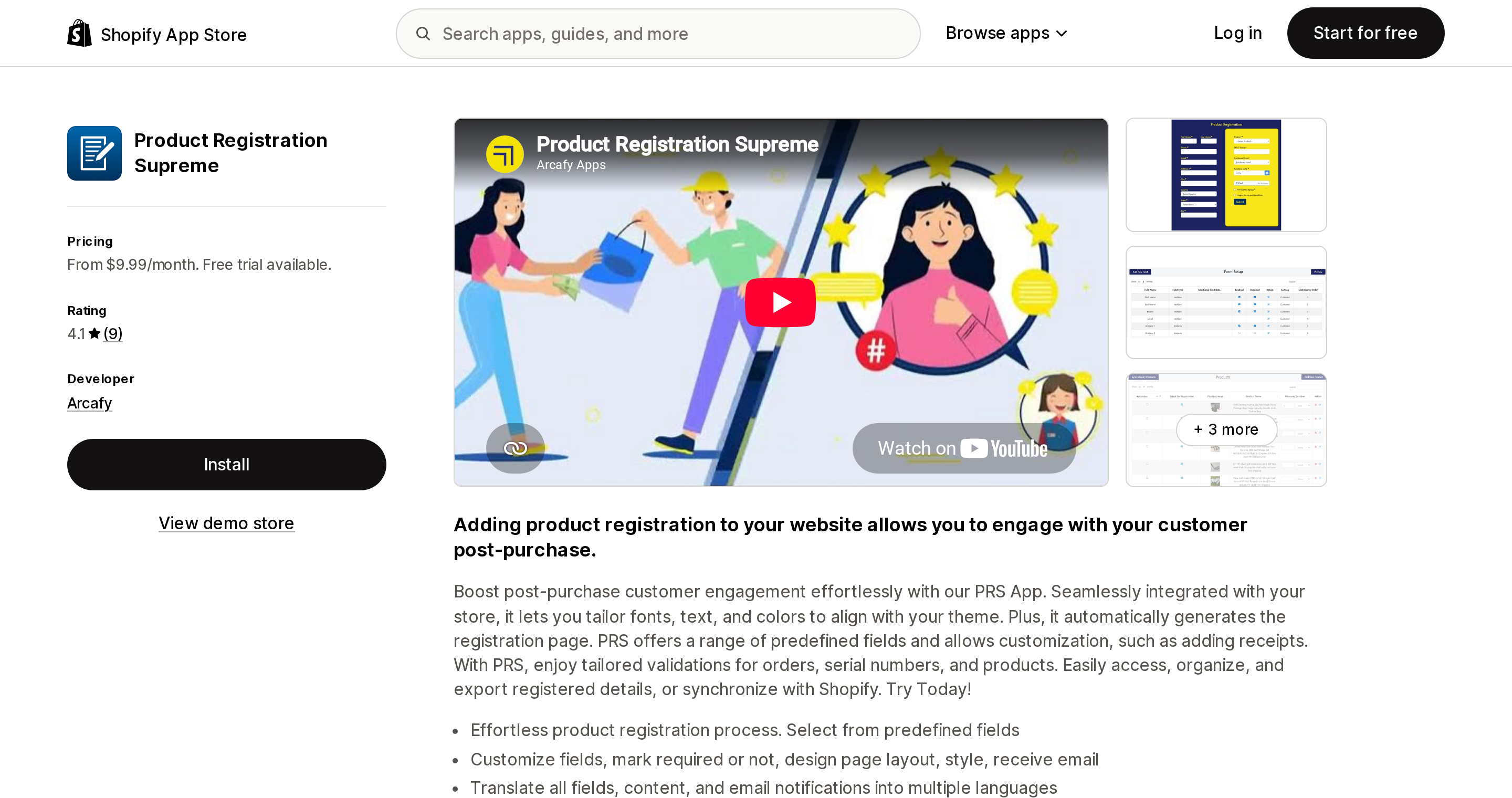
Source: Shopify App Store (Product Registration Supreme), retrieved September 3, 2026
Arcafy's app is the longest-listed here, launched July 22, 2021, developed in Irvine, California. It generates the registration page for you, supports custom fields and proof-of-purchase receipt uploads, works with the Customer accounts extension, and offers both order number validation and serial number validation.
Standard is $9.99/month, Advance $15.99, Supreme $19.99, and Business $39.99, on a 5-day free trial — the shortest in this set — with no free plan. Serial No Add / Update / Import and Serial No Validation appear only on the Supreme plan. If serial-based validation is why you are considering this app, your price is $19.99/month, not $9.99. A second oddity: as listed on the App Store, Business at $39.99 is described as everything from Advance, not everything from Supreme, which reads as the more expensive plan not including the serial features. Confirm that with Arcafy before buying Business.
Constraints: 4.1 across 9 reviews, with 3 of those 9 at one star — a third of the base — and the most recent review dated December 2024. The vendor documentation at prdreg.arcafy.com is embedded video with no written specification, which is why several questions here went unresolved. Claims handling is a request form only, with no dashboard or tracking in the feature tags.
Warranty Registration ‑ Propel
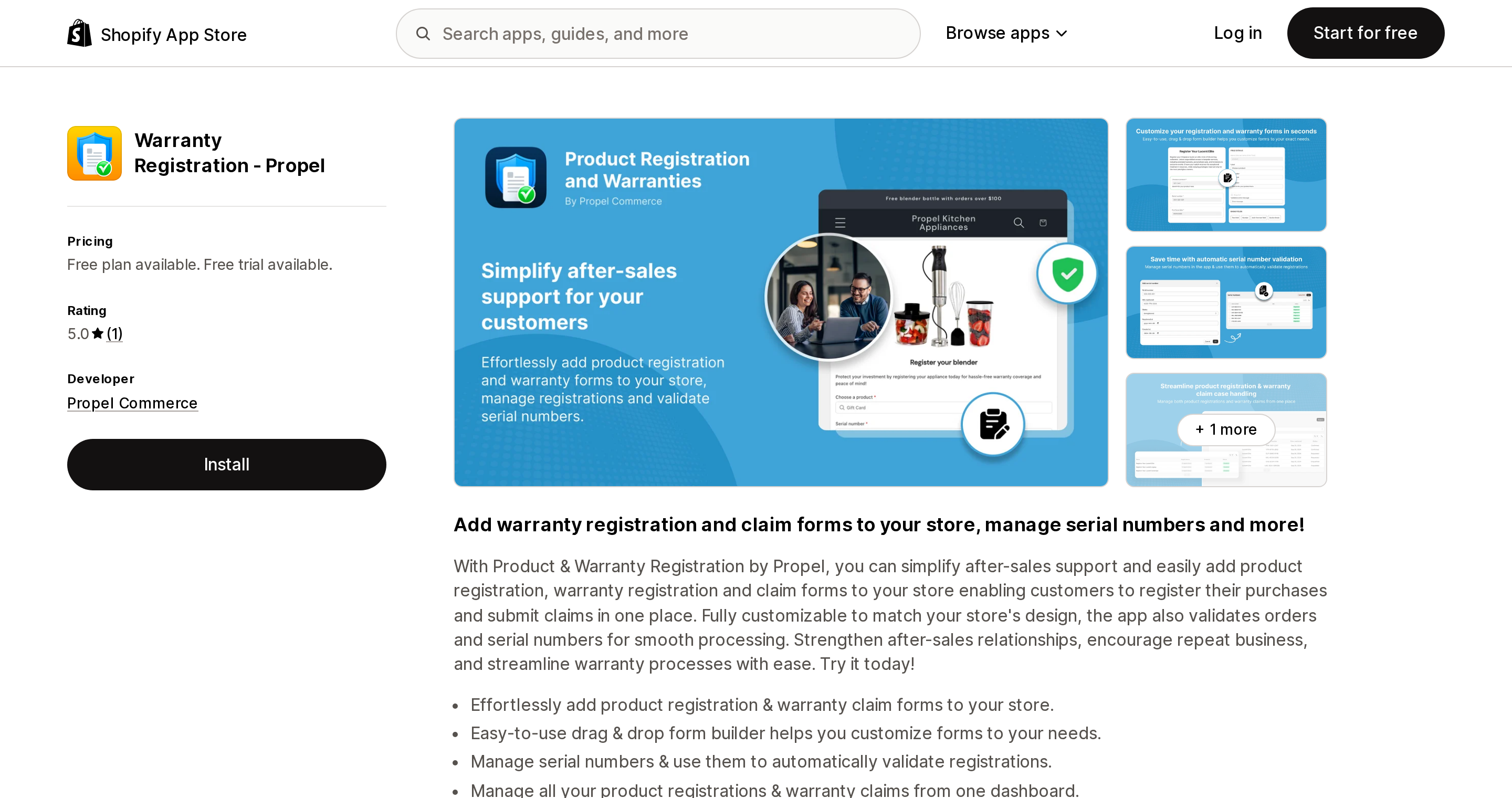
Source: Shopify App Store (Warranty Registration ‑ Propel), retrieved September 3, 2026
Warranty Registration ‑ Propel, by Propel Commerce in Vancouver, launched January 7, 2025. It has a drag-and-drop builder for registration and claim forms, order validation, serial number validation, and one dashboard for both. Its free plan includes one registration form and serial number validation; the only other free tier in this set, Dyrect's, does not include serialization. That makes it a cheap way to test whether serial-based validation fits your process at all. Pro is $9.95/month, or $83.58/year at 30% off — the steepest annual discount among the listings here that publish one — adding unlimited forms, unlimited registrations, and warranty claims. Documentation is public and step-by-step, and states a support response expectation of usually within one business day.
The rating needs its denominator. 5.0 is the headline; the base is one review, from a Hong Kong store recorded as having used the app for 42 minutes. That is not evidence of production behavior in either direction. Other constraints: the listing has no Works with section, so POS, Flow, and Customer accounts compatibility is unconfirmed rather than absent. The free plan's registration volume cap is not published, and claim depth is shallower than Dyrect's — the documentation does not describe repair or replacement order generation.
Registering a unit someone bought on Amazon or in a store
For a US brand with retail and marketplace distribution this is usually the requirement that eliminates most of the list, and the evidence quality varies sharply.
Documented — Warranty Registration & Claims. Dyrect's product page states the app captures first-party ownership data "even when the sale happened through Amazon, retail stores, dealers, distributors, or offline channels", via QR codes, registration links, branded pages, and post-purchase flows. It is the only vendor here whose published material states this explicitly; for two of the six we could not confirm the behavior either way. Pair that with the credit model above, since those are precisely the registrations that consume credits, and with serial validation sitting in the Enterprise add-on.
Inferred from a documented schema — Warranty Registration ‑ Propel. Propel's bulk serial upload documentation specifies a CSV of two comma-separated columns, serial_number and sku. No order identifier is in that schema, so validation checks the uploaded serial pool rather than a Shopify order, and units that went to Amazon or a dealer can structurally validate without an order number. Propel does not state this as a supported use case anywhere we found, so treat it as an inference from published structure and confirm it first.
Not stated in the app's official documentation — SerializeIt and Product Registration Supreme. SerializeIt's vendor FAQ answers did not render, and Arcafy's documentation is video-only, so in neither case could we confirm whether registration is accepted without a matching Shopify order.
Not applicable — SeriaLogic and Serializer. Neither describes a customer registration form, so ownership is whatever the Shopify order says.
One further listing, H and Co Serial Manager, fell outside this comparison's scope: it launched November 7, 2025 and had no reviews as of September 3, 2026, leaving nothing to place on the same axes as the others.
Choosing
You only need model-level identification. No app. Variant SKU and barcode already cover POS scanning by UPC and stock reporting by SKU.
Serials assigned at fulfillment and printed on packing slips, all sales through Shopify. SeriaLogic ‑ Order Serializer from $9.99/month, and the only Built for Shopify badge in this set.
Serials at fulfillment plus a customer registration page. SerializeIt ‑ Serial Numbering from $9.99/month is the one app here describing both. Accept 3 reviews as your evidence base, or wait.
Mostly in-person or low volume, needing lot numbers, supplier SKUs, and serial-bearing receipts. Serializer ‑ Product Tracking, going straight to Unlimited at $19/month rather than Starter.
Testing serial-based registration before spending anything. Warranty Registration ‑ Propel's free plan includes serial validation, then $9.95/month for claims. With one review, you are the pilot.
Serial validation on a registration form, from a US-based developer. Product Registration Supreme at the Supreme tier, $19.99/month — budget that, not the $9.99 headline.
Buyers on Amazon, at dealers, and in retail, plus a real claims desk. Warranty Registration & Claims at $49/month for claims or $149/month for repair and replacement orders, with the credit ceiling and the Enterprise serialization add-on settled with the vendor first.
All three jobs. Nothing here does all three. Plan on two apps — a serial app for (a), plus Dyrect for (b) and (c) — and on owning the join between them.
What we could not verify
Support hours in US time zones are unpublished for five of the six. Checkout Extensibility, Customer Account UI extensions, Markets, and B2B compatibility are not stated on any of these listings, which is not the same as unsupported. Uninstall behavior is undocumented across the set, and Dyrect's Enterprise price, add-on prices, and credit rollover behavior are not published.
Sources
- InventoryItem object — shopify.dev
- Metaobject limits — shopify.dev
- About metaobjects — shopify.dev
- Adding variants — Shopify Help Center
- Variants — Shopify Help Center
- Product details page — Shopify Help Center
- Metafields — Shopify Help Center
- Returns and exchanges — Shopify Help Center
- SerializeIt ‑ Serial Numbering — Shopify App Store
- SeriaLogic ‑ Order Serializer — Shopify App Store
- Serializer ‑ Product Tracking — Shopify App Store
- Warranty Registration & Claims — Shopify App Store
- Product Registration Supreme — Shopify App Store
- Warranty Registration ‑ Propel — Shopify App Store
- H and Co Serial Manager — Shopify App Store
- SerializeIt official site
- Dyrect pricing
- Dyrect product registration software
- Warranty Registration by Propel — documentation
- Propel — how to bulk upload serial numbers
- Product Registration Supreme — documentation
- Serializer ‑ Product Tracking — documentation
Shopify Flow adds and removes product tags for free on every paid plan, but its Get product data action returns at most 100 products per run, so backfilling an existing catalog becomes a scheduled loop. Flow also has no generic Product updated trigger, which means it structurally cannot re-tag a product after you edit its type, vendor, or price. Shopify Magic suggests a product category and fills category metafields, but product tag generation is not on its published feature list. The six apps compared here meter completely different units: Leap Auto Tags counts every tag added and every tag removed as one credit against 2,000 per month at $8, FilterTag meters 500 to 50,000 generated tags per month at $9 to $59, TAGit AI works out to 3 to 9 cents per generated tag, and Helium charges $9.99 one-time per 100 products. Mechanic and Matrixify charge flat fees of $16 to $199 and $20 to $200 with no per-tag metering at all. Check the denominator before you check the price. Researched September 3, 2026.