
What you will learn
On this pageContentsCloseOpen
Somewhere around your three-hundredth order, someone tells you that serious stores use ShipStation. You look it up, see $14.99 a month, and wonder what you're missing — because Shopify already prints your labels and the software costs nothing.
The honest answer for most US merchants is: not much, yet. Shopify Shipping is better than the comparison articles say, largely because they haven't been updated. But there are eight specific capability gates that Shopify structurally cannot pass, and if you hit one of them, order volume is irrelevant — you need a platform on day one.
This article establishes Shopify's native limits from the Help Center, corrects three claims that get repeated everywhere, and prices five real apps.
Research date: September 2, 2026. All prices are USD from the English App Store listings.
The short version
- FedEx is available natively for US fulfillment locations, alongside USPS, UPS, DHL eCommerce, and DHL Express. The "Shopify Shipping is USPS/UPS/DHL only" line is out of date.
- UPS Ground Saver and USPS Priority Mail Cubic Pricing are both reachable natively. Those are the two services third-party platforms advertise as their edge.
- Labels bought through Shopify are priced on Shopify's carrier account, not yours. There is no way to attach your negotiated contract — with one documented exception, UPS return labels.
- Shopify states plainly that shipping label discounts "don't always change with your subscription plan." Upgrading for cheaper postage is only conditionally true.
- Shopify Shipping and third-party carrier-calculated rates at checkout are two different features. Merchants conflate them constantly.
- Not one of the five apps in this comparison carries a Built for Shopify badge. This whole category is external SaaS with a sync connector.
What Shopify Shipping actually reaches
Shopify's Help Center has largely renamed the merchant-facing feature to "shipping labels," so if you're searching for old documentation, that's why it moved.
Label buying via Shopify's own carrier accounts is available for fulfillment locations in the US, Canada, Australia, the UK, France, Germany, Italy, the Netherlands, and Spain. For US locations the carriers are USPS, UPS, DHL eCommerce, DHL Express, and FedEx, with UPS and both DHL services restricted to the continental US.
The services list is deeper than merchants expect. USPS gives you Ground Advantage, Priority Mail, Priority Mail Express, First-Class Mail for large envelopes, and Media Mail domestically, plus three international products. UPS gives you Ground, Ground Saver, 3 Day Select, and the full Air ladder. And USPS Cubic Pricing is available on Priority Mail (up to 20 lb, 0.5 cu ft) and Ground Advantage (up to 20 lb, 1 cu ft).
That last paragraph invalidates a common argument for switching. Ground Saver and Cubic Pricing are exactly what Pirate Ship markets as its secret services, and Shopify reaches both.
Whose rates you're getting
Shopify is explicit: the rates you're charged are based on Shopify's account with the carrier. Your own negotiated UPS or FedEx contract cannot price a label bought this way. The single documented exception is UPS return labels, which can be created against your connected UPS account.
The discount question, answered carefully
Shopify's pricing page advertises "up to 87% off" shipping and shows that figure in the Basic column, with label buying included on every plan. The Help Center then adds a sentence worth reading twice: shipping label discounts "don't always change with your subscription plan. Some discounts are the same on every plan."
Shopify no longer publishes a plan-by-plan discount ladder. Anyone showing you one has reconstructed it from an old blog post. Use the in-admin rate calculator on your actual lanes before upgrading a plan for postage reasons.
Two features, constantly confused
This trips up more merchants than anything else in shipping, so it's worth a table.
| Shipping labels (Shopify Shipping) | Third-party carrier-calculated shipping | |
|---|---|---|
| What it does | Buys the label after the order | Shows live rates from your carrier account at checkout |
| Whose account | Shopify's | Yours |
| Plan gate | None — available on Basic | Advanced and Plus included. Grow: extra monthly fee, or included with annual billing. Other plans: unavailable |
| Carriers | USPS, UPS, DHL eCommerce, DHL Express, FedEx | UPS, FedEx; USPS for US locations |
Two nuances follow from that. First, you can get carrier-calculated rates displayed at checkout without the paid feature and without a carrier account, depending on your store location — so "I need Advanced for live rates" is often false. What Advanced buys you is your own account's rates. Second, backup rates only fire when calculated rates fail, and flat rates always show when eligible, so customers may pick a flat rate over the accurate calculated one.
What Shopify Shipping does not do
- No third-party carrier accounts for label buying. Your contract can't price a Shopify label.
- No regional or alternative carriers. No OnTrac, LSO, Better Trucks, Veho, Amazon Shipping, GlobalPost, or freight.
- No conditional rule engine. You get preferred carrier defaults and a "Suggested" service based on your history. Not if-then rules on tags, weight, destination, SKU, or order value.
- No multi-store or multi-channel order pool. Labels come from orders in that one store.
- Bulk purchase caps at 250 labels at a time.
- International declared value caps at $2,500.
- DDP labels only via Canada Post and the DHL services. For a US merchant collecting duties at checkout, that means DHL or nothing.
- Return labels are US-domestic only, unavailable on UPS Ground Saver, and no additional insurance can be bought on them.
Two more worth knowing. You cannot print a label without an order — there is no ad-hoc label in the Shopify admin — and you cannot buy labels for stock in an app-managed location, which means a 3PL location is off the table entirely.
On insurance: coverage up to $5,000 is purchasable through Shipsurance at $0.89 per $100 domestic and $1.29 per $100 international, but the $200 of included coverage requires Grow, Advanced, or Plus with Shopify Payments active. Basic gets none.
The apps
| App | Built for Shopify | Rating (reviews) | From | Meter | Own carrier accounts |
|---|---|---|---|---|---|
| ShipStation Orders & Inventory | No | 4.3 (630) | $14.99/month | Users × volume × geography | From $29.99 |
| Shippo ‑ Simplified Shipping | No | 4.2 (286) | Free / $19 | Labels per month | From $19 |
| Easyship ‑ All in One Shipping | No | 4.1 (368) | Free / $29 | Shipments per month | From $29 |
| Pirate Ship: CheapARR Shipping | No | 4.9 (168) | Free to install | None — postage only | No |
| Veeqo Shipping and Inventory | No | 4.0 (125) | Free to install | None — postage only | Not stated |
ShipStation Orders & Inventory
Source: Shopify App Store (ShipStation Orders & Inventory), retrieved September 2, 2026
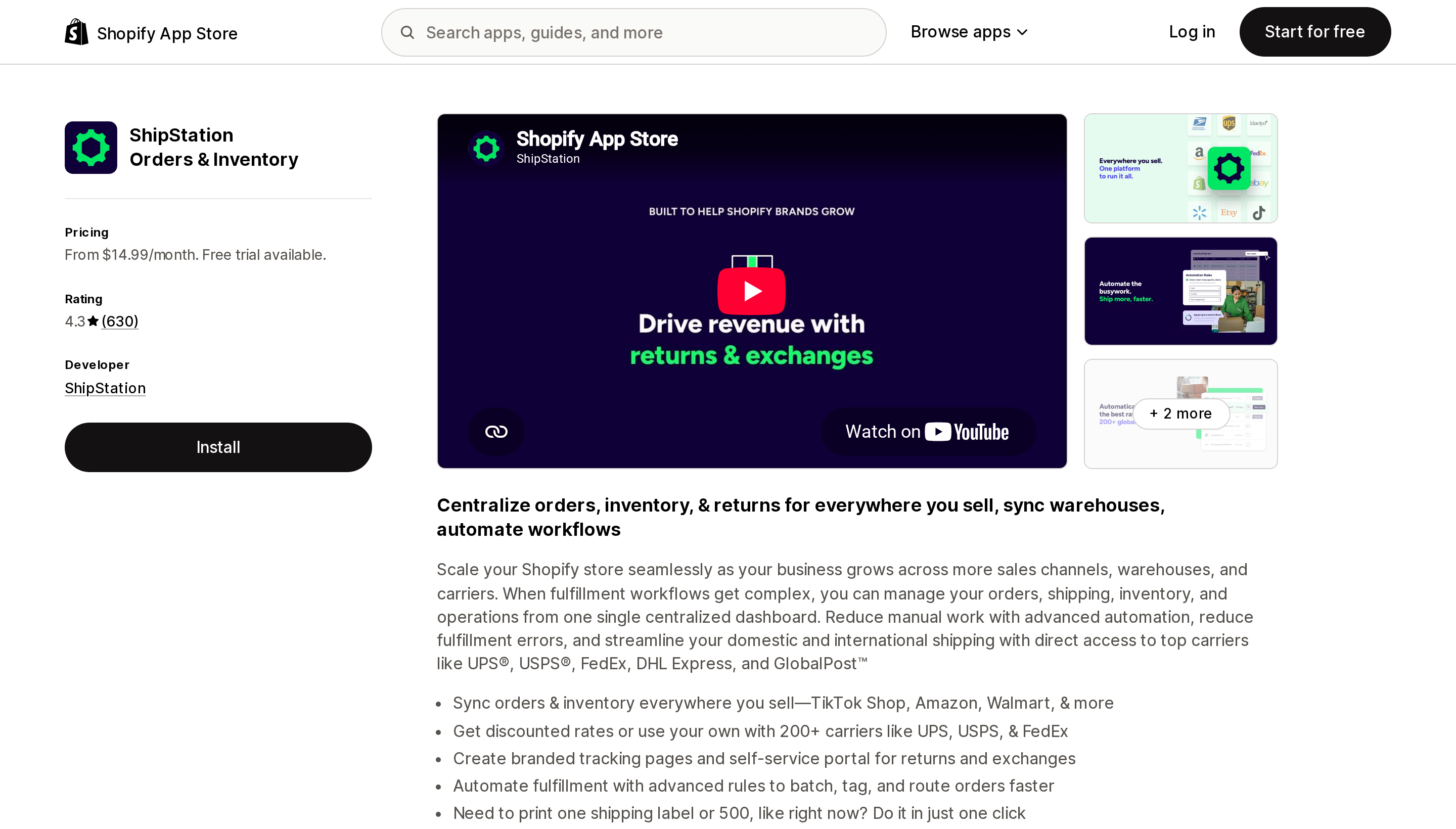
The deepest automation in the category, and the most commonly misquoted price. Starter is $14.99/month for 3 users, unlimited store connections, rate shopping, return labels, and basic automations. Bringing your existing carrier accounts is a Standard-tier feature at $29.99, alongside unlimited automations, combine and split orders, returns and exchanges, and basic warehouse management. Premium is $349.99 with inventory management. ShipStation notes its pricing varies by geography and monthly order volume, so the sticker is not the price at scale.
Its 630 reviews are barbell-shaped: 72% five-star, 18% one-star, with the middle hollowed out. Positive reviews cluster on named implementation managers and automation payoff. Negative reviews cluster on order sync fidelity — the recurring theme is that ShipStation imports an order once, so post-import changes in Shopify don't propagate. One detailed July 2026 review describes multi-location handling as the core failure, with separate user logins rather than child accounts per location. That is a single observation, but it lands directly on the multi-warehouse case and is worth testing deliberately during a trial.
Shippo ‑ Simplified Shipping
Source: Shopify App Store (Shippo ‑ Simplified Shipping), retrieved September 2, 2026
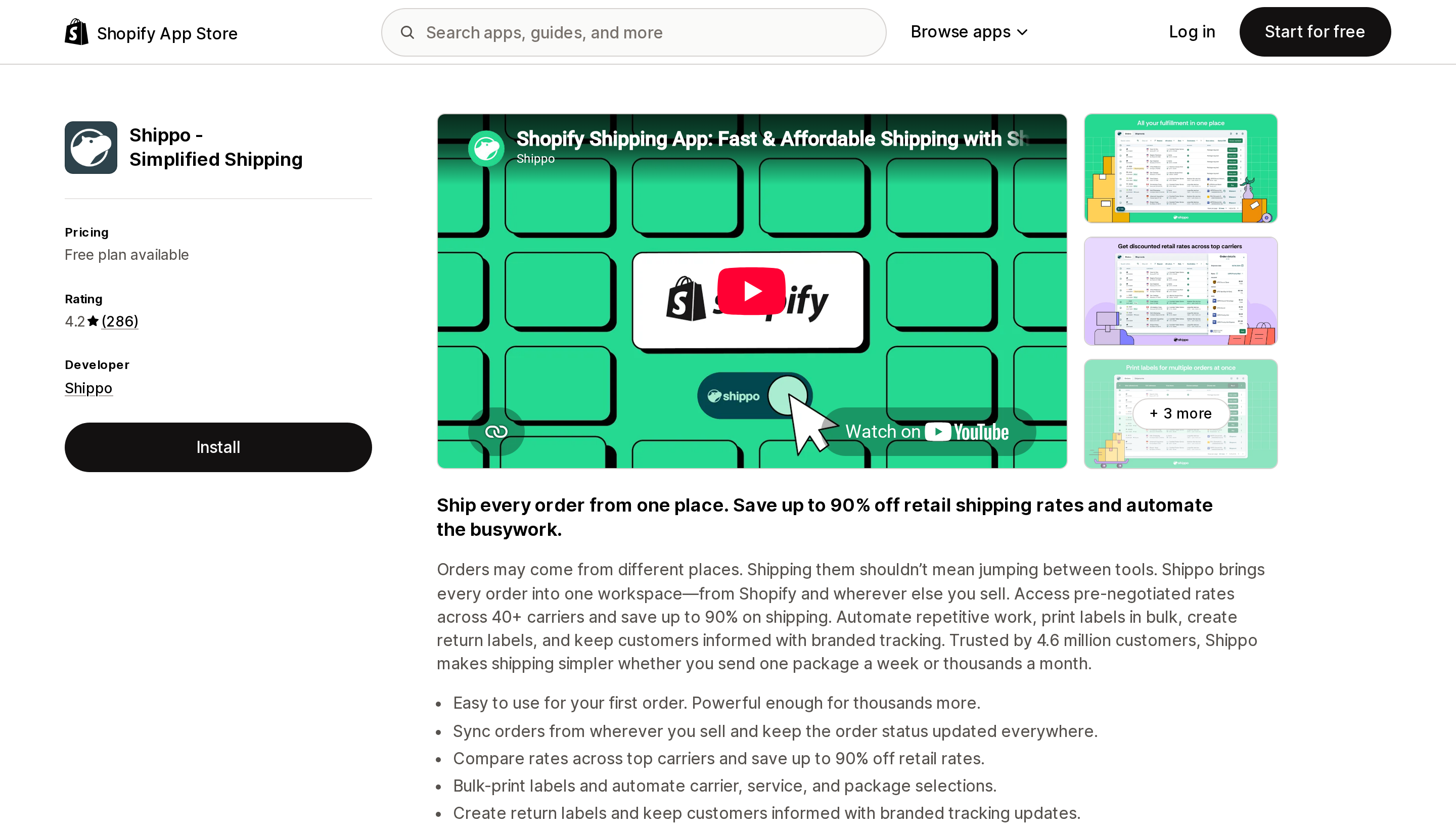
The cleanest meter here: labels per month. Starter is free for up to 30 labels a month with one user, tracking, returns, and automations. Professional starts at $19/month, scales with label volume up to 10,000, and adds connecting your own carrier accounts at no extra charge plus up to five user logins.
That $19 makes Shippo the cheapest legitimate path to using your own negotiated contract, which is the single thing Shopify structurally cannot do.
Its distribution mirrors ShipStation's — 69% five-star, 18% one-star — with two recurring negative themes: order sync and status flow-back to Shopify failing with no manual correction, and support access gated behind an AI chatbot. Two single reviews worth flagging rather than generalising: one US merchant in May 2026 reports a police report being demanded for a lost-package insurance claim and billing continuing after uninstall, and the same reviewer volunteers that Shopify's own UPS Ground Saver availability removed their reason to stay.
Easyship ‑ All in One Shipping
Source: Shopify App Store (Easyship ‑ All in One Shipping), retrieved September 2, 2026
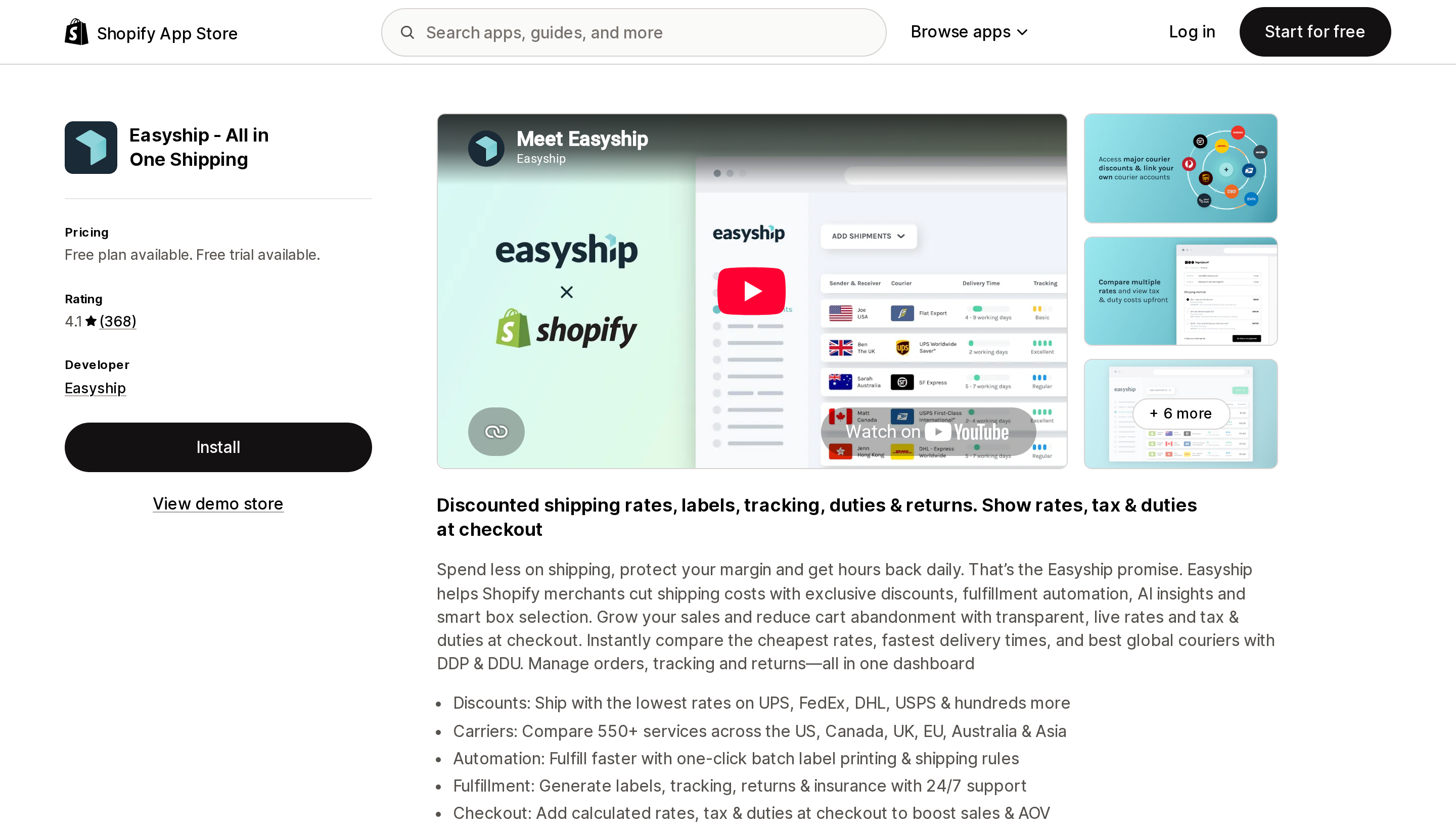
The cross-border specialist, and the clearest answer to Shopify's international ceiling. Free covers 50 shipments a month. Plus is $29 for 500 shipments and adds your own courier accounts and live rates at checkout. Premier is $69 for 2,500 and adds live tax and duties at checkout with DDP and DDU, plus returns management. Scale is $99 for 5,000 and is where the multi-location global account appears — multi-warehouse on Easyship is not a $29 feature.
If you ship internationally and want duties collected accurately on a non-DHL carrier, or you ship items declared above $2,500, this is the gap Easyship exists to fill. If you're domestic-only, you'd be paying for a cross-border product you never use.
Reviews run 72% five-star and 17% one-star. The dominant negative theme is support responsiveness, with multiple reviewers describing AI bots escalating cases with no human follow-up. One long, specific August 2026 US review documents being charged $441.18 in import tax plus a $15 DDP handling fee, after which FedEx still billed the recipient CAD 238.97, with no itemisation provided. That is one merchant's experience, not a proven defect — but given that DDP accuracy is Easyship's headline feature, verify it on real shipments before you scale.
Pirate Ship: CheapARR Shipping
Source: Shopify App Store (Pirate Ship: CheapARR Shipping), retrieved September 2, 2026
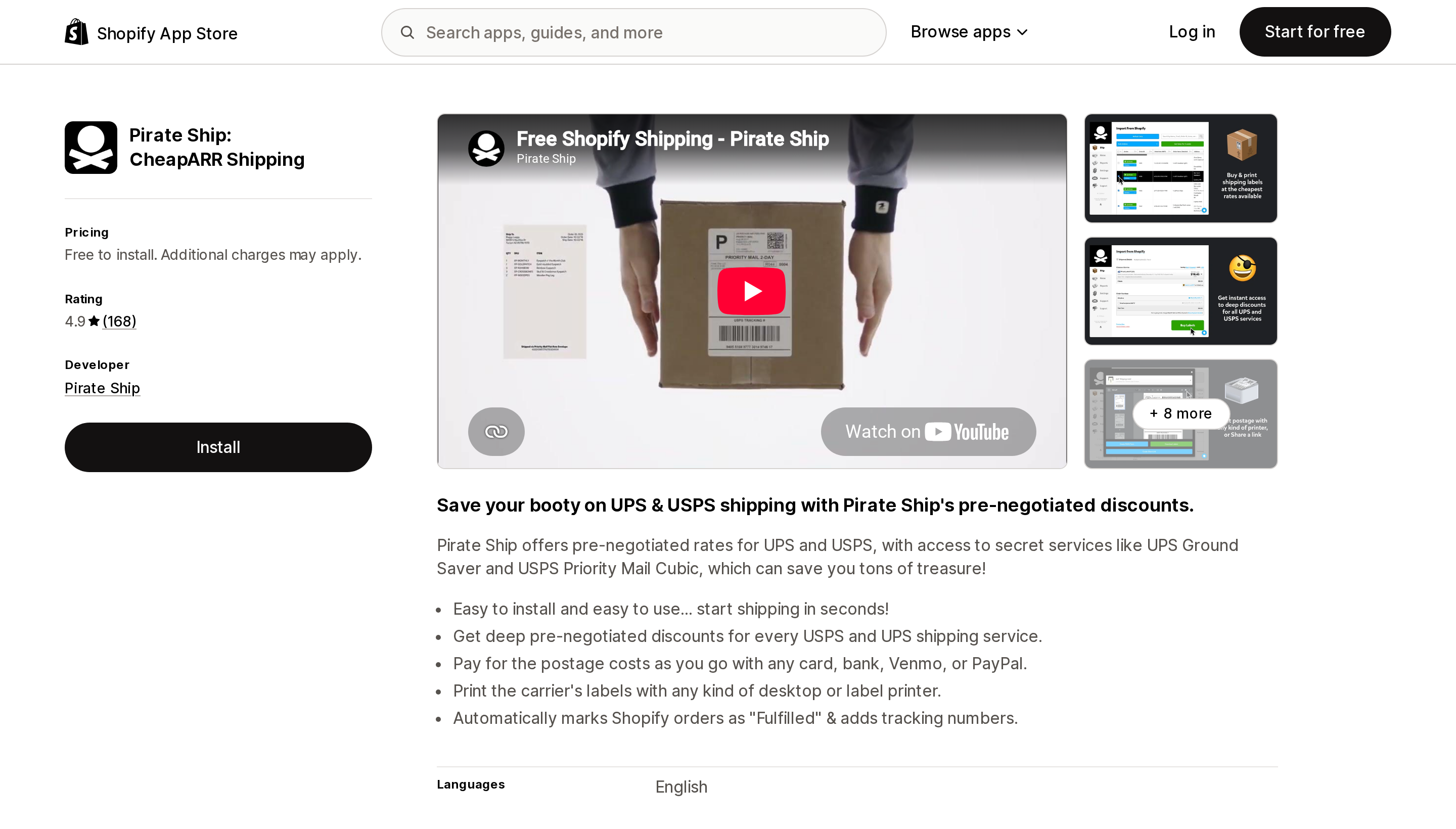
Free to install, no monthly fee, postage only. USPS and UPS only — no FedEx, no DHL. It does bulk printing, batch purchase from a spreadsheet, address validation, packing slips, customs documents, and scheduled pickups, but there is no conditional rule engine and multi-store is not a listed capability.
Its genuinely differentiating use case is the one Shopify cannot do at all: buying labels for shipments that never were a Shopify order — wholesale, markets, replacements. That alone justifies it for some merchants at zero cost.
At 4.9 across 168 reviews with only 4% one-star, it has by far the healthiest distribution here. Read that carefully: it reflects a narrow, self-selecting user base of simple USPS and UPS shippers, not superiority over ShipStation on capability.
Veeqo Shipping and Inventory
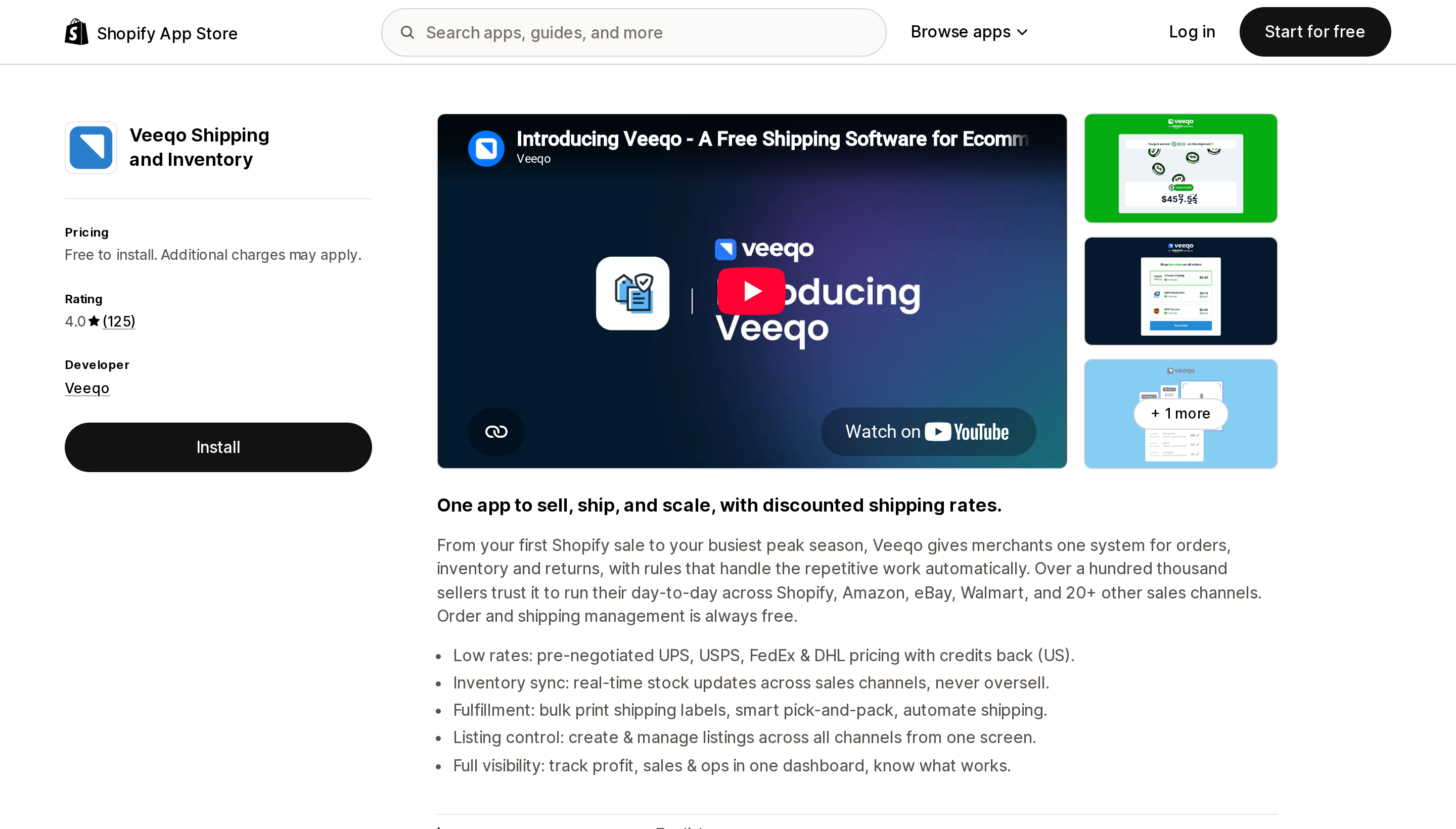
Source: Shopify App Store (Veeqo Shipping and Inventory), retrieved September 2, 2026
Amazon-owned, free to install, with order and shipping management stated as always free — you pay for labels only, at pre-negotiated UPS, USPS, FedEx, and DHL rates. It lists inventory sync across channels and locations, rules-based automation, bulk label printing, barcode scanning, and 20+ sales channels.
It is the only app here offering multi-channel plus multi-location plus rate shopping at $0 a month, which makes it the strongest answer to "I need all that but refuse to pay a SaaS fee." Customs documents and return labels are not listed among its features, so treat international as unproven rather than absent.
At 4.0 it carries the lowest rating here, but with an unusually high 12% four-star share — a less polarised distribution than its competitors. Positive reviews are operational and specific, from multi-year US sellers. Recurring improvement requests centre on reporting depth. One US reviewer of about three years runs Veeqo for roughly 90% of shipments with ShipStation as backup, which is a useful signal that these tools coexist rather than strictly substitute.
The eight gates
Volume is the wrong trigger. A 2,000-order-a-month single-warehouse USPS shipper is fine natively — that's eight bulk runs of 250. A 150-order-a-month merchant with three warehouses and a UPS contract is not. Leave Shopify Shipping when any one of these is true:
- You have your own carrier contract you want applied to labels. → Shippo Professional at $19 is the cheapest correct answer.
- You sell on a second channel or run a second store and want one fulfillment queue. → Veeqo at $0, or ShipStation.
- You need a carrier Shopify doesn't resell — regional, Amazon Shipping, GlobalPost, or freight. → ShipStation, Easyship, or Veeqo.
- You need conditional rules. Shopify has no rule engine at all. → ShipStation Standard.
- You collect duties at checkout on a non-DHL carrier, or declare above $2,500. → Easyship Premier.
- You need international or APO/FPO return labels, or insured returns above $100.
- You need to buy labels for non-Shopify shipments. → Pirate Ship, at $0.
- You fulfill from a 3PL or app-managed location. Shopify can't buy labels for those.
The arithmetic nobody shows you
Shippo Professional is $19 a month, or $228 a year. On 500 labels a month that's 3.8¢ per label. If your own UPS contract beats Shopify's rate by even five cents a package, it pays for itself immediately. If it doesn't beat Shopify's rate, you're paying $228 a year for a rate-comparison interface.
That is the whole decision, and it's why "ShipStation gets me cheaper postage" is the misconception worth killing. It doesn't, inherently. It gets you more rates to compare and lets you attach a contract you already negotiated. If you have no contract and you ship USPS and UPS domestically, you may be paying $14.99 to $29.99 a month for a rate table you could already see.
One operational detail to budget for either way: Shopify enforces shipping-label billing thresholds — $200 on Basic, $480 on Grow, $1,280 on Advanced, $4,000 on Plus — and hitting one triggers an immediate invoice. You can keep buying to 110% of the threshold, then label purchasing is blocked until you pay. That is a real BFCM hazard, and it applies to native labels, not app ones.
Also worth planning around: ShipStation, Shippo, and Easyship all bill outside your Shopify invoice. Uninstalling the app does not necessarily stop the SaaS charge.
Sources
- Shopify Help Center — Shopify Shipping setup and carriers
- Shopify Help Center — USPS services and Cubic Pricing
- Shopify Help Center — UPS services for US merchants
- Shopify Help Center — Calculating shipping label rates
- Shopify Help Center — Buying labels in bulk
- Shopify Help Center — Return labels
- Shopify Help Center — Shipping insurance
- Shopify Help Center — Third-party carrier-calculated shipping
- Shopify App Store listings, retrieved September 2, 2026: ShipStation Orders & Inventory, Shippo ‑ Simplified Shipping, Easyship ‑ All in One Shipping, Pirate Ship: CheapARR Shipping, Veeqo Shipping and Inventory
Shop Pay Installments is free to activate, needs no app, and Shopify never publishes what it costs you — the rate is visible only inside your own admin. It also refuses Capital One and Chase credit cards, restricts monthly plans to debit cards only, excludes gift cards and subscriptions, and can't be turned off for individual products. Affirm can suspend your account for being password-protected, for having a non-English storefront, or for being primarily B2B. And Shopify's Getting paid page says disputes appear in your admin while its FAQ says they don't. If you fail the eligibility gates, the alternative is on-site messaging apps from Klarna, Afterpay, Sezzle, Zip, and PayPal — a category rated between 1.0 and 3.2 stars. Researched September 2, 2026.