
What you will learn
On this pageContentsCloseOpen
Search "best Shopify web push apps" and you get the same six or seven names, the same claim that push is "the cheapest channel you are not using," and almost never the one fact that decides whether the channel is worth anything to your store: on iPhone and iPad, web push does not reach anyone who has not added your store to their Home Screen first.
That is not an app limitation. It is Apple's, it has been in place since iOS and iPadOS 16.4, and no Shopify app can route around it.
Shopify itself does not offer web push at all. Shopify Messaging, Shopify's own free marketing app, sends email, SMS, and WhatsApp. That is the complete native list. So push is entirely an app decision — and the App Store category you are shopping in is messier than it looks.
Below: what Apple actually requires, what Shopify does and does not give you, the three incompatible things push apps charge for, and six real apps compared with prices verified on September 2, 2026.
The short version
- Shopify has no native web push. Shopify Messaging covers email, SMS, and WhatsApp only.
- On iOS and iPadOS 16.4+, Web Push works only for Home Screen web apps. The shopper must tap Share → Add to Home Screen, open your store from that icon, and then opt in. In the browser, the prompt does not exist.
- On macOS Safari and on Android Chrome, no install is needed. So your push list skews desktop and Android by construction, and your iPhone traffic — usually the majority of a US DTC store's sessions — is mostly unreachable.
- Three different pricing denominators are in play. Firepush and PushBot charge by notifications sent. Aimtell and ChirpyWeb charge by subscribers held. PushAlert charges by feature tier and sends unlimited notifications on every plan, including the free one.
- The Shopify App Store "Web push" category holds 63 apps, and much of the top of that list is mobile app builders and WhatsApp tools, not web push.
- Two names that appear in nearly every listicle are not where those articles point.
apps.shopify.com/izootoreturns 404.apps.shopify.com/pushengagealso returns 404 — PushEngage's real listing is atpushengage-1, rated 3.5 from 10 reviews.
What Apple requires, in Apple's words
Web Push arrived for Safari on macOS Ventura in Safari 16.1, where it works like it does on Chrome: a site asks, the user allows, notifications arrive. No install.
iOS and iPadOS took a different route. In the WebKit announcement for iOS and iPadOS 16.4, Apple describes the mechanism precisely: support for Web Push was added to Home Screen web apps. A web app that has been added to the Home Screen can request permission to receive push notifications, and only in response to direct user interaction such as tapping a subscribe button the web app provides.
Three conditions follow from that, and all three have to be true before a single notification can be delivered to an iPhone:
- Your storefront has to be installable as a web app. Apple's requirement is a manifest file whose
displaymember is set tostandaloneorfullscreen— or, per the same post, a meta tag marking the site as web-app capable. Without one of those, "Add to Home Screen" produces a bookmark, not a web app, and bookmarks open in the default browser and cannot receive push. - The shopper has to actually add it. Share button → Add to Home Screen. This is a manual step on a menu most shoppers never open.
- The shopper has to open the store from that icon and then opt in. The permission prompt only appears inside the installed web app, in response to a tap.
Nothing about this is Shopify-specific and nothing about it is app-specific. Every vendor in this comparison is subject to it identically, which is exactly why it belongs in the buying decision rather than in a footnote.
The practical consequence: your web push list is a desktop and Android list. If you are a US DTC store where mobile Safari is the single largest slice of sessions, the addressable audience for this channel is a fraction of your traffic, and no amount of prompt optimization changes that. It does not make push worthless — desktop and Android reach is real, and the per-message cost is far below SMS. It does mean that any projection built on total sessions is wrong by a large multiple.
What Shopify gives you natively
Nothing, in this category, and it is worth being precise about why that matters.
Shopify Messaging is Shopify's own marketing app, free to install, rated 4.8 from 4,265 reviews. Its channels are email, SMS, and WhatsApp. Web push is not among them, and there is no web push surface anywhere else in the admin — not in Shopify Forms, not in Shopify Flow, not in notifications settings, which govern transactional email only.
So unlike most categories we cover, there is no "the native feature is probably enough" branch here. If you want web push, you install an app. The question is only which one, and on what meter.
The three meters
This is the part that decides your bill, and it is not a difference of degree. Notifications sent per month (list unlimited, sending costs). Subscribers held (sending unlimited, growing costs). Features, with sends unbounded (you pay only to unlock automations).
Two stores with identical revenue land on opposite recommendations. A store with 5,000 subscribers sending daily is punished by send metering and rewarded by subscriber metering. A store with 40,000 subscribers sending twice a month is the reverse. Every listicle that ranks these apps 1 through 8 is implicitly assuming one usage pattern and never says which.
The six apps
All prices are USD as published on the Shopify App Store, retrieved September 2, 2026.
| App | Meter | Free plan | Entry paid | What the paid tier buys | Rating (reviews) |
|---|---|---|---|---|---|
| Firepush ‑ SMS & Web Push | Sends | 500 web pushes, unlimited subscribers | $13/mo | 10,000 web pushes | 4.8 (161) |
| PushBot: Web Push Notification | Sends (impressions) | Unlimited subscribers, campaigns only | $15/mo | 10,000 impressions + cart automation | 4.6 (18) |
| Brevo PushOwl: Email,Push,SMS | Sends, inside a bundle | 500 web pushes/mo, subscribers ∞ | $19/mo | 10k–30k web pushes/mo + email + SMS | 4.9 (2,037) |
| Aimtell Web Push Notifications | Subscribers | None (14-day trial) | $49/mo | Up to 10,000 subscribers, unlimited sends | 4.7 (4) |
| ChirpyWeb Push Notifications | Subscribers | Up to 200 subscribers, unlimited sends | $14/mo | Up to 2,000 subscribers | 5.0 (26) |
| PushAlert ‑ Push Notifications | Features | Unlimited notifications | $12/mo | Abandoned cart automation, analytics, segments | 5.0 (3) |
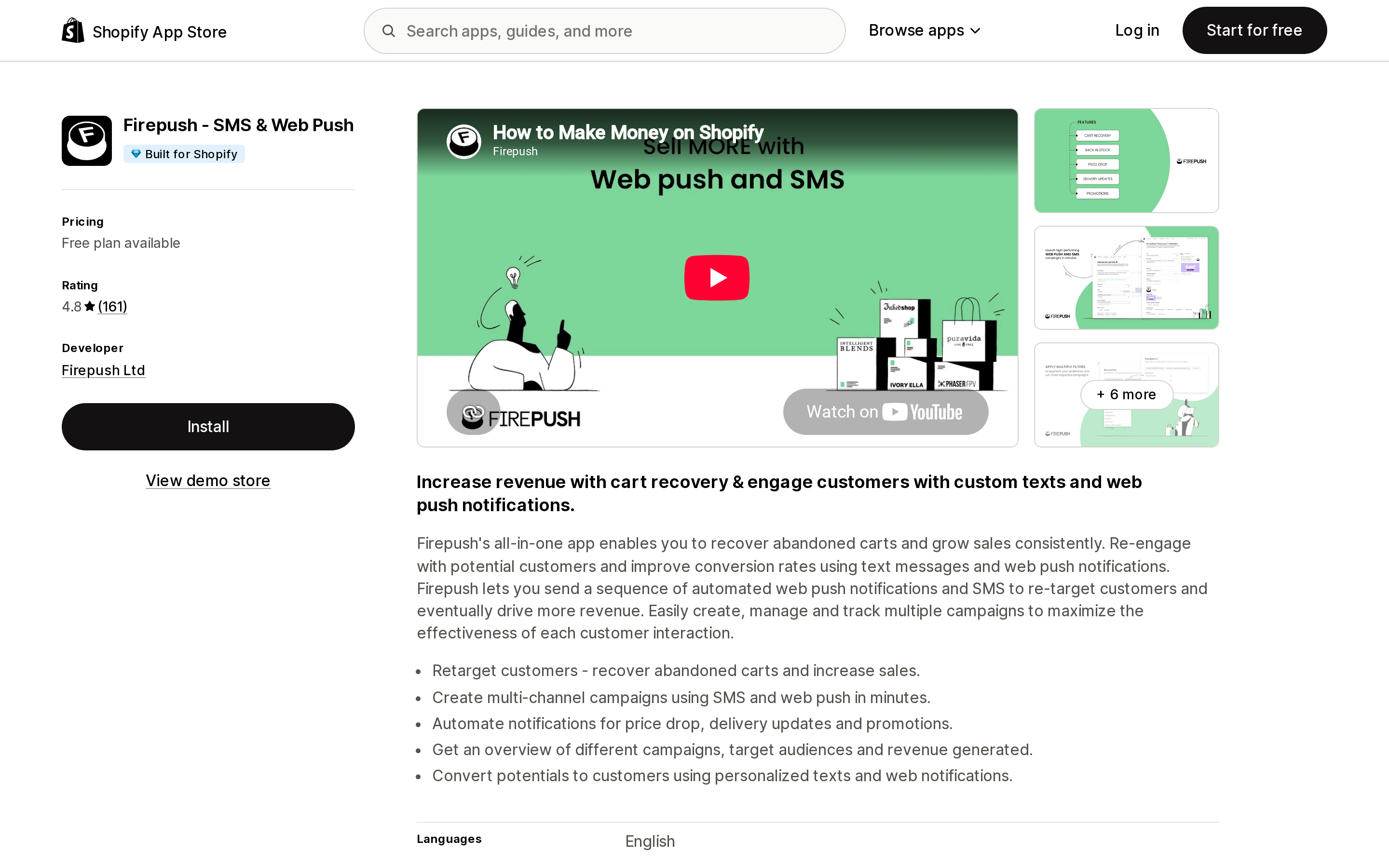
Firepush ‑ SMS & Web Push
Source: Shopify App Store (Firepush ‑ SMS & Web Push), retrieved September 2, 2026
The only app in this group carrying the Built for Shopify badge, and the one with a meaningful review base among the push-first tools: 4.8 from 161 reviews, developer Firepush Ltd, launched February 17, 2016. It works with Shopify Flow and Shopify Admin, and pairs web push with SMS in the same app.
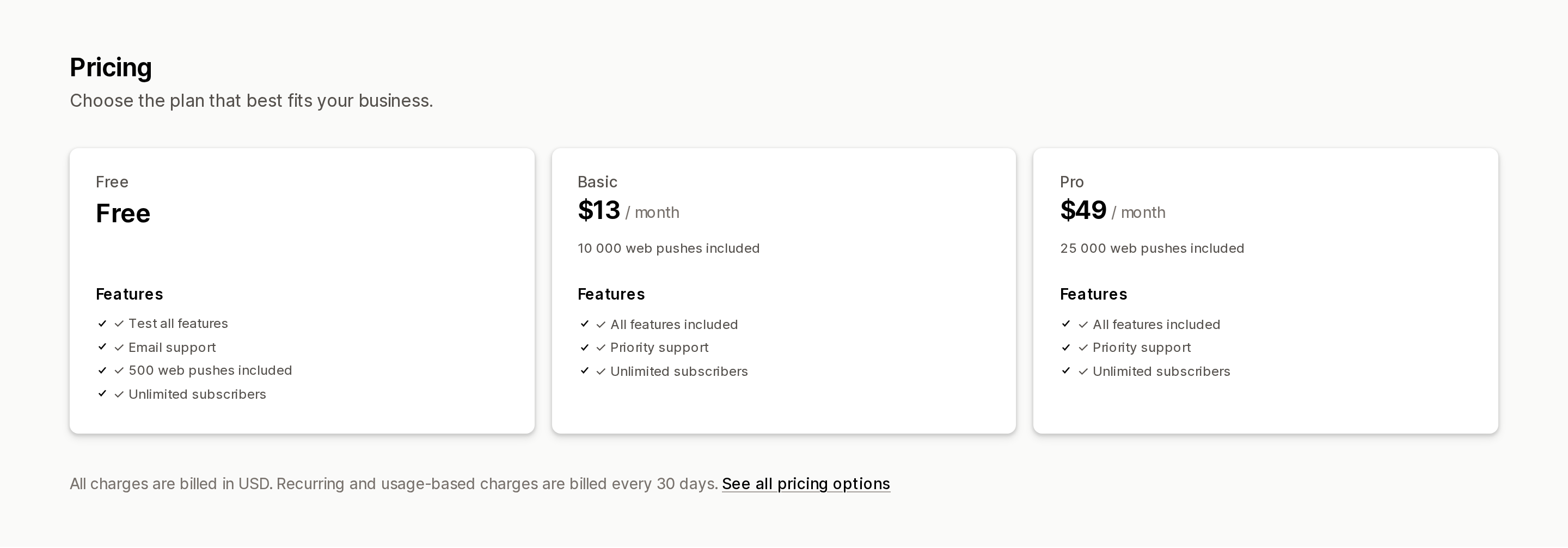
Pricing is cleanly send-metered and unusually transparent about it — each tier's headline is a send allowance, and subscribers are unlimited on all three, including Free.
Source: Shopify App Store (Firepush ‑ SMS & Web Push), retrieved September 2, 2026
- Free — 500 web pushes, unlimited subscribers, all features testable, email support
- Basic, $13/month — 10,000 web pushes
- Pro, $49/month — 25,000 web pushes
Work the math before committing. 10,000 sends against a 5,000-subscriber list is two campaigns a month. Against a 20,000-subscriber list it is one campaign every other month. The allowance is not a monthly campaign count; it is a total-recipients count.
Best fit: a store with a moderate list that sends deliberately — flash sales, back-in-stock, price drops — and wants SMS in the same tool. Poor fit: a store that wants a high-frequency drip on a large list. Sends are the meter, so frequency is the cost driver.
One caveat on the reviews: the rating is built on 161 reviews, but the ones surfaced on the listing today are from 2016 and 2017. Read the recent ones on their own before treating the score as current.
PushBot: Web Push Notification
Source: Shopify App Store (PushBot: Web Push Notification), retrieved September 2, 2026
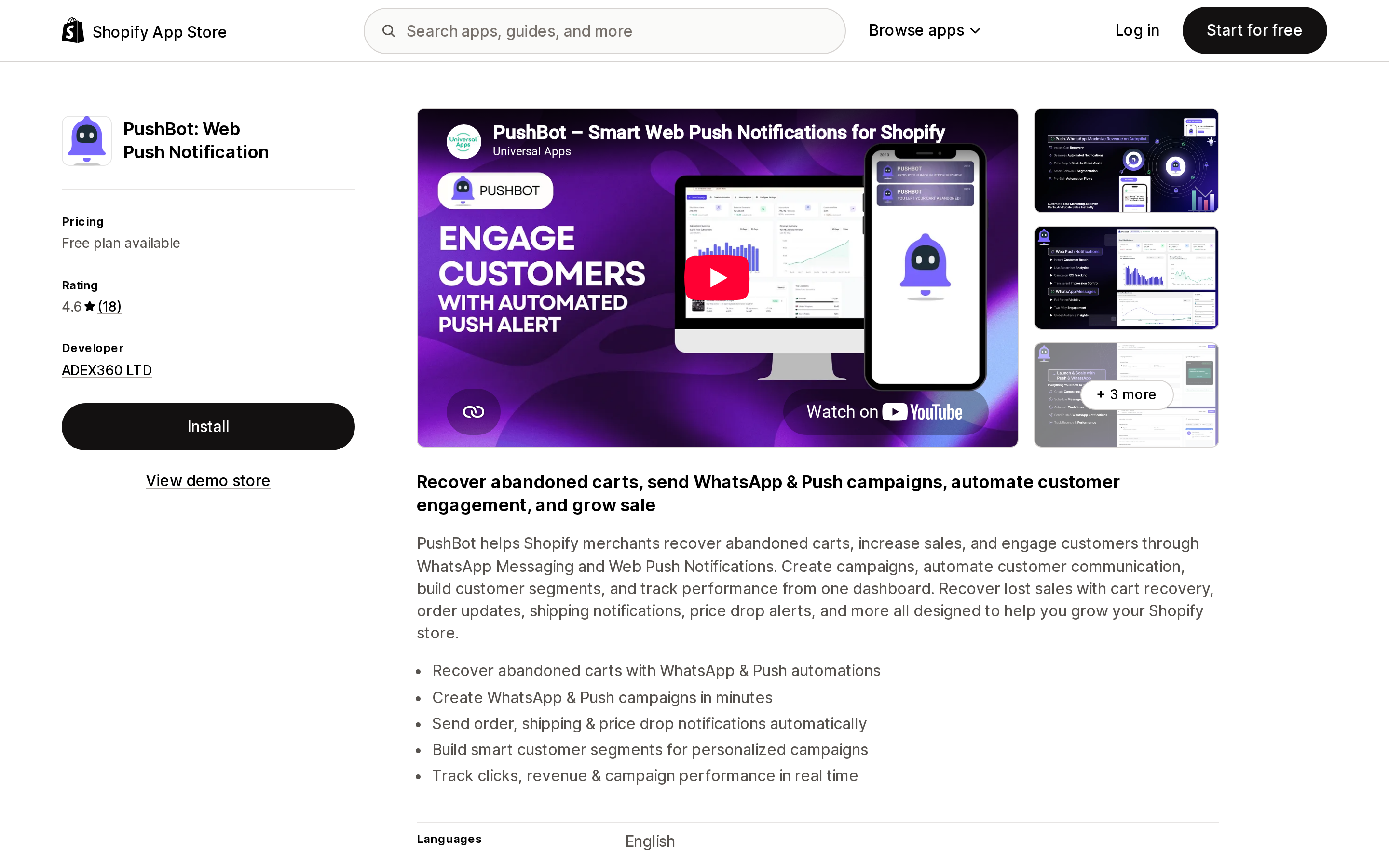
Developer ADEX360 LTD, 4.6 from 18 reviews, and the most recent reviews on the listing are from late 2025 — the freshest review signal of the six. It works with Checkout and Shopify Admin, and combines push with WhatsApp campaigns.
- Basic, free — unlimited subscribers, send/schedule/duplicate campaigns, basic report
- Business, $15/month — 10,000 impressions, abandoned cart automation, shipping and welcome notifications
- Enterprise, $109/month — 50,000 impressions, segmentation, flash sale, checkout recovery, AI push content generation
The structural detail worth catching: the free plan has no abandoned cart automation. You can broadcast, but the one push use case with a reliable return — recovering an abandoned cart — starts at $15/month. That is true of most of this category, but PushBot's free tier is generous enough elsewhere that it is easy to misread.
The jump from $15 to $109 is also the steepest second step in the group. There is no middle tier.
Best fit: a store that wants to trial broadcast push at zero cost and add cart recovery once it works. Poor fit: a store that needs segmentation but not 50,000 impressions — you will pay $109 for both.
Brevo PushOwl: Email,Push,SMS
Source: Shopify App Store (Brevo PushOwl: Email,Push,SMS), retrieved September 2, 2026
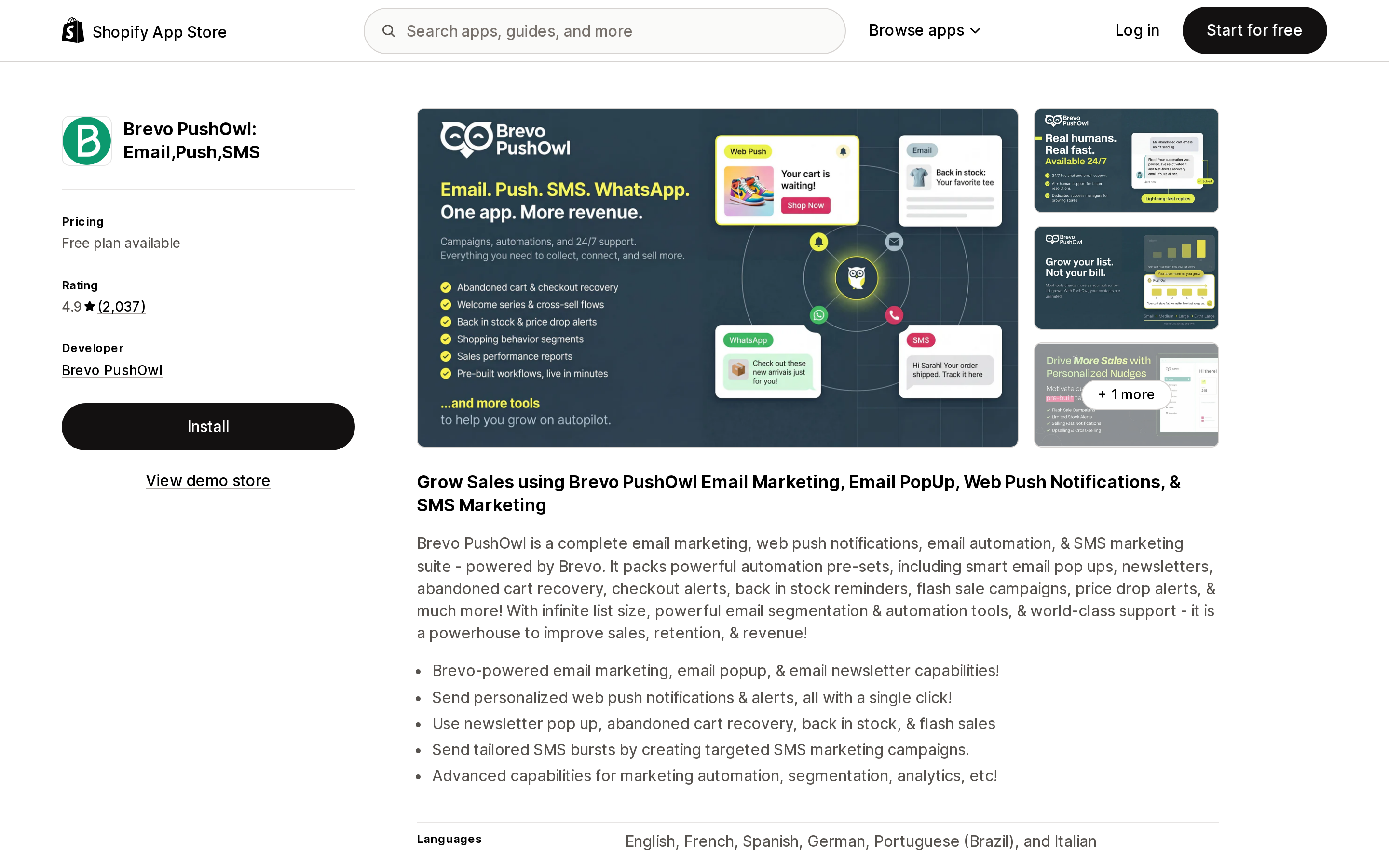
If you have read a web push roundup in the last few years, this app appeared in it as "PushOwl," a push-first tool with push-first pricing. That is no longer what it is. The listing name is now Brevo PushOwl: Email,Push,SMS, the developer is Brevo PushOwl, and the plans are bundles that price email, push, and SMS together.
- Basic Bundle, free — Web Push Notifications 500/month, Emails from 500/month, unlimited subscribers
- Plus Bundle, $19/month (or $180/year, save 21%) — Web Push 10k–30k/month, Emails from 1,000/month, custom email pop-ups, abandoned cart recovery automation, hero images in notifications
- Power Bundle, $79/month (or $852/year, save 10%) — unlimited web push, flash sale campaigns, browse abandonment, custom automation and segmentation, dedicated account manager
It carries the strongest ratings in the category by a wide margin — 4.9 from 2,037 reviews — but read those reviews with the rebrand in mind: they span the PushOwl era and the Brevo era, and the recent critical ones are largely about Brevo's email side rather than push. One July 2026 review from a merchant of over a year describes an account being locked over Brevo's sending-frequency thresholds. Another from a US merchant in June 2026 reports that onboarding calls are gated behind higher subscription tiers.
Best fit: a store that wants push as one channel inside a consolidated email/SMS stack, and would otherwise be paying for an email tool separately. Poor fit: a store that only wants push and already runs Klaviyo or Shopify Messaging for email. You would be buying a bundle for one of its parts.
Aimtell Web Push Notifications
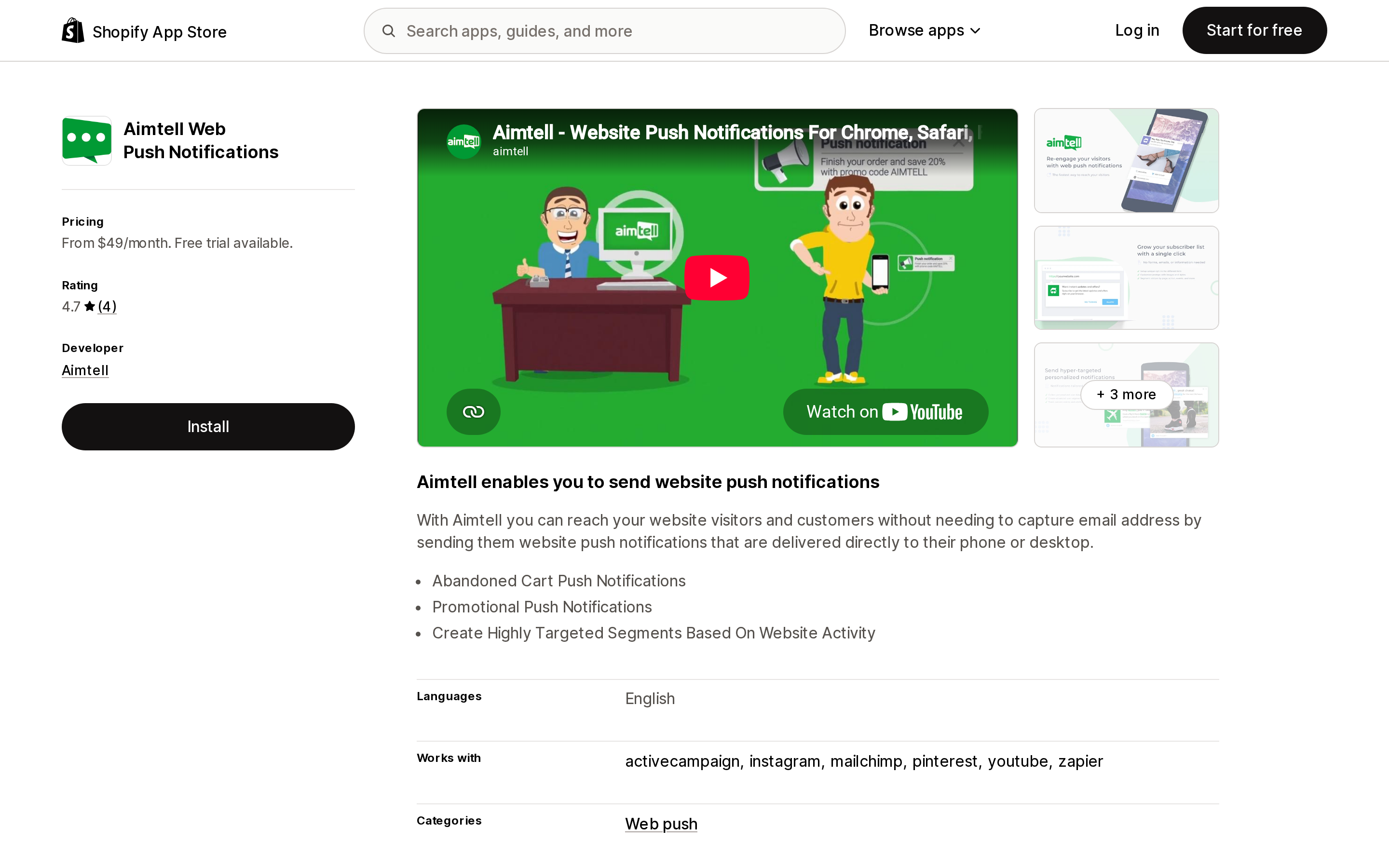
Source: Shopify App Store (Aimtell Web Push Notifications), retrieved September 2, 2026
Aimtell is the clearest example of the opposite meter, and the price list makes the philosophy explicit: every tier says unlimited notifications, unlimited websites, unlimited impressions. What scales is the subscriber count.
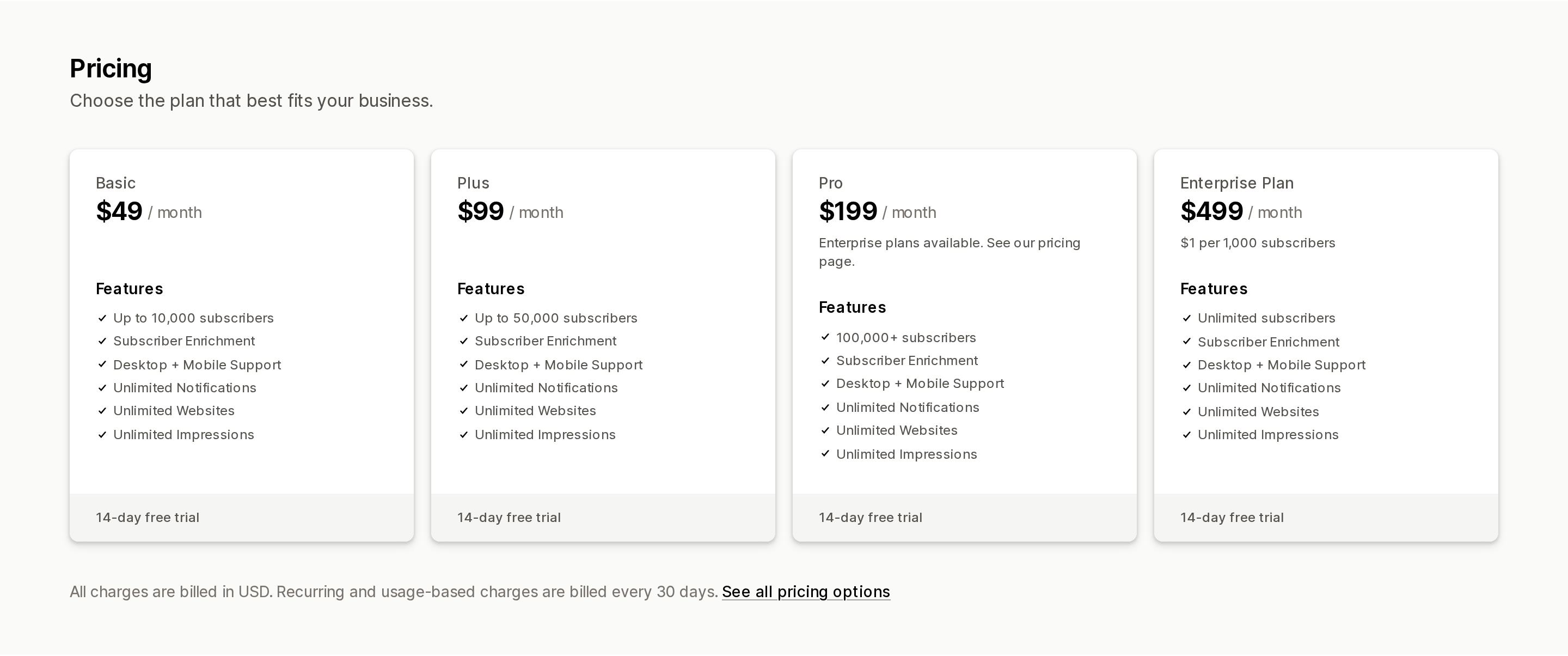
Source: Shopify App Store (Aimtell Web Push Notifications), retrieved September 2, 2026
- Basic, $49/month — up to 10,000 subscribers
- Plus, $99/month — up to 50,000 subscribers
- Pro, $199/month — 100,000+ subscribers
- Enterprise, $499/month — unlimited subscribers, billed at $1 per 1,000 subscribers
There is no free plan; the listing shows a 14-day free trial. There is also no cheap entry point — $49/month is the floor, roughly four times Firepush's or PushAlert's entry price.
Compare the two meters at a realistic volume. A store with 8,000 subscribers sending three campaigns a month is generating 24,000 sends. On Firepush that requires the $49 Pro plan and still exceeds it. On Aimtell it is the $49 Basic plan with room to send far more. Flip it: a store with 30,000 subscribers sending once a quarter is 30,000 sends a year, well inside Firepush's $13 tier, and $99/month on Aimtell.
Best fit: a large list sent to frequently — the case where per-send metering compounds fastest. Poor fit: a small store, or any store still testing whether push earns its place. The floor price and the absent free tier make experimentation expensive.
The review base is thin: 4.7 from 4 reviews, the most recent dated January 2021. That is not evidence of a problem, but it is not evidence of anything else either.
ChirpyWeb Push Notifications
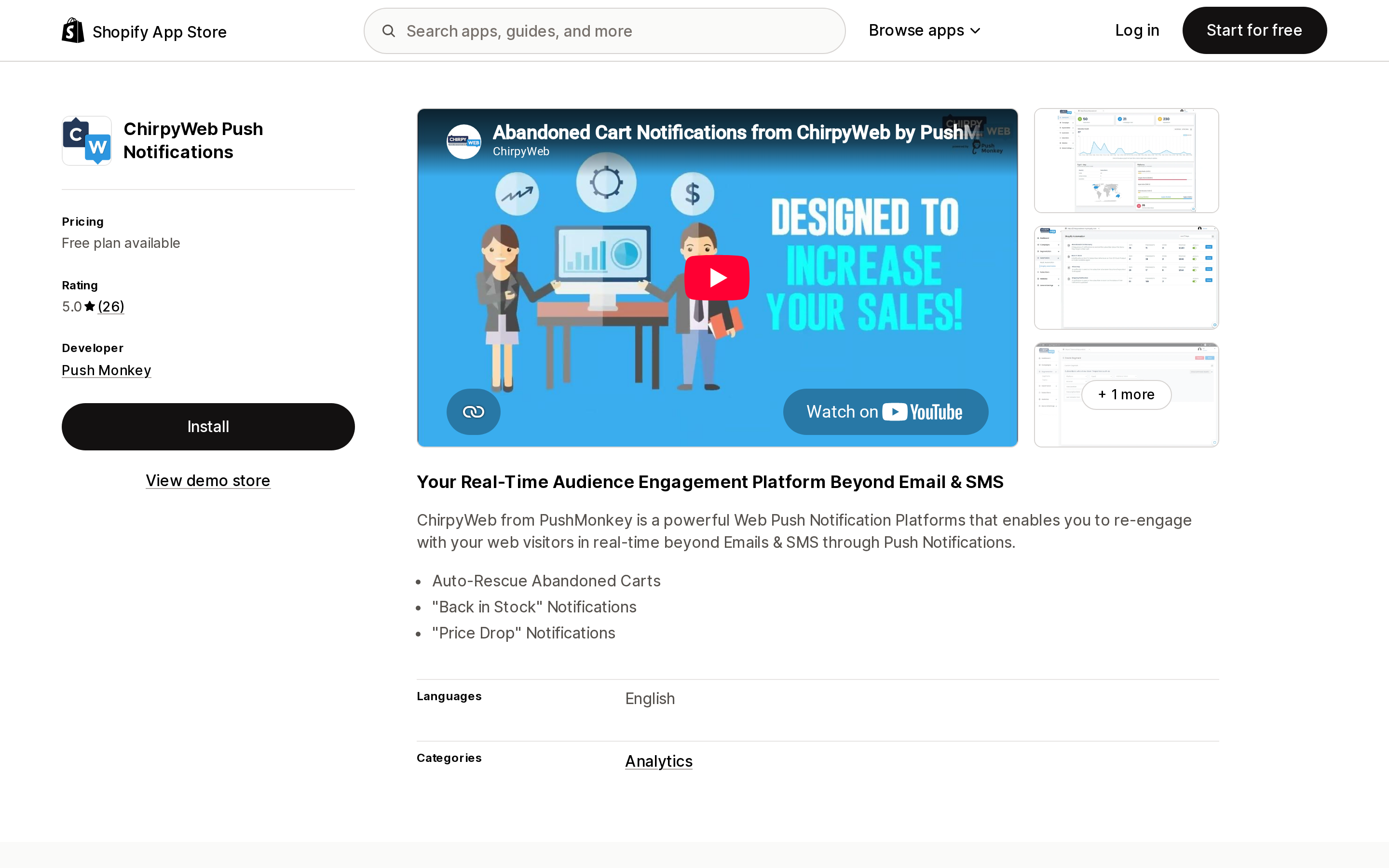
Source: Shopify App Store (ChirpyWeb Push Notifications), retrieved September 2, 2026
Another rename to know about: the app many articles still call Push Monkey is listed as ChirpyWeb Push Notifications, with Push Monkey as the developer name. It is subscriber-metered like Aimtell, but starts far lower.
- Free Plan — up to 200 subscribers, 1 website, single user, unlimited notifications, analytics and report export
- Premium 2K, $14/month (or $134/year, save 20%) — up to 2,000 subscribers, multi-user, hide branding, segmentation, scheduling, abandoned cart recovery, back-in-stock alerts
- Premium 5K, $28/month (or $269/year) — up to 5,000 subscribers
- Premium 10K, $49/month (or $470/year) — up to 10,000 subscribers
The listing also notes that impression-based plans are available beyond the published tiers, so the meter is not fixed for larger stores — worth asking about directly rather than assuming.
Two things to check against your own situation. The free tier's 200-subscriber ceiling is a genuine cap on the list, not on sending, so it fills and stops. And the listing's own category label reads "Analytics" rather than "Web push," which is a reminder that App Store categorisation is not a reliable filter here.
Rating is 5.0 from 26 reviews — an unbroken 26 out of 26 five-star record — though the reviews surfaced on the listing today date from 2018 to 2020.
Best fit: a small-to-mid store that sends often and wants subscriber-based pricing without Aimtell's $49 floor. Poor fit: a store past 10,000 subscribers on the published tiers, or one that needs a documented enterprise path.
PushAlert ‑ Push Notifications
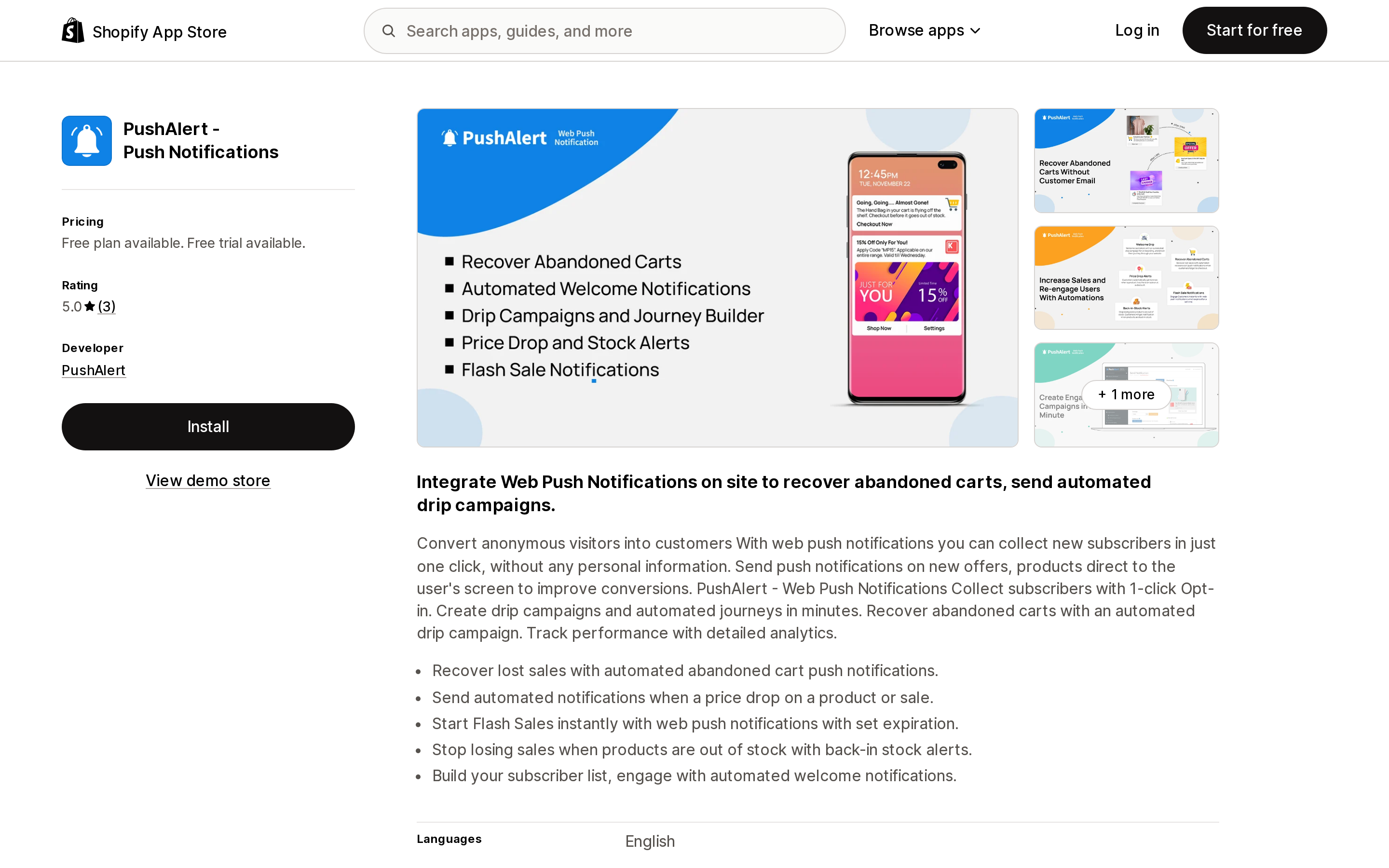
Source: Shopify App Store (PushAlert ‑ Push Notifications), retrieved September 2, 2026
The third meter, and the most unusual pricing in the group: unlimited notifications on every plan, including the free one. What the paid tiers sell is automation.
- Free — unlimited notifications, HTTP/S support, mobile and desktop, a branded HTTPS sub-domain, 1,000 REST API calls per month, email support
- Basic, $12/month (or $120/year, save 17%) — abandoned cart notification automation, detailed analytics, scheduled push, auto segments by location, device, and OS
- Premium, $39/month (or $390/year) — automated price drop alerts, shipment notifications, audience creator, A/B testing, up to 3 users
- Platinum, $69/month (or $690/year) — automated in-stock notifications, complete localization, multi-language notifications, up to 5 users
Paid tiers carry a 15-day free trial. The one specific limit stated on the free plan is the API call ceiling, which matters only if you intend to trigger push from your own systems.
Note also where the features sit. Abandoned cart is $12. Price drop is $39. Back-in-stock is $69. Those three automations are the reason most stores install a push app at all, and here they are spread across three tiers rather than bundled — so price the tier that contains the automation you actually want, not the entry tier.
Best fit: a store that wants to send a lot to a large list and only needs one automation. Poor fit: a store that wants back-in-stock plus price drop plus cart recovery. That is the $69 tier, and at that price the subscriber-metered options deserve a look.
The caveat is the review base, which is the thinnest here: 5.0 from 3 reviews — two from September 2018 and one from December 2022. Treat the rating as close to no signal and validate during the 15-day trial.
The category itself is not a shortlist
Shopify's Web push category, under Marketing and conversion → Marketing, currently lists 63 apps. Browsing it is not the same as browsing web push tools.
Near the top of that category today are Ampify PWA: Mobile App Builder, AppOkart‑ Mobile App Builder, MageNative‑Mobile App Builder, and Hulk Mobile App Builder — native iOS and Android app builders, which send app push, not web push, and which solve a different problem at a different price. Also present are WhatsApp automation tools (WaFlows, bitCRM WhatsApp Abandoned Cart), an SMS tool (Branded SMS Pakistan), a loyalty app, and K: Favicon Tab Animations, which animates the browser tab title.
None of that is mislabelled exactly — those apps do send notifications of some kind — but if you sort the category by review count and install the top result, there is a good chance you have bought a mobile app builder.
Two more names to correct while you are shopping, because both appear constantly in third-party roundups:
- iZooto is not on the Shopify App Store.
apps.shopify.com/izootoreturns 404. - PushEngage is listed, but not where most articles link.
apps.shopify.com/pushengagereturns 404; the live listing ispushengage-1, shown in the category at 3.5 stars from 10 reviews — the lowest rating among the push apps visible on the category's first pages.
How to decide
Skip web push entirely if your traffic is overwhelmingly mobile Safari and you have no plan to promote Add to Home Screen. The channel will underperform every projection you build from session counts, and the reason will not be the app you picked.
Start on a free plan if you are testing. PushAlert's free tier gives unlimited sends with no automation; PushBot's gives unlimited subscribers with no cart recovery; Firepush's gives 500 sends with everything unlocked. Those three fail in different places, which is convenient — pick the one whose ceiling you will hit first, because hitting it tells you what you actually need.
Send-metered (Firepush, PushBot) wins when the list is modest and sending is deliberate: under roughly 10,000 sends a month, $13 to $15 is the whole cost. Subscriber-metered (ChirpyWeb, Aimtell) wins past about 20,000 sends a month — ChirpyWeb's $14 for 2,000 subscribers is the cheapest way in, Aimtell's $49 the most scalable. PushAlert wins when you want unlimited sends and exactly one automation; price the tier that automation lives in.
Whichever you pick, do the manifest work first. Making your storefront installable as a web app — a manifest with display: standalone, or the equivalent web-app-capable meta tag — is the precondition for iOS reach, and it is independent of the vendor. Install an app before that is in place and you will be measuring a channel with a large part of its audience switched off — and you will most likely blame the app.
Sources
- Web Push for Web Apps on iOS and iPadOS — WebKit, Apple
- Push API and Web app manifest
displaymember — MDN - Shopify App Store listings for Shopify Messaging, Firepush ‑ SMS & Web Push, PushBot: Web Push Notification, Brevo PushOwl: Email,Push,SMS, Aimtell Web Push Notifications, ChirpyWeb Push Notifications, and PushAlert ‑ Push Notifications, retrieved September 2, 2026
- Shopify App Store — Web push category, retrieved September 2, 2026
Shop Pay Installments is free to activate, needs no app, and Shopify never publishes what it costs you — the rate is visible only inside your own admin. It also refuses Capital One and Chase credit cards, restricts monthly plans to debit cards only, excludes gift cards and subscriptions, and can't be turned off for individual products. Affirm can suspend your account for being password-protected, for having a non-English storefront, or for being primarily B2B. And Shopify's Getting paid page says disputes appear in your admin while its FAQ says they don't. If you fail the eligibility gates, the alternative is on-site messaging apps from Klarna, Afterpay, Sezzle, Zip, and PayPal — a category rated between 1.0 and 3.2 stars. Researched September 2, 2026.